Are you a first-time trekker looking for the trek to Mardi Himal but wondering whether the trek is suitable for you? Well, you’ve come to the right blog. Make sure to go through the blog to know about the difficulty of Mardi Himal, factors that make the trek difficult, tips to make your trek easy, and find out if the trek really suits you.
The Mardi Himal is a popular and scenic trek in the Annapurna region of Nepal. The trek to Mardi Himal is a shorter and quieter alternative to bigger treks like Annapurna Base Camp or Everest Base Camp. But the main question is: Can beginners trek Mardi Himal? This is an essential question trekkers should know, as many first-time travelers want this scenic adventure without challenges. However, the answer depends on understanding the difficulty of the Mardi Himal trek.
The Mardi Himal is a moderately difficult trek with a relatively short and not too technical path, but it involves steep climbs and descents. So, if you are a beginner willing to conquer the trek, this journey is perfect for you. But, only if you maintain a steady pace and proper breaks. Also, a basic level of physical fitness is necessary to complete the trek.
For those beginners who seek a well-structured adventure with less risk, choosing a Mardi Himal Trek Package can make the experience smoother and more enjoyable. Additionally, the main attraction of the trek lies in its diverse landscapes and outstanding, close-up mountain views. The view of Machapuchhre (Fishtail Mountain), Annapurna South, Hiunchuli, and the Annapurna range from the Mardi viewpoint provides trekkers a sense of accomplishment and encouragement to first-time trekkers.
Table of Contents
Why Mardi Himal Trek Attracts Beginners?
As Mardi Himal perfectly introduces the beauty of the Himalayas with moderate challenges, it’s easy to notice why it has become a popular choice among beginners. One of the primary reasons why the Mardi Himal Base Camp Trek attracts beginners is obvious that it is due to its moderate challenge. The Mardi Himal trek is known for its moderate difficulty, which makes it accessible to first-time trekkers with basic fitness levels.
Another reason why to trek to Mardi is its short duration. Unlike some of the popular treks in Nepal that take 10-15 days, the Mardi Himal takes 5-6 days to complete. Thus, the trek lets beginners experience the Himalayas without committing to long days, making the trek their ideal choice. The peaceful and less crowded route of the Mardi also attracts beginners. This means fewer crowds, more peace, and the chance to really enjoy the surroundings even in the first adventure.
Furthermore, beginners are attracted to the Mardi Himal trek for its close proximity to Pokhara, the capital city of Tourism. Plus, the trek is affordable (USD 300 to 600) and provides good value for money, which is why it attracts beginner who don’t want to risk their money. Moreover, the trek builds confidence to try harder treks later among beginners, as the trek has a high success rate for fit beginners.
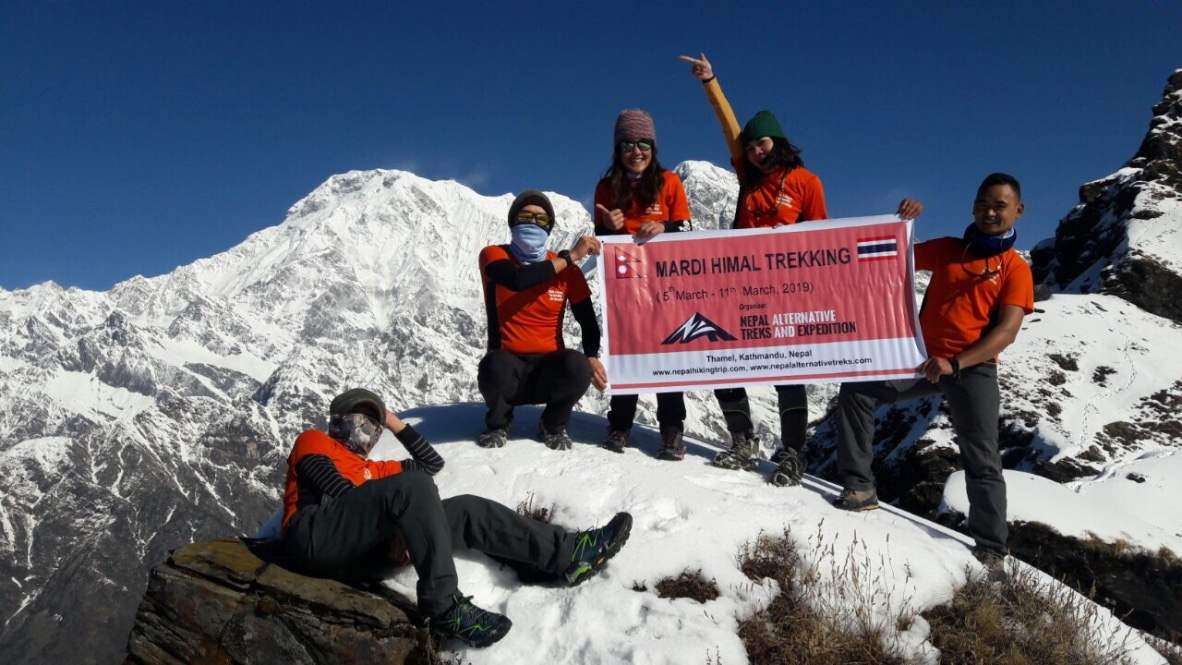
An excellent memory that'll live on We just concluded the Mardi Himal trek with Nepal Alternative Treks & I'm writing this review from Pokhara. Our team included friends as well as a few families with kids. Most of the team was able to complete till Mardi base camp (4500m), with…
I’ve got a good experience for my first trekking , which is Mardi Himal route. Thank you for good service and helpful guide:Nauser and porters: Samir and Supra. We will visit you again.
In terms of difficulty, the Mardi Himal trek is known for being easy to moderate. It is neither too long nor technically demanding, yet it still gives adventurers a taste of high-altitude trekking with incredible rewards. Similarly, travelers with no previous trekking skills in the Himalaya can also complete the trek due to its beginner-friendly nature.
On average, during the Mardi Himal trek, trekkers should walk 4 to 7 hours a day, depending on the section of the trail. The entire trek covers around 40-50 km, usually taking 5-6 days to complete. Thus, considering each day’s walking hour, duration, and distance, the Mardi Himal trek is the ideal choice for beginners.
Similarly, even when compared with other popular routes, the Mardi Himal sits comfortably. When compared with the iconic Everest Base Camp, EBC takes two weeks of trekking, much higher altitudes (5,364 m), and longer daily walking hours. The Mardi Himal Trek route is shorter, less demanding, and more beginner-friendly.
However, it’s important to note that the Mardi Himal trek is more demanding compared to the Poon Hill trek. While the Poon Hill trek is shorter and reaches up to 3,210 m, Mardi Himal takes you up to 4,500 m and requires more endurance.
Here’s a detailed difficulty analysis to help you decide how exactly difficult the trek is and if it’s right for you:
We’ve already mentioned that the Mardi Himal is a moderate trek in the Annapurna region. But we have yet to explain what really influences the Mardi Himal Trek’s difficulty. So, here are the key factors that make the Mardi Himal Trek moderately difficult:
Altitude
The Mardi Himal Trek starts from Deurali (3,200 m) with a trek to Forest Camp (2,500 m), then reaches up to Mardi Himal Base Camp at an elevation of 4,500 m. The height is high enough for some trekkers to feel Altitude Mountain Sickness (AMS). While the altitude is not as extreme as Everest Base Camp or other well-known treks, it can still affect beginners. Moreover, the good thing is that you only sleep as high as 3,580 m at High Camp, which lowers the risk related to altitude sickness.
Trail conditions
The trek to Mardi Himal starts through a forested route from Dhampus, Pitlam Deurali, to Forest Camp and stone steps through villages. But, as you climb higher, the route becomes narrower and steeper that follows the ridgelines, particularly as you get High Camp and Mardi Himal viewpoints with great views. Although the route is safe during the dry season, it is not recommended to trek during the monsoon or winter season as the paths can become slippery or icy. Moreover, the final part of the trek involves steep ascents and descents, where beginners must be careful while walking.
Weather and seasons (rain, snow, cold)
The weather and season you choose for your trek make a huge difference in your journey’s difficulty. As a beginner, you might be unaware of Nepal’s Himalaya’s weather and best season. Thus, we suggest you trek during Autumn (September to November) and Spring (March to May) as the weather during this time is ideal for trekking.
However, trekking will be harder during the winter and summer seasons due to the cold nights, icy paths, and heavy snow above High Camp in winter. And, a slippery trek route, a leech-infested forested area, and an obstructed view of the mountains in Summer.
Physical fitness
As the Mardi Himal takes 5-6 days to complete, covering a distance of 40-50km, beginner may face some physical challenges during their trek. While you don’t need to be an athlete, you must be comfortable walking long days and climbing uphill. Thus, we suggest that beginners train themselves before starting the trip by trying brisk walking, stair climbing, or light jogging three to four times a week.
Mardi Himal Trek Difficulty by Season
Mardi Himal Trek in Winter
When planning to trek to Mardi Himal, beginners should understand how the seasons affect the trekking experience. Each season affects weather, trail safety, and overall comfort, especially for beginners. So, choosing the best season for the Mardi Himal trek is crucial. Thus, here’s the detailed explanation of each season:
Spring
Whether it is for beginner or for experienced trekkers, Spring (March to May) is the best time to trek. The mild weather with warm days and moderate temperatures makes the season best for trekking in the Mardi Himal. Similarly, the trekking paths are also dry and safe during this time. Likewise, the clear skies offer the stunning sights of mountain peaks. Additionally, forests are full of blooming rhododendrons during Spring, which makes the trek enjoyable. Therefore, beginners will find Spring to be the most welcoming and comfortable time to experience the Himalayas.
Summer
Monsoon (June-August) is a less preferred time for the Mardi Himal Trek; it is especially unsuitable for first-time trekkers. Heavy rainfall during this time makes the paths muddy, slippery, and uncomfortable to walk on. Leeches are very common in the forest sections, along with the risk of landslides and blockages in the trekking section, which can bother trekkers. Similarly, Clouds often cover the mountains, and teahouse facilities are also less reliable, which affects the overall trekking.
Autumn
Like Spring, Autumn is the best time for trekking in Mardi Himal, especially if you are trekking for the first time. The season spans from September to November, after the monsoon that clears the air, offering bright skies and crystal clear views. The trekking sections are dry, which makes walking easier and safer for beginners. The only difficulty a beginner can expect during this time is crowded trails and accommodation due to the peak season. Still, autumn offers stable trekking conditions, reliable weather, and the least risk, which keeps the Mardi Himal trek difficulty lower for first-time trekkers.
Winter
Winter (December-February) makes the Mardi Himal trek more challenging for beginners. During the time, snow is common above 3,000 m, and trails may become icy or harder to walk on. Thus, beginners may find it challenging to cope with the cold and long walking days if they trek in Winter.
Is Mardi Himal Trek Suitable for Beginners?
Yes, the Mardi Himal trek is suitable for beginners, as trekkers with no prior trekking experience can complete the trek. The Mardi Himal offers a real taste of the Himalayas among first-time trekkers without the long days or extreme altitudes that make other routes more demanding. The short trekking journey to Mardi Himal, which takes a week or less, makes it ideal for trekkers who are new to multi-day trekking.
For beginners, Mardi Himal is suitable as long as you prepare with basic fitness, stay steady in your pace, and go with the right expectations. Compared with the Annapurna Base Camp (ABC) trek, the Mardi Himal trek is less crowded and requires fewer days on the trail, which also makes it the best alternative in the Annapurna region among beginners. Similarly, against the Everest Base Camp (EBC) trek, Mardi Himal is far less challenging because it operates at a lower altitude, avoiding the thin air above 5,000 m.
Fitness & Preparation for Mardi Himal Trek
If you are new to the multi-day trekking field in the Himalayas, it is crucial to be fit and prepared before starting your adventure for a successful and smooth adventure. The best approach for a beginner to be fit is to focus on light training that builds stamina and strength for long walking days. We recommend engaging in simple cardio activities, such as running, cycling, or swimming, to improve your breathing and consistency. Similarly, the trek to Mardi Himal involves a steep uphill climb, for which stair climbing is excellent practice.
As much as physical fitness is essential, mental well-being is equally important. As first-time trekkers, you may find the trek mentally exhausting as you haven’t walked for this long and in such rough terrain with limited facilities. But, staying positive, focusing on the views, and reminding yourself of your goal will keep you motivated.
To stay mentally fit throughout the journey, many trekkers also incorporate yogic activities into their trek. For example, the growing idea of the Mardi Himal yoga trek allows you to practice yoga each day to relax and provide peace to your mind. This form of adventure also helps beginners to recover faster and feel calmer on the journey.
As a beginner, is it normal to worry about whether the trek you are about to attempt is too challenging? Well, the Mardi Himal is not that hard. Still, here are tips that help to make your trek easier as a beginner:
Walk at your own pace: As a beginner, you can’t walk fast, and your body will likely become exhausted even after a few walks. So, don’t try to match others and walk at your own pace. Listen to your body and walk steadily, as it helps to reduce your tiredness and helps to prevent altitude sickness.
Stay Hydrated: Staying hydrated is key to a successful trek. So, we recommend you take small sips often along the trek. Also, carry a refillable water bottle along with a water purification tablet, and drink as much water as you can.
Take regular breaks: Since you won’t face any pressure during your trek, it is crucial to take a break every hour for a few minutes. The pause along the trek allows your body to adjust to changing temperatures and lets you experience nature’s beauty.
Hire a Guide or Porter: As a beginner, hiring a trekking guide and porter is a great idea for a successful adventure. A guide helps you to navigate the trekking sections, and a porter carries all your backpacks.
Eat well and rest: Have balanced food with the required nutrients, as it helps to keep you active throughout the walk. Also, take proper rest and get enough sleep each night.
Pack light: Bring only what you want and avoid overpacking, as even an extra paper feels heavy during your walk.
Acclimatize: Don’t climb too fast; instead, take rest time to time to let your body adjust to the changed environment. If necessary, add an extra acclimatization day in your itinerary.
Use trekking poles: They protect your knees on steep descents and give balance on uneven terrain.
Have a backup option: If you feel tired along the trek and can’t continue, but still want to witness the stunning view of Mardi Himal, you can opt for the Mardi Himal Heli Tour.
Comparing Mardi Himal Trek Difficulty with Other Treks
Feature
Mardi Himal Trek
Poon Hill Trek
Annapurna Base Camp Trek
Everest Base Camp Trek
Duration
5-6 days
3-4 days
9-10 days
11-12 days
Max Altitude
4,500 m
3,210 m
4,130 m
5,644 m
Difficulty Level
Easy-Moderate
Easy
Moderate
Moderate-challenging
Crowds
Less crowded
Popular
Busy in peak seasons
Popular/Busy
Accommodation
Teahouses, but more basic above Low Camp
Plenty of teahouses
Well-developed teahouse
Basic teahouses with fewer comforts at higher altitudes
Walking Hours
5-6 hours
4-6 hours
4-6 hours
5-8 hours
Highlights
Close views of Machhapuchhre, ridgeline walk
Sunrise views, villages, rhododendron forests
Annapurna Sanctuary, diverse landscapes
Khumbu Glacier, Everest views, Sherpa culture
Mardi Himal, the “Middle Ground”
The Mardi Himal Trek perfectly balances time, effort, and scenery. It is longer and higher than Poon Hill, so trekkers seeking a shorter and less challenging trek prefer Poon Hill over Mardi Himal. But Mardi Himal is much shorter and easier than the Everest Base Camp trek, so it can be the best alternative to EBC. Compared to the Annapurna Base Camp trek, Mardi Himal is quieter, with fewer crowds, but still offers breathtaking mountain views.
Note: For those seeking a diverse trek, combining Mardi Himal with Annapurna Base Camp provides a rewarding adventure with ridgelines and the famous Annapurna Sanctuary.
Accommodation, Food & Trail Comforts
One of the most common questions among beginners going on Mardi Trek is about the food, accommodation, and trail comfort. So, the answer is that the Mardi Himal trek offers enough facilities to make the journey manageable, even if they are more basic than city standards.
Teahouse accommodation
On the Mardi Himal Trail, you’ll stay in a small teahouse run by local families in the area. The accommodation point offers simple rooms with two single beds, a mattress, a blanket, and a pillow. While blankets are provided, bringing your own light sleeping bag adds warmth and cleanliness. Similarly, toilets are mostly shared, and at higher camps, they may be outside.
Food
Tea houses provide the food along the Mardi Base Camp Trek with menus offering both local and simple Western dishes. The most common lunch and dinner meals are dal bhat (rice, lentil soup, and vegetables), which is nutritious and healthy. Likewise, options of noodles, soups, fried rice, pancakes, and omelets are also available. Pasta or pizza is also available in some teahouses, but it is simpler than what you’d get in towns. Additionally, tea, coffee, and hot lemon are common drinks to stay warm.
Trail Comfort
While the trail of Mardi Himal doesn’t offer luxury, the available facilities are enough. You have a bed to sleep in, warm food every day, and friendly hospitality from locals. A basic discomfort from city life to rural areas is common in the Himalayas, which adds the real taste of walking through nature. Still, for many beginners, it adds the charm of the trek.
Is Mardi Himal Trek Worth It for You?
Yes, without a doubt, the Mardi Himal Trek is worth it for you, especially if you are a beginner seeking your first Himalayan adventure. With a little preparation, light fitness training, a positive mindset, and the right packing, no one can stop you from completing the trek.
Similarly, the Mardi Himal trek provides beginners with a perfect combination of mountain views, peaceful ridgelines, and the warm welcome of nature and locals in less than a week. So, if you are ready to take the first step into the world of trekking with the Mardi Himal Trek, go for it and achieve your goal. The journey might be just the beginning, but not the end, as who knows how far you’ll reach.
With an experience of almost two decades, founder Mr. Tej Bahadur Gurung has established Nepal Alternative Treks as a widely recognized and reliable tourism operator. His degree in Tourism Studies and devotion to the sector has given him in-depth knowledge about trekking, climbing, cultural, and geological aspects of the country. He is a pioneer in introducing the concept of ‘off-beaten tracks’ and ‘alternative routes’ as well as treks and tour packages surrounding it.
Mr. Gurung had several contributions to ‘Visit Nepal 1998’. Similarly, he campaigned actively to make ‘Nepal Tourism Year 2011’ success in terms of establishing new destinations for valued customers. His benevolent act extends to offering socio-cultural tourism to benefit marginalized communities of Nepal. As a result of his dedication, he was elected the first Vice President of the Trekking Agency’s Association of Nepal (TAAN) from 2015-17. He was also the President of the Ganesh Himal Tourism Development Committee (GHTDC) from 2017-2020.
As a sociologist, he’s been involved in scientific research for tourism and recently on the subject of ‘conflict and peace’ at the Chulalongkorn University of Bangkok. At just 37, he has a double Master’s degree in Linguistic and Tourism Study. He holds a Ph.D. in Tourism from Lincoln University College of Malaysia.
Let our local mountain experts craft a personalized itinerary around your schedule, fitness level, and travel goals — safe, authentic, and rooted in Nepal Alternative Treks’ trail experience.
Need assistance? Our travel expert Tej Bahadur Gurung is here to help! Please fill out the form below to initiate a chat and get your queries resolved quickly.


 India5.0 /5
 Bangkok, Thailand5.0 /5