Safety update: our trekking groups are safe, and our routes are running as planned. Read full flood notice.

Makalu Base Camp trek with Heli Return – 9 Days
|
Duration |
Duration | 9 Days | |
|---|---|---|---|
|
Difficulty |
Difficulty | Challenging to Strenuous | View Difficulty Detail |
|
Accommodation |
Accommodation | Lodge | |
|
Meals Included |
Meals Included | Breakfast, Lunch, Dinner | |
|
Best Season |
Best Season | March to May, September to October | |
|
Transportation |
Transportation | Flight + ground transportation + helicopter | |
|
Daily Activity |
Daily Activity | 5-7 hours trek | |
|
Religion |
Religion | Tibetan Buddhism, Hinduism, and the indigenous Kirat | |
|
Ethnic People |
Ethnic People | Sherpa, Bhote, Rai, Limbu, Tamang, Gurung, Magar | |
|
Geographic Terrain |
Geographic Terrain | Rugged and vertically diverse Himalayan terrain | |
|
Region of Nepal |
Region of Nepal | Eastern Nepal, Sankhuwasabha District | |
|
Max. Altitude |
Max. Altitude | 4,870 m / 15,977 ft |
Overview
The Makalu Base Camp Trek with heli return is a rare yet exciting Himalayan adventure in eastern Nepal. The trek combines walking through Nepal’s most remote and raw regions with the comfort and excitement of a helicopter flight back. The trek takes place within the Makalu-Barun National Park and is centered around the world’s fifth-highest peak, Mt. Makalu (8,485 m).
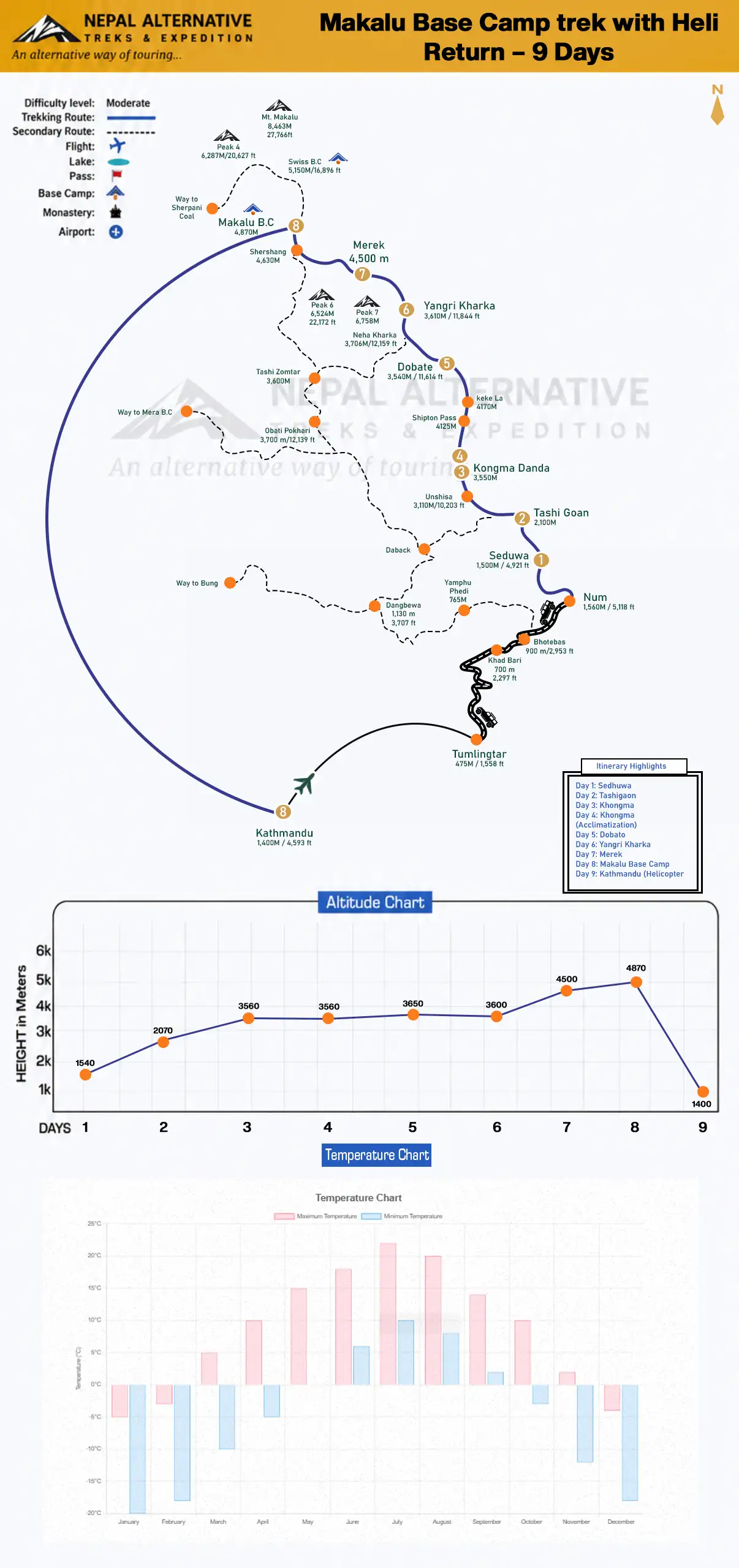
The Makalu Base Camp Trek with heli return begins with a flight from Kathmandu to Tumlingtar, followed by a drive to Sedhuwa, then trek along Tashigoan, Khongma, Dobato, Yangri Kharka, and Merek before reaching Makalu Base Camp. From base camp, trekkers return directly to Kathmandu by helicopter, a highlight of the adventure. Thus, the option lets adventure seekers experience a fast, hassle-free, and aerial perspective return from Makalu Base Camp after completing the trek on foot.
The key advantage of choosing the Makalu Trek with helicopter return is the time-saving, making it the best choice for time-bound adventure seekers. However, it is a strenuous, off-the-beaten-path, adventurous trek, suited for fit, experienced trekkers rather than complete beginners. Besides, spring and autumn are the best times to take the trek for a safe and comfortable adventure.
Planning the Makalu Base Camp Trek with Helicopter Return? Send us your inquiry today, and we’ll provide the latest 2026/27 departure dates, detailed itinerary, package price, group discounts, and booking information within 12 hours.
Highlights of Makalu Base Camp Trek with Heli Return
- Aerial flight from Kathmandu to Tumlingtar over the Himalayan foothills.
- Walk through the most remote wilderness areas, Makalu Barun National Park.
- Cross numerous high passes like Kauma La Pass (3,603 m), Keke La Pass (4,127 m), Shipton La Pass (4,170 m), and Khongma La (3,890 m).
- Walk through authentic Rai and Sherpa villages, including Tashigoan and Sedhuwa, where traditional mountain life still remains raw.
- Descend into the wild and remote Barun Valley, one of the unspoiled corridors in all of Nepal.
- Walk alongside the thundering Barun River, following into the center of the Makalu mountain.
- Walk through high mountain meadows like Yangri Kharka, Merek, and Langmale, where yaks graze freely.
- See old glacial ridges, clear mountain lakes, and waterfalls falling down the cliffs on the way to Makalu Base Camp.
- Listen to the sound of birds like Tibetan snowcocks, hill pigeons, and mountain finches near base camp.
- Stand at the foot of Mt. Makalu (8,463 m), the fifth-highest mountain on Earth, and witness stunning sights of Everest, Lhotse, Baruntse, Chamlang, Peak 6, Peak 7, and glaciers.
- Get a bird’s-eye view of high mountain passes, glaciers, and river valleys during the helicopter return.
The Makalu Base Camp Trek is graded as a challenging-to-strenuous high-altitude adventure in Nepal’s Himalayas. It is also one of the toughest base camp treks in Nepal due to its remoteness, lack of modern infrastructure, steep elevation gains, numerous high-altitude passes, and high altitude. However, the trek does not require technical climbing experience or equipment. As the trek is highly challenging, beginners are not recommended to participate unless they have strong physical fitness and a strong mindset, along with the support of a professional guide.
Makalu Base Camp Trek with Heli Return – 9 days Itinerary
Day 1
Fly to Tumlingtar – Drive to Sedhuwa (1,540 m)
|
Trekking Time Average |
Flight (30 minutes) Drive (160 km / 7 hours) |
|---|---|
|
Accommodation |
Lodge |
|
Altitude |
1,540 m / 5,052 ft |
|
Included meals |
Breakfast, Lunch, Dinner |
The Makalu adventure starts early with a flight from Kathmandu to Tumlingtar. Our representatives will pick you up at your hotel around 5:00 AM and take you to Tribhuvan Domestic Airport by 5:30 AM. Tumlingtar flights generally depart between 6:30 and 9:00 AM, depending on the season.
The highlight of the day is the Kathmandu-Tumlingtar flight. In just 30 minutes, you go from a busy city to the calm eastern hills of Nepal. When you land, the Arun and Sabha river valleys greet you. After collecting your bags, your guide and trekking team meet you and take you to Tumlingtar Bazaar, where you’ll have breakfast before starting your drive.
After breakfast, you board a jeep and drive southwest, uphill, to the Bhojpur hills. The road is mostly paved, with a few rough patches. The scenery includes terraced farmland, forested ridges, and traditional villages. After a one-and-a-half to two-hour drive, you reach Bhojpur Bazaar. The road then follows the Koshi Highway through higher hill landscapes to Sedhuwa, where you stay overnight and have dinner.
Day 2
Trek to Tashigoan (2,070 m)
|
Trekking Time Average |
12 km / 4 hours |
|---|---|
|
Accommodation |
Lodge |
|
Altitude |
2,070 m / 6791 ft |
|
Included meals |
Breakfast, Lunch, Dinner |
From the second day of the Makalu Base Camp Trek with the Heli return journey, your actual trekking begins. You begin your day with crisp air and a warm meal at your lodge. Leaving Sedhuwa, the trail ascends through small settlements and forests. Farmland leads to views of traditional life in eastern Nepal. As you move north, you enter rhododendron forests and pass wildflowers. Enjoy stunning views of the Arun River valley and the mountain peaks.
After about two hours of walking, you reach Chyaksa Danda. Pause, rest, and have lunch. While eating, enjoy the scenery. After lunch, continue past farmland and villages. Cardamom plantations line the route. The trail follows stone paths through the forest, passing small settlements. In the dense woods, you may cross streams on sturdy wooden bridges.
Reaching Tashigoan is marked by Buddhist prayer flags and small chortens. This is a Tibetan Buddhist village between the hills. You spend the night here and have dinner at the lodge.
Day 3
Trek to Khongma (3,560 m)
|
Trekking Time Average |
14 km / 6 hours |
|---|---|
|
Accommodation |
Lodge |
|
Altitude |
3,560 m / 11,680 ft |
|
Included meals |
Breakfast, Lunch, Dinner |
As usual, the day begins with an early breakfast at your teahouse before you start your trek, leaving Tashigoan and climbing up stone steps. As you keep walking, you cross a wooden log bridge and enter a rhododendron forest. Here, the trail starts going uphill right away, with no flat sections. The forest is thick and beautiful, offering cool air and the sounds of birds as you gain altitude.
After about three hours of hiking, you reach Danda Kharka, a small spot with a tea house. This is a good place to have lunch, as it is the last chance for rest and refreshments until Khongma. From Danda Kharka, the trail continues steeply uphill; along the way, you pass through Chipla and then reach Unshisha, where you cross a large rock.
Beyond Unshisha, the climb continues on stone steps through a beautiful rhododendron forest. These stair sections can be tough on your knees and legs, so a slow and steady pace is highly recommended. After several hours of hard climbing, you reach a stone rest area decorated with prayer flags. From here, it is about a 45-minute walk to Khongma Danda.
Reaching Khongma Danda feels like a real accomplishment after the long ascent. Enjoy your evening and witness the sunset over mountain peaks. Have dinner and spend an overnight at Khongma.
Day 4
Acclimatization day/Exploring around
|
Accommodation |
Lodge |
|---|---|
|
Altitude |
3,560 m / 11,680 ft |
|
Included meals |
Breakfast, Lunch, Dinner |
After the challenging climb from Tashigoan, the acclimatization day at Khongma Danda is essential for both today and the entire Makalu trek. At altitudes above 3,500 m, the risk of altitude sickness increases, so giving your body time to adjust is crucial. Following Khongma, you’ll cross four high passes, including Shipton La and Keke La. This day prepares you physically and mentally for these challenges.
On this day, there’s no need to wake early. Enjoy a relaxed breakfast, explore the village and its surroundings, and remember to drink plenty of fluids, such as herbal tea, hot lemon, or water. Even with a lower appetite, eat a nutritious breakfast and regular meals.
One of the key rules of acclimatization is “climb high, sleep low.” Instead of spending the entire day resting in the lodge, it is wise to take a short hike to Khongma La Pass (3,890 m). The hike not only helps your body adapt more effectively to the thinner air but also rewards you with stunning views. From the pass, you can enjoy impressive views of Makalu, Chamlang, and, on days with clear weather, even Mount Everest, Kanchenjunga, and Lhotse. Enjoy some time at the pass, then return to Khongma for an overnight stay, feeling prepared for the challenges ahead.
Day 5
Head to Dobato (3,650 m)
|
Trekking Time Average |
14 km / 6 hours |
|---|---|
|
Accommodation |
Lodge |
|
Altitude |
3,650 m / 11,975 ft |
|
Included meals |
Breakfast, Lunch, Dinner |
Day five takes you from Khongma to Dobato. It is one of the most challenging days on the entire Makalu Base Camp with the Heli return adventure, as you have to cross three different passes on the same day. Start your day early, before sunrise, with a headlamp. Make sure you have a filling breakfast and layer warmly before setting out.
The day starts with a climb up switchbacks through a rhododendron forest.
Continuing the walk, you reach the first pass, Kauma La, at 3,603 m. The pass serves as the gateway to the higher terrain ahead. Here, you get your first unobstructed views of Chamlang, Peak 6, and Peak 7. After Kauma La, the trail continues ascending toward Keke La Pass (4,127 m). The climb to Keke La is challenging due to the increasing altitude and rocky sections, but the views from the pass are equally stunning.
From Keke La, the trail follows a steep path to Shipton La Pass (4,170 m). Shipton La is the highest pass along the base camp route and the highlight of the day’s trek. It was named after the celebrated British explorer Eric Shipton, who first trekked into this region in the 1950s. On a clear day, the views from here are among the finest of the entire trek, featuring Mount Chamlang, Baruntse, Peak 6, Peak 7, and, on exceptionally clear days, Kanchenjunga.
On the descent from Shipton La, you’ll pass Kalo Pokhari Lake, meaning “Black Pond” in Nepali. After Kalo Pokhari Lake, the route crosses Tutu La Pass (4,080 m) before finally reaching Dobato. By the end of the day, you will have crossed all four passes, completing one of the most significant sections of the trek. You are now moving from the Arun Valley into the Barun Valley, and Makalu Base Camp is within reach. Overnight stay at Dobato.
Day 6
Trek to Yangri Kharka (3,600 m)
|
Trekking Time Average |
12 km / 5 hours |
|---|---|
|
Accommodation |
Lodge |
|
Altitude |
3,600 m / 11,811 ft |
|
Included meals |
Breakfast, Lunch, Dinner |
After the tough day of crossing four passes, today is much easier and more scenic. The day starts with a warm breakfast at Dobato. After the morning meal, the trail follows stone paths, descending through the forest to the Barun River, your first sight of the river that later joins the Arun River downstream. The descent is steep in some sections and can be hard on your knees, so trekking poles are helpful. Some parts of the trail can also be slippery, so moving slowly and carefully is highly recommended.
After descending through the forest, you eventually reach the Barun River and continue along a trail below a large landslide area. From here, the path turns northwest and follows the river upstream. Over the next few days, you will continue trekking through this valley. Around midday, you arrive at Themathang Kharka, where you’ll stop for lunch while enjoying clear views of a nearby waterfall.
After lunch at Themathang, the trek continues until you reach a wooden bridge over the Barun River. Crossing the bridge, you move to the eastern side of the valley. From there, it takes about 1.5 hours to reach Yangri Kharka, where you will spend the night.
Day 7
Trek to Merek (4,500 m)
|
Trekking Time Average |
12 km / 5 hours |
|---|---|
|
Accommodation |
Lodge |
|
Altitude |
4,500 m / 14,764 ft |
|
Included meals |
Breakfast, Lunch, Dinner |
The seventh day brings you closer to your final destination. The day begins early with a hearty breakfast. Before leaving Yangri Kharka, dress warmly, as mornings in the Barun Valley are very cold. Your trek follows a pleasant trail through open meadows beside the Barun River, offering wonderful views of the sacred Shiva and Parvati cave shrines. To your left are towering rock walls, waterfalls, and mountain peaks.
As you continue the trek, the trail climbs alongside the river through yak-grazing areas. After a while, you pass Nehe Kharka, where you see the river winding through a stunning S-shaped bend between mountain cliffs on both sides. This is one of the most visually striking sections of the Barun Valley, where the Barun River cuts through rock walls that rise high above the landscape.
A gentle walk along the mani walls leads to Yak Kharka, the last settlement before Merek. As its name suggests, this area is used for traditional yak grazing, with open meadows where yaks roam freely. The trail climbs stone steps, passes through forest, and then opens into high meadows with views of Mount Tutse, Chamlang, Hongu Chuli, and Peak 4. The route follows an old glacial ridge formed by the Barun River. Overnight stay and dinner are at Merek.
Day 8
Trek to Makalu Base Camp (4,870 m)
|
Trekking Time Average |
12 km / 5 hours |
|---|---|
|
Accommodation |
Lodge |
|
Altitude |
4,870 m / 15,978 ft |
|
Included meals |
Breakfast, Lunch, Dinner |
Today is the day you have been waiting for, as you finally reach the beautiful Makalu Base Camp. You wake up in Merek and immediately sense its importance. Whether it’s the silence, the cold air, or simply your anticipation, you know this is the day. Dress warmly, enjoy a hearty breakfast, and step outside. The journey begins with a two-hour walk from Merek to Langmale Kharka.
Along the way, you pass through mountain landscapes, crossing small wooden bridges over streams and following trails through forests, moraines, and open grazing areas. At Langmale Kharka, you can stop to enjoy the scenery with views of Peak 7. After a short rest, you continue into a completely different landscape, where rocks, glaciers, and towering mountains dominate the surroundings. The trail climbs across the valley, with the Barun River flowing below on your left. Around almost every corner, a new mountain view comes into sight.
After several hours of trekking, you reach Shershong before continuing to Makalu Base Camp. After the final challenging stretch, you arrive at your destination. Put down your backpack, take a moment, and look up at the immense south face of Makalu rising above you—you’ve earned it. From the base camp, you’ll be surrounded by spectacular views of Mount Makalu, the Kangshung Face of Everest, Baruntse, Chamlang, Mera Peak, as well as the Makalu and Barun glaciers. Tonight, you’ll stay at Makalu Base Camp, encircled by towering Himalayan peaks beneath a stunning high-altitude night sky.
Day 9
Excursion around – Fly back to Kathmandu by Helicopter
You open your eyes at Makalu Base Camp, and the first thing you see is Mount Makalu. Get refreshed and watch the sun touch the summit of Makalu, one of the most extraordinary natural moments you will ever witness. Then, enjoy breakfast while taking in the crisp mountain air. After breakfast, it is time to explore. The day is yours, with no fixed destination, no pass to cross, and no set distance to cover.
You can take a short hike to the beautiful Barun Pokhari, a high-altitude lake located between Kangchung Ri and the south face of Makalu. By late morning or early afternoon, it’s time to return to the helicopter pickup point. Take one last long look at the south face of Makalu and savor the memory before departing.
As the helicopter takes off, Makalu Base Camp gradually disappears beneath you. The vast landscape transforms into a small patch of land surrounded by towering mountains. From above, you can clearly see the entire valley you trekked through—the river, ridges, forests, and places such as Yangri Kharka and Dobato. As you approach Kathmandu, the scenery gradually changes from glaciers and rocky peaks to forests, rolling hills, farmland, and finally the bustling Kathmandu Valley.
Upon landing, the air feels noticeably warmer and heavier than in the mountains. Our representative will meet you at the helipad and transfer you to your hotel, marking the end of your Makalu Base Camp Trek with Heli Return.
What’s included
- Tribhuvan International Airport pick-up and transfer to your hotel in Kathmandu.
- Lodge accommodation (double/twin-sharing basis) during the trek.
- All meals (breakfast, lunch, and dinner) throughout the trek.
- One highly experienced, first aid-trained, fluent English-speaking, friendly, government-authorized trekking guide and required porters (one porter for every two trekkers).
- Guide and porter food, accommodation, salary, insurance, transportation, and equipment.
- Overland transportation as mentioned in the itinerary.
- Makalu-Barun National Park entry fee and all necessary permits.
- A trekking map, daily oxygen saturation checks, beanie, first aid kit, water purification tablets, fresh seasonal fruits, trekking completion certificate, company T-shirt, and more.
- Flight from Kathmandu to Tumlingtar and helicopter return from Makalu Base Camp to Kathmandu.
- Government taxes and service charges.
- Assistance with emergency rescue evacuation.
- Public liability insurance.
What’s not included
- Hotel accommodation and meals in Kathmandu.
- Hard and soft drinks, including tea, coffee, Coke, Fanta, hot water, bottled water, beer, as well as hot showers, device charging, laundry, phone bills, and bar bills.
- Personal travel insurance.
- International flight tickets.
- Nepal tourist visa fee.
- Tips for guides and porters (highly recommended).
Add-ons and Options
Make your Makalu trek easier and more enjoyable with extra services like private transport, Kathmandu stays, fun activities, porter help, and gear rental that fit your budget and style.
How to add them:
Book the Trip → choose your date → add the extras you want on the checkout page.
List of add-ons available for Makalu Base Camp Trek with Heli Return – 9 Days:
- Personal Porter Service (USD 220 per porter): Hire a porter to carry your main backpack, allowing you to trek with less weight and save energy for the challenging climbs.
- Trek Gear Rental (sleeping bag USD 10, jacket USD 10, walking poles USD 10, crampons/spikes USD 10): Rent useful equipment, such as a sleeping bag, a warm jacket, a pair of walking poles, and a pair of crampons/spikes, for the high-altitude trail and changing weather conditions.
- Spa Massage in Kathmandu (USD 50 per person for 90 minutes): Enjoy a relaxing massage after your trek to help your tired muscles recover.
- Hotel Accommodation in Kathmandu (USD 50 per night): Stay in a comfortable hotel with breakfast included in Kathmandu. The price is based on double or twin sharing and can be used before or after the trek.
- Trishuli River Rafting (USD 45 per person): Add an exciting rafting trip before traveling to the Makalu region or after returning to Kathmandu.
- Kathmandu City Tour (USD 30 per person): Explore Kathmandu’s famous temples, historic squares, and local markets with a guide.
- Bhotekoshi Bungee Jumping (USD 100 per person): Add an exciting bungee jump in Bhotekoshi during your free day.
- One-Hour Everest Flight (USD 300 per person): Enjoy aerial views of Everest, Makalu, and other Himalayan peaks during a one-hour flight. Private airport pickup and drop-off in Kathmandu are included. The flight does not include a landing.
Makalu Base Camp trek with Heli Return – 9 Days Temperature chart
January
-20°C to -5°C
-20°C to -5°C
February
-18°C to -3°C
-18°C to -3°C
March
-10°C to 5°C
-10°C to 5°C
April
-5°C to 10°C
-5°C to 10°C
May
0°C to 15°C
0°C to 15°C
June
6°C to 18°C
6°C to 18°C
July
10°C to 22°C
10°C to 22°C
August
8°C to 20°C
8°C to 20°C
September
2°C to 14°C
2°C to 14°C
October
-3°C to 10°C
-3°C to 10°C
November
-12°C to 2°C
-12°C to 2°C
December
-18°C to -4°C
-18°C to -4°C
Located in Nepal’s Far East, the Makalu region experiences rapid changes in weather and temperature. The ideal trekking conditions are during spring (March to May) and autumn (September), when days are generally warmer and nights cool but not extreme. However, Himalayan weather is unpredictable; trekkers should check forecasts daily and pack accordingly. Expect the temperature to drop about 6°C for every 1,000 m of elevation gain. For example, even though it may feel warm in Tashigoan, nighttime temperatures at Makalu Base Camp can drop to 0°C or lower.
Route Map
Join our group departures
Our scheduled group tours offer fixed departure dates, providing an excellent opportunity for travelers to join our small group trips.
Note : Our fixed group departure dates, services and price is guaranteed even if the group numbers are 1 person to maximum 18 persons. We will provide a guide cum porter if there is only 1 person to operate the trek and one more assistant guide if group size is above 10 persons. And of course, guide cum porter will carry 10 kg luggage
Book a private trip on your own date.
Every journey we create is uniquely tailored to you. Share your interests and passions, and our travel experts will design an unforgettable adventure filled with extraordinary, one-of-a-kind experiences crafted just for you.
Additional Info
Does the Heli Return Make the Makalu Base Camp Trek Less Difficult, or Do You Still Need to Be Extremely Fit?
Yes, the heli return makes the Makalu Base Camp Trek slightly less physically exhausting, but it does not make the trek easy. The real challenge lies in the altitude, long walking days, and remote terrain. You still need a high level of fitness and trekking experience, even with the helicopter return.
Likewise, the helicopter does not skip any part of the trek. It does not take you to the start of the trail, carry you over the high passes, or fly you through the Barun Valley. You still complete the entire trek on foot, walking every trail, experiencing every challenge, crossing every pass, and reaching Makalu Base Camp through your own effort. The only difference is that the helicopter replaces the return trek at the end of the adventure.
To complete the Makalu Base Camp Trek safely and comfortably, good cardiovascular fitness is essential. Your legs, knees, and ankles also need to be strong enough to handle long ascents and steep descents. Since the trek reaches an altitude of 4,870 m, you should be mentally prepared for the challenges of high-altitude trekking. Training for several months before the trek is highly recommended, and previous trekking experience is also beneficial for the Makalu Base Camp Trek with heli return.
Altitude and Acclimatization on the Makalu Base Camp Trek
Without a doubt, the Makalu Base Camp Trek is one of the most raw yet rewarding journeys in the Himalayas. However, it is not for everyone, as it comes with significant challenges. The primary difficulty is the high altitude. Success on this trek does not come from walking fast but from maintaining a steady pace and giving your body enough time to adapt to the increasing elevation.
The journey begins in Tumlingtar at 380 m, where the air is warm and oxygen levels are high. From there, you drive to Sedhuwa (1,540 m) and continue trekking to Tashigoan (2,070 m). The trail then climbs steeply to Khongma (3,560 m). Along the way, you cross major high passes, including Kauma La (3,603 m), Keke La Pass (4,127 m), Shipton La Pass (4,170 m), and Tutu La Pass (4,080 m), before passing through Yangri Kharka (3,557 m) and Langmale Kharka (4,410 m). Eventually, you reach the highest point of the trek, Makalu Base Camp (4,870 m), where oxygen availability is only about 55% of what it is at sea level.
As the altitude increases, your body must adapt to thinner air. Proper acclimatization is essential throughout the trek to reduce the risk of altitude sickness. Khongma is one of the key acclimatization stops on the Makalu Base Camp Trek, and even if you feel strong and healthy, you should not skip this rest day. A short hike to Khongma La in the morning, followed by a return to Khongma Danda to sleep at a lower elevation, follows the golden rule of acclimatization: “climb high, sleep low.”
Who Is This Trek Best Suited For?
The Makalu Base Camp Trek with helicopter return package is ideal for trekkers who want to combine adventure with comfort while avoiding the long and physically demanding return trek.
Trekkers Seeking a Unique Adventure
If you have already completed popular treks in Nepal, such as the Everest and Annapurna routes, and are looking for a different experience, the Makalu Base Camp Trek with Helicopter Return is an excellent choice. From the beginning of the journey to the final helicopter flight, this adventure offers a unique and unforgettable experience. Like other Himalayan treks, it takes you through diverse landscapes and spectacular scenery, but what makes it truly special is returning by helicopter instead of retracing the same trail.
The combination of trekking and a helicopter flight allows you to experience the Himalayas from both the ground and the air, creating an adventure unlike any other.
Travelers with Limited Time
Many adventure enthusiasts have limited vacation time but still dream of exploring the Himalayas. The standard Makalu Base Camp Trek typically takes around 19 to 23 days from Kathmandu and back. By choosing the helicopter return from Makalu Base Camp, the return trek is replaced with a scenic flight, reducing the overall trip to approximately 9 days.
This makes the Makalu Base Camp Trek with Helicopter Return an excellent option for travelers who want to experience one of Nepal’s most remote trekking destinations without requiring an extended holiday.
Adventure Seekers Looking for Comfort
The Makalu Base Camp Trek is a challenging adventure, but it can also include a touch of comfort. While the trek takes you through the high-altitude landscapes of the Barun Valley to Makalu Base Camp, the helicopter return provides a relaxing and luxurious finish to the journey. It is an ideal option for trekkers who appreciate both adventure and convenience.
Trekkers Wanting to Avoid a Long Descent
The return journey on the standard Makalu Base Camp Trek involves five to six days of descending steep trails, rocky paths, and long stone staircases. After the demanding ascent to the base camp, this extended downhill trek can be physically exhausting. For trekkers who want to avoid the long descent, the helicopter return offers a faster, more comfortable, and scenic alternative.
What Makes This Makalu Base Camp Heli Trek Different from Standard Makalu Trek?
It Ends Where the Adventure Reaches Its Peak
On the standard Makalu Base Camp Trek, reaching the base camp is the ultimate goal of the adventure, with the journey ending at the Sedhuwa. However, the helicopter’s return provides a very different ending. Instead of taking you back along the same trail that took you up, your adventure ends at the Makalu Base Camp itself. This means the adventure ends at its most memorable moment. You fly all the way back to Kathmandu from the base camp. So, for many trekkers, this experience offers a complete Himalayan adventure, with memorable flight rather than a road trip.
Offers Extra Experience, the Standard Trek Simply Cannot
On the traditional Makalu Base Camp Trek, you experience the mountains step by step. You walk through valleys, cross passes, and follow rivers before getting to the destination. It is, of course, an incredible experience, but on the journey, you see one section at a time.
The helicopter return provides a completely different experience. As you lift off from Makalu Base Camp, you can see the entire region from a bird’s perspective. This aerial perspective gives you an appreciation of the journey that is impossible to get from the ground alone. Additionally, it allows you to look back on everything that took you days to cross and walk through.
Turn Five Days of Walking Into Thirty Minutes of Incredible Views
One of the biggest differences between the standard trek and the helicopter return comes after reaching Makalu Base Camp. On the traditional route, trekkers spend another five days walking back to Seduwa along the same trails they used on the way up, witnessing the same scenery. With the helicopter return, those five to six days are replaced by 30 minutes aerial flight. Instead of trekking back, you experience the mountains in an entirely new way, and within half an hour.
It Protects Your Body So You Can Actually Enjoy Coming Home
The standard route to Makalu Base Camp is an incredible achievement, but it can also be extremely challenging on the body. Trekkers have to walk for about 10-12 days continuously, with some days ascending and some days descending. By the time the journey is over, many people are physically exhausted and need some time to recover. But, with the helicopter return, trekkers reduce much of the wear and tear that often comes from long descents. As a result, trekkers can enjoy their achievement in Kathmandu rather than spending their first days back recovering.
Why a Helicopter Return Is the Perfect Ending to the Makalu Base Camp Trek
Reaching Makalu Base Camp after days of hard work and determination is an achievement you’ll remember for a lifetime. Getting there requires time, perseverance, physical strength, patience, discipline, and the willingness to step outside your comfort zone. It’s only natural to feel a deep sense of pride and accomplishment when you finally stand at the foot of Mount Makalu.
Although reaching Makalu Base Camp is incredibly rewarding, many trekkers have little energy left to retrace the same route back. This is why the helicopter return is the perfect conclusion to the adventure. Instead of spending several more days descending the same trails, you complete the trek with a spectacular flight back to Kathmandu, ending your journey in the most memorable way possible.
The points below explain why the helicopter return from Makalu Base Camp is the perfect ending to the adventure:
- Reduces five days of return trekking, making the itinerary ideal for busy professionals, working parents, and time-conscious travelers.
- Minimizes strain on the knees and joints by avoiding thousands of meters of steep downhill walking on stone steps and rugged terrain.
- Gives your body a well-deserved rest after completing the challenging ascent to Makalu Base Camp.
- Makes the trek more suitable for trekkers with knee discomfort, joint issues, or previous lower-body injuries.
- Provides a unique opportunity to admire Makalu’s magnificent four-sided pyramid shape from the air.
- Ensures the adventure ends with excitement and breathtaking scenery rather than physical exhaustion.
Does a Heli Return Require Extra Permits on the Makalu Base Camp Trek?
No, the helicopter return does not require any additional trekking permits for the Makalu Base Camp Trek. However, all trekkers must obtain the Makalu Barun National Park Entry Permit and the Makalu Rural Municipality Permit, regardless of whether they return on foot or by helicopter.
Makalu Barun National Park and Conservation Area Permit
The Makalu Barun National Park and Conservation Area Permit is the primary permit required for the Makalu Base Camp Trek with a helicopter return. Since the trek passes through a protected area, this permit is mandatory. The permit fee helps support the conservation of the region’s wildlife, forests, mountain landscapes, and trekking trails. You can obtain the permit from the Nepal Tourism Board in Kathmandu or at the park entry point near Khandbari.
Cost of the Makalu Barun National Park Permit:
| Nationality | Cost (NPR) |
| SAARC Nationals | 1,500 per person |
| Foreign Nationals | 3,000 per person |
Makalu Rural Municipality Permit
The Makalu Rural Municipality Permit is the second mandatory permit required for the Makalu Base Camp Trek, whether you return on foot or by helicopter. This local permit helps manage tourism in the Makalu region, protects its fragile environment, and supports local communities. It can be obtained from the Makalu Rural Municipality Office in Num or at designated checkpoints along the trekking route.
- Cost of Makalu Rural Municipality Permit is USD 25 per person.
What You See from the Helicopter That Most Trekkers Never Do
Trekkers who complete the standard Makalu Base Camp Trek experience the journey from the ground, one step, one valley, and one ridge at a time. While this offers an immersive trekking experience, you never get to see the entire landscape at once. The helicopter return from Makalu Base Camp provides a completely different perspective, revealing the full scale and beauty of the region from above.
Here are some of the spectacular sights you can enjoy during the helicopter return that are difficult or impossible to experience from the trekking trail:
The Full Barun Valley
The trek to Makalu Base Camp passes through the breathtaking Barun Valley. While trekking, you experience the river, forests, and surrounding mountains section by section. During the helicopter flight, however, you can admire the entire Barun Valley from above, offering a true appreciation of its vast size, dramatic landscape, and the incredible distance you covered on foot.
Mount Makalu
From the trekking trail, you usually see only one side of Mount Makalu. The helicopter flight provides a much broader perspective, showcasing the mountain’s striking pyramid-shaped summit and its four prominent ridges. This rare aerial view highlights the mountain’s scale and natural beauty in a way that few trekkers ever experience.
The Barun Glacier
From Makalu Base Camp, only the lower section of the Barun Glacier is visible. As the helicopter lifts off, the glacier comes into full view, stretching like a massive river of ice flowing from the high Himalayas. This breathtaking aerial perspective is one of the highlights of the helicopter return.
Everest, Lhotse, Kanchenjunga, and the Surrounding Peaks
As the helicopter flies above the Barun Valley, you can enjoy panoramic views of several of the world’s highest mountains. Peaks such as Mount Everest, Lhotse, Nuptse, Ama Dablam, and Cho Oyu are visible to the west, while Kanchenjunga, the world’s third-highest mountain, dominates the eastern skyline on clear days.
Changing Landscapes from the Air
One of the most remarkable parts of the helicopter flight is watching the landscape transform beneath you. Within a short time, you travel from the rugged alpine terrain of Makalu Base Camp, across glaciers, rocky slopes, rhododendron forests, and deep river valleys, before flying over terraced farmland and eventually reaching the urban landscape of Kathmandu. It is a unique perspective that would otherwise require several days of trekking to experience.
Perfect time for Makalu Base Camp Trek with Heli Return Journey
Choosing the best time for the Makalu Base Camp Trek with helicopter return is essential for both safety and a successful experience. The Makalu region experiences four distinct seasons—spring, monsoon, autumn, and winter—each offering different trekking conditions. For trekkers planning a helicopter return, seasonal weather is especially important, as safe flying requires clear and stable conditions.
Considering factors such as clear skies, stable weather, excellent mountain views, comfortable trekking conditions, and reliable flying conditions, spring (March to May) and autumn (September to November) are the best seasons for the Makalu Base Camp Trek with helicopter return. During these months, the high mountain passes are generally safer, and teahouse availability is at its best. Outside of spring and autumn, weather conditions become less predictable, making trekking and helicopter operations more challenging in the remote Makalu region.
Have questions before you book? Contact us at info@nepalalternativetreks.com, and our trekking experts will be happy to assist you with trip planning, packing, permits, and helicopter return arrangements.
FAQs
How much does the Makalu Base Camp Trek with Helicopter return journey cost?
How long does the Makalu Base Camp Trek take?
Among the Kanchenjunga Base Camp and Makalu Base Camp Trek, which one is more remote?
What is the specialty of the Makalu Base Camp helicopter tour?
What is the maximum altitude reached on the Makalu Base Camp trek with a heli return?
From which location does the helicopter return operate?
Is the helicopter return shared or charter?
How difficult is the Makalu trek compared to the Annapurna Base Camp trek and the Everest Base Camp trek?
Is there mobile network coverage and Wi-Fi during the Makalu trek?
Will the heli return shorten the trek experience or reduce the cultural experience?
How fast can rescue helicopters reach the Makalu region if needed?
Related Trips

View Detail For Annapurna Base Camp Trek with Helicopter Return – 5 Days


Annapurna Base Camp Trek with Helicopter Return – 5 Days