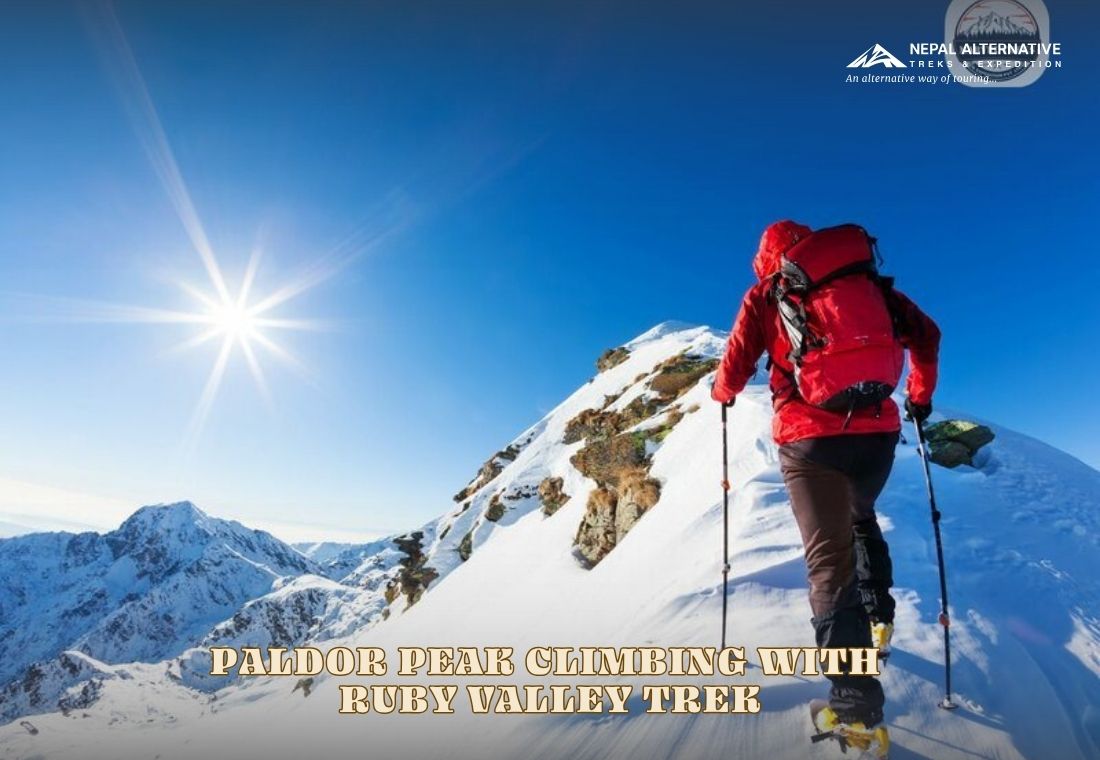
Ruby valley trek begins with a beautiful ride to Syabrubesi. The road to Syabrubesi is excitingly adventurous with a narrow and dirt path. We drive through Langtang National Park, where we will be lured to sight enchanting floras and faunas. We head steep uphill towards Gatlang via Chawatar. We explore the beauty of the Tamang culture and tradition as we pass through the lush green forests and thrilling suspension bridges. The trail lead us to the sacred Lake Parvati Kunda. We further ascend to Yuri Kharka and walk down to Somdang which is the literally Ruby valley beginning point. We can explore the zinc, copper and mines in short distance. Next, is our key highlights of the trip. Crossing through the marvelous Pangsang Pass witnessing a panoramic view of the Ganesh Himal range, Langtang Range, Manaslu, and Paldor peak will amuse you dramatically.
Leaving Pangsang pass behind, we walk downhill through a panoramic view of the Himalayas, embellished with diverse terrain, farmland, green meadow, and rocky hills. We will walk through Sertung and Chalish villages to end the trek. These villages are so special to explore diverse species of herbal plants and minerals like ruby, crystal, and zinc. The trail is even more beautiful as we get a glimpse of exotic flora and fauna.
The upper area of Ruby Valley is a blend of Buddhist, Bon, Christian, and Hindu, inhabited by Tamang, Gurung, and Dalit, while the lower area gives the opportunity to explore Brahmin, Chhetri, Dalit, Tamang, and Magar communities. You will have a scenic and pleasant drive through Lisne, Percho, and Dundure towards Kathmandu via Dhading Besi with a fantastic memory of the trip that we will cherish for the rest of our lives.
Newly opened, unexplored and unspoiled ethnic communities close trekking destination from Kathmandu Valley
Panoramic close up view of Ganesh Himal range, Langtang Himal, Paldor Peak and Manaslu
Indulge yourself in local country life while staying at a homestay.
A dense forest of Rhododendron, pine, oak and bamboo
Mid -hills diverse terrain farmland, green meadow and rocky mountains
Homes to the domestic animals like sheep, yak, goat and ox and exotic animals like musk deer, leopards.
Several rivers along with suspension bridges, Georges, waterfalls and stone- driven mills
Ruby, Crystal, Zinc mines in the mountains
Unique and unspoiled cultures and traditions of Tamang, Gurung, Ghale, Brahmin and Dalit people
7 Days Ruby Valley Trek Itinerary
Day 1
Drive to Syafru Besi from Kathmandu
Day 1 Facts
Trekking Time Average
170km Drive to safrubensi
(Avg 6hrs)
Accommodation
Old Namaste or Similar category
Altitude
(1503m/4945ft.)
Included meals
Lunch, Dinner
Early Morning, we drive to safrubensi through the gateway to the Langtang Valley at the confluence of the Bhote Kosi and Langtang Rivers. Mesmerizing scenic driving and passing through Trisuli Bazaar makes you scenic driving. Narrow and bit adventurous zig zags road but amazing landscapes along the way driving will take your to reach Safrubensi. Stay overnight at lodge.
Day 2
Trek to Gatlang
Day 2 Facts
Trekking Time Average
12km Uphill Hike
(Avg 5hrs)
Accommodation
Paldor Peak Guest House or Similar category
Altitude
(2337m/7690ft.)
Included meals
Breakfast, Lunch, Dinner
We begin our trek with a dirt track zig-zags to the west up to Bahun Danda Pass and then down to the Tamang settlement of Gatlang, a cornerstone village on the Tamang Heritage Trail or hike to Gatlang by way of Chawatar. Gatlang is a Tamang village with unique customs and craftsmanship in a magnificent setting. Just above the villes lies Parvati Kund, popular during Janai Purnimaa when thousands of pilgrims are attracted to the sacred pond and nearby temple. Stay overnight at community lodge.
Day 3
Trek to Somdang
Day 3 Facts
Trekking Time Average
14km Hike
(Avg 6hrs)
Accommodation
Kanchha Hotel or Similar category
Altitude
(3271m/10760ft.)
Included meals
Breakfast, Lunch, Dinner
After breakfast, We ascend through pine and rhododendron forest to a lunch point of Yuri Kharka before continuing to Khurphu Bhanjyang and then dropping down to the Somdang River, border between Rasuwaa and Dhading districts. Ruby valley Municipality begins here.
A sprawling mining compound, no longer functioning but it seems locals appealing government to revive it, lies a few hours to the north upriver. The hike passes through a scenic valley featuring the 200 m Chukarma Waterfall. The former mine leaves a lot be explored and is the site of a 1.4 km tunnel bored into the mountain to extract zinc, copper, tin, crystal and even highly-prized rubies. Stay overnight at lodge.
Day 4
Trek to Tipling
Day 4 Facts
Trekking Time Average
22km Hike
(Avg 8hrs)
Accommodation
Lapdung Homestay, Tipling
Altitude
(1960m./6468ft.)
Included meals
Breakfast, Lunch, Dinner
Begin the day with ascending to pangsang pass which is a viewpoint southwest of Somdang village with a broad panorama of the surrounding terrain. To the north are the soaring peaks of Manaslu and the Ganesh Himal Range. The large meadow is graced with a giant entry gateway and is a sensational location for taking in the breathtaking scenery. The whole Ganesh Himal region is blessed with abundant herbal plants. Previously, herbs were taken to Tibet along an ancient trade route and exchanged for salt, livestock, wool and turquoise.
You will have the best sun rise view and magnificent 270 degrees mountain views then trek to all the way down to Laptung village. Passing through fine, fir and amazing rhododendron forest thick jungle along the way arrive at Laptung village. After lunch turn rise side and passing Phyang village, paddy terraces and surrounding landscape finally arrive in Tipling Village. Stay overnight at Homestay.
Day 5
Trek to Chalish Village
Day 5 Facts
Trekking Time Average
12km Hike
(Avg 5hrs)
Accommodation
Homestay in Chalish Village
Altitude
(1674m/5505ft.)
Included meals
Breakfast, Lunch, Dinner
After breakfast, trek down to Kami gaun then steep descend to Adha khola. The trail leads you gradually to Chalish village.
Chalish is inhabited primarily by Gurung, Ghale and Kami. There used to be Newar people but they migrated to Kathmandu city. The hospitable people of this area have unique customs and craftsmanship and traditional dances, including a hospitable welcome dance, Ghatu Dance, Dohori is also popular with call and response between male and female participants, a type of courtship ritual, complemented by folk music.
Gurung men traditionally wear vangra, a woven, embroidered cotton cloth tied at the ends that serves as a pouch for carrying goods. Sri Tinkanya Devi Mandir lies above Chalish. In the evening mother group of Chalish gaon will welcome you performing Gurung typical dance program and culture show. Stay overnight at local lodge.
Day 6
Explore Sertung Village and visit Tatopani ( Natural hot spring)
Day 6 Facts
Trekking Time Average
12km./5hrs Round Trip
Accommodation
Homestay in Chalish village
Altitude
(1674m/5505ft.)
Included meals
Breakfast, Lunch, Dinner
Early Morning, view point (buddha park ) ”. You will have a magnificent view of Ganesh himal range, Paldor peak, low land villages and surrounding high hills. On the way back, visit phyanchyat Gumpa and Tamang village- Sertung.
Have a breakfast then visit Natural hot spring – tatopani with pack lunch. In the evening, often local cultural group offers entertainment program with cultural show on your request. Stay overnight at same home stay.
Day 7
Drive to Kathmandu
Day 7 Facts
Trekking Time Average
158km./ 08 hours drive to Kathmandu
Altitude
(1295m./4273ft.)
Included meals
Breakfast, Lunch
After breakfast, you will jump on jeep towards Dhading bensi through Lishne jungle, Jharlang village ( Percho), Kimthang phedi and finally arrives dhading besi. You will then continue drive towards Kathmandu another 3 hours.
What’s Included
Pick Up at Tribhuwan International Airport and Transfer to Hotel in Kathmandu .
All meals during the trekking (Breakfast, Lunch, Dinner with tea/coffee).
Accommodation ( Lodge/ Home stay) during the trekking.
One experienced, well trained, fluent English speaking, friendly, specialized in Ganesh himal/Langtang region and government authorized trekking guide
1 Porter per 2 Trekkers and keep luggage weight under 10kg per person.
Guide and porter’s food, accommodation, salary, insurance, transportation and equipments.
Overland transportation as per mentioned in the itinerary.
Langtang national park fee and required necessary documents.
A Trekking map, Water purification, Oxygen saturation check up everyday, duffle bag, company t-shirt, first aid medical and trekking completion certificate etc.
Assistance for emergency rescue evacuation.
Government tax and service charge.
Public Liability Insurance.
What’s not included
Hotel accommodation and meals in Kathmandu.
Hard and soft table drinks such as coke, fanta, mineral water, beer, laundry, phone bill etc.
Personal Travel insurance.
International Flight Tickets.
Nepal Tourist Visa Fee
Tips for guide and porters.( Highly suggested ).
Add-ons and Options
On the Ruby Valley Trekking route, add-ons work as comfort and adventure upgrades that can make a remote cultural trek feel smoother and more complete. They help you manage your load, stay properly equipped, recover in Kathmandu, and add river or bungee days before or after the trek.
To include these add-ons in your booking, follow this simple arrow flow:
Book the Trip → choose your Ruby Valley departure date → proceed to checkout → scroll to the add-ons section → select porters, gear, hotels, vehicles, rafting, bungee, and tours → adjust quantities → confirm your booking with all chosen extras.
Personal Porter Service (USD 140 per porter): Arrange for a personal porter to carry your main bag so you can hike through Ruby Valley villages with just a light daypack.
Trek Gear Rental (sleeping bag USD 10, jacket USD 10, walking poles USD 10, crampons/spikes USD 10): Rent a sleeping bag, warm jacket, a pair of walking poles, and a pair of crampons/spikes so you stay well-equipped for cool mornings and mixed terrain without overpacking.
Spa Massage in Kathmandu (USD 50 per person for 90 minutes): Enjoy a 90-minute massage in Kathmandu after the trek to ease muscle fatigue and help your body recover.
Hotel Accommodation in Kathmandu (USD 50 per night for double/twin share with breakfast): Add comfortable hotel nights in Kathmandu with breakfast included, ideal before starting or after finishing your Ruby Valley journey.
Private transport from Kathmandu to Syabrubesi (USD 150 for a private jeep – 7 seater, USD 300 for a private bus – 28 seater): Travel between Kathmandu and Syabrubesi in a private jeep or bus for a more relaxed and flexible road journey.
Helicopter return from Sertung/Chalish to Kathmandu (USD 2,200 per flight – up to 5 persons): Fly from Sertung or Chalish back to Kathmandu instead of driving out, saving time for sightseeing or shopping at the end of your trek.
Private transport from Chalish to Kathmandu (USD 200 for a private jeep – 7 seater): Use a private jeep from Chalish to Kathmandu for a direct and comfortable transfer.
Rafting at Trishuli River (USD 45 per person): Add a Trishuli rafting day for a fun mix of rapids and river scenery before or after your Ruby Valley trek.
Kathmandu City Tour (USD 30 per person): Explore Kathmandu’s famous temples, heritage squares, and markets with a local guide as a cultural add-on.
Bungee Jumping in Bhotekoshi (USD 100 per person): Include a Bhotekoshi bungee jump for a high-adrenaline adventure either before or after your trek.
1-hour Everest Flight (USD 300 per person): Take a 1-hour flight for aerial views of Everest, Makalu, and nearby summits, including private airport pick-up and drop-off in Kathmandu. The aircraft remains in the air and does not land.
Our scheduled group tours offer fixed departure dates, providing an excellent opportunity for travelers to join our small group trips.
Note : Our fixed group departure dates, services and price is guaranteed even if the group numbers are 1 person to maximum 18 persons. We will provide a guide cum porter if there is only 1 person to operate the trek and one more assistant guide if group size is above 10 persons. And of course, guide cum porter will carry 10 kg luggage
Book a private trip on your own date.
Every journey we create is uniquely tailored to you. Share your interests and passions, and our travel experts will design an unforgettable adventure filled with extraordinary, one-of-a-kind experiences crafted just for you.
Tej arranged a fine trek for my sister and me. This 9 day trek is off the beaten track and we saw very few other trekkers. The scenery was beautiful, the villages we passed through were welcoming and friendly. Our guide Nauser was excellent – very informative, attentive and helpful.…
My sister and I have just returned from an incredible 9 day trek in Nepal. Thank you Tej for arranging our trek, permits, hotel accommodation, taxis, buses, jeeps and final night in Nagarkot. Our trek took us through beautiful countryside, lovely scenery, small villages and very friendly locals. Nauser, our…
I did the Alternative (5 day) Ruby Valley hike to Chalish Gaun. As a gem enthusiast, Tej helped me arrange special day trips to a quartz mining area to explore traditional gem collecting methods in the area. Tej did so much to make this trip truly special and unique. I…
We first traveled to Nepal in 2013 when thanks to the organization and guidance of Nepal Alternative Treks we experienced an unforgettable visit to the Mustang region of the country. This time, accompanied by friends, we journeyed through the stunning Ruby Valley, up to Borang, Chalish and Sertung. Since we…
Similar to other treks Ruby Valley Trekking is very famous for its glorious view of the Himalayas. Similarly, the perfect time to visit this trek is during the spring and autumn season. But, the ideal time to do this trek is between September to November. If not, you can always do this trek in the spring and autumn seasons. During this time of the year, you will find an ideal climate to trek in, Similarly, April is the warmest month of the year in Nepal. So, you can do this trek at this time of the year. During this time of the year, the climate is moderately stable and suitable. Therefore, it can be very helpful for people who want to enjoy the scenery and the surroundings. In addition, if you travel here during this time then you can enjoy a stunning view of the Himalayas.
Ruby Valley Trek Difficulty
There can be a lot of difficulties if you climb at a higher altitude. Similarly, the trek to Ruby Valley is very troublesome. Likewise, you can face a lot of difficulties climbing here. The most common difficulty that you are going to face while trekking here is high altitude sickness. Altitude sickness is a condition when your body has shortness of breath and dizziness. Similarly, if you travel here during overripe seasons then there might be a shortage of suitable porters and accommodation facilities because they might already be hired by other tourists. Likewise, if you travel here during the winter season then you might find slippery trails which can hamper your journey. In addition, if you do this trek in the rainy seasons then the climate and weather can affect your journey.
Travel insurance Requirement During Trek To Ruby Valley
You must have your travel insurance with you. So, make sure your travel insurance company has covered all your safety measures. Make sure that the insurance company provides you with every facility. Because it has a lot of benefits during the trek. Therefore, make sure your travel insurance covers your injury, medical expenses, repatriation expenses, rescue mission, loss of property, etc. But, most importantly make sure your travel insurance is not expired. Furthermore, make sure that your Insurance policy has covered your 3000m trekking and adventure policy. Otherwise, it will be difficult for us to cooperate. Therefore, make sure you have it with you.
Meals and Accommodation During Ruby Valley Trek
We provide a wide range of food and accommodation to our visitors at Ruby valley trekking. Similarly, we provide a suitable and peaceful environment for our visitors for yoga and meditation. Likewise, at the routes of Ruby Valley, we provide a wide range of comfortable hotel lodges and accommodation facilities. As most of the accommodation facility is run by the locals you will get a chance to experience quality local food and hospitality. In addition, the locals there also provide western foods though its a bit expensive compared to the local meals. Local dishes are less pricey because they prepare them with their local farm produce and spices. Whereas, most of the ingredients for western foods are imported from cities. So, western foods are slightly expensive. Furthermore, as you go higher up the altitude the price of the meals also increases. In addition, meals and accommodation can add value to your trip.
Ruby Valley Trek Fitness Requirement
Climbing at a higher altitude requires you to be mentally and physically fit. Similarly, if you can walk for around 4-5 hours with a light backpack then this trek is very fruitful for you. This trek is for around 8 days which is suitable for busy people. Similarly, you should not have any health issues. So, if you have some health issues then you cannot do this trek. Your heart and lungs should be perfectly fine if you want to enjoy and complete this trek. Similarly, you should not have any blood-related diseases. In addition, walking and running initially before the trek is helpful. However, you should not be that experienced for the trek. But, you should have a little knowledge about the trek.
Climate & Weather During Ruby Valley Trek
Climate and weather are important factors to consider for your trek. Similarly, your trek success rate solely depends on this. So, it is very important to consider before heading on the trek. The spring and autumn season is the best time to trek here. During this time of the year, the weather is very pleasant and warm. However, it gets cold at night. It can probably snow above 3000m altitude. However, the climate of the Himalayas is unpredictable. It is usually warm during the day and cold during the night. So, you should have a reliable sleeping bag with you. But, it is quite warm if there is sunshine. Similarly, if there is sunshine during the trek then you can fully enjoy the view of the surroundings and watch the stunning view of the Himalayas. Likewise, you will travel in clear visibility. However, in the winter season, the weather gets cloudy which makes it challenging to trek.
Addressing Safety and security Concerns During Trek To Ruby Valley
The Safety and Security of our trekkers are very important for us. Similarly, while trekking in Ruby Valley we carefully check every route for the trek. So, don’t worry you will be safe with us. Similarly, we also take good care of the belongings of our trekkers on the lodges and during the trek as well. Therefore, you feel free and fully enjoy yourself during the trek, you should not worry about yourself and your belongings. We fully take care of that.
Ruby Valley Trek Required Permits
Langtang National Park Fee: NPR 3000 for foreigner and NPR 1500 for SAARC
Note : Child under 10 years are free
What People Ask About
Ruby Valley Trek
Is this trekking route safe for trekkers ?
Yes, Tsum Valley is safe for tourists. This area has already recovered from the earthquake in 2015. Also, there is no burst of epidemics or viral diseases, or covid -19 in this region. The government and other respective bodies are continuously are trying to facilitate accessible communication, comfortable and safe internal travel, proper healthcare facility, and services of accommodation for tourists.
What are the physical fitness and other criteria required for this trek ?
Some of the days pass through the steep country lanes with climbs and ascents that can be demanding and tiresome, so it is beneficial for all travelers to exercise daily from a month before their trip. This helps the body get accustomed to the physical work required during the journey. Participants with pre-existing medical conditions such as heart, lung, and blood disease should inform us before booking the trek and are advised to seek medical advice or consent from their doctors before the trek.
When is the best season ?
The best season to trek this route is during autumn (September to November) as the weather is stable, dry, and clear. Also, the atmosphere is merry during these seasons, as autumn is the major festive season of the country. Another favorable season for trekking is during spring (March to May) as the trails become more vibrant and pleasing with the blooming of different wildflowers and Rhododendrons. The days are clear and perfect for trekking.
Is Travel Insurance compulsorily required ? Does your company pay for the Travel Insurance of guides and porters?
While booking a trek with us, we do require you to have travel insurance that must cover medical and emergency helicopter rescue with evacuation expenses at 4000m. high altitudes for trekking members. You should provide the insurance documents before you depart for the trek.
If you do not or cannot find an appropriate insurance policy, we will assist you with one. It will help you in potential altitude sickness and unforeseen events due to sudden weather changes.
Yes, we do pay for the insurance policy of our team members. Nepal Alternative Treks fund the expenses for insurance of all of its members along with their meals, salary, lodging, transportation, and other necessary equipment.
What is the role of your guides ?
Our licensed guides speak fluent English, and most of them even speak additional local languages like Gurung and Tamang. They are extensively trained in handling any crisis and accidents along with managing accommodation and have good experience in the safe operation of treks.
Our guides have ample knowledge about the Himalayas, altitude sickness, geography, local culture, and customs, as well as the biodiversity of the area. Their primary concern is your safety and satisfaction throughout the trek. Therefore, they will make your journey easier, exciting, and enriching.
What is Acute Mountain Sickness? What happens if we fall sick?
As you ascend, the atmospheric pressure decreases. Hence, the amount of oxygen available also decreases. When your body is unable to acclimatize adequately to a rapid decrease in oxygen volume, altitude sickness occurs. Its symptoms are nausea, vomiting, headache, lack of appetite, exhaustion, muscle aches, rapid pulse even at rest (+/- 120 beats per minute), and insomnia.
To avoid AMS, our itineraries include acclimatization days in between. You should walk at a slow and steady pace, eat enough carbohydrates, and drink plenty of water. You could eat chocolates and toffee while walking and avoid alcohol and smoking.
Our guides are well-trained to handle emergencies like AMS and other sicknesses. They know how to use an oxygen meter to monitor blood oxygen saturation levels at high altitudes. They can facilitate you with other medical kits (First Aid) and health check-up as per necessity.
If you happen to have symptoms of AMS or the feeling of being sick, you have to report it to your guide immediately. You must not ascend any further, take rest, and take medicines like acetazolamide or Diamox. If symptoms persist, you must descend to a lower altitude and visit a doctor immediately. If the condition seems to worsen, we shall coordinate with your insurance company for helicopter evacuation.
Can we change money along the trek ? Can we pay by credit card or foreign currency ?
No, you won’t be able change money along route. We recommend changing money at Thamel. Credit card and foreign currency is not accepted along the route. You are better to take enough cash from Kathmandu.
What is the weight limit for porters ?
Usually, we arrange one porter for two trekkers, and one porter carries weights up to 20 kilograms. Hence, each trekker’s luggage should weigh only up to 10 kilograms. However, if your essentials weigh more than that, we can provide you a personal porter with some additional costs.
What kind of food will be provided during the trek?
Our package includes three meals per day, breakfast, lunch, and dinner. Dinner and lunch include the authentic Nepali Daal-Bhat (rice and lentils) along with seasonal vegetables, spinach, and pickle. If you do not like it, you can choose any item from the wide range of menu offered by the lodges.
Home stay and lodges serve Nepalese, Asian, and Continental food, and even pizzas. The food is prepared hygienically, but the taste of western food might not meet your expectations as there are minimal resources available. We usually suggest eating vegetarian food to avoid falling ill.
How can drinking water be managed in the mountain ?
Bottled plastic water is readily available along route at USD 1 per liter. However, we recommend you carry your own water bottles. You can fill them up with filtered water or boiled water wherever possible and purify it using chlorine or iodine. We shall provide water purification drops and tablets.
How long will we have to hike each day ?
An average day of trekking involves around 4 to 6 hours of hiking, including breaks for meals as needed. The average distance covered depends on the terrain and altitude, but ranges from 10 to 15 kilometers on average.
Along the way, you will have many chances for photography and other personal interests such as bird watching and discovering local areas of interest like natural springs, hot water ponds, and even exploring flora and fauna.
What are the documents that we need to bring for this trek ?
You need to submit the following documents that should be sent via email :
A copy of passport,
Passport-sized photos,
Flight details,
Copy of travel insurance (it has to cover Heli rescue and medical evacuation) and other documents required to claim it.
What are the accommodation arrangements during the trek ?
In this trekking, the accommodation options are Home Stay and lodges only. Nepal Alternative Treks generally manages your accommodation in best available lodges or homestay that provide single or double rooms, mostly in dormitory-style. The bed has a mattress, pillow, and blanket. Very few teahouses offer a room with the blanket provided by the teahouse alone will not be enough to withstand the cold. So, it would be better to carry a warm sleeping bag. You can buy or hire one at the rental shops in Kathmandu.
What kind of toilet facilities are there? Will we be able to take a shower in Mountain ?
You are most likely to find an Indian squat-styled toilet. Finding toilet paper is almost impossible in these areas, so we advise you to carry plenty of your own.
Usually, Nepal Alternative Treks arranges accommodation with proper shower facilities. Please understand that it becomes difficult to arrange running shower and hot water facilities as the altitude increases. So, in remote mountainous regions, showers cost some extra money.
Can we hire trekking gears in Kathmandu ?
Yes, you can. There are plenty of shops around Thamel that sell as well as rent all the necessary gear for trekking. These shops have great varieties of goods ranging based on their brand as well as price. We will help you with buying or hiring all the necessary equipment.
Do we need to tip my porter and guide ?
It is not mandatory to tip the porters and guides. It ultimately depends on your choice. As your porter and guide play a big role in the success of your trip, from guiding and carrying your necessities to being mindful of your safety, your tips reflect gratitude towards them. Hence, tipping is a recommended culture for porters and guides in Nepal as a gesture of thankfulness.
Is it possible to recharge batteries and electronics during the trek ?
Tsum valley has electricity and recharging facilities available for a minimal service charge.
However, to be on a safer side, we do recommend you carry solar chargers. Also, note that the Nepalese plugs are of Type D, and the voltage is about 220-240 V. So, make sure that your devices are chargeable. Otherwise, you shall require adapters and voltage stabilizers.
Is it possible to communicate with friends and family back home while on trek ?
Ruby valley has nowadays mobile network access and internet data coverage.
For mobile network and internet data, you will require a Nepalese SIM-Card. If you wish to buy a Nepalese SIM-Card, we will assist you in getting it. You can buy a SIM-Card from local distributors easily with some fees. We recommend NAMASTE sim for better network coverage and 4G data usage.
What if the guide/porter leaves alone on the trail?
Guides and porters will always walk together with you, but, sometimes in case if there is no communication available to reserve lodge in advance, your porter may have to go ahead to book a room in an excellent lodge for the night. Our guides /porters will not leave you behind otherwise.
If by any chance such a circumstance occurs, you have to contact us immediately. We will then connect to our guides/porters and get back to you.
What is the weather and temperature like during the trek?
The temperature could range around and above 25 degrees Celsius in summers and decrease below -10 degrees Celsius in winters. During autumn and spring, temperature ranges around 10 to 20 degrees Celsius, making it suitable for trekking purposes.
Need assistance? Our travel expert Tej Bahadur Gurung is here to help! Please fill out the form below to initiate a chat and get your queries resolved quickly.

 Winchester, UK5.0 /5