Are you planning to take a trek to the Everest region on your own, but also want someone to support you for your climbing expedition? We’ve got you covered. This 3-day 2-night Island Peak Climbing from Chhukung is a perfect option for you. It is an exciting Himalayan expedition customized for trekkers who have already acclimatized in the Everest region. The package not only takes you to the summit of the Island Peak and provides you with success but also offers you a meaningful mountain experience in the Khumbu region of Nepal.
Island Peak, located at an elevation of 6,189 m / 20,305 ft, is a popular trekking peak in Nepal. This climb takes you through peaceful Sherpa villages, glacier sections, and mountain valleys. You’ll walk on ice, use ropes, and other climbing gear, and stay in a tented camp under the sky, which provides you with a real taste of adventure. The best part of the Island Peak Climb via Chhukung? It’s a climb in the shadows of Everest, Lhotse, and Ama Dablam. You can also try 11 days Short Island Peak Climbing if you have more than 3 days.
The adventure to Island Peak Summit begins in Chhukung, from where you’ll make your way to Island Peak Base Camp. A half day is set at the base camp for your technical training, where our expert Sherpa guides introduce you to essential mountaineering techniques, along with providing training on using different climbing gear. Summit day begins before dawn through a challenging section. From the summit of the Island Peak, you’ll witness a 360-degree panorama of the Everest region and Himalayan peaks that will be forever in your heart and mind.
This way, the Peak climbing to the Island from Chhukung is a perfect combination of trekking, adventure, and mountaineering experience. It’s a chance to challenge yourself, enjoy the stunning Himalayan landscape, and create lifelong memories with your plan and customized itinerary.
Core Experience of Island Peak Climbing via Chhukung
You’ll get an opportunity to explore Chhukung village and its surrounding landscape before starting the climb.
Sleep under the stars with a clear view of the sky, away from city dust at Chhukung and Island Peak Base Camp.
You’ll experience glacier trekking and technical ice climbing accompanied by towering mountain peaks.
Walk through the less crowded section where you’ll get a real taste of adventure and a peaceful climb.
Climb the iconic Island Peak (Imja Tse) at an elevation of 6,189 m above sea level, from where you can get an astonishing view of Mount Everest, Lhotse, Ama Dablam, and Makalu.
Island Peak Climbing From Chhukung Difficulty
The Island Peak Climbing from Chhukung is strenuous with moderate technical climbing sections. The main challenge of the climb is the high altitude and significant elevation gain that requires excellent physical fitness. Similarly, the climb requires proficiency in using equipment like ice axes, crampons, harnesses, and ropes, making it challenging for those who aren’t accustomed to using such gear.
Furthermore, the route involves crossing a glacier, which can be challenging and requires careful walking around crevasses. Likewise, other prominent challenges of the climb are the final ascent to the summit, the “headwall” that consists of a steep and icy slope. Thus, hiring experienced guides and having a well-planned itinerary with enough acclimatization days is essential for a safe and successful summit of Island Peak via Chhukung.
3 Days Island Peak Climbing From Chhukung Itinerary
Day 1
Trekkers and Porters at Chhukung
Trekkers and Porters at Chhukung
Island Peak Training
Island Peak Training
Island Peak Pre-training
Island Peak Pre-training
Island Peak Climbing Group
Island Peak Climbing Group
Arrival in Chhukung
Day 1 Facts
Accommodation
Tea House (on your own)
Altitude
4,750 m
Our Island Peak Climbing from Chhukung Itinerary begins after you arrive at Chhukung village from your journey to the Everest region. As you get to the village, you’ll meet your climbing guide along with the climbing team. After meeting with the climbing team, your guide will describe the routes and the use of different equipment. If you don’t have the climbing equipment, our team can help you rent it at the teahouse.
On the day, we’ll stay overnight and have dinner at the teahouse of Chhukung, but the cost of the expenses is at your own. We recommend that you sleep early, as you must begin the next day’s journey early.
Day 2
Island peak base camp
Island peak base camp
Island Peak Climbing Beginning
Island Peak Climbing Beginning
Night View From Island Peak Climbing
Night View From Island Peak Climbing
Island Peak Ice And Ladder
Island Peak Ice And Ladder
Ascend to Island Peak Base Camp
Day 2 Facts
Trekking Time Average
3 to 5 hours
Accommodation
Tent
Altitude
5,200 m
Included meals
Breakfast, Lunch, and Dinner
Day two marks the beginning of our Island Peak climbing route from Chhukung. However, if you wish to acclimate before starting your journey, you can do so on this day, adding an extra day to the itinerary. However, if you are confident enough that you don’t need an extra acclimatization, we can start the expedition from today. We’ll leave Chhukung between 7:00 AM and 8:00 AM after the morning meal.
The walkway from Chukung ascends south and then turns east to reach the main line of the valley. It then winds down the southern side of the moraine from the Lhotse Glacier. Continuing the walk alongside the river, we’ll get to the area called Big Rock. The crossroad of the crisis, which runs through the moraines of the Imja and Lhotse glaciers, leads to a wide valley extending along the southwestern side of the island peak’s Base Camp.
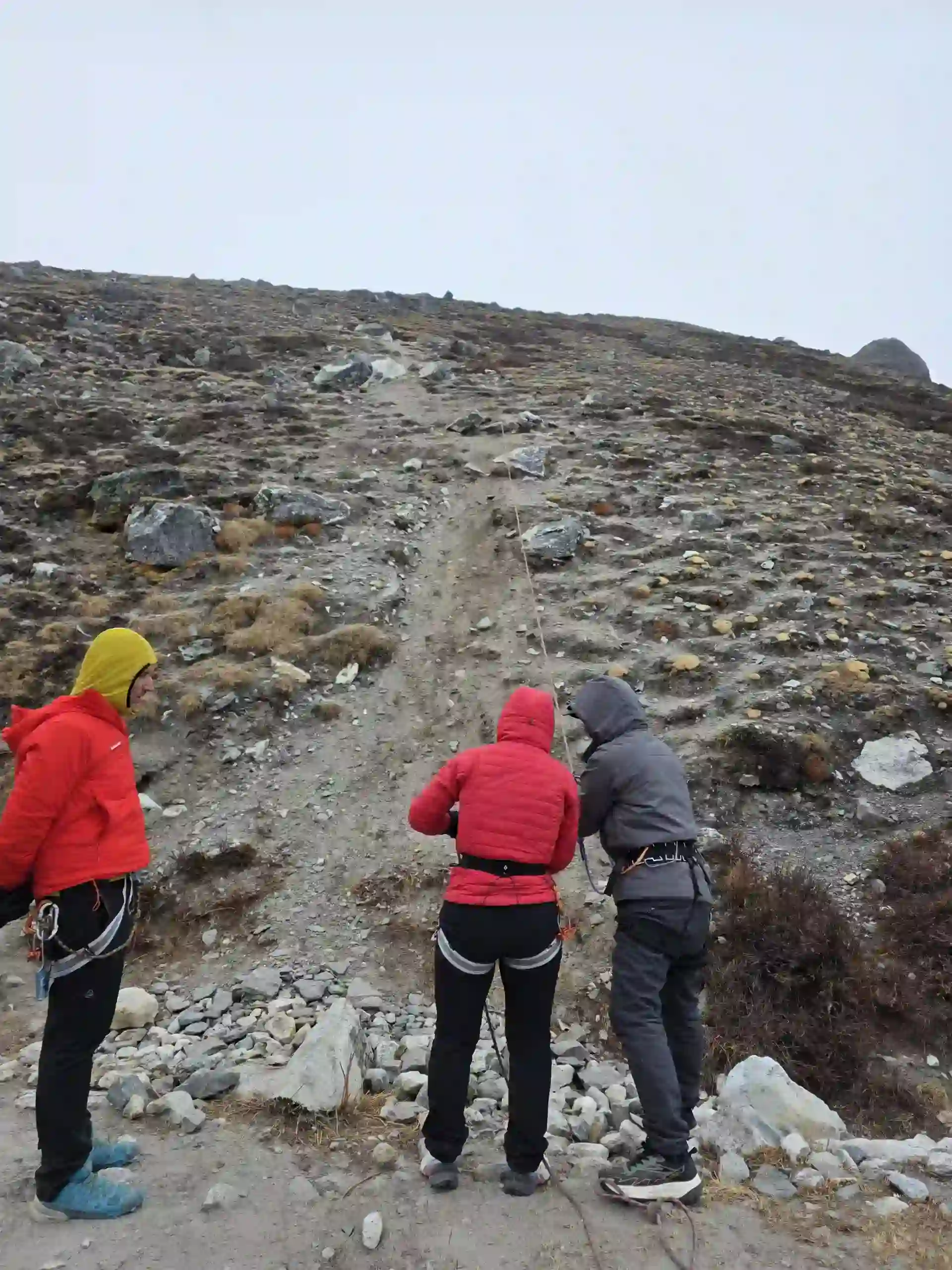
After getting to the Base Camp, we’ll take a rest, and later on, our highly experienced and professional Sherpa guide will provide you with training on using the different climbing equipment needed to reach the summit of the Island. On this pre-climbing training session, you’ll learn how to use climbing gear such as the ice axe, climbing boots, crampons, harness, ascender, and rope. At the evening, we’ll enjoy a warm supper made by our cook and sleep under the sky while stargazing.
Day 3
Climbers in Island Peak Climbing
Climbers in Island Peak Climbing
Island Peak Climbers Group Photo
Island Peak Climbers Group Photo
Island Peak Climbers With Head Lamp
Island Peak Climbers With Head Lamp
2 Island Peak Climbers with Banner
2 Island Peak Climbers with Banner
Ascend to Island Peak And Return To Chhukung
Day 3 Facts
Trekking Time Average
14 to 16 hours
Accommodation
Tea House (on your own)
Altitude
6,189 m
Included meals
Breakfast and Lunch
The third day is one of the most awaited days on the journey to Island Peak Climbing from Chhukung. Early morning with a headlamp and a packed lunch, energy bars, water, and a camera, we will begin our climb towards our ultimate destination, Island Summit. The climb from Island Base Camp to Island Peak is steep and challenging.
The first few hours of the climb are a steep, non-technical trek over rocky moraine and loose scree. We’ll follow a winding path that leads to the base of the glacier. As we get closer to the glacier, we’ll reach a “crampon point” where we put on our technical gear, including harness, crampons, and other climbing equipment. The next section involves crossing a glaciated area where our guide will have already set up fixed ropes in some sections and will lead the way.
The most technical and challenging part of the climb is the “headwall”, a steep, icy slope leading to the summit ridge. Our guides will have fixed ropes on this section, which you will ascend using a jumar on the rope. After climbing the headwall, we will emerge onto the edge of a short, exposed summit ridge. A final, gentle ascent along this ridge leads to the summit of Island Peak (6,189 meters/ 20,305 ft).
Standing at the summit of Island Peak will provide us with a sense of accomplishment and make us forget all the challenges we faced along the climb. The view of some of the world’s highest mountains, including Lhotse, Makalu, and Ama Dablam, with rays of the rising sun, will appeal to our eyes.
After taking a moment to enjoy your win, we’ll start to descend as we can’t stay overnight at the peak’s summit due to cold and unpredictable weather. The descent is just as challenging as the ascent. We’ll descend through the same route that took us up to the summit. It takes 10 to 14 hours from the Island Base Camp to the Summit and back to Chhukung. Our day’s overnight and dinner are at the tea house of Chhukung.
What’s Included
Island peak climbing permit and Garbage deposit.
Public Liability Insurance.
A professional climbing guide and all expenses. ( 1- 4 pax = 1 climbing guide, 6- 10 pax = 2 climbing guides, 10 – 14 pax = 3 climbing guides)
Assistant Cook & Transportation: Trekking assistant cook & necessary kitchen helper based on the Member, who carries the camping equipment and the tent from Chukung.
Camping Equipment Utensils: EPI Gas, gas stove or fuel stove for Cooking, Fuel or Kerosene oil, Cooking pot, Mattress, etc.
1 Porter per 2 Trekkers and keep luggage weight under 10kg per person.
Staff salary and Allowance: All our staff & porters’ daily wages/equipment/food/clothing, etc
High Altitude Tents: North Face Dome Tent, Space for Two Pax, Wall/Cabin Tent for Dining and Kitchen, etc
High Camp Lodging & Fooding Service: Three Meals (Breakfast, Lunch, Dinner) a day for Members and Staff.
Drinks & Beverage: Tea with Biscuits and Hot drinking water in the climbing Period and Hot washing water in case required.
Fixing Gear: Fix rope, main rope, snow bar, ice crew, rock pitons, etc
What’s not Included
Meals/accommodation in Chhukung.
Airplane flight to Lukla.
Other permits, except for peak climbing.
Personal Travel Insurance.
Personal climbing gear such as Climbing boots, Crampons, Ice axe / Ice hammer, Harness, Jammers, Karabiners, Finger eight / ATC guide, Tap sling, etc. (Possible to hire at Chukung )
Tips for guides and staff. ( Highly suggested ).
You can hire the following equipment at Dingboche/Chhukung for climbing purposes
Climbing boot
Carmpons
Iceaxe/ Ice Hammar
Harness,jumars
Karabiners
Tap sling
Fix/ main rope
Snow bar
Ice crew/ rock pitkung
Other equipment you can get on hire at Chhukung/Dingboche
Oxygen cylinder & Max regulator
Gloves
Sunglasses
Sticks
Helmet
High thermos
Hot Bag
Water bottle
Ski Boards
Sleeping bag
Clothing (Waterproof trousers & jacket, down jacket, Socks, etc.),
Walkie-talkie (talk back)
Thurya Set light phone.
Add-ons and Options
The Short Island Peak climbing itinerary is suited to travelers with limited time, and these add-ons provide extra convenience without changing the main character of the expedition. You can add dedicated climbing support, porter service, technical gear rental, hotel accommodation, or helicopter transfers.
Steps to add add-ons:
Choose a departure date and continue through the Short Island Peak reservation form. The optional extras appear before payment, where you can select the services that best match your schedule, comfort level, and equipment needs.
List of add-ons available:
Private Climbing Sherpa from Chhukung (USD 300 for the entire climbing period): Receive dedicated climbing support from Chhukung through the technical and summit sections. Choose this service if you want personal guidance and closer assistance during the most challenging parts of the climb.
Personal Porter (USD 220 per porter): Arrange for a porter to carry up to 20 kg of your personal and trekking gear. A porter allows you to walk with a lighter daypack and preserve more energy for the high-altitude climbing days.
Full-Day Kathmandu City Tour (USD 30 per person): Visit Kathmandu’s important temples, courtyards, and heritage sites with a guide and arranged transport. This is a convenient way to include cultural sightseeing in a short overall travel schedule.
Kathmandu to Lukla by Helicopter (USD 500 per person): Begin the trek with a helicopter transfer from Kathmandu to Lukla. It offers a faster and more comfortable alternative to regular flights, particularly when you want greater flexibility.
Helicopter Return from Chhukung to Kathmandu (USD 1,300 per person): Return directly to Kathmandu by helicopter after the Island Peak climb. This saves several days of trekking and is useful when you need to return to Kathmandu quickly.
Accommodation in Kathmandu (USD 40 per room on a twin-share or double-bed basis): Add a hotel stay before or after the expedition. Pre-booked accommodation makes your arrival and post-climb recovery easier and more organized.
Gear rental (USD 11 per item): Rent a down jacket, sleeping bag, pair of trekking poles, or pair of crampons/spikes. Renting is a practical solution if you do not own specialized high-altitude equipment or want to avoid carrying bulky items internationally.
Helicopter from Chhukung to Lukla (USD 700 per person): Fly from Chhukung to Lukla after completing the climbing section. This is a time-saving option for travelers who want to continue their journey without retracing the complete trekking route.
One-Hour Everest Scenic Flight (USD 300 per person): Enjoy an aerial view of Everest and the Himalayan range on a flight with private Kathmandu airport transfers. There is no landing. This add-on allows you to enjoy a broad Himalayan panorama without adding another demanding trek.
Best Time for Island Peak via Chhukung as per ideal weather conditions
January
-15°C to -10°C
February
-15°C to -10°C
March
-10°C to -5°C
April
-5°C to 0°C
May
0°C to 5°C
June
5°C to 10°C
July
5°C to 9°C
August
5°C to 10°C
September
0°C to 5°C
October
-5°C to 0°C
November
-10°C to -5°C
December
-15°C to -10°C
As shown above, January, February, March, November, and December experience extreme cold, with temperatures dropping below zero degrees Celsius. Although June, July, and August have favorable temperatures, the season is monsoon, which brings heavy rainfall that adds to the difficulty of the trek. Besides, months that include April, May, September, and October are best for climbing to Island Peak from Chhukung. Therefore, for safe climbing to the Island, choose April, May, September, and October as the time offers ideal conditions for an expedition in Nepal’s Himalayas.
Our scheduled group tours offer fixed departure dates, providing an excellent opportunity for travelers to join our small group trips.
Note : Our fixed group departure dates, services and price is guaranteed even if the group numbers are 1 person to maximum 18 persons. We will provide a guide cum porter if there is only 1 person to operate the trek and one more assistant guide if group size is above 10 persons. And of course, guide cum porter will carry 10 kg luggage
Every journey we create is uniquely tailored to you. Share your interests and passions, and our travel experts will design an unforgettable adventure filled with extraordinary, one-of-a-kind experiences crafted just for you.
I did island peak 3 days, due to logistics it ended up being just me which was great, Bimal was my guide and he had experience of multiple successful summits on Everest Lhotse Ama Dablam and of course island peak. I didn’t succeed in the summit but Bimal helped me…
Important Notes for Island Peak Climbers Starting at Chhukung
Spend at least 2 nights in Chhukung before heading to Island Summit. Consider hiking to Chhukung Ri to help your body adjust to the altitude.
Be prepared for tented accommodation in the Island Peak base Camp, where you’ll face cold and basic lodging. So, it is best to bring a warm sleeping bag for undisturbed sleep.
You must know how to use crampons, an ice axe, and especially the Jumar (ascender) for the final headwall.
Wind, snow, or whiteouts can happen unexpectedly. Thus, always listen to your guide and be ready to turn back.
Make sure your harness fits, your boots work with crampons, and nothing is missing.
Drink plenty of water and eat well, as it helps in proper acclimatization and good performance.
Be aware of Acute Mountain Sickness (AMS) symptoms, including headaches, nausea, and dizziness.
Conduct a pre-climb training session at Base Camp to ensure you’re comfortable with the gear.
Wear layered clothing to adapt to changing temperatures. A waterproof/windproof outer shell and a heavy down jacket are crucial.
Island Peak Climb via Chhukung vs. Island Peak via Everest Base Camp (EBC)
Both route via Chhukung and Everest Base Camp takes you to the same goal, the majestic summit of Island Peak (Imja Tse). However, choosing between the two depends entirely on your priorities, fitness level, time, and what kind of experience you’re looking for in the Khumbu region. Here is a comparison table of Island Peak Climb via Chhukung vs. Island Peak via Everest Base Camp:
Feature
Island Peak Climb via Chhukung
Island Peak Climb via EBC
Trekking Route
Begins from Chhukung, a village after the main EBC section split.
Follows the classic Everest Base Camp and Kala Patthar trek before the climb.
Trip Duration
Shorter (typically a 3-4 day)
Longer (typically 18-20 days)
Best For
Climbers focused on Island Peak only
Trekkers wanting to visit both EBC and climb Island Peak
Difficulty
More challenging due to the rapid ascent after acclimatization.
Less challenging overall, as the EBC trek provides a gradual and safe acclimatization period.
Crowds
Fewer trekkers, quieter experience
Busy trail, more tourist traffic until EBC
Experience
The focus is solely on the climb.
Offers a complete experience of both the EBC trek and the Island Peak climb.
Cost
Lower, as it’s a shorter package.
Higher, as it includes the full EBC trekking logistics.
Scenic Variety
Mainly Mountain views
More diverse
Acclimatization Days
Generally 1–2 days at Chhukung
2–3 days spread across Namche, Dingboche, and EBC
Why Chhukung Is the Ideal Starting Point for Island Peak?
Chhukung village, at an elevation of 4,730 meters / 15,518 ft, lies at the edge of the Imja Valley. Similarly, it is the last human settlement before reaching the Island Peak Summit. One of the primary reasons why Chhukung is the ideal starting point for the Island Peak climb is its proximity. The close location of Chhukung to Island Summit makes it the perfect place to rest, prepare, and adjust before attempting the summit.
The trek from Chhukung to Island Summit is a relatively short and manageable journey compared to starting from any other route. The short distance of 15-16 km makes it possible to return to Chukung the same day after the climb, thus avoiding the need to spend a second night in the harsh conditions of the base camp.
Similarly, the Chhukung valley offers a number of essential facilities for climbers. You can find teahouses for accommodation and dining options, along with shops where you can rent or purchase last-minute climbing gear. This convenience means you don’t have to carry all their technical equipment from Kathmandu, which is a major logistical advantage.
Furthermore, starting your climbing trip to Island Peak from Chhukung is safe from a weather perspective. Because Chhukung is not too far from Island Peak, staying here gives climbers the ability to watch the weather closely and wait for a good summit day. Moreover, Chhukung is a central hub for guides, porters, and climbing support staff.
Island Peak Climbing NMA Permit Cost 2027
The table below shows the latest 2027 Nepal Mountaineering Association (NMA) permit cost for Island Peak climbing.
Climbing Season
Months
NMA Permit Cost (Per person)
Spring
March-May
USD 350
Autumn
September-November
USD 175
Winter
December-February
USD 175
Summer
June-August
USD 175
Glacial Landscapes Between Chhukung and Imja Valley
The glacial landscape between Chhukung and the Imja Valley is an example of glacial geomorphology, shaped by the powerful forces of ice and erosion over thousands of years. Similarly, the section between the Chukung and Imja valleys offers one of the most visually appealing and geologically dynamic glacial landscapes in the entire Khumbu region.
As you leave Chhukung, you will notice that the ground is rough and rocky. These piles of stones, called lateral moraines, were pushed there by glaciers in the past, and some of them are hundreds of years old. As you move further, you’ll see more indications of ice and melting. The Chhukung Glacier and Nup Glacier come down from the snowy peaks of Nuptse and Lhotse. Their meltwater flows into the valley, causing the ground to become wet in some places, requiring careful walking.
The Imja Glacier is a prominent feature, originating from the slopes of Lhotse and Baruntse, and is the major glacial landscape between Chhukung and Imja Valley. Like many Himalayan glaciers, it is a debris-covered glacier, meaning its surface is insulated by a thick layer of rock and soil. One of the most significant landforms created by the Imja Glacier is Imja Tsho. This glacial lake is formed in a depression left by melting glaciers, where moraine acts as a natural dam.
What People Mostly Ask About I
sland Peak Climbing From Chhukung
What is the distance from the Island Peak summit to Chhukung?
The total distance from Island Peak Summit to Chhukung is approximately 15-16 km. The distance includes Chhukung to Island Peak Base Camp, which is about 5-6 km, and Base Camp to the summit, which is 10km. Additionally, the distance between the points is long and challenging.
What are the necessary permits for Island Peak Climbing from Chhukung?
Nepal Mountaineering Association (NMA) climbing permit, Sagarmatha National Park Entry Permit, and Khumbu Pasang Lhamu Rural Municipality Permit are necessary for Island Peak Climbing from Chhukung. Additionally, a garbage deposit fee is also applicable, but it is refundable upon proof of proper waste disposal.
How many days does the climb take from Chhukung to the summit of the Island?
The climb from Chhukung to the summit of Island generally takes 2 to 3 days. The first day includes getting to Island Peak Base Camp from Chhukung, and the second day takes you to Island Peak summit and back to Chhukung. But, many climbers add another day for pre-climbing training at Chhukung.
Is one night in Chhukung enough for acclimatization before heading to the Island summit?
Whether one night in Chhukung is enough for acclimatization before heading to the summit of the Island depends on the climber’s needs and prior climbing experience. Still, it is generally recommended to spend at least two nights at Chhukung for adequate acclimatization before climbing Island Peak.
What kind of food and accommodation are available in Chhukung and the Island Peak base camp?
In Chhukung, you’ll have food and accommodation in a basic teahouse, but as you head towards Island Peak Base Camp, human settlement disappears. Thus, your accommodation will be at a tented camp, and you’ll have food cooked by our climbing team at Island Peak Base Camp.
Is there a mobile signal and Wi-Fi in Chhukung and Island Peak Base Camp?
Yes, mobile signals and Wi-Fi are available in Chhukung. However, in the Island Peak base camp, you won’t find Wi-Fi, as there are no permanent teahouses or lodges. Yet, mobile signals are available, but are extremely poor. But, for emergencies, your climbing guide will have a satellite phone.
Can I do Island Peak via Chhukung after the Everest Base Camp Trek?
Yes, it is possible to climb Island Peak via Chhukung after completing the Everest Base Camp trek. In fact, it is a very popular trek extension option many trekkers choose, and many climbing companies offer the combined itinerary. Yet, know that the Island Peak via Chhukung after the Everest Base Camp trek will be longer.
Need assistance? Our travel expert Tej Bahadur Gurung is here to help! Please fill out the form below to initiate a chat and get your queries resolved quickly.




 Australia5.0 /5