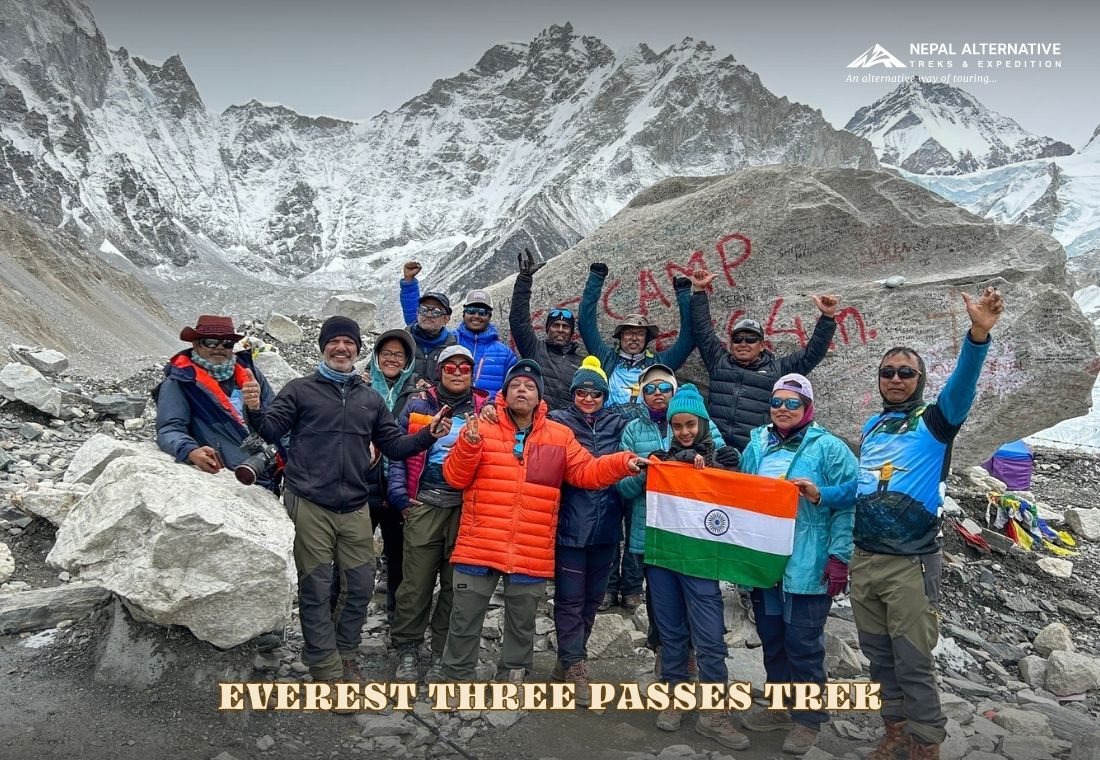
Everest Three Passes Trek Anticlockwise Route Overview
The Everest Three Passes Trek Anticlockwise Route is a thrilling trekking route to experience every legendary corner of the Everest region of Nepal. This route covers three stunning high mountain passes: Kongma La Pass (5,535 m), Cho La Pass (5,420 m), and Renjo La Pass (5,360 m). It also lets us explore the iconic Everest Base Camp, Kala Patthar, turquoise Gokyo Lakes, Gokyo Ri, and the remote Thame Valley. It’s the perfect journey for experienced trekkers looking for all the physically demanding challenges that the EBC trek route has to offer while also providing rich cultural immersion.
The Everest Three Passes Trek via the Anticlockwise Route begins with a flight to Lukla and follows the popular Everest Base Camp trek trail through Phakding, Namche Bazaar, and Dingboche. From Dingboche, we’ll head to Chhukhung and cross the first and highest pass, Kongma La Pass. Then, after visiting Everest Base Camp (5,364 m) and hiking up Kala Patthar (5,555 m) for sunrise views of Mt. Everest, the route continues over Cho La Pass. From Cho La Pass, the trail takes us to stunning Gokyo Valley. We’ll climb Gokyo Ri (5,480 m) for stunning views of Everest, Lhotse, and Cho Oyu, and Gokyo Lakes. Now, we will descend and we will cross the final pass, Renjo La Pass, to reach the quiet Thame Valley and return to Namche.
One significant advantage of doing the Everest High Three Passes trek in Nepal via the anticlockwise route is better acclimatization. Unlike the clockwise route, which starts with Renjo La and ends with Kongma La, this counterclockwise route starts with the most challenging pass (Kongma La Pass) first. This itinerary helps in gradual altitude gain and also gives us more time to acclimatize and get used to the altitude, especially before reaching Everest Base Camp.
Furthermore, the anticlockwise route of the Everest 3 passes trek provides a cultural experience on the trail. We will gain first-hand experience of Sherpa culture by staying in family-run teahouses throughout the trek. What’s more? We will visit ancient Buddhist monasteries like Tengboche and witness the mountain culture of Khumbu. The trek takes 17 days to complete, starting and ending at Kathmandu.
Major Attractions of Everest Three High Passes Trek Anticlockwise Route
Cross the three challenging high passes in the Everest region: Kongma La, Cho La, and Renjo La.
Stand at the base of the world’s highest peak, Mount Everest.
Get surreal views of the Himalayas, including four of the world’s tallest peaks, Mount Everest, Lhotse, Makalu, and Cho Oyu.
Trek through three beautiful valleys of the Everest region: Khumbu Valley, Gokyo Valley, and Thame Valley.
Relax in the tranquil beauty of the Gokyo Lakes.
Walk across the Ngozumpa Glacier, Lobuche Glacier, and Khumbu Glacier.
Travel through a mix of landscapes, from green forests and riverbanks to high alpine meadows and icy glacier paths.
Explore Sherpa villages and learn about their deep-rooted culture and mountain lifestyle.
Spot varied flora and fauna within Sagarmatha National Park.
Start and end our journey with flights to Lukla airport.
How Difficult is the Everest 3 High Passes Trek via the Anticlockwise route?
The Everest three passes trekking anticlockwise route falls in the strenuous trekking category due to its high altitude, long walking days, and tough mountain passes. Compared to the regular EBC trek route, this route is harder to follow. We’ll need to cross massive glaciers like Khumbu Glacier and Ngozumpa Glacier, where the trail markers are often unclear and keep changing with the movement of ice.
The highest and hardest section is the Kongma La Pass (5,535 m / 18,100 ft). This part involves a difficult “class 4 scramble” on steep, gravelly slopes, which require careful footing and physical strength. Also, this pass is less traveled. It’s not recommended to go without a guide, as some areas see fewer trekkers and are harder to navigate on your own.
Further, we will be walking in extremely high altitudes, which can lead to altitude sickness. Symptoms may include headaches, dizziness, and in serious cases, life-threatening conditions like HAPE (fluid in the lungs) or HACE (swelling in the brain). Other common issues include Khumbu cough, caused by cold, dry air, and dust. Exhaustion and dehydration are also frequent because the thin air makes walking more tiring.
Furthermore, logistics and basic comfort are also tough on this route. Lukla flights are often delayed or canceled due to bad weather, which can affect your travel plans. On the trail, accommodation is simple. Expect cold rooms, limited heating, and basic food. The Everest Three Passes trek trail is also less crowded in some parts after Dzongla, which makes solo trekking risky. Because of all these reasons, this challenging trek is best suited for experienced hikers in good physical shape.
17 Days Everest Three High Passes Trek Anticlockwise Route Itinerary
Day 1
At Lukla Airport
At Lukla Airport
Mustard Flower
Mustard Flower
Phakding Village
Phakding Village
Rhododendron Flower
Rhododendron Flower
Fly to Lukla – Trek to Phakding
Day 1 Facts
Trekking Time Average
35 minutes flight, 8 km uphill hike (Avg 3 hours)
Accommodation
Khumbu Traveler’s Guest House or Hotel Sherpa
Altitude
(2,652 m / 8,698 ft.)
Included meals
Lunch, Dinner
The Everest Three Passes trek anticlockwise route adventure begins with a short 35-minute flight from Kathmandu to Lukla. From above, we can enjoy stunning aerial views of forested hills and Himalayan peaks. After landing at Lukla Airport, we’ll get our first feel of the Everest region’s mountain atmosphere. Lukla is the gateway to the Everest region trekking.
Once we land, our trek starts immediately. The Lukla to Phakding trek is a gentle walk. The trail follows stone paths and passes through small villages filled with teahouses, local shops, and prayer walls. We will also cross the famous Pasang Lhamu Gate. The route mostly heads downhill at first, then climbs slightly toward Phakding. The route is peaceful and scenic, with the Dudh Koshi River flowing beside you and mountain views appearing along the way. We’ll reach Phakding by afternoon. It is a lively village and a popular stop for trekkers on both the Everest Base Camp trek and the Three Passes trek.
Day 2
Tenzing hillary suspension bridge
Tenzing hillary suspension bridge
Jorsalle Waterfall
Jorsalle Waterfall
Tuktuk village
Tuktuk village
Namche Bazaar with Mt. Kongde
Namche Bazaar with Mt. Kongde
Trek to Namche Bazaar
Day 2 Facts
Trekking Time Average
12 km uphill hike (Avg 5 hours)
Accommodation
Sun Shower Hotel or Khumbu Lodge
Altitude
(3,440 m / 11,283 ft.)
Included meals
Breakfast, Lunch, Dinner
On the second day, after breakfast in Phakding, we’ll start walking towards Namche Bazaar. The Everest Three Passes trek trail goes uphill and passes through villages like Benkar, Monjo, and Jorsale. Before Monjo, there’s a checkpoint where the Khumbu Trek Card is checked. Soon after, we will enter Sagarmatha National Park, which protects the Everest region’s natural beauty and wildlife. We will enjoy lovely views of rivers, green forests, and mountain cliffs along the way.
The trail crosses several suspension bridges, but the most thrilling is the Hillary Suspension Bridge, hanging 125 meters above the Dudh Koshi River. From here, the trail climbs steeply through a pine forest. The path can get dusty and crowded, especially with yaks and porters going up and down. The uphill climb to Namche is tough, but rewarding. Along the way, we may spot locals selling snacks, fruits, or drinks, so carry some cash just in case.
Once you arrive in Namche Bazaar, you will feel the energy of this vibrant Sherpa town. It’s the biggest village on the EBC trek route, with teahouses, bakeries, cafes, and even a few gear shops. We will spend the night here, resting and adjusting to the higher altitude before continuing our adventure on the Everest 3 Passes trek route.
Day 3
Mt. Everest from Everest View hotel
Mt. Everest from Everest View hotel
Yeti Skull
Yeti Skull
Khumjung village
Khumjung village
Khunde village
Khunde village
Acclimatization / Exploration Around
Day 3 Facts
Trekking Time Average
Excursion around
Accommodation
Sun Shower Hotel or Khumbu Lodge
Altitude
(3,440 m / 1 1,283 ft.)
Included meals
Breakfast, Lunch, Dinner
Today is a rest and acclimatization day in Namche Bazaar. Though it’s a “rest” day, we will stay active by hiking to a higher point and coming back down to sleep at the same elevation following the “climb high, sleep low” practice. This helps our body adjust to the thinner air. Acclimatization is key for the Everest Three Passes trek trail since the upcoming days take you to elevations above 5,000 m. Even if you feel fine, spending a second night at 3,440 m gives your body the chance to adapt and lowers the risk of altitude sickness. Make sure to drink plenty of water and take it easy.
A popular option is to do a short hike to Everest View Hotel (3,880 m), which offers panoramic views of Mt. Everest, Lhotse, and Ama Dablam. It takes about 3 hours to hike up and return, and you can relax with a drink on the hotel’s terrace while taking in the sights. On the way, don’t miss Sagarmatha Next, a visitor center and art gallery promoting waste management and sustainability in the Khumbu.
For a longer acclimatization hike, you can take a loop through Khumjung village. In Khumjung, you can visit the monastery said to house a yeti scalp, and the school built by Sir Edmund Hillary in 1960, which includes a visitor center.
Day 4
Tyangboche Monastery
Tyangboche Monastery
Tyangboche Stupa
Tyangboche Stupa
Debuche Village
Debuche Village
Trek to Debuche
Day 4 Facts
Trekking Time Average
14 km uphill hike (Avg 5 hours)
Accommodation
Hotel Good Luck or Rivendell Lodge
Altitude
(3,750 m/ 12,705 ft.)
Included meals
Breakfast, Lunch, Dinner
On Day 4 of the Everest Three Passes trek (anticlockwise route), we leave Namche Bazaar and begin a hike toward Debuche. The trail first climbs gently through rhododendron forests and wraps around the hillside, offering incredible views of Ama Dablam, Everest, and Lhotse. After 1.5 hours, we’ll reach Kyangjuma, a great place to rest and enjoy tea. Along the way, we will also see the Tenzing Norgay memorial chorten.
From Kyangjuma, the trail heads downhill through pine forests, crossing Lawi Schyasa and reaching Phunki Thanga, a peaceful village by the river. This is an ideal spot for lunch. After that, we will have to go through the most significant challenge of the day – a steep climb of around 600 m up to Tengboche. Though the switchbacks can feel demanding, the reward is spectacular. Tengboche is home to the region’s largest and most important Buddhist monastery, Tengboche Monastery. We will visit the monastery for a blessing. If we arrive right on time, we can see the monks in maroon robes gather for prayers as the scent of juniper incense drifts through the air.
After soaking in the views and monastery ambiance, the final part of the day is a short 30-minute descent to Debuche. Debuche is less crowded than Tengboche, but still offers warm lodges and lovely mountain views. Debuche also serves as a great stop for acclimatization before you continue higher on the Everest Three High Passes trekking trail.
Day 5
Pangboche Stupa
Pangboche Stupa
Pangboche Village
Pangboche Village
Somare village
Somare village
Dingboche village
Dingboche village
Trek to Dingboche
Day 5 Facts
Trekking Time Average
14 km uphill hike (Avg 5 hours)
Accommodation
Hotel Good Luck or Similar category
Altitude
(4,350 m / 14,35 ft.)
Included meals
Breakfast, Lunch, Dinner
Following the anticlockwise route of the Everest Three Passes trek itinerary, today, after breakfast in Debuche, we will trek towards Dingboche. The walk begins with a gentle descent through rhododendrons and pine forests. Then we will cross a wooden bridge over the Imja Khola and continue along a flat path through shaded woodlands with wonderful views of the Dudh Koshi River. This section feels peaceful, surrounded by trees draped in lichen (known as Old Man’s Beard), until we begin a steady uphill climb leading toward Pangboche.
At Pangboche (3,985 m), we can stop for a quick rest or even lunch. The views of Ama Dablam are stunning here. From Pangboche, the trail gently ascends past Shomare and reaches the confluence of the Lobuche River and Imja Khola. A small metal bridge marks the start of the final climb toward Dingboche.
As we approach the village, we will get wide panoramic views of Island Peak, Ama Dablam, and other surrounding giants. Dingboche is the gateway to Chhukhung Valley and the Kongma La Pass, one of the most challenging sections of the Everest Three Passes trek trail.
Day 6
At Dingboche Sun set
At Dingboche Sun set
Acclimatize hike to Nangkartshang
Acclimatize hike to Nangkartshang
Picturesque Stone
Picturesque Stone
Acclimatization at Dingboche
Acclimatization at Dingboche
Acclimatization / Nangartshang Peak Climb
Day 6 Facts
Trekking Time Average
Excursion around
Accommodation
Hotel Good Luck or Similar category
Altitude
(4,375 m / 14,355 ft.)
Included meals
Breakfast, Lunch, Dinner
Today is another acclimatization day on the Everest 3 High Passes trekking Anticlockwise route itinerary. On this extra day, we will hike up to Nangartshang Peak. The hike is a steady uphill climb. The trail to Nangartshang Peak is well-defined all the way to the top. We will pass under two white stupas and then reach a ridge with small chortens and prayer flags.
As we gain elevation, we will see stunning views of Ama Dablam, Island Peak, Makalu, and the Imja Valley. The climb takes about 2.5 to 3 hours up and 1 to 1.5 hours back down. The trail is not technical, but it can be steep and exposed near the top. Once at the summit, take time to soak in the Himalayan panorama of Ama Dablam, Lhotse, and Nuptse. There are rocky platforms for sitting and enjoying the peaceful environment. After enjoying the views, we will get back to Dingboche and rest.
Day 7
Trek to Chhukung
Day 7 Facts
Trekking Time Average
5 km uphill hike (Avg 3 hours)
Accommodation
Kang Ri Resort or Similar category
Altitude
(4,730 m / 15,518 ft.)
Included meals
Breakfast, Lunch, Dinner
On Day 7, we will hike to Chhukung. This is a short, gentle walk. The trail is much quieter than the main Everest Base Camp route. We will walk on a dirt path through a rocky, open landscape to the small village of Chhukung.
As we leave the village of Dingboche, we will walk along a valley with a river on our right. We will see great views of the Ama Dablam and Island Peak mountains as we get closer to Chhukung. Make sure to bring enough water with you, as there are no places to stop for a drink along the way. Your breakfast, lunch, and dinner are included in the trip cost.
Day 8
Cross Kongma La Pass and Trek to Lobuche
Day 8 Facts
Trekking Time Average
9.8 km uphill hike (Avg 8 hours)
Accommodation
National Park Hotel or Similiar category
Altitude
(4,910 m / 16,108 ft.)
Included meals
Breakfast, Lunch, Dinner
Today is one of the most challenging and rewarding days on the Everest Three Passes trek trail. We will be crossing Kongma La Pass, the highest of the three passes. We will start our day early in the morning, as the weather is usually clearer and less windy during this time. The trail from Chhukung to Lobuche is steep and tough. Reaching the top of Kong Ma La Pass feels like an achievement, with colorful prayer flags and great views of Ama Dablam, Nuptse, including Mount Everest, and the Khumbu Glacier far below.
After resting at the top of the pass, we will begin the difficult descent. The first part is very steep and slippery, so be cautious while walking on the loose rocks and dirt. Once we reach the valley floor, we will need to climb onto the Khumbu Glacier. This part of the trekking route involves crossing uneven trails, large boulders, and small glacial lakes. After crossing the glacier, it’s a short walk downhill to Lobuche. Overnight at the New EBC lodge or the National Park Hotel in Lobuche.
Day 9
Lobuche Glacier
Lobuche Glacier
At Gorakshep
At Gorakshep
Sun Set from EBC
Sun Set from EBC
At Everest Base Camp
At Everest Base Camp
Trek to Gorakshep Excursion to EBC
Day 9 Facts
Trekking Time Average
12 km uphill hike (Avg 8 hours)
Accommodation
Himalaya Inn or Similiar category
Altitude
(5,100 m / 16,830 ft.)
Included meals
Breakfast, Lunch, Dinner
Today’s journey takes us from Lobuche to Gorakshep. Gorakshep is an important stop on the Everest Three Passes trek route and serves as the base for both Everest Base Camp (EBC) and Kala Patthar hikes. The trail consists of some ups and downs through the valley. The path becomes steeper and more challenging as we climb up the moraine-covered glacier. This section requires careful steps due to loose rocks and uneven terrain. Once we reach Gorakshep, we will check into the Himalayan Inn or Buddha Lodge.
After that, we will hike to Everest Base Camp. We will walk along the glacier path to reach EBC. Once we reach the base, we will be greeted by the panoramic views of Nuptse, Ama Dablam, and Lhotse. Later on, we will get back to our lodge in Gorakshep and rest for the night.
Day 10
Hike to Kallapathar for Sun Rise – Trek to Dzongla
Day 10 Facts
Trekking Time Average
10.5 km downhill hike (Avg 6 hours)
Accommodation
Green Valley Lodge or Similar category
Altitude
(4,830 m / 15,84 ft.)
Included meals
Breakfast, Lunch, Dinner
On day 10, we will go for an early morning hike to Kala Patthar for a sunrise view over the Himalayas. While Everest isn’t visible from base camp itself due to surrounding ridgelines, the views from the Kala Patthar vantage point make up for it with a full frontal panorama. After soaking in the view, we will retrace the trail from Gorakshep to Lobuche. We will walk across the rocky glacier moraine near Gorakshep. This walk is familiar and mostly downhill. The path levels out and becomes gentler as we reach Lobuche.
From Lobuche, we will leave the classic Everest Base Camp trek route and head southwest towards Dzongla. The trail to Dzongla begins easily, following a clear path with only gentle ups and downs. After about 1.2 km, we will reach a signpost pointing right to Cho La Pass. We will take this turn and continue walking around the hillside. Eventually, we will reach Dzongla. Mountain views are spectacular, especially during sunset when Taboche Peak lights up in golden hues. If you still have energy, you can take a short hike up the hill behind the village for even more stunning views. Overnight at Green Valley Lodge or a Similar Category in Dzongla.
Day 11
View from Cho La
View from Cho La
Inn in Cho La
Inn in Cho La
Photo session in Cho la Pass
Photo session in Cho la Pass
Cross Cho La Pass and Trek to Thangna
Day 11 Facts
Trekking Time Average
18 km uphill/downhill hike (Avg 7 hours)
Accommodation
Tashi Friendship or Similar category
Altitude
(4,70 m / 15,419 ft.)
Included meals
Breakfast, Lunch, Dinner
Day 11 of the Everest Three Passes Trekking anticlockwise route takes us to Thangna (also spelled Thangnak) via Cho La Pass. This is another challenging part of the trek to Everest Three Passes and requires great attention. It is also one of the most beautiful and adventurous parts of the entire route of the High Passes of the Everest. We will start early to avoid bad weather and cross the Cho La Pass in daylight.
The first part of the walk is a gradual ascent through a scenic valley, slowly turning steeper as we climb towards Cho La Pass. The path includes rocky sections and a stretch across the icy Cho La Glacier, which can be tricky. You can use microspikes or a good grip to avoid slipping here. Once we reach the top of Cho La Pass, we will see colorful prayer flags fluttering in the wind and dramatic Himalayan scenery.
After that, we will descend. The descent is initially steep and rocky but becomes easier after a while. A short flat trail leads us across a boulder field before climbing briefly again to a small ridge. From here, the path goes towards a peaceful valley, taking us to the peaceful Thangna, which sits beside the massive Ngozumpa Glacier. Once in Thangna, we will check in at Hotel Khumbila to rest and recover.
Day 12
Arlia Group at Gokyo Lake
Arlia Group at Gokyo Lake
Trekkers at Gokyo Ri
Trekkers at Gokyo Ri
Gokyo Lake Trekking
Gokyo Lake Trekking
Trek to Gokyo
Day 12 Facts
Trekking Time Average
4 km downhill hike (3 hours)
Accommodation
Thanka Inn or Similiar category
Altitude
(4,750 m / 15,675 ft.)
Included meals
Breakfast, Lunch, Dinner
On this day, we will begin the Gokyo Lake trek. This is a short day hike that involves crossing the massive Ngozumpa glacier, the longest glacier in the Himalayas. The route is rocky with many ups and downs, but it does not require walking on ice. Also note that there are no tea houses or villages on the way, so we will have to carry enough water and snacks for the whole walk.
At first, we will trek heading northwest and will climb before reaching the edge of the glacier. From here, we will see the Gokyo Ri towers in the distance and the glacier stretches endlessly below. The trail goes up and down across the glacier for about 2 km. Cairns (rock piles) guide the way, but snowfall or shifting terrain can make the path confusing. The climb off the glacier is steep, but once we reach the top, we will see the first magical sight of turquoise Gokyo Lake.
Gokyo village sits at the northeastern edge of the lake, and snowy peaks surround the village. To be specific, the village lies beside the third Gokyo Lake (Dudh Pokhari) with other lakes to the north and south. We will stay at the Cho We Lodge or Gokyo Resort for the night.
Day 13
Gokyo Ri Ascent – Explore around
Day 13 Facts
Trekking Time Average
3.6 km uphill hike (Avg 3 hours)
Accommodation
Thanka Inn or Similiar category
Altitude
(5,480 m / 17,979 ft.)
Included meals
Breakfast, Lunch, Dinner
Today we will go to the top of Gokyo Ri. Gokyo Ri is one of the best viewpoints in the entire Khumbu region. The uphill hike is short and is 1.8 km of zigzag trail. The trail to Gokyo Ri starts from the lakeside of Gokyo Village. We will walk past the helipad and over a bridge of large stones before reaching a clear signpost that marks the trailhead. From there, it is a steady, steep climb all the way up.
From the top of Gokyo Ri, we will see the panoramic views of Gokyo Lakes, the Ngozumpa Glacier, and four 8,000 m peaks: Mount Everest, Khotse, Makalu, and Cho Oyu. Most trekkers aim for a sunrise hike. But if you can’t make it in the early morning, we can still do it in a sunny midmorning, which also offers stunning scenery. However, you need to be aware of winds and clouds later in the day.
If you still have energy, Gokyo offers even more exploration. After post-climb rest, you can hike to the 4th Gokyo Lake (Thonak Tsho), which takes about 1.5 hours round trip. Or, you can go further to the 5th lake (Ngozumpa Tsho). It is a longer hike that covers about 12.5 km for a round journey.
Day 14
Trek to Lumde via Renjo La Pass
Day 14 Facts
Trekking Time Average
9 km downhill hike (Avg 8 hours)
Accommodation
3 Pass Lodge or Similar category
Altitude
(4,368 m / 14,33 ft.)
Included meals
Breakfast, Lunch, Dinner
Day 14 of the trek to the Three High Passes of Everest through a counterclockwise route begins with a climb from Gokyo towards Renjo La Pass. Renjo La Pass is the final pass of the three high mountain passes of the Everest region. The trail starts off along the northern side of Gokyo Lake. The ascent has some steep switchbacks, but it’s still considered one of the easiest among the three passes, especially in clear weather. Once at the top of Renjo La Pass, we will see the views of Gokyo Lakes, panoramic views of Mount Everest, and the surrounding peaks.
Descending from the Renjo La, we will follow a wide stone staircase that quickly drops in elevation. So, this also makes it one of the easiest descents of the entire 3 high mountain passes trek. We will pass through alpine lakes and scenic stone mounds. We will reach Lumbe by late afternoon, where we will rest for the night.
Day 15
Himalayan Thar
Himalayan Thar
Debuche Village
Debuche Village
Pheasant
Pheasant
Namche Bazaar
Namche Bazaar
Trek to Namche
Day 15 Facts
Trekking Time Average
16 km downhill hike (Avg 7 hours)
Accommodation
Sun Shower hotel or Khumbu Lodge
Altitude
(3,440 m / 11,284 ft.)
Included meals
Breakfast, Lunch, Dinner
After days of high-altitude trekking, Day 15 brings a sense of return to civilization. It offers rich cultural experiences and stunning scenery. Leaving Lumbe, we will descend through quiet, traditional Sherpa villages set amid terraced fields, prayer walls, and alpine landscapes. The route to Namche is mostly downhill, but it has several uphill stretches that can catch tired legs off guard.
We will follow the Bhote Koshi River, passing through villages like Marulung, Tarangar, and Thame. Beyond Thame, the trail undulates through peaceful settlements like Thamo and Samde, with gompas, mani walls, and prayer flags dotting the trail. The final stretch to Namche Bazaar is uphill. When we reach Namche, you will feel bustling after the quieter days on the trail with the presence of cafes, bakeries, gear shops, and hot showers. We will spend the night at Namche before the final descent towards Lukla.
Day 16
Dudhkoshi River
Dudhkoshi River
At Manju Village
At Manju Village
Phakding
Phakding
At Lukla
At Lukla
Retrace to Lukla
Day 16 Facts
Trekking Time Average
19 km downhill hike (Avg 8 hours)
Accommodation
Hotel Ganesh Himal or Similiar category
Altitude
(2,800 m / 9,240 ft.)
Included meals
Breakfast, Lunch, Dinner
After breakfast in Namche Bazaar, we will begin our trek with a downhill walk towards Monjo at first. As we descend through forest areas and pass the Sagarmatha National Park checkpoint, we will retrace the scenic Everest Base Camp trail. Expect some traffic along the narrow trail. Along the way, we will cross the Hillary Suspension Bridge and follow the riverbank through Jorsale before making a short uphill climb to Monjo.
From Monjo, we will pass through villages like Benkar, Phakding, and Cheplung to reach Lukla. The trail has a few ups and downs, and we will walk along the beautiful stone-paved paths, crossing several suspension bridges. Depending on the pace, we can reach Lukla in 4 hours, with time for lunch on the way. This section is scenic but emotional, as we will be finishing our Everest Three High Passes adventure. Once in Lukla, we will celebrate the completion of our unforgettable trek. We’ll stay overnight here and prepare for our flight to Kathmandu the next morning.
Day 17
Lukla Airport
Lukla Airport
Boudhanath Stupa
Boudhanath Stupa
Pashupatinath Temple
Pashupatinath Temple
Kathmandu Durbar Square
Kathmandu Durbar Square
Fly to Kathmandu
Day 17 Facts
Trekking Time Average
25-45 minutes Flight
Altitude
(2,860 m / 9,383 ft.)
Included meals
Breakfast
In the morning, we will take a 35-minute flight from Lukla back to Kathmandu. The small aircraft offers amazing aerial views of the Himalayas. Once you land in Kathmandu, you’ll be transferred to your hotel, where you can rest. This return to city life might feel surreal after spending over two weeks in the remote Everest region surrounded by towering peaks and Sherpa culture.
Spend the rest of the day relaxing or exploring Thamel, the tourist hub of Kathmandu. You can shop for souvenirs, enjoy a good meal, or even book a massage to soothe your tired legs. With memories of the EBC trek trail and the high-altitude passes fresh in your mind, Day 17 wraps up your once-in-a-lifetime adventure on the Everest Three Passes trekking route.
What’s Included
Tribhuwan International Airport Pick Up and Transfer to Hotel in Kathmandu.
Lodge accommodation ( Twin share basis) during the trek
All meals (Breakfast, Lunch, Dinner) during the trek
An English-speaking, licensed, and Everest-region expert trekking guide
1 Porter per 2 Trekkers and keep luggage weight under 10kg per person.
Guide and porter’s food, accommodation, salary, insurance, and transportation, etc.
Sagarmatha National Park Fee and Pashang Lhamu Rural Municipality Entry Fee
Trekking map, oxygen saturation check-up every day, water purification, first aid medical, duffle bag, Company T-shirt, and Trekking completion certificate
Assistance for emergency rescue evacuation
Government tax and service charge
Public Liability Insurance
What’s Not Included
Hotel accommodation and meals in Kathmandu
Hard and soft table drinks, including tea/coffee, Coke, fanta, mineral water, beer, battery charge, hot water, phone bill, laundry, and hot shower.
Personal Travel Insurance
Nepal Tourist Visa .
International Flight Tickets.
Tips for guides and porters ( Highly suggested)
Add-ons and Options
On this challenging Three Passes route, these add-ons help you trek with more comfort and safety, from better lodges and porters to helicopter transfers and gear rental.
Here’s how to add them: Book the Trip → select your route/date → review the add-on options → choose the services you want before completing the booking.
Accommodation in Kathmandu (USD 40 per night for twin share or double bedroom): Arrange comfortable hotel stays in Kathmandu before and after your Everest Three Passes trek, customized to your preferences for a hassle-free experience.
Helicopter Transfer (Kathmandu–Lukla and Return) (USD 1000 per person): Fast, reliable helicopter flights both ways, helping you avoid delays and travel comfortably to and from the Everest region.
Private Porter (USD 340 per porter): A porter carries up to 20 kg of your gear, allowing you to trek lighter and more comfortably across the challenging Three Passes route.
Accommodation Upgrade (Where Available) (USD 250 per person): Stay in better lodges with improved rooms and facilities at select stops like Lukla, Phakding, Namche, Debuche, Dingboche, and Gokyo for added comfort (private room with attached bathroom).
Full Day Kathmandu City Tour (USD 30 per person): Explore Kathmandu through visits to UNESCO World Heritage Sites, exploring the city’s culture, history, and architecture before or after your trek.
Gear Rental: Access professionally maintained, trek-ready equipment, including insulated layers and technical gear. Sleeping bag (USD 17), down jacket (USD 17), walking poles (USD 17), Crampons or Spikes (USD 17).
1-hour Everest Scenic Flight (USD 300 per person): Enjoy a 1-hour mountain flight to see Everest and the Himalayan range from the air, with private airport pick-up and drop-off in Kathmandu included. This is a scenic flight only with no landing.
Best Season to Trek Everest Three Passes Anticlockwise Route
January
-20°C to -5°C
February
-18°C to -4°C
March
-12°C to 0°C
April
-8°C to 5°C
May
-3°C to 8°C
June
0°C to 10°C
July
2°C to 12°C
August
2°C to 12°C
September
0°C to 10°C
October
-5°C to 8°C
November
-10°C to 2°C
December
-18°C to -3°C
The best season to do the Everest High Passes Trek via the anticlockwise route is in spring (April to May) or autumn (late September to November). These months offer the most reliable weather, with clear skies, stable conditions, and great visibility for crossing all three high passes, Kongma La, Cho La, and Renjo La. In spring, the trails are lined with blooming flowers, and the passes usually become safe to cross by mid-April. Autumn, especially October, brings crisp mountain air and stunning panoramic views without the risk of heavy snow or rain. Both seasons ensure safer trail conditions, magnificent mountain views, and a rewarding experience through Everest’s valleys and high passes.
Our scheduled group tours offer fixed departure dates, providing an excellent opportunity for travelers to join our small group trips.
Note : Our fixed group departure dates, services and price is guaranteed even if the group numbers are 1 person to maximum 18 persons. We will provide a guide cum porter if there is only 1 person to operate the trek and one more assistant guide if group size is above 10 persons. And of course, guide cum porter will carry 10 kg luggage
Every journey we create is uniquely tailored to you. Share your interests and passions, and our travel experts will design an unforgettable adventure filled with extraordinary, one-of-a-kind experiences crafted just for you.
Friendly Team and Excellent Guidance This company made the best possible experience for me and my friend. I did a trek and was impressed by their professionalism. The owner was kind and easy to communicate with, and we had an excellent guide and porter. Worth recommending.
ABC and 3 passes Did both ABC and 3 passes trekk with Nepal Alternative and everything was great. They took care of everything, had quick responses and the porters and guides were very nice and friendly. Great company that i recommend very much
I have just completed a 17-day Three Passes & EBC trek, and it was hands down the most breathtaking and perfect journey of my life. Our timing was nothing short of miraculous: looking back, if we had started just one day later, our entire itinerary would have been delayed for…
Fabulous experience of 17 days Three Passes and EBC trek with Nepal Alternative Treks and Expeditions. Nice weather, with excellent and experienced mountain guide, helpful and friendly porters. 100% satisfactory and it is highly recommended.
Everest Three Passes Trek – Daily Elevation Gain/Descent Table
Day
Route
Start Altitude
End Altitude
Elevation Gain
Elevation Loss
Notes
1
Lukla → Phakding
2,800 m
2,652 m
~180 m
~330 m
Mostly downhill; easy warm-up day.
2
Phakding → Namche Bazaar
2,652 m
3,440 m
~900 m
~100 m
Steep climb after the Hillary Bridge; challenging.
3
Acclimatization at Namche
3,440 m
3,440 m
~400 m (day hike)
~400 m
Optional hike to Everest View Hotel or Khumjung.
4
Namche → Debuche
3,440 m
3,750 m
~850 m
~550 m
Includes descent to Phunki Thanga, then climb to Tengboche and Debuche.
5
Debuche → Dingboche
3,750 m
4,350 m
~700 m
~100 m
Gradual but sustained uphill climb.
6
Acclimatization at Dingboche
4,350 m
4,350 m
~500 m (day hike)
~500 m
Optional hike to Nangartshang Peak (5,100 m).
7
Dingboche → Chhukung
4,350 m
4,730 m
~400 m
~50 m
Gentle incline through open valley.
8
Chhukung → Kongma La → Lobuche
4,730 m
4,910 m
~800 m
~650 m
Hardest day: glacier walk and steep descent from Kongma La.
9
Lobuche → Gorakshep → EBC → Gorakshep
4,910 m
5,100 m
~500 m
~300 m
Out-and-back to Everest Base Camp from Gorakshep.
10
Gorakshep → Kala Patthar → Dzongla
5,100 m
4,830 m
~450 m
~700 m
Early climb to Kala Patthar, then long descent and traverse to Dzongla.
11
Dzongla → Cho La → Thangna
4,830 m
4,700 m
~600 m
~750 m
Steep, icy climb; boulder and glacier walk on descent.
12
Thangna → Gokyo
4,700 m
4,750 m
~200 m
~150 m
Short day; crossing Ngozumpa Glacier with ups/downs.
13
Gokyo → Gokyo Ri (side trip)
4,750 m
5,480 m (max)
~730 m
~730 m
Optional day hike to Gokyo Ri and back.
14
Gokyo → Renjo La → Lumde
4,750 m
4,368 m
~700 m
~1,000 m
Final pass day; long descent from Renjo La.
15
Lumde → Namche Bazaar
4,368 m
3,440 m
~200 m
~1,100 m
Gentle descent through Sherpa villages.
16
Namche → Lukla
3,440 m
2,800 m
~100 m
~800 m
Long descent with minor ups/downs along the Dudh Koshi River.
17
Lukla → Kathmandu (Flight)
2,800 m
1,400 m
N/A
N/A
35-minute flight back to Kathmandu.
Why Choose Anticlockwise Route of Everest Three Pass Trek?
The anticlockwise route of the Everest Three Passes trek is the safest and most preferred way to complete this high-altitude journey. Here are the reasons why to choose the counterclockwise route for the Everest Three Passes trek:
Gradual Altitude Gain with Better Acclimatization Points
One of the major benefits of taking the Everest Three Passes trek anticlockwise route is that it helps our body slowly adapt to high altitudes. We get three rest days before crossing Kongma La, the first and highest pass. There are acclimatization days at Namche (3,440 m), Dingboche (4,410 m), and a half-day rest at Chhukung (4,730 m). This reduces the risk of altitude sickness and helps us enjoy the journey with fewer health issues.
Gentler Climb and Safer Descents Over All Three High Passes
The Everest three passes trek anticlockwise route also makes the physical challenge more manageable. For example, when we go from Chhukung to Lobuche, the ascent to Kongma La is long but gradual. Also, descending Cho La from the Dzongla side is easier and less icy compared to climbing up from Thangna. Likewise, Renjo La is crossed last, when you’re best acclimatized and physically prepared. The anticlockwise direction puts less pressure on our knees and joints compared to the steeper climbs of the three passes trek’s clockwise path.
Better Views and Scenery Flow (EBC First, Gokyo Lakes Later)
The anticlockwise route of the Everest Three Passes route gives us a perfect flow of adventure. We first visit major highlights like Everest Base Camp and Kala Patthar. The view keeps getting better as we cross Cho La to the Turquoise Gokyo Lakes and massive Ngozumpa Glacier. And as we descend from Renjo La, we see panoramic views of Everest, Lhotse, and the beautiful Gokyo Valley all at once. It’s a beautiful visual progression that feels rewarding at every stage.
More Safety, Support, and Better Trail Conditions
Most trekkers and guides follow the counterclockwise route of the Everest Three Passes. So, you will see the trail busier and better maintained. You will find clearer signage and more teahouses and communication along the path. Also, you will meet fellow trekkers and guides on the trail, which adds a layer of safety if anything goes wrong. Plus, rescue or evacuation and emergency medical facilities (if needed) are readily available in commonly trekked areas like Namche, Dingboche, or Lobuche.
Exit Strategy After EBC for Weather or Health-Related Changes
Another big benefit of the anticlockwise trek of the Everest Three High Passes is flexibility. We visit Everest Base Camp and Kala Patthar before tackling the hardest sections of the trek. If you feel unwell, face bad weather, or simply wish to shorten the journey, you can exit via the standard EBC trail after Lobuche. Further, you can opt for a helicopter return. It won’t feel like a loss even if you skip the Gokyo section, as you’ve already covered the trek’s iconic highlights. This route gives you multiple points to reassess and adapt based on how you’re feeling.
Clockwise vs Anticlockwise Route of Everest Three Passes Trek
Both the clockwise and counterclockwise routes of the Everest Three Passes trek involve crossing three high passes- Renjo La, Cho La, and Kongma La Pass. However, choosing to trek in a clockwise direction or anticlockwise direction can make a big difference in how safe, enjoyable, and manageable your trekking experience can be. Here’s how the two routes compare:
Quick ascent over Renjo La early on. Higher risk of altitude sickness.
Acclimatization Point
2 acclimatization days. At Namche, Dingboche, and a half day at Chhukung.
2 acclimatization days. At Namche and Everest Base Camp
Difficulty Level
More manageable. The uphill climbs are gentle and not too steep, and easier descent routes.
More physically demanding early in the trek. Steeper climbs and descents.
Trek Flow
First reach Everest Base Camp, then continue to Gokyo.
Starts with scenic Gokyo and Renjo La, and later continues to Everest Base Camp.
Altitude Exposure
Delayed exposure to extreme altitude gives time to adjust.
Early high-altitude exposure can shock the body.
Safety and Evacuation Access
Safer route with easier exits (via EBC trail) and more trekkers/lodges for support.
More remote sections early on. Limited support and difficult emergency exits.
Trail Popularity
More commonly used, well-marked, and supported.
Less crowded. Trails can be confusing and less developed.
Flexibility and Exit Points
Easier to shorten the trek after EBC or Cho La if needed.
Fewer options to exit or reroute once you cross Renjo La
Who is it Suitable For?
Ideal for moderate to experienced trekkers who are seeking experience with better acclimatization.
Better for highly experienced high-altitude trekkers or those seeking a more adventurous and remote journey.
Permits Required for Anticlockwise Everest Three Passes Trek Route
To complete the Everest Three Passes Trek via the anticlockwise route, you’ll need two essential permits: the Sagarmatha National Park Permit and the Pasang Lhamu Rural Municipality Entry Permit. It is mandatory to obtain the permits required for the trek as the trek passes through protected and locally governed areas in the Everest (Khumbu) region.
The Sagarmatha National Park Permit is required because most of the trek lies inside the boundaries of the Sagarmatha National Park, a UNESCO World Heritage Site. This permit costs NPR 3,000 for foreign nationals and NPR 1,500 for SAARC nationals.
In addition, the Pasang Lhamu Rural Municipality Entry Permit is required to enter and trek through areas under local municipal administration. This permit ensures your contribution goes toward local development and maintenance. It costs NPR 3,000 per person.
You can get the Sagarmatha National Park Permit from the Nepal Tourism Board Office in Kathmandu, where you’ll need to submit a valid passport copy and passport-sized photos. The Pasang Lhamu Municipality Permit can be obtained at the checkpoint in Lukla with a passport copy. If you’re trekking with us, Nepal Alternative Treks, we will handle all permit arrangements and paperwork for you.
How to Get Prepared For the 3 High Passes Trek in the Everest Region?
To get prepared for the Everest Three High Passes trek, you will need to focus on your fitness, mindset, and trek planning. For fitness, you should train your legs and build body strength. Do exercises like squats, lunges, planks, and step-ups. If you can, try hiking uphill with a backpack to get used to carrying weight over long distances.
Besides this, you also need to engage in cardio exercises. Cardio exercises help your body handle low oxygen levels at high altitudes. Try running, cycling, swimming, jumping jacks, or brisk walking several times a week. These workouts boost your heart health, increase lung capacity, and help you trek for longer without getting tired quickly.
Similarly, being mentally strong is just as important as being physically fit. The trek can get tough, especially in high passes, so stay focused and keep a positive mindset. Remind yourself that it’s okay to feel tired or uncomfortable. You can practice yoga, breathing exercises, or meditation before the trek to help reduce stress and improve focus.
Furthermore, don’t skip the acclimatization when planning your Everest Three Passes Trekking Anticlockwise route itinerary. Acclimatization gives your body time to adjust to the thinner air at higher elevations. Take it slow, stay hydrated, eat well, and listen to your body.
Packing Checklist for Everest Three Passes Trekk via Anticlockwise Route
Clothing:
Thermal tops and bottoms
Fleece jackets or pullovers
Insulated down jacket
Insulated trekking pants
Warm wool hat or beanie
Sun hat or baseball cap
Insulated, waterproof gloves or mittens
Buff or neck gaiter
Footwear:
Trekking boots
Sandals
Microspikes
Trekking socks
Gear & Equipment:
Backpack (50-70L)
Daypack (20-30L)
Sleeping Bag (rated for -15°C or lower)
Sleeping Bag Liner
Trekking Poles
Headlamp with extra batteries
Water bottles
Water purification system (tablets, drops, or filter)
Sunglasses (UV 400 protected)
Health & Hygiene:
Personal First-Aid Kit
Altitude Sickness Medication (consult your doctor)
Small towel
Travel-sized toiletries
Toilet paper
Hand sanitizer and wet wipes
Sunscreen (SPF 30+)
Lip balm with SPF
Electronics:
Power bank
Camera with spare batteries and memory cards
Phone and charger
Universal travel adapter
Documents & Miscellaneous:
Passport and multiple photocopies
Passport-sized photos (4-5)
Cash (Nepalese Rupees)
Travel insurance information
What People Really Ask About
Anticlockwise Three Pass Route
How long does it take to finish the Anticlockwise Everest Three Passes Trek?
It takes 16 to 19 days to complete the Anticlockwise Everest Three Passes trek. The duration depends on the itinerary of the trekking agency. You can even customize the duration as per your needs, as we offer customization benefits.
What kind of accommodation is available on the Everest Three Passes anticlockwise route?
Accommodation during the trek is in locally run tea houses or lodges. These teahouses are simple and offer basic twin-sharing rooms with beds, blankets, and shared toilets. Charging and internet facilities are available at an extra cost.
How risky is altitude sickness on the anticlockwise route of Everest Three Passes?
Altitude sickness is a real concern on this trek since all three passes exceed 5,000 m. Luckily, the anticlockwise route allows for gradual acclimatization, especially with stops at Namche, Dingboche, Chhukung, and other key points. It’s essential to stay hydrated, take rest days, and ascend slowly to reduce the risk of AMS.
Is hiring a local guide necessary for the Anticlockwise Everest High Passes Trek?
It’s not legally mandatory to hire a local guide for the anticlockwise Everest High Passes trek. But to ensure safety and support throughout the trek, one should certainly hire a trekking guide. A guide provides navigation, support, and safety in emergencies as they are well-versed with the trail. They also enrich your trek by sharing cultural insights and arranging accommodation or permits.
Are there any age restrictions for trekking Anticlockwise Everest Three Passes Route?
There is no official age limit. But it is best suited for individuals aged 15 to 65 who are physically and mentally fit. That being said, older trekkers can still do it with proper preparation, a slower pace, and guidance. Also, you should consult a doctor before attempting this trek if you have health issues.
Can I charge my electronic devices during the trek?
Definitely, you can charge devices like phones or cameras at most tea houses. It is readily available in lower altitudes without extra costs. However, as you go higher, the facility becomes limited, and the only way to charge electronic devices is via solar-based power, so extra costs are charged.
Is vegetarian food available during the Anticlockwise Everest Three High Passes Trek?
Yes, vegetarian meals are widely available throughout the trek to the anticlockwise Everest Three High Passes. Most tea houses offer dishes like vegetable dal bhat, fried rice, noodles, and soups. You can also carry snacks to supplement your meals.
Need assistance? Our travel expert Tej Bahadur Gurung is here to help! Please fill out the form below to initiate a chat and get your queries resolved quickly.




 Austria5.0 /5
 Singapore5.0 /5