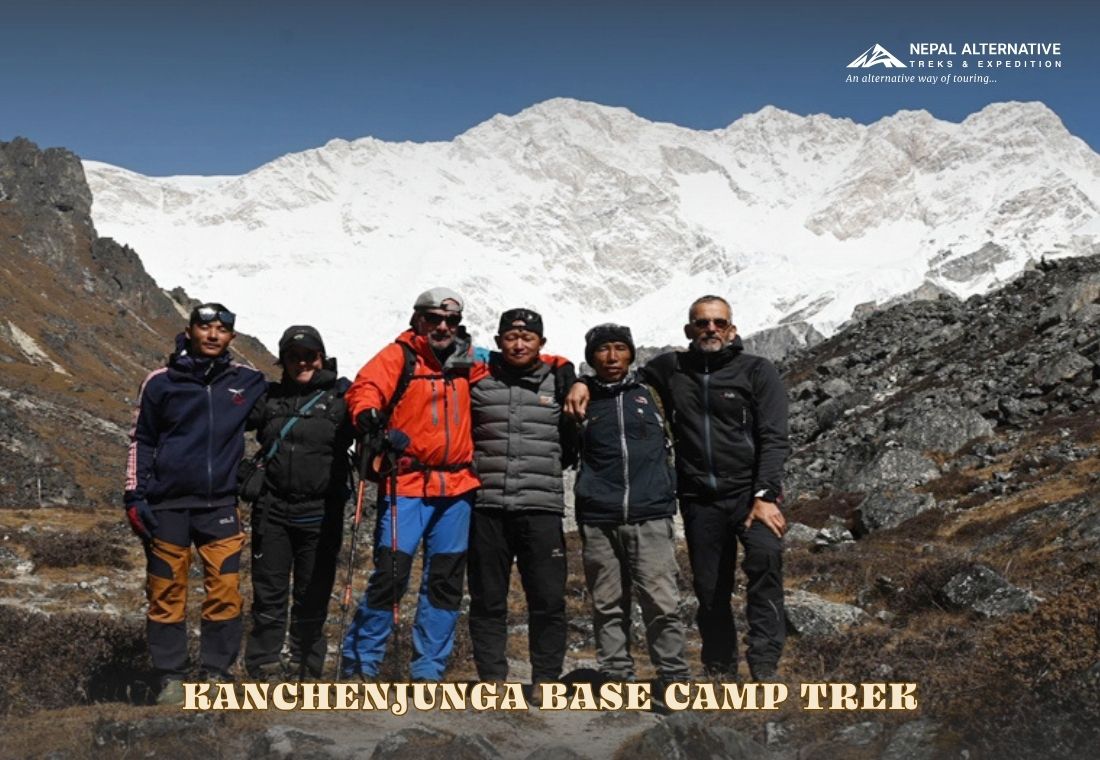
The Kanchenjunga North Base Camp trek is an off-the-beaten-path journey in eastern Nepal, taking you to the base of the North Face of the third-highest mountain in the world, Mt. Kanchenjunga (8,586 m). It is a challenging yet rewarding trek that takes you from majestic Himalaya mountains to sub-tropical landscapes, rhododendron and pine forests, and glacier landscapes. Surrounded by towering cliffs and pristine natural beauty, the trek is ideal for those seeking to escape the crowds and immerse themselves in pure and untouched nature.
The North Kanchenjunga Trek takes 13 days to complete and begins with a flight from Kathmandu to Bhadrapur. It is a strenuous trek that requires a high level of fitness, mental preparedness, and an effective acclimatization plan. Similarly, the Kanchenjunga North Base Camp Trek distance is 220 km (depending on trek route), with an average daily distance of 10 km. Moreover, the trek takes place within the Kanchenjunga Conservation Area, a protected area that is home to rare flora and fauna, adding to the trek’s beauty.
Mountain Views Along the Pangpema Base Camp Trek
What motivates you to complete such challenging treks, even when you’re tired and feel like giving up? It’s none other than stunning mountain views that accompany you throughout the trek. Different mountain views are visible from various points, adding to the thrill of the journey and encouraging you to reach your destination for a more exceptional and up-close view. One of the significant highlights and views of the journey is Mount Kanchenjunga (8,586 m), and without a doubt, Pangpema (North Base Camp) is the best viewpoint for its sight.
Mount Jannu (Kumbhakarna), at 7,710 m, is another beautiful mountain visible during the trek, and Ghunsa and Lhonak villages offer their most stunning sights. Yalung Kang, also known as Kanchenjunga West (8,505 m), is seen from Ramche during the South Base Camp segment. Additionally, Kabru North (7,338 m), Kabru South (7,318m), Rathong (6,678 m), Nepal Peak (7,177 m), and Twins Peak (7,350 m) are mesmerizing during the trek to Kanchenjunga North Base Camp.
Key Experiences That Make Kanchenjunga Trek Memorable
Get an eye-appalling close-up view of Kanchenjunga’s north face with ice cliffs.
You’ll walk for days in less crowded sections, providing a sense of isolation, peace, and raw exploration.
Stay in stone-roofed villages like Ghunsa and learn about the local culture of ancient Tibetan Buddhism.
Stay overnight in authentic lodges, where you’ll experience the raw trekking culture and exceptional hospitality.
Walk through a varied landscape of Kanchenjunga Conservation Area, from forest to glacial valleys, providing you with an experience through different climatic zones.
You’ll witness stunning glaciers, including Kanchenjunga Glacier, Yalung Glacier, and Tseram.
Get away from the chaos of city life, listening only to the sound of river winds, yak bells, birds chirping, and your boots.
Sport lesser-known peaks like Jannu, Kirat Chuli, and Wedge Peak.
Pass through the numerous chortens, mani walls, and ancient gompas, adding the cultural charm and spiritual experience of the trek.
You’ll be awed by the mesmerizing view of the sunrise, where the first ray of the rising sun scatters into the world’s third-highest mountain peaks along with other surrounding peaks.
Kanchenjunga North Base Camp Trek Itinerary
Day 1
Fly to Bhadrapur and drive to Taplejung (1,820 m/ 5,971 ft)
Day 1 Facts
Accommodation
Mountain Hotel or similar category
Altitude
1820m. | 5971ft.
Included meals
Dinner
The journey to Kanchenjunga North Base Camp begins with a flight to Bhadrapur,a southeastern lowland town that serves as the air gateway for treks into eastern Nepal. The flight to Bhadrapur takes 45 minutes from Kathmandu and offers aerial views of lush hills, rivers, and the Himalayan range. Upon landing at Bhadrapur Airport, you’ll take a short break and then continue your drive to Taplejung, an official entry point of the Kanchenjunga Base Camp Trek. The drive from Bhadrapur to Taplejung takes approximately 8 to 10 hours, depending on the road conditions and weather.
Additionally, the road passes through the picturesque towns of Birtamod, Illam, and Phidim before reaching Taplejung. The road is winding and rough, but it’s worth it for the breathtaking views of Nepal’s natural scenery and rural life. Upon arriving in Taplejung, you’ll meet your guide and porter. Your overnight stay and dinner are at the lodge in Taplejung.
Day 2
Drive to Sekathum (1,650 m/ 5,413 ft)
Day 2 Facts
Trekking Time Average
120km (06 hours drive)
Accommodation
Lodge in Sekathum
Altitude
1650m. | 5413ft.
Included meals
Breakfast, Lunch, Dinner
Have your first-morning meal at Taplejung and get ready for the drive to Sekathum. The journey begins on a black-topped road from Taplejung to Suketar or Ranipul/Tapethok. Near Ranipul/Tapethok, there is a Kanchenjunga Conservation Area permit entry point where you must check in your permit. From there, the road turned into a bumpy and dusty route. The road winds along ridges, offering stunning views of the Tamor and Ghunsa River Valleys. Within 6 hours of driving from Taplejung, you’ll get to Sekathum, covering a distance of 39 km.
Day 3
Trek to Amjilosa (2,498 m/ 8,195 ft.)
Day 3 Facts
Trekking Time Average
14km (06 hours walk)
Accommodation
Chiring Kpa Hotel or similar category
Altitude
2498m. | 8195ft.
Included meals
Breakfast, Lunch, Dinner
The official trek to Kanchenjunga North Base Camp begins from Sekathum. After finishing your breakfast at the lodge where you stayed overnight last night, you’ll start your trek. As the trek begins, you’ll cross the Ghunsa Khola via a suspension bridge and enter the lush rhododendron, oak, and bamboo forests. The route is steep and winding, with glimpses of waterfalls, Grey langurs, and occasionally musk deer. After an uphill trek, you’ll reach Amjilosa, which takes 5-6 hours from Sekathum, covering a distance of 9 km. You’ll stay and have dinner at the lodge of Amjilosa on this day.
Day 4
Trek to Gyabla (2,725 m/ 8,940 ft)
Day 4 Facts
Trekking Time Average
10km (04 hours walk)
Accommodation
Hotel Shingi Namzong or similar category
Altitude
2725m. | 8940ft.
Included meals
Breakfast, Lunch, Dinner
Day four begins with a warm breakfast at Amjilosa and packing your backpack for another adventure. Leaving Amjilosa behind, the pathway follows the Ghunsa Khola, winding through dense forests. Along the way, you’ll cross several suspension bridges and pass waterfalls. The route gently gains altitude as it gets closer to Gyabla. A 4-5 hour trek from Amjilosa takes you to Gyabla, covering a distance of 7 km. Your overnight stay and dinner are at the Hotel Shingi Namzong or a similar category lodge.
Day 5
Trek to Ghunsa (3,415 m/ 11,204 ft)
Day 5 Facts
Trekking Time Average
10km (05 hours walk)
Accommodation
Zhonga Family Guest house or similar category
Altitude
3415m. | 11204ft.
Included meals
Breakfast, Lunch, Dinner
Today’s trek begins after breakfast in Gyabla with a gentle ascent through oak, rhododendron, juniper, and dwarf conifer forests. Similarly, you’ll cross the Ghunsa Khola via wooden suspension bridges. In the middle of the trek, you’ll pass through Phale, a Tibetan refugee village with mani walls and prayer flags. There, you’ll rest and have lunch. After lunch, you’ll resume your walk, following a steeper yet steady climb alongside the river. After about 5 hours of trek from Gyabla village, you’ll get to Ghunsa, your overnight and dinner point.
Day 6
Trek to Khambachhen (4,145 m/13,599 ft)
Day 6 Facts
Trekking Time Average
10km (06 hours walk)
Accommodation
Kanchanjunga White House or Hotel Shingi Namjong
Altitude
4145m. | 13599ft.
Included meals
Breakfast, Lunch, Dinner
Some trekkers choose Ghunsa for their acclimatization and stay one more night in the village. However, we’ll head towards Khambachen after breakfast at Ghunsa. The journey begins on the south bank of Ghunsa Khola, passing through pine and rhododendron forests and featuring mani walls. After one to one and a half hours of trek, you’ll cross Rampuk Kharka via a suspension bridge. The view of Mount Jannu, Temachungi, Pholesobi Thongje, and others will accompany you on your way. It takes 5-6 hours to get to Khambachhen from Ghunsa, covering a distance of 10 km. Overnight and dinner at Khambachhen’s Kanchanjunga White House or Hotel Shingi Namjong.
Day 7
Acclimatization
Day 7 Facts
Trekking Time Average
Depends
Accommodation
Kanchanjunga White House or Hotel Shingi Namjong
Altitude
4145m. | 13599ft.
Included meals
Breakfast, Lunch, Dinner
After a week of trekking at high altitude, you need rest, and your body must adapt to the changed temperature. Thus, day seven is your acclimatization day at Khambachhen. On this day, you will not stay idle; instead, you’ll go for a day hike and follow the rule of “trek high, sleep low”. Most trekkers prefer to visit the Jannu viewpoint on this day, located at 4,449m, which takes approximately 4 hours for a round trip. The viewpoint is famous for offering a stunning north face view of Jannu and the glacier Moraine.
Furthermore, the Nupchu viewpoint at 4,952m is another option for a day hike that takes 5 hours round-trip and lies west of the Khambachhen village. Whichever viewpoint you choose, you’ll return to Khambachhen for your overnight stay and dinner.
Day 8
Trek to Lhonak (4,792 m/ 15,721 ft)
Day 8 Facts
Trekking Time Average
10km (05 hours walk)
Accommodation
Lhonak Guest House or similar category
Altitude
4792m. | 15721ft.
Included meals
Breakfast, Lunch, Dinner
Day eight takes you close to your final destination. After breakfast at Kambachhen, the trek begins gently, crossing alpine meadows and past shepherd’s huts at Ramtang. As we get to the village, the view of Mount Kanchenjunga, Ramtang, Gimmigela, and others will encourage you to trek further. However, as we move forward, the pathways become rocky, so proper caution is recommended. The route involves ascending along the lateral moraines of Kanchenjunga Glacier. A 4-5 hour trek from Kambachhen takes you to Lhonak, covering a distance of 10 km. Your overnight stay and dinner are at the Lhonak Guest House or a Similar category.
Day 9
Day hike to Kanchanjung North Base Camp (5,143 m / 16,873 ft) – Retrace to Lhonak
Day 9 Facts
Trekking Time Average
9km (06 hours walk)
Accommodation
Lhonak Guest House or similar category
Altitude
4792m. | 15721ft.
Included meals
Breakfast, Lunch, Dinner
Day nine is your most-awaited day for which you have trekked this long. The day begins early to avoid afternoon weather and experience a mesmerizing sunrise. The route gently ascends along the glacial terrain as you start your walk. It involves passing through rocky moraine fields, offering a clear view of the Kanchenjunga Glacier and the north face of the mountain. A 2-3 hours trek from Lhonak takes you to the Pangpema (5,140 m) north base camp of the world’s third-highest mountain peak, Mount Kanchenjunga.
As you get to the base camp, you’ll feel a sense of accomplishment. Marked by a prayer flag and a jaw-dropping setting that overlooks a 360-degree view of Wedge Peak, the North Face of Kanchenjunga, Nepal Peak, Cross Peak, and the twin summits of Gimmigela Chuli, the location is indeed worthy of an 8-day trek. Enjoy the sunrise and the surrounding area, take the time to soak in the beauty, and take pride in yourself. After a while, you should return to Lhonak for your overnight stay. It takes 6-7 hours, round trip, from Lhonak to Kanchenjunga Base Camp and then back to Lhonak.
Day 10
Retrace to Ghunsa
Day 10 Facts
Trekking Time Average
21km (08 hours walk)
Accommodation
Zhonga Family Guest House or similar category
Altitude
3415m. | 11204ft.
Included meals
Breakfast, Lunch, Dinner
Good morning, Champion. You’ve successfully completed your journey, having reached your ultimate destination. Now what? It’s time to return. After your final breakfast in Lhonak, you’ll start retracing your steps. The route descends slowly through rocky moraines and open alpine meadows. The best part of this journey’s descent is the view of Mount Jannu, Kanchenjunga Glacier, and the high Himalayan ridges that will accompany you. You’ll have a break and lunch in Khambachen. Continuing the descent after lunch, you’ll reach today’s overnight point, Ghunsa. Additionally, it takes 7-8 hours to descend from Lhonak to Ghunsa.
Day 11
Trek to Amjilosa
Day 11 Facts
Trekking Time Average
22km (07 hours walk)
Accommodation
Chiring Kpa Hotel or similar category
Altitude
2498m. | 8195ft.
Included meals
Breakfast, Lunch, Dinner
Leaving Ghunsa after breakfast, the pathway begins by crossing the Ghunsa Khola and descending into pine and rhododendron forests. The route involves crossing several small wooden suspension bridges. Similarly, the walkway offers stunning scenery from waterfalls, streams, and towering cliffs. It takes about 6 hours to descend from Ghunsa to Amjilosa. Your overnight and dinner for the day are at the Amjilosa’s lodge.
Day 12 marks the final trekking day of the return journey of Kanchenjunga. After breakfast at Amjilosa, the trek begins with a descent through bamboo forests, rhododendrons, and mossy trees. Similarly, the route passes multiple suspension bridges over the Ghunsa and Tamor rivers, along with a view of river gorges and cascading waterfalls. After 4-5 hours of trek from Amjilosa, you’ll get to Sekathum, where you’ll have lunch, and from where you’ll take a ride to Taplejung. It is approximately a 6-hour drive from Sekathum to Taplejung, covering a distance of 39 km.
Day 13
Drive to Bhadrapur – flight to Kathmandu
Day 13 Facts
Trekking Time Average
8-9 hours drive to Bhadrapur and 45 minutes flight to Kathmandu
Accommodation
Hotel in Kathmandu
Altitude
1400 m.
Included meals
Breakfast, Lunch
After completing the adventurous Kanchenjunga trek and reaching Taplejung, the final section of the trip involves a drive to Bhadrapur and a flight back to Kathmandu. Having breakfast at Taplejung, you’ll drive towards Bhadrapur, which takes 8-9 hours. As you get to Bhadrapur, you’ll take a flight to Kathmandu, which is around 45 minutes. The day concludes with escorting you to your hotel from Kathmandu’s domestic airport. If you are tired, you can experience the nightlife of Thamel. Your overnight stay is at the hotel in Kathmandu.
What’s Included
Tribhuwan International Airport Pick Up and Transfer to Hotel in Kathmandu .
All meals during the trekking (Breakfast, Lunch, Dinner).
Lodge accommodation ( Twin share basis) during the trekking.
One highly experienced, first aid trained, fluent English speaking, friendly and government authorized trekking guide
1 Porter per 2 Trekkers and keep luggage weight under 10kg per person.
Guide/ Porter’s food, accommodation, salary, insurance, transportation and equipments.
Kanchenjunga special permit and Kanchenjunga Conservation.
Oxygen saturation check up everyday, water purification, A trekking map, first aid medical, company t-shirt, trekking completion certificate etc.
Overland transportation as per mentioned in itinerary.
Kathmandu- Bhadrapur – Kathmandu by flight.
Assistance for emergency rescue evacuation.
Government tax and service charge.
Public Liability Insurance.
What’s Not Included
Hotel accommodation and meals in Kathmandu
Hard and soft table drinks such as tea/coffee, coke, fanta, mineral water, alchoholic drinks, laundry, phone bill, boilled water, battery charge, desert, hot shower etc.
Personal Travel insurance.
International Flight Ticket.
Nepal Tourist Visa
Tips for guide and porters.( Highly suggested).
Add-ons and Options
For the Kanchenjunga North Base Camp Trek, add-ons allow you to shape how supported and comfortable this remote eastern route feels. They help with load-carrying, cold-weather readiness, and building in some lighter experiences around Kathmandu on either side of the expedition.
As you reserve your Kanchenjunga North Base Camp Trek, you’ll add these services within the same booking journey. Click “Book the Trip”, choose your departure date, and once you reach checkout, scroll to the add-ons section. There, you can choose porters, rental gear, hotels, rafting, city tour, and bungee options, and scale up quantities for your group before completing the booking.
Personal Porter Service (USD 325 per porter): Hire a personal porter to carry your main bag so you can focus on the trail and views with only a light daypack.
Trek Gear Rental (sleeping bag USD 13, jacket USD 13, walking poles USD 13, crampons/spikes USD 13): Rent a sleeping bag, warm jacket, a pair of walking poles, and a pair of crampons/spikes so you’re well equipped for cool, unpredictable weather on Kanchenjunga’s northern side.
Spa Massage in Kathmandu (USD 50 per person for 90 minutes): Add a 90-minute massage in Kathmandu after the trek to ease accumulated fatigue.
Hotel Accommodation in Kathmandu (USD 50 per night for double/twin share with breakfast): Add hotel nights in Kathmandu with breakfast included before or after your Kanchenjunga trek.
Rafting at Trishuli River (USD 45 per person): Include a Trishuli rafting trip to enjoy some fun white-water and river scenery as part of your overall visit.
Kathmandu City Tour (USD 30 per person): Join a guided city tour to see Kathmandu’s important temples, heritage squares, and markets as a cultural contrast to the remote trek.
Bungee Jumping in Bhotekoshi (USD 100 per person): Add a Bhotekoshi bungee jump for a short, high-adrenaline experience alongside your trekking holiday.
Everest Flight 1 Hour (USD 300 per person): Take a 1-hour flight with views of Everest, Makalu, and other eastern Himalayan peaks, with private airport pick-up and drop-off in Kathmandu. The experience is all in the air and does not include landing.
Weather Chart for Kanchenjunga North Base Camp Trek
Our scheduled group tours offer fixed departure dates, providing an excellent opportunity for travelers to join our small group trips.
Note : Our fixed group departure dates, services and price is guaranteed even if the group numbers are 1 person to maximum 18 persons. We will provide a guide cum porter if there is only 1 person to operate the trek and one more assistant guide if group size is above 10 persons. And of course, guide cum porter will carry 10 kg luggage
Every journey we create is uniquely tailored to you. Share your interests and passions, and our travel experts will design an unforgettable adventure filled with extraordinary, one-of-a-kind experiences crafted just for you.
A 13 day trek to the north basecamp of Kangchenjunga. A remote corner of Nepal, but surprisingly smoothly organized with an experienced guide & porters. Excellent lodges, stay & food. Wonderful trail. Right at the feet of the third highest mountain of the world.
Places you will pass through on the Kanchenjunga North Base Camp Trek
Taplejung
At an elevation of 1,820 m/ 5,971 ft, Taplejung a district hub or staging point before you begin trekking to the Kanchenjunga North Base Camp. The town lies close to the border with Sikkim, India, and serves as the gateway to the trek. The village is beautiful and has several attractions, including the Kanchenjunga Conservation Area, Phurumbu Danda, and the Phurumbu Monastery. Similarly, the town offers a view of stunning terraced fields and distant hills. Additionally, the village serves as an overnight stop and is accessible via an 8-to 10-hour drive from Bhadrapur.
Sekathum
Located at an elevation of 1,650 m (5,413 ft), Sekathum is a small riverside settlement along the Ghunsa Khola, near the villages of Lelep and Lungthung. The official trek to Kanchenjunga North Base Camp begins from the town, involving several suspension bridges and entering the deeper parts of the Kanchenjunga Conservation Area. Moreover, the village has few teahouses and offers basic food and shelter.
Amjilosa
Amjilosa is a peaceful settlement situated at an elevation of 2,498 m (8,195 ft). It is the first destination you’ll reach after walking for several hours, offering a taste of Himalayan adventure. The village is small, with limited accommodation options, operated by Tibetan-descended locals. A thick rhododendron and bamboo forest surrounds the village, creating a mystical atmosphere. It is also an ideal place to observe the transition from subtropical forests to higher alpine vegetation.
Gyabla
Gyabla, at 2,725 m (8,940 ft), is a scenic village surrounded by dense forest. Tibetan culture has a significant influence on the village, and locals in the area wear traditional dresses. The village’s life is simple, making it one of the unique settlements with culture and tradition. Gyabla is also a location where trekkers can feel the effects of increasing altitude. It’s a peaceful environment, combined with cultural beauty, that makes it a memorable village along the trek to Kanchenjunga North Base Camp.
Ghunsa
At an altitude of 3,415 m (11,204 ft), Ghunsa is a small settlement in the Kanchenjunga region. It is a charming Sherpa settlement with wooden houses, chortens, and monasteries. Pine forests and snow-capped peaks surround the village, making it a popular place for an overnight stay along the trek to Pangpema Base Camp. The Ghunsa River runs beside the village, and yak grazing can be seen nearby. Some trekkers also choose the destination for an acclimatization point and spend an extra night here.
Khambachhen
Khambachhen is situated at an elevation of 4,145 m (13,599 ft), offering majestic views of towering peaks. The village’s landscape is truly stunning, featuring alpine meadows, rocky slopes, and glacial streams. This is another common place for an acclimatization point before heading to a higher elevation of the journey. Those who skip acclimatization at Ghunsa stay at Khambachhen for acclimatization. Near the village, there are several viewpoints, making it ideal for a day hike on acclimatization day.
Lhonak
Lhonak, at 4,792 m (15,721 ft), is a remote and high-altitude seasonal outpost near the Kanchenjunga Glacier. It is the last location trekkers spend before reaching the ultimate destination, Kanchenjunga North Base Camp. Barren hills, glacial moraines, and mountain peaks surround the village, making it feel like heaven. However, the thin air makes the location quite challenging for trekkers.
What makes the Kanchenjunga North Base Camp Trek difficult?
The Kanchenjunga North Base Camp trek is one of the most challenging journeys in Nepal’s Himalayas. What makes the trek difficult is its combination of factors that demand trekkers’ endurance, adaptability, physical conditioning, and high altitude. Here is a brief of what makes the trek difficult:
Remoteness
One of the challenges of the Kanchenjunga North Base Camp Trek is its remoteness. Unlike popular routes like Annapurna Base Camp or EBC, this trek’s route passes through less populated villages with minimal access to roads, communication, and amenities. Due to its remoteness, trekkers must be self-reliant, mentally prepared, and conduct careful planning. Similarly, there are no medical shops, so even when trekkers get injured, they will not receive immediate treatment, which adds to the trek’s difficulty.
Long Distance
The Kanchenjunga North Base Camp Trek is one of the longest distance treks, covering an approximate distance of 220 km. Thus, the long distance, combined with longer trekking days and hours, makes the trek physically exhausting, adding to the challenges of the trek. Additionally, trekkers must walk for 6-7 hours and cover a distance of at least 10 km each day, traversing uneven and rough terrain. Moreover, the long duration of the journey tests your consistency, patience, and ability to deal with day after day, for which you must be prepared.
High Altitude
Another factor that adds to the difficulty of the trek is High Altitude. The trek reaches a high elevation up to 5,143 m at Pangpema (North Base Camp). High altitude means thinner air, which reduces the oxygen level and increases the risk of Acute Mountain Sickness (AMS). However, the risk of altitude sickness is a concern as you begin trekking above 2,500 m. Thus, we recommend that trekkers acclimatize properly, stay hydrated, eat light food, ascend slowly, avoid alcohol and caffeine, and be aware of altitude sickness.
Harsh Weather
The weather in the Himalayas, including the North Kanchenjunga Base Camp trek, can change rapidly, especially above 3,500 m. Even in ideal trekking conditions, such as spring and Autumn, nights can fall below -10°C. The unpredictable thick fog, icy winds, and rain can affect the overall trek. Similarly, the harsh weather conditions increase the risk of delays, fatigue, and hypothermia. As the Kanchenjunga region has fewer shelters and emergency points, trekkers must be equipped with proper gear to prepare for unpredictable weather conditions.
Physical and Mental Challenges
The trek to Kanchenjunga demands a high level of physical fitness and mental strength. Long hours of daily trekking on tough sections at high altitudes, where breathing becomes difficult and exhaustion, even for an experienced trekker, is not easy. Thus, trekkers must be in excellent physical condition for this trek. Still, physical strength alone isn’t enough, and mental tolerance is equally essential. Trekkers may feel homesick, anxious, or even frustrated. So, staying motivated, disciplined, and mentally strong is key to completing this challenging adventure successfully.
What to Expect on This Offbeat Route to Kanchenjunga North Base Camp?
Quiet and Peaceful Routes
Unlike other popular trek routes in Nepal’s Himalayas, the Kanchenjunga route is quiet and peaceful. Thus, you can expect to walk in a quiet section where you’ll walk for hours but see not many trekkers. This makes the journey feel very special and personal. Instead of hearing the sound of people, you’ll listen to birds, rivers, and the wind, making it perfect for people who enjoy nature. Additionally, the peacefulness of the route allows you time to relax, reconnect with yourself, and appreciate the beauty of the surroundings without disturbance.
Village Life
On the North Kanchenjunga Trek, you can expect to pass through small and remote villages like Sekathum, Amjilosa, and Ghunsa. The people here are kind and live simple lives. The communities belong to Sherpa, Limbu, or Tibetan Communities, providing you with a chance to experience diverse cultures and traditions. Similarly, you can expect to see traditional wooden houses and people farming (in the lower region) and enjoying their lives. Thus, it will be your great chance to experience the real Nepal, far from cities and modern life.
Untouched Nature
On the trek to Kanchenjunga North, you can expect to trek through untouched nature. You’ll walk through the forest, river, and mountains, which are all untouched and raw. Similarly, there is also a chance to see wild animals like yaks and blue sheep. The air on the route is pure, and the views are clean. Thus, expect to feel like walking in a natural paradise where very few people have been.
Mountain Views and Sunrise
One of the obvious things you can expect while you’re on a trek to North Kanchenjunga is the view of snow-capped peaks. The sight of mountains is impressive as you climb higher. You’ll get a close-up view of the Kanchenjunga massif on this journey. Similarly, you can expect to see other peaks like Jannu, Nepal Peak, and Yalung Kang along your route. Another attractive sight you can expect to get on this trek is witnessing sunrise every day over mountain peaks, where the snow on the peaks turns gold and pink.
Diverse Terrain
The trek passes through various types of terrain, so you can expect to walk through different landscapes throughout the journey. At the beginning, the route passes through lush green hills and forests featuring bamboo and rhododendrons. As you continue trekking further, the trees become fewer, and the landscape turns rocky. Similarly, expect to walk along rivers, cross wooden suspension bridges, and pass through narrow paths. However, the diverse terrain keeps you excited and motivates you to trek higher.
What Makes the Kanchenjunga North Trek Different from the Kanchenjunga Circuit and South?
Kanchenjunga North Base Camp Vs. Kanchenjunga South Base Camp Trek
Feature
North Base Camp Trek
South Base Camp Trek
Final Destination
Pangpema (5,140 m)
Oktang (4,730 m)
Mountain Views
Close-up view of Mount Kanchenjunga’s North Face
Wide view of the Kanchenjunga massif and nearby peaks
Landscape
Rocky, alpine, glaciers, high altitude
Green hills, forests, rivers, and glacier zones
Local Culture
Sherpa and Tibetan Buddhist
Limbu and Rai
Duration
13-15 days
12-14 days
Trek Difficulty
Challenging
Moderate to Challenging
Popularity
Less crowded
Very quite
Connectivity
Relatively better with satellite phones in Ghunsa
Limited connectivity due to a more remote location
Acclimatization Stops
Ghunsa/ Kambachhen
Cheram
Kanchenjunga North Trek Vs. Kanchenjunga Circuit Trek
Feature
North Base Camp Trek
Circuit Trek
Route
Taplejung ti Pangpema and return the same way
Loop covering both the North and South Base Camp
Pass along the Trek
None
Sele La Pass (4,290m)
Duration
13-15 days
21-25 days
Route Variety
Alpine terrain and glaciers
Forests, passes, glaciers, and hill villages
Difficulty Level
Challenging
Strenuous
Remoteness
Remote but more established route
Extremely remote, especially the section between Sele La and Cheram
What People Ask About
Kanchenjunga North Base Camp Trek
Is the Kanchenjunga North Base Camp harder than the Annapurna Circuit or Everest Base Camp treks?
Yes, the Kanchenjunga North Base Camp trek is generally more challenging than both the Annapurna Circuit and the Everest Base Camp treks. The combination of high altitude, remote location, more rugged terrain, and longer duration makes it harder than the Annapurna Circuit and Everest Base Camp treks.
How do I deal with permits and checkpoints in such a restricted area of Kanchenjunga?
To deal with permits and checkpoints in the Kanchenjunga restricted area, you must arrange a trek through a licensed trekking agency. Your trekking agency will handle the permit application process on your behalf. The required permits for the Kanchenjunga North Trek are the Kanchenjunga Conservation Area Permit (KCAP) and a Restricted Area Permit (RAP).
Can I charge my phone or camera anywhere on this trek?
Yes, you can charge your phone or camera on the Kanchenjunga North Base Camp Trek, but not everywhere. Many teahouses have electricity facilities powered by hydropower or solar energy, but charge extra for charging your phone. Charging is usually available in Ghunsa, Khambachen, and occasionally in Amjilosa, but not guaranteed in Lhonak and Pangpema.
How long is the walk to Kanchenjunga North Base Camp, and how many hours will I be trekking daily?
The trek to Kanchenjunga North Base Camp typically takes 13 days to complete (including only trekking days), involving daily walks of 5-7 hours. However, the itinerary is customizable and can be tailored to meet the preferences of trekkers and their individual needs for acclimatization.
Can I do this trek in Winter and summer, or is spring and autumn the only good seasons for it?
While trekking to Kanchenjunga is possible during both Winter and summer, it comes with significant risks. Trekking to such adventurous treks and in the off-season might be the biggest mistake. Thus, we recommend trekking during the spring and autumn seasons, which are the ideal times for trekking in the Himalayas.
Need assistance? Our travel expert Tej Bahadur Gurung is here to help! Please fill out the form below to initiate a chat and get your queries resolved quickly.

 India5.0 /5