Most trekkers imagine Upper Mustang as a relaxed walk through desert terrain, and honestly, I thought the same until I laced up my boots and crossed the checkpoint at Kagbeni. Let me tell you, the landscape is as beautiful as the photos make it look. But the challenge of the trek? That’s a whole different story.
If you’ve been looking for an honest breakdown of how difficult the Upper Mustang trek actually is, you’re in the right place. In this guide, we’ll talk about the full experience from landscape to altitude, and the wind conditions. Similarly, this guide covers the kind of fitness you’ll need to finish the trek feeling accomplished rather than completely drained.
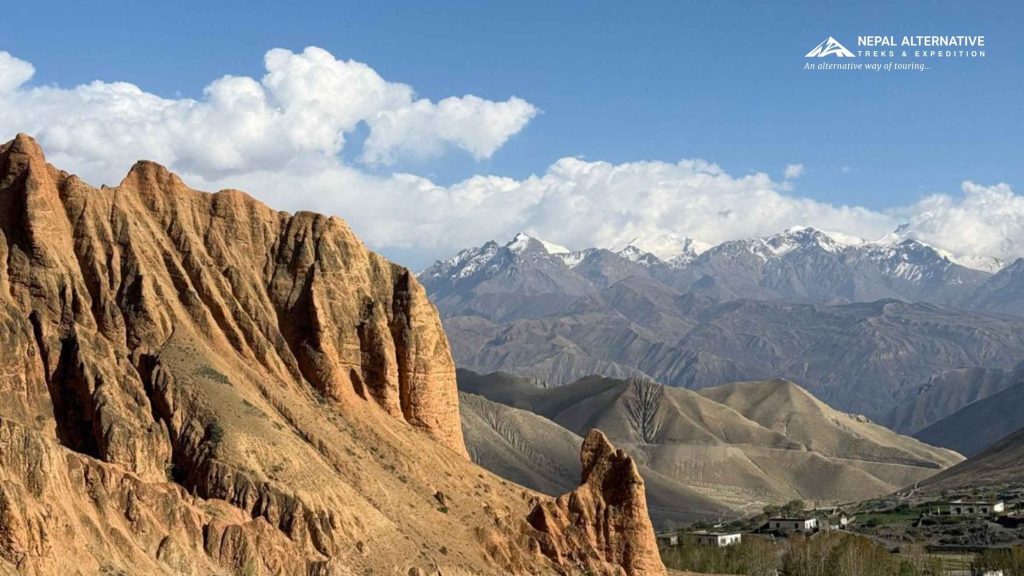
I still remember entering this restricted region for the first time after landing in Jomsom. The change in scenery was so sudden. The dense green hills disappeared, and everything around me was barren cliffs and rust-colored canyons. The air was crisp and dry, a warning that the higher I went, the more I’d experience it. Over the next couple of weeks, I trekked across windy plateaus, explored cave monasteries, and passed through ancient villages like Lo Manthang in the Upper Mustang region.
Most trekkers who have been to the adventure, and honestly, my own experience too, would rate the Upper Mustang trek as moderately difficult. It’s not as physically challenging as crossing technical high passes like Thorong La on the Annapurna Circuit. But it’s definitely more challenging than shorter treks due to long walking days, remote terrain, and dry, high-altitude conditions.
Different Upper Mustang Trek Variants & Their Difficulty Level
One of the things I love most about the trek to Upper Mustang is how flexible the experience can be. And this is something I wish someone had spelled out for me before I began my first journey to Upper Mustang. Whether you want a standard trek experience, a shorter version of the trip, an extended version with added destinations, or a luxury version, the Upper Mustang Trek itinerary offers all of these options.
Trek Variant
Duration
Difficulty
Maximum Altitude
Best Suited For
Standard Upper Mustang Trek
11 days
Moderate
3,840 m (Lo-Manthang)
Experienced or beginner trekkers who want to complete the trek within a short duration
Luxury Upper Mustang Trek
9 days
Easy-Comfortable
3,840 m (Lo-Manthang)
Those wanting comfort with adventure
Upper Mustang Alternative Trek
15 days
Strenuous
4,230 m (Chogo La)
Experienced trekker seeking an alternative route
Manaslu, Annapurna Circuit, and Upper Mustang Trek
33 days
Strenuous
5,416 m (Thorong La)
Experienced, high-altitude trekkers; serious athletes seeking a month-long challenge
Standard Upper Mustang Trek
This is the most popular and straightforward way to experience the beauty of the forbidden Kingdom of Mustang. You drive to Pokhara, fly into Jomsom, trek through Kagbeni, Chele, Syangboche, Ghami, Tsarang, and reach Lo Manthang, with an exploration day there before flying out. For me, the Standard Upper Mustang trek is moderate, taking 11 days to complete in dry conditions, with visits to ancient monasteries, cave dwellings, and living Tibetan Buddhist communities. Moreover, I’ve seen many first-time trekkers complete it successfully with good pacing and preparation.
Manaslu, Annapurna Circuit, and Upper Mustang Trek
This is a great Himalayan journey I did once, and it still remains one of the epic adventures of my life. I want to describe this trek’s difficulty carefully because “very hard” doesn’t fully explain it. This is a 33-day adventure across three regions, combining the Manaslu Circuit, the Annapurna Circuit, and Upper Mustang, with crossings of Larkya La Pass and Thorong La Pass.
Furthermore, the long duration, multiple high mountain passes, changing landscapes, from green subtropical forests to dry Tibetan-style plateaus, and weeks of continuous trekking are what made my Manaslu, Annapurna Circuit, and Upper Mustang Trek challenging. And yet I truly mean this, it is one of the most meaningful experiences I have ever had. Still, I suggest that only experienced trekkers with high-altitude experience consider this trek.
Upper Mustang Alternative Trek
If you’re like me, who enjoys peaceful routes away from the busy trails, this alternative Upper Mustang Trek is ideal for you. Along with taking the usual path, you explore hidden places like Chungsi Cave and remote villages such as Dakmar, Marang, Yara, and Dhee, and cross higher passes like Chogo La (4,230 m).
The journey takes 15 days round-trip, with 6-8 hours of walking and significant elevation gain. Moreover, I found this variant strenuous due to the added remoteness and physical effort, which makes it feel more adventurous yet satisfying. For this trek, previous high-altitude trekking experience is not just helpful, but it is necessary.
Luxury Upper Mustang Trek
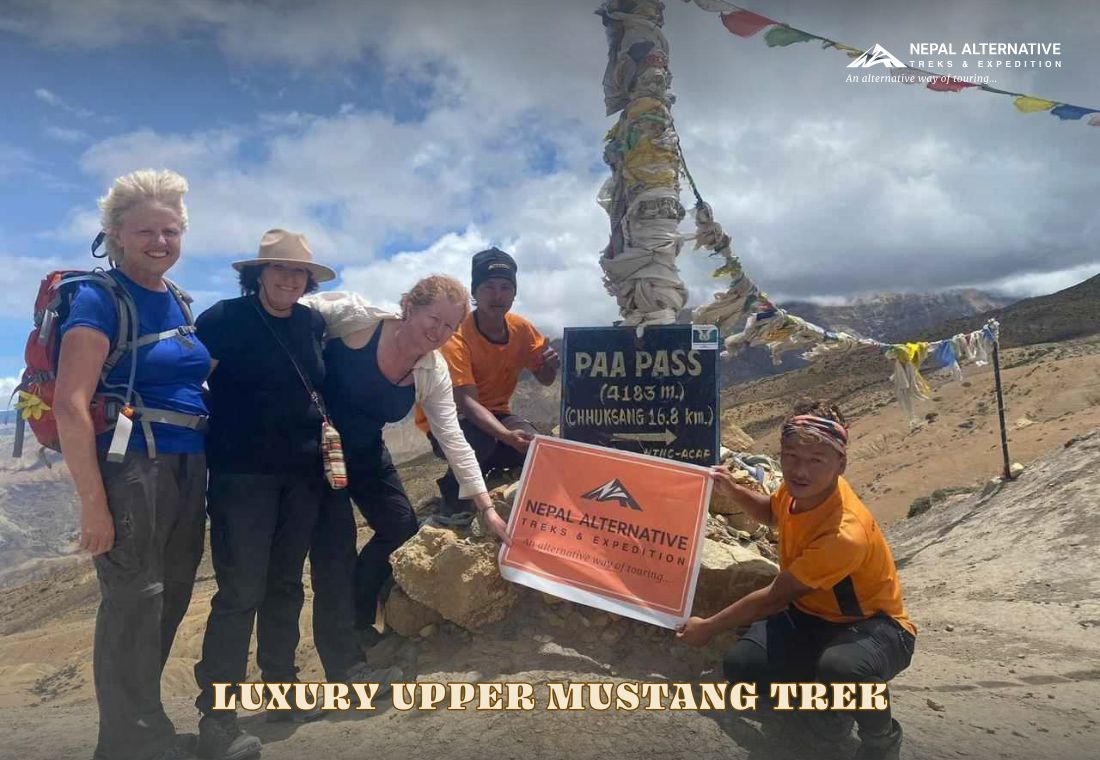
I’ll be honest, when I first heard the term “luxury trek,” I assumed a luxury trek would feel less adventurous. It sounded like an easier version of the real adventure. Like expecting the mountains to adjust to you. But after experiencing the Luxury Upper Mustang Trek, I realized it isn’t a lesser version of the experience.
Daily walking is similar to the standard route (around 5-6 hours), but everything feels lighter and more enjoyable. I rate the Luxury Upper Mustang Trek as easy to comfortable. This Upper Mustang tour is shortened to 9 days and includes helicopter rides and comfortable, high-end lodges, which, honestly, I didn’t expect to find in such a remote place.
Physically, it presents many of the same challenges; you still reach Lo Manthang at 3,840 m and deal with thin air, and still feel the strong winds. But I had my own porter to carry my backpack and a good place to sleep after long walking days.
Breathtaking part of the world A truly magnificent trek through a unique part of the world. The team at Nepal Alternative Treks were fantastic to deal with, nothing was a problem.
This is my second trekking with Nepal alternative as well as Mr. Kumar gurung. We have a great trip to Lo Manthang ! Enjoying the super scenery! I will come again soon for next trip and I will use same company for services. I also will recommend my friends if…
Incredible views and invaluable memories 10-Day Upper Mustang Trek: We decided to do this trek without a porter — and wow, it was tough at times. We are so grateful for our guide, Laxman, who continuously encouraged us, carried snacks for us, and was always a smiling face when we…
We made it to Lomanthang, upper mustang. It was fantastic and memorable. The service is excellent. We had good time even though this trekking is very tough. Again thanks for your service that make this trip so impressive.
Hot and slow We did the 10 days upper Mustang trek with our guide Laxman, who always had a snickers ready for us as soon as we felt tired during the trek. It was overall an amazing experience, which I'll never forget. Thanks to Nepal alternative trek.
I did a volunteering project in Nepal and got to know Tej Bahadur Gurung during an event with TAAN. He is the managing director of Nepal Alternative Treks and already helped other volunteers in the program to book their trekking. When my girlfriend arrived in Kathmandu, we met him to…
Factors That Contribute to Upper Mustang Trek Difficulty
After trekking through Upper Mustang multiple times, I can honestly say its difficulty doesn’t come from any single factor. Instead, it comes from a combination of challenges. The dry, high-desert landscape, the remoteness, and the daily effort make trekkers tired, which adds to the overall challenge of the Upper Mustang Trek. Below are the difficulty factors that I’ve personally experienced on the trail:
Upper Mustang Trail Conditions
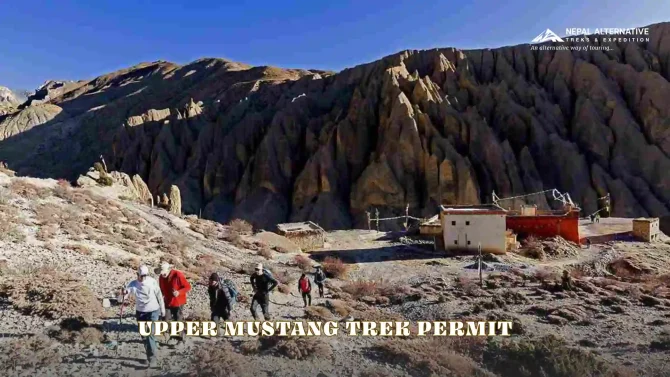
Before I went, I expected the Upper Mustang’s trail to be like the Annapurna Circuit, a well-marked route. But after trekking through the pathways, I found the route wasn’t easy. The terrain in Upper Mustang changes constantly, with a mix of rocky jeep roads, loose stone slopes, narrow paths along cliffs, and dry riverside routes where every step requires extra effort.
What makes the trek tougher is that all of the challenges happen when your body is already tired and at a higher altitude. Even the downhill walk feels challenging after hours of walking. Keeping your balance is very important up there. I twisted my ankle twice on loose stones, and both times on descents I thought were simple.
From my experience, the Upper Mustang trail is moderate most days, but the constant walking over hard, uneven, dusty terrain for 10+ days can leave your legs tired and your feet sore, so prepare carefully.
High Altitude
High altitude is the factor that ultimately affects everything else. I generally consider myself fit; I have trekked before, trained well, and am in good shape. But, altitude still hit me hard on some days. Not harshly, with no bad headaches or sickness, but a constant heaviness that made every step feel much harder than it looked, and poor sleep that left me waking up each morning already tired.
Altitude affects everyone differently, and no level of fitness makes you immune. I’ve seen marathon runners struggle at Ghami, and people in their sixties walk through Lo Manthang with no issues. What really matters is how well you acclimatize and how carefully you pay attention to your body. The main rule I followed to reduce the effects of altitude was simple: if you feel fine, continue walking at your pace; if you feel anything other than fine, stop and let your body adjust to the changing temperature.
Walking Hours Per Day
On the map, the daily distances in Upper Mustang look manageable, with an 8-10 km walk and 5-6 hours. But those numbers can be misleading, and I say that from experience. Remember that the same trek that takes others 5 hours can take you 7-8 hours. But that’s okay. Many trekkers compare their pace to others, but everyone adjusts to altitude differently. Just know that the mountains aren’t going anywhere; take your time walking, and let your body feel good before continuing the trek.
Weather & Seasonal Factors
More than anything, wind is the most challenging factor in Upper Mustang hiking. I wasn’t ready for it, and neither was anyone in my group when we first reached the open plateau north of Chele. By midday, the weather had become difficult. It wasn’t just a quick wind; it kept blowing strongly for a long time, slowing the walk and leaving me feeling more tired than usual. It often comes from the north in the afternoons during trekking season, and on open ridges and valleys, there’s nowhere to hide from it.
Temperature is another thing that adds to the difficulty of the trek. Days in Mustang can be warm, even hot, in the southern parts in late spring and early October, when the sun is strong, and there is little wind. Nights are very different. After sunset, it gets cold very quickly at high altitude, and in the early and late seasons (March-April and October-November), the cold at night can be quite bad. The best season for trekking is mid-March to May and September to early November. October is also the best time to trek Upper Mustang, with clear skies, steady weather, fresh air, and stunning views across the Upper Mustang Valley.
Having guided and trekked Upper Mustang with people of different fitness levels, I can tell you: this trek is beginner-friendly for those who prepare properly. More than athletic ability, the trek requires consistent training and a positive mindset.
Is Upper Mustang Suitable for Beginners?
Yes, the Upper Mustang Trek is suitable for beginners, but with the right preparation. The standard and luxury versions are achievable for beginners with a basic level of fitness, a good training plan, and a licensed trekking guide. Still, if you have never been involved in any walking, I recommend starting a fitness program for 2-3 months before the trek. The combination of altitude, dust, wind, and longer days can feel demanding after a week if you’re unprepared.
What Level of Fitness Does Upper Mustang Actually Demand?
One way to judge your fitness level is to be able to walk 5 to 7 hours on uneven, hilly trails for two days and see how your body reacts. If it feels tired but okay by the end without being completely exhausted, then the trek is suitable for you, and you are fit for the Upper Mustang Trek.
The main challenge in Upper Mustang is endurance. You need the stamina to keep walking for long hours and strong legs for both ascent and descent. Your core also helps more than most people expect, because it keeps you balanced while carrying a backpack on rough trails.
How Many Weeks Out Should You Start Training?
If I were advising someone who is moderately active, someone who walks regularly, goes to the gym sometimes, but hasn’t done much trekking recently, I’d suggest at least 8 weeks of proper preparation. Ten to twelve weeks would be even better. If you’re starting from a lower fitness level or haven’t exercised consistently for a while, aim for around 12 weeks before your trip to Upper Mustang. Also, your goal shouldn’t be to become an athlete but to build three things: better stamina, stronger legs and core, and the ability to stay comfortable walking for long hours in different landscapes.
Build Your Cardiovascular Base
The most important aspect of fitness for the Upper Mustang Trek is stamina, and you should build it slowly over weeks. For the first few weeks, focus on building a routine with 3-4 cardio sessions per week, each around 30-45 minutes. Walking, hiking, cycling, swimming, or running all help in the training. From the fourth week, start doing one longer session each week, around 60-90 minutes, either on hills or inclines. By weeks six to eight, aim for hikes for two hours or more and continue walking back-to-back days.
Strength Training
I underestimated strength training before my first trek and thought cardio was what mattered. But by day three in Mustang, my legs, especially my quads, proved me wrong. For strength training, squats, lunges, and step-ups are useful as they help to build strength for climbs and descents. Single-leg exercises are also important because trekking on uneven trails requires balance and stability. Additionally, calf raises help with long uphill walks, while core exercises like planks improve balance and reduce strain on your knees and back.
Every trek has certain sections that challenge you and where you feel like, “No, I can’t do it anymore, and should stop.” Upper Mustang has several moments like that, and I want to share the ones that truly challenged me, because knowing what to expect makes a big difference in your journey.
Chele to Syangboche (especially the climb to Taklam La and beyond)
This was the hardest day of the Upper Mustang Trek for me. The day involves crossing two high passes: Taklam La at around 3,624 m and Dajori La at approximately 3,735 meters above sea level. I clearly remember the climb to Dajori La. The trail was narrow, following the edge of a ridge, with a steep drop on one side. It was not very dangerous, but it needed full attention, especially because breathing was already difficult in the thin mountain air.
Some parts of the route had loose rocks that made walking harder. Strong winds blew across the open ridge, and I even had to stand wider to keep my balance. The weather was clear that day, so I can only imagine how difficult it would be during bad weather.
The way down to Syangboche was also tough. The trail was steep, rocky, and uneven due to erosion, and felt like walking down a rough stone-and-dirt staircase. My legs and knees became very tired from the long downhill walk. This part of the trek taught me how important acclimatization is. Many trekkers try to move too quickly after gaining altitude from Jomsom and Kagbeni without proper acclimatization. That can be a mistake.
Ghami to Tsarang
Tsarang is on a high plateau above Ghami, and the trail between these two places is harder than many trekkers expect. It is not the steepest climb of the trek, but by the time you walk between the villages, your legs are already very tired from many days of walking. The walk also gains altitude on a trail that zigzags along open canyon walls. The path is made of dirt and loose rocks, and the high altitude requires a slow walk even if you feel strong.
During this climb, I started counting my steps because it became so tiring. I would walk fifty steps, stop to breathe, and then walk fifty more. It was not because I was unfit, but because the steep climb and thin air simply made it difficult. Moreover, this part of the trek taught me an important lesson about pacing.
Exposed Trails Along the Kali Gandaki Gorge and Ridgelines
Some parts of the Upper Mustang trekking route are very narrow and built along the sides of huge cliffs above the Kali Gandaki Gorge, one of the world’s deepest gorges. Looking down can be scary because the drop is very steep, and the rocky path can be loose and uneven. So, walking carefully while watching every step is important during the section.
Tips to Successfully Complete Upper Mustang Trek
After multiple journeys through the Kingdom of Mustang, I would say the trek is moderately challenging but achievable for anyone with general fitness and proper preparation. The trek doesn’t involve extreme technical difficulty or super-high passes like some other treks in Nepal. Still, the combination of daily walking, high-altitude dryness, strong winds, and remote terrain makes the trek challenging. Ultimately, Upper Mustang is not just about physical strength. It is more about being ready to prepare well and adjust to its unique high-altitude desert environment.
Here are some honest, specific tips I wish someone had given me before I crossed that checkpoint at Kagbeni. Some of it is practical. Some of it is about mindset.
General Tips That Apply Every Single Day
Start walking slowly every morning
Don’t rush even if you feel fresh
Fast starts lead to exhaustion later in the day
Drink water regularly
Don’t wait until you feel thirsty
Drink at least 2 liters while hiking to Upper Mustang
Eat at every meal
Even if you don’t feel hungry, don’t skip your meals
Your body still needs energy at high altitude
Prefer light, high-energy foods like rice, noodles, dal bhat
Dress in layers
Weather conditions change quickly in Mustang
Keep a windproof layer easy to access
Use trekking poles
Helpful on steep downhill trekking trails
Protects knees and improves balance
Take photos in the morning
Morning light is clearer and better
Less dust and wind in the air
Sleep and rest early
Body recovers mostly at night
Even rest without sleep helps
Earplugs or an eye mask can help you sleep
Route-Specific Tips for the Harder Sections
Chele to Syangboche
Do not attempt this section without proper rest and a filling breakfast. The double pass crossing of Taklam La and Dajori La is one of the hardest parts of the route, and your body must adjust to high altitude before starting the section. Walk very slowly and steadily while trekking. Take short breaks every 20-30 minutes to rest and control your breathing. Pay close attention to signs of altitude sickness in yourself, such as headache, nausea, and extreme tiredness. If these symptoms appear, stop immediately and consider going back down.
Ghami to Tsarang
There is no shame in counting steps on the climb out of Ghami. I did it. On the ascent, take shorter, slower steps rather than long ones. Small, steady steps use less energy and help you breathe more easily. Before starting this walk, eat a proper, filling breakfast in Ghami. Your body needs enough energy for the long uphill walk, especially after being tired from the previous days.
Exposed Trails Along the Kali Gandaki Gorge and Ridgelines
Never walk narrow gorge or ridgeline trails with music in both ears. At least keep one ear free so you can hear the wind. Adjust your trekking poles before you enter narrow or exposed sections. On tight paths, make them slightly shorter so they don’t hit rocks or walls and throw you off balance. On windy days, pause before entering the narrowest ridges. Wait for a calm moment.
Laxman Gurung was Born in Ruby valley, Dhading and moved to Kathmandu 8 years back to begin a career in Tourism as a porter. Mr. Gurung worked hard and learned quickly to be upgraded and serve as a guide cum porter.
He conducted guide training and started to work as a trekking guide for 5 years with Nepal Alternative treks. Our clients who trekked with him reviewed positively as he is fluent English speaking, good knowledge of local culture, trail and mountain.
Let our local mountain experts craft a personalized itinerary around your schedule, fitness level, and travel goals — safe, authentic, and rooted in Nepal Alternative Treks’ trail experience.
Need assistance? Our travel expert Tej Bahadur Gurung is here to help! Please fill out the form below to initiate a chat and get your queries resolved quickly.




 Sydney, Australia5.0 /5
 Malaysia5.0 /5