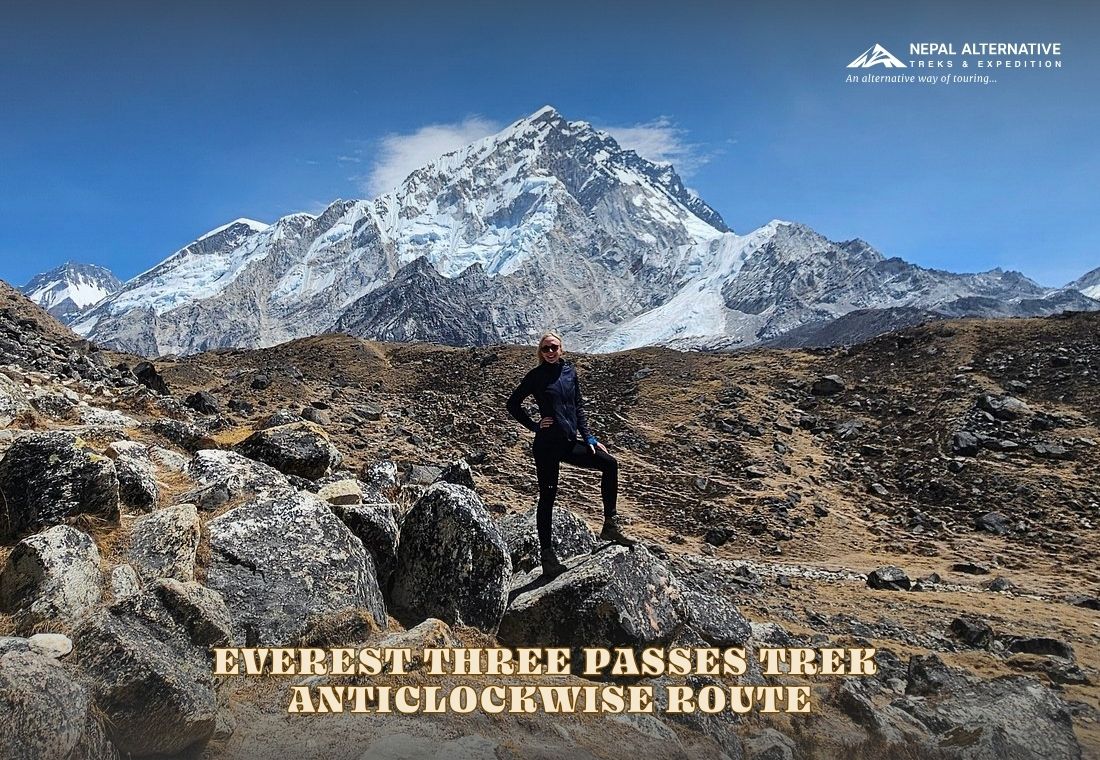
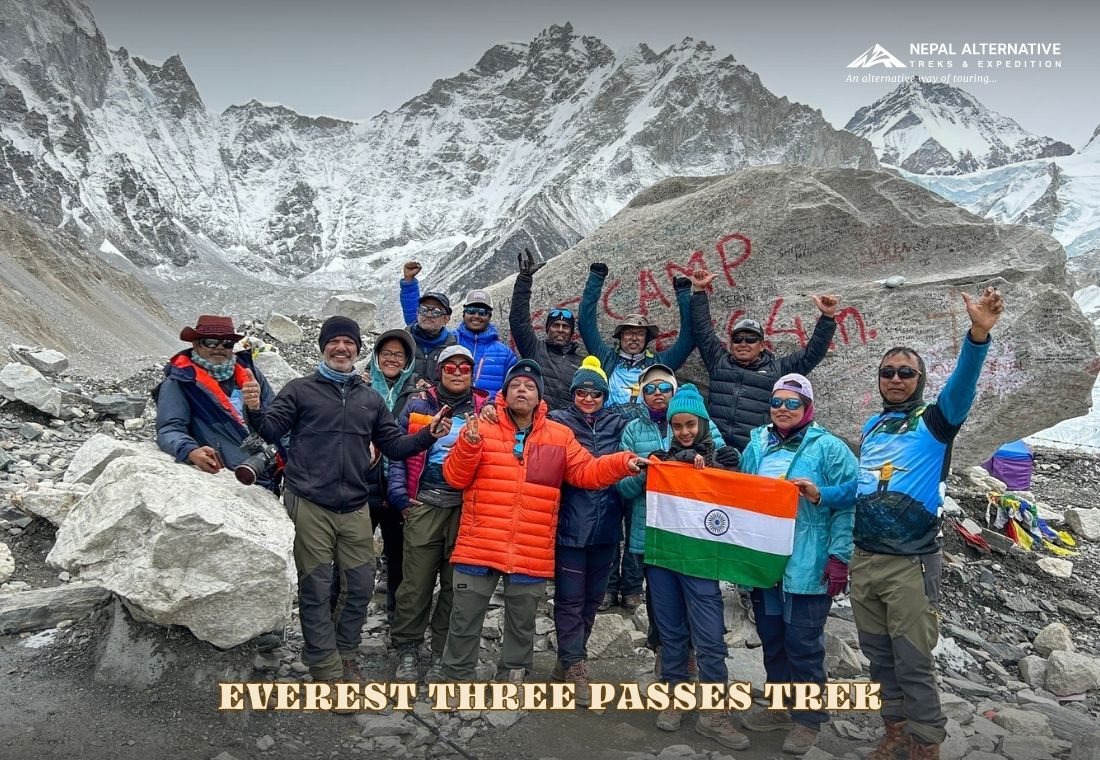
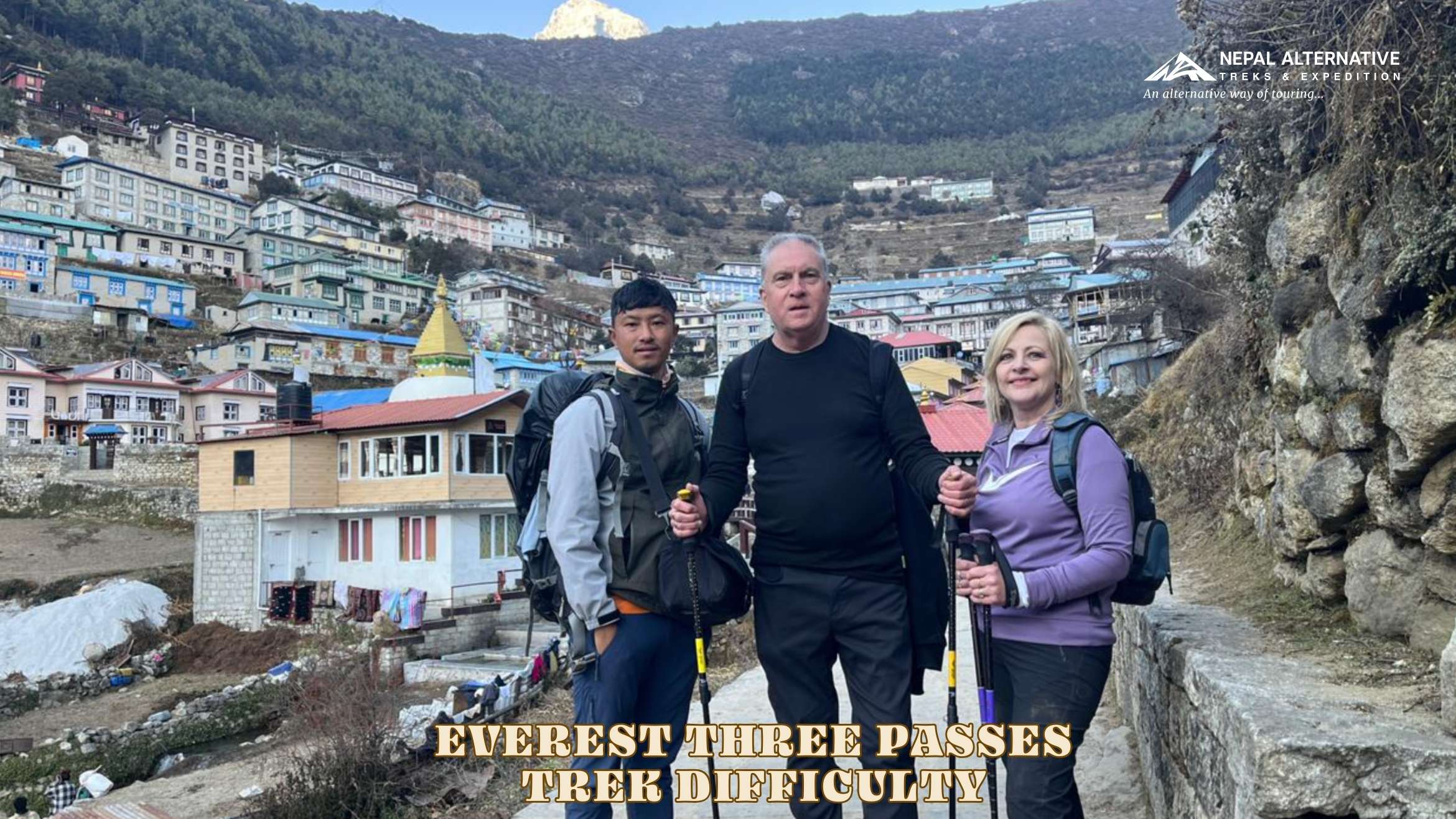
The Everest Three Passes Trek is known as the ultimate challenge for adventurers in Nepal. It is more challenging than the standard Everest Base Camp Trek because it crosses three high mountain passes above 5,000 m / 16,400 ft.
The Three Passes Trek comes in two variants: clockwise and anti-clockwise, and the direction you choose can determine how challenging the journey feels. However, both clockwise and anticlockwise routes to Everest Three Passes cover the same legendary passes: Kongma La, Cho La, and Renjo La.
Clockwise, the trek starts in Namche and first heads to Renjo La, then to Cho La, and finally to Kongma La. Thus, this direction can feel harder due to steeper early ascents. On the other hand, the anticlockwise route first follows Kongma La, then Cho La, and finally Renjo La. Still, the route takes a gradual approach through Namche, Dingboche, and Everest Base Camp, then crosses three passes that make acclimatization feel slightly more manageable.
Table of Contents
Overall, the Everest Three Passes Trek is a strenuous, high‑altitude trek that suits fit and experienced trekkers. Without a doubt, high altitude is the key factor that makes the trek difficult. Likewise, remote trail sections with limited facilities, steep and rocky pass crossings, and unpredictable Himalayan weather add to the journey’s challenge. Besides, mental challenges are another key factor that makes your journey to the Everest Three Passes difficult.
What is The Most Difficult Part Of Everest Three Passes Trek?
Without a doubt, crossing three high passes, especially Kongma La and Cho La, is the most difficult part of the Everest Three Passes trek. Still, the trek is not difficult for just one reason: the high mountains, very thin air, cold weather, and long walking days add to the trek’s difficulty. Similarly, you have to walk over 5,000 m, and at that height, breathing is hard and the body tires very quickly.
An unforgettable experience! Me and my girlfriend had a great experience doing a 4 day trek to muldai view point. Our guide Ritika and porter Rahan were both ace – really attentive, happy to answer our constant questions and always positive – even when we were sheltering from hail the…
Восхитительный непальский дебют This is the first time we have been to Nepal for Manaslu Circuit Trekking. We were advised by Alternative Treks & Expeditions. We have never regretted it. The organization is at a high level, despite the democratic prices. I also want to express my gratitude to our…
UNFORGETTABLE experience. The team formed by Dawa (guide), Dorje, and Purba was unbeatable; they are great professionals and even better people. Everything was perfect. Without them, reaching the summit and the trekking would have been impossible. We were able to feel the warmth of the people of Nepal. Tej was…
It was a pleasure to hire the services of Nepal Alternative Treks & Expeditions Pvt. Ltd. The entire staff was very attentive at all times. The experience has been excellent.
Once in a lifetime experience. Bring plenty of snacks. Everything was organised very smoothly. The flights home from Luklea were cancelled and an alternative route was organised for us. Had such a great time!!
I’m very grateful to have had the opportunity to hike to Everest base camp with Nepal Alternative Treks. From the moment we arrived in Nepal until we left, Tej from Nepal alternatives was very helpful and welcoming, ensuring the trek ran smoothly. Our guide Tek was knowledgeable, friendly, and made…
What can I say, fantastic experience and totally manageable but not easy… sometimes it was a real grind but it’s only as hard as you want to make it. Tej, the owner-operator, was fantastic. He spent lots of time both before and after the trek with me, making sure I…
Our 23 day trek was a great experience in all aspects. Our trio consisting of my friend, our guide Nauser and me succesfully managed the whole trek. I can only recommend booking this option as we got to see the himalayas in it‘s fullest. Gej‘s briefing beforehand prepared us about…
I had a fantastic experience with Nepal Alternative Treks on the Poon Hill Trek. Everything was well organized, and our guide was friendly, knowledgeable, and very supportive throughout the journey. The sunrise view from Poon Hill overlooking the Annapurna and Dhaulagiri ranges was absolutely breathtaking and the highlight of the…
The whole trip was amazing from start to finish. It all started when our guide, Nauser Ghale, picked us up from our hotel in Kathmandu. Right away, he explained the plan for the trip. The daily routine was great. After breakfast, we started our trek to the next destination. We…
I cannot recommend Nepal Alternative Treks highly enough. To be honest, I’m not a hiker at all. When my girlfriend suggested a trekking vacation in Nepal, my first thought was, “You’re going to get me killed!” I had never done a trek in my life, and suddenly I was preparing…
We completed 12 day Everest Base Camp hike with local guide Saroj. We felt extremely safe and well looked after, the only thing we had to worry about was the walking and snacks! Everything else was sorted. Thank you Saroj and Taj! Highly recommend.
This is my 7th Nepal Alternative Treks trip. Fair price Professional guides and a great team. TEJ's coordination was excellent; we became close friends.
Tej and Nepal Alternative treks and Expeditions made the trip special and unforgettable experience. We’ve made a plan to Lantang or Manussalu route next year. And for sure, with Tej and his team again for their wonderful service and a friendships that extends beyond business.
Similarly, the paths to Everest Three Passes are rocky and steep, and covered with snow or ice in early spring and winter, which is also one of the trek’s difficult parts. Therefore, the trek needs good fitness, slow walking, and strong determination. Here are some of the most difficult parts of the Everest Three Passes Trek explained:
Crossing Kongma La Pass
Crossing Kongma La Pass is the hardest part of the Everest Three Passes Trek, and it is harder than the other two passes, Cho La Pass and Renjo La Pass. Kongma La lies at an elevation of 5,535 m / 18,159 ft and is the highest pass, and the walk to the top is long, steep, and very tiring. Because of its extreme height, long walking hours, rough trail, and isolation, Kongma La Pass is the hardest and most demanding part of the trek.
Similarly, the climb to Kongma La involves scaling steep “walls” and ridges. Also, the descent is equally challenging, requiring spikes (crampons) to navigate steep, icy snow.
What makes Kongma La more difficult than the other passes is that there are no villages or lodges along the route. In comparison, Cho La Pass is also challenging but shorter and often difficult, mainly because of ice and snow near the glacier. Furthermore, Renjo La Pass is the easiest of the three, as the path is gradual and well-defined.
Extreme Altitude & Weather
The trek to Everest Three Passes takes you above 5,000 m, and that’s what makes the journey challenging. Likewise, at the altitude, you feel headaches, dizziness, or tiredness all the time. Even walking slowly can feel hard because the body does not get enough oxygen and time to adjust.
Ready to Trek?
Let’s Go!
5.0/5
Everest Three Passes Trek Anticlockwise Route – 17 Days
In addition to altitude, weather is another challenge on the trek. The weather in the Everest region is unpredictable and changes frequently, especially at elevations above 4,500 m. It can be sunny one moment and cold and windy the next. At night, temperatures can go below freezing. Cold wind, snow, and thin air together make trekking very tiring.
Khumbu Icefall
Khumbu Icefall
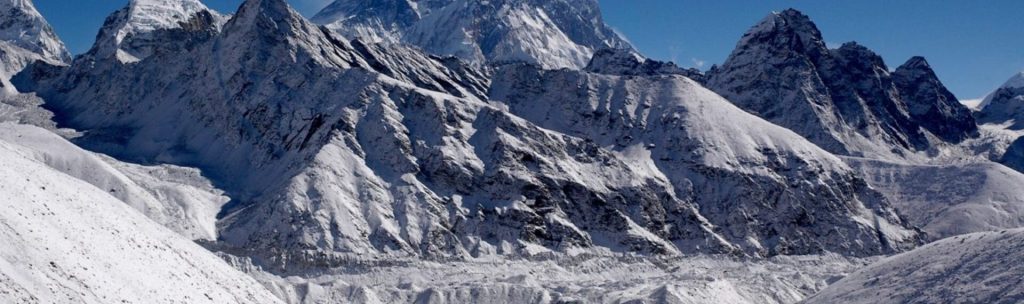
The Khumbu Icefall is one of the most dangerous places in the Everest region. The Everest Three Passes Trek takes you to Everest Base Camp, which lies just below Khumbu Icefall. However, trekkers do not actually cross the Khumbu Icefall. Instead, it is crossed only by climbers attempting to summit Mount Everest.
The Khumbu Icefall consists of huge blocks of moving ice, deep crevasses, and unstable glaciers. What makes it dangerous is that the ice is constantly shifting. Even experienced climbers must use ladders and ropes to cross it safely. You can also see the Icefall and understand how risky it is from Everest Base Camp.
Comparing the Difficulty Level of the Clockwise and Anticlockwise Three Passes Route
Whether you choose the clockwise or anticlockwise route to the Everest Three Pass Trek, both routes cover the same passes. However, the difficulty of the trek depends on the chosen direction. The main difference comes from how quickly you gain altitude and when you face the hardest pass. Similarly, this trek involves high elevation; even small changes in route can affect how hard the journey feels on the body.
While both routes are physically and mentally tough, the anticlockwise route is often preferred by trekkers and is more popular for its gradual acclimatization. It is also known for safer, more manageable routes and is best for first‑time high‑altitude trekkers. Likewise, you gain height more gradually via Tengboche to Dingboche to Chukhung, so by the time you cross Kongma La, you have several nights of acclimatization.
In contrast, the clockwise route is more demanding and better suited to very fit, experienced high‑altitude trekkers who want faster adventure. In this direction, you ascend faster from Namche to Gokyo and then over Renjo La. Thus, this direction increases the risk of AMS and makes the first high‑pass day feel harder.
Aspects
Clockwise
Anticlockwise
Overall Difficulty
Very challenging and more intense early on
Very challenging but more balanced
First Pass
Renjo La (5,360 m)
Kongma La (5,535 m)
Acclimatization
Risky. Reach high altitude much faster.
Better. More days on the trail before the first pass.
Altitude Gain
Faster and steeper
Gradual and steady
Physical Strain
High from the beginning
Increases gradually
Glacier Crossing
Cross in the morning (fresh/better visibility).
Cross late in the day (tiring/lower visibility).
Crowd Levels
Low. You split from the main crowd early
High. You share the route with the main EBC, so there will be a crowd for the first week.
Safety Margin
Lower. The Thame/Lungden valley is more isolated if AMS feels early.
High. If you get sick, you are closer to the main EBC rescue infrastructure.
Success Rate
Higher if you are highly experienced trekkers and lower if it’s your first time in high altitude.
Higher for most trekkers due to better pacing.
Who Is Best Suited For the Everest Three Passes Trek?
The trek to the Everest Three Passes is not for everyone, as it is the most challenging route in the Khumbu Valley, and it is important to be honest about this. Thus, the trek is best suited for physically fit and experienced trekkers who have already done high‑altitude trekking and are ready for a tougher walk. Also, to start the trek, trekkers should be mentally strong and comfortable walking 6-9 hours a day for many days on steep, rocky, and sometimes icy trails.
Similarly, this trek is ideal for advanced trekkers who have completed challenging routes such as Everest Base Camp, the Annapurna Circuit, or the Manaslu Circuit. However, it is also suitable for moderate trekkers who have strong fitness, prior experience at altitude, and sufficient time for proper acclimatization.
In addition, if you’re a complete beginner to trekking or have no mountain hiking experience, it is best to avoid the trek. We offer alternatives, such as the Everest Base Camp Trek or the Gokyo Lakes Trek, which are safer and easier than the tough three passes.
Quick Checklist: Is this you?
Feature
You’re Ready If…
Think Twice If…
Experience
You’ve hiked above 4,000m before
This is your first trek.
Fitness
You can hike 7+ hours with a pack.
You struggle with 3-hour simple hikes.
Health
No history of respiratory/heart issues.
You have asthma or heart conditions.
Mindset
You enjoy “the struggle” and ruggedness.
You prefer a comfortable journey.
Tips To Successfully Complete the Everest Three Passes Trek
The Everest Three Passes trek is indeed a tough journey, but not impossible. To complete it successfully, you need good preparation, patience, proper guidance, and the right mindset. Being physically fit, mentally strong, and well-prepared helps you handle long walking days, cold weather, and thin air. Listening to your body, following a proper acclimatization plan, and packing wisely are practical tips for successfully completing the trek. The tips below are explained to help you understand what really matters during the Everest Three Passes Trek.
EBC Trekking Group
Physical & Mental Preparation
The foremost tip when planning the Everest Three Passes Trek is to be physically and mentally prepared. You should prepare your body at least 2-3 months before the trek. You don’t need to do heavy preparation; simple activities like walking uphill, climbing stairs, jogging, cycling, or hiking with a backpack can help build strength.
Physical and mental preparation are like two sides of a coin. Thus, mental preparation is also crucial for the successful trek to the Everest Three Passes. The trek is long, tiring, and sometimes uncomfortable. Cold weather, basic lodges, and slow progress can test your patience. You must stay calm and positive, even when you feel tired. Accept that some days will be hard, but not the entire journey.
Proper Acclimatization
Acclimatization is crucial for any high-altitude trek in the Himalayas, especially on the Everest Three Passes Trek. The journey to Three Passes takes you above 4,500 m on most days, and acclimatization plays a vital role in making the adventure successful. Therefore, choose an itinerray that includes proper acclimatization days and allows you to adapt to the changing temperatures.
Following the rule “walk high, sleep low” on acclimatization day is the perfect way to adapt to the environment in the Everest region. Take acclimatization days seriously, even if you feel fine. Drink plenty of water, eat well, and avoid alcohol and smoking. If you feel headaches, dizziness, or nausea, inform your guide and rest. Moreover, proper acclimatization helps keep you safe and enjoy the trek without health problems.
Efficient Packing & Right Gear Choice
Efficient packing and the right gear choice are another pro tip for a successful three-pass adventure. Packing the right gear makes the trek easier and safer. Do not overpack, but also don’t miss important items. Wear comfortable trekking shoes; they protect your feet on rocky and icy trails. Similarly, carry warm clothes, including a down jacket, gloves, a hat, and thermal layers, because it gets very cold at high altitude.
The weather in the Everest region can change unexpectedly, especially at high altitude, so be sure to carry gear and equipment suited to all conditions. Pack light but smart. Bring a good sleeping bag, sunglasses, sunscreen, lip balm, and basic medicines. Trekking poles help reduce pressure on your knees, especially during long descents. Over and above, choosing the right gear keeps you warm, comfortable, and confident throughout the trek.
Amar Gurung is experienced for 10 years as a trekking guide from Nepal alternative treks. He was born on the border of Tibet and Nepal Ganesh Himal ruby valley region. He has been specialized for guiding in off the beaten trekking trails as Makalu base camp, Kanchanjunga, Manaslu, Ruby valley, Tsum valley, Nar Phu valley, and Mustang but as well as he is expert in classical trekking routes.
Let our local mountain experts craft a personalized itinerary around your schedule, fitness level, and travel goals — safe, authentic, and rooted in Nepal Alternative Treks’ trail experience.
Need assistance? Our travel expert Tej Bahadur Gurung is here to help! Please fill out the form below to initiate a chat and get your queries resolved quickly.


 United Kingdom5.0 /5
 Russia5.0 /5