Safety update: our trekking groups are safe, and our routes are running as planned. Read full flood notice.

Tamang Heritage and Langtang Valley Trek – 12 Days
|
Weather |
Weather | -2°C to 19°C | |
|---|---|---|---|
|
Duration |
Duration | 12 Days | |
|
Difficulty |
Difficulty | Moderate | View Difficulty Detail |
|
Accommodation |
Accommodation | Guesthouse | |
|
Meals Included |
Meals Included | Breakfast, Lunch, Dinner | |
|
Best Season |
Best Season | Sept, Oct, Nov, Mar, Apr, May | |
|
Transportation |
Transportation | Overland | |
|
Daily Activity |
Daily Activity | Approx. 5 – 7 hours | |
|
Religion |
Religion | Buddhism | |
|
Ethnic People |
Ethnic People | Tamang | |
|
Geographic Terrain |
Geographic Terrain | Mountain, Forest, Village, Glacier, Hot Spring, Terrace | |
|
Region of Nepal |
Region of Nepal | Langtang Region, Rasuwa | |
|
Max. Altitude |
Max. Altitude | 5,033 m / 16,512 ft (Tserko Ri) |
Overview of Tamang Heritage and Langtang Valley Trek
The Tamang Heritage and Langtang Valley Trek is a 12-day Himalayan journey that brings together two rewarding trails in the Langtang region of Nepal, the Tamang Heritage Trek and the Langtang Valley Trek. The Tamang Heritage Trek focuses on village culture, local traditions, and community life, while the Langtang Valley Trek is known for its mountain views, forests, and high alpine landscapes. Since both trails lie close to each other, they can be explored in one well-planned itinerary. It’s ideal for travelers who want both cultural experiences and scenic mountain walking close to Kathmandu.
The trek begins with a drive from Kathmandu to Gatlang and follows the Tamang Heritage Trail through traditional settlements. Along the way, the route passes forests, rivers, terraced hills, and high Himalayan landscapes. The first part of the trek passes Gatlang, Tatopani, Thuman, Briddim, and Khangjim. These villages are home to the Tamang community.
You can see prayer flags, chortens, mani walls, stone houses, and small monasteries along the trail. Walking through small settlements, green hillsides, forests, and river valleys makes this part of the trip feel relaxed and personal. Tatopani is one of the popular stops on the route, known for its natural hot spring area.
After Khangjim, the trek connects with the Langtang Valley route near Lama Hotel. From here, the trail follows the Langtang River through bamboo, oak, pine, and rhododendron forests. The route climbs through peaceful settlements before reaching Langtang Village. This section offers a different side of the trek, with wider valleys, grazing yaks, and closer views of the snow-covered mountains.
Kyanjin Gompa is the main highlight of the Langtang Valley section. Surrounded by high peaks and glacier valleys, this small mountain village is a great place to spend extra time exploring. Trekkers can hike to Kyanjin Ri for sunrise or sunset views and choose a full-day trip to Tserko Ri, Langshisha Kharka, or the Langtang Glacier. On clear days, the trail offers views of Langtang Lirung, Ganesh Himal, Dorje Lakpa, Gaurishankar, and even Shishapangma in Tibet.
Highlights of Tamang Heritage and Langtang Valley Trek
- Explore two popular Langtang trekking routes in one journey: the Tamang Heritage Trail and the Langtang Valley Trek.
- Walk through traditional Tamang villages such as Gatlang, Tatopani, Thuman, Briddim, and Khangjim.
- Learn about Tamang culture, Buddhist traditions, local rituals, traditional farming, food, and daily mountain life.
- Enjoy warm hospitality from Tamang families and stay in locally run lodges or homestays along the trail.
- Relax around the natural hot spring area at Tatopani during the Tamang Heritage Trail section.
- Visit old monasteries, chortens, mani walls, prayer flags, and stone-built villages throughout the trek.
- Follow scenic trails through bamboo, pine, oak, and rhododendron forests in Langtang National Park.
- Walk alongside the Langtang River as the route gradually climbs towards Langtang Village and Kyanjin Gompa.
- Spend time in Kyanjin Gompa, a high-altitude settlement surrounded by the Langtang Himalayan range.
- Hike to Kyanjin Ri for wide views of Langtang Lirung, Ganesh Himal, Dorje Lakpa, Gaurishankar, and nearby peaks.
- Take an optional day hike to Tserko Ri for a memorable sunrise and an outstanding panorama of snow-covered mountains.
- Choose from rewarding side trips to Langshisha Kharka, Langtang Glacier, Kyanjin Ri, or Tserko Ri.
- Visit the local yak cheese factory in Kyanjin Gompa and try fresh cheese made in the Langtang Valley.
- Experience changing landscapes, from green terraced hills and forest trails to open alpine meadows, glacier valleys, and rocky mountain terrain.
- Look out for Himalayan wildlife in Langtang National Park, including langur monkeys, Himalayan tahr, and, with luck, red pandas and Himalayan black bears.
- Enjoy local organic meals and simple mountain hospitality while staying in family-run teahouses and lodges.
- Experience a quieter trekking route that combines nature, culture, village life, and Himalayan views within easy reach of Kathmandu.
How Difficult is the Tamang Heritage and Langtang Valley Trek?
The Tamang Heritage and Langtang Valley Trek is a moderately difficult adventure. This means the trek is not an easy walk, but it is not extremely difficult either. To complete the trek, you need to be reasonably fit and prepared; you do not need special climbing skills. Compared with difficult treks such as the Everest Three Passes, Manaslu Circuit, Annapurna Circuit, or routes with high mountain passes, this trek is easier.
However, you will still walk for about 5 to 7 hours for about 10 days during the Tamang Heritage and Langtang Valley Trek. Also, some parts of the trek are rocky, uneven, steep, or slippery, which adds to its difficulty. You also do not need special climbing equipment. However, trekking poles are necessary, especially on steep or uneven sections.
The Tamang Heritage section has some harder uphill sections. The Nagthali hike and the ridge between Thuman and Briddim can be especially tiring. Also, the hike to Kyanjin Ri, Tserko Ri, Langshisha Kharka, or the Langtang Glacier on the Langtang Valley section is challenging.
However, the biggest challenge of the Langtang Valley and the Tamang Heritage Trail is not walking but the high altitude. The journey starts around 1,200 m in Kathmandu and eventually takes you above 4,000 m. Above 3,000 m, the risk of altitude sickness increases, the greatest challenge of the entire journey.
The mental side of the trek is also another difficulty. Walking for 5-7 hours every day for about 10 days can be tiring, especially when the weather changes or the trail becomes difficult with each passing day. Yet, with strong mental strength and physical fitness, the trek to Langtang Valley and the Tamang Heritage Trail is achievable.
Tamang Heritage and Langtang Valley Trek Itinerary
Day 1
Drive from Kathmandu to Gatlang (2,238 m)
|
Trekking Time Average |
135-140 km drive (7-9 hours) |
|---|---|
|
Accommodation |
Paldor Peak Guest House |
|
Altitude |
(2,238 m / 7,342 ft) |
|
Included meals |
Lunch, Dinner |
The journey to Tamang Heritage and Langtang Valley Trek starts with a drive from Kathmandu to Gatlang. Early morning, you’ll leave Kathmandu and head northwest. The first part of the drive takes you to Trishuli Bazaar, and the road is paved and has gentle turns. Trishuli Bazaar is also a nice place to stop for tea or breakfast beside the Trishuli River.
From Trishuli, the drive continues uphill towards the Rasuwa district. You will pass through Dhunche, the district headquarters and a starting point for the Gosaikunda Trek. After Dhunche, you will travel for about two more hours and reach Syabrubesi. It is the last major location to get fuel, food, and other supplies before leaving the main highway.
After Syabrubesi, the drive starts to feel different. Gatlang lies only 12 km from Syabrubesi, but the road conditions are poor; the ride takes about an hour by jeep. The road takes you through winding mountain roads and beautiful river valleys. You will also get to see the local Tamang culture and villages along the way. As the drive continues, the landscape becomes more beautiful with steep hills, waterfalls, and mountain peaks on a clear day.
You will reach Gatlang, a traditional Tamang village known for its stone houses and monasteries. Nearby, you can also visit the beautiful and sacred Parvati Kunda Lake. Overnight and dinner at Gatlang.
Day 2
Trek from Gatlang to Tatopani (2,600 m)
|
Trekking Time Average |
10-12 km Uphill hike (6 hours) |
|---|---|
|
Accommodation |
Eco Guest House |
|
Altitude |
(2,600 m / 8,530 ft) |
|
Included meals |
Breakfast, Lunch, Dinner |
Wake up with fresh mountain air and bird chirping. This morning feels different from the previous day in a good way. Have your breakfast at the hotel you stayed at and pack your backpack. It’s your first day on the trail, so the walk starts gently. You’ll leave Gatlang through the village’s terraced fields. Along the way, you will see chortens and mani walls before entering the forest.
The route then goes down toward the river and follows the riverbank to Thangbuchet, where most trekkers stop for lunch. After lunch, you will cross a suspension bridge and make your way towards Chilime. You will also pass some hydropower buildings near Chilime. Afterward, the pathway takes you towards Gonggang Village.
The final walk to Tatopani is harder as the route becomes steeper. As the altitude increases, you’ll get views of the Ganesh Himal and Langtang mountain ranges. When you reach Tatopani after a tough climb, you’ll check into your overnight stay point, Eco Guest House. Tatopani means “hot water”; the village was once famous for its natural hot springs, which were a great way to relax after a long hike. However, the hot springs stopped flowing after the 2015 earthquake, so you should not expect to take a hot-spring bath here.
Day 3
Trek from Tatopani to Thuman (2,400 m)
|
Trekking Time Average |
9-9.5 km Uphill hike (5-7 hours) |
|---|---|
|
Accommodation |
Potala Palace Guest House |
|
Altitude |
(2,400 m / 7,874 ft) |
|
Included meals |
Breakfast, Lunch, Dinner |
The day starts with a steady uphill walk through a dense mountain forest. Passing through dense alpine forest, you reach the small Tamang settlement of Brimdang, and from there it’s a few hours’ walk uphill until Nagthali Hill. The forest is quiet and peaceful, with many rhododendron trees. As you climb higher, the trees become fewer, and the land becomes more open.
Nagthali is the main highlight and highest point of the trek and is known for some of the best mountain views on the entire route. Located at about 3,165 m, you can see mountains in all directions from Nagthali. On a clear day, you can see Langtang Lirung, Ganesh Himal, and mountains in Tibet, including Shishapangma. There is also a small monastery and meditation center nearby, which makes the location an ideal point to rest before continuing the day’s trek.
After enjoying the views, the trail goes downhill to Thuman. The descent takes a few hours and is steep in some sections, so walking carefully is necessary. Thuman is a small and peaceful village with open grasslands and beautiful mountain views. It is also known for its traditional shamanic practices, giving it a different culture from some of the Buddhist villages along the trail. Stay overnight at the Potala Palace Guest House at Thuman.
Day 4
Trek Thuman to Briddim (2,230 m)
|
Trekking Time Average |
9-14.5 km Uphill hike (5-7 hours) |
|---|---|
|
Accommodation |
Pema Guest House |
|
Altitude |
(2,230 m / 7,316 ft) |
|
Included meals |
Breakfast, Lunch, Dinner |
As usual, the day begins with a warm cup of tea and a hearty breakfast while enjoying the surrounding area’s views. After breakfast, get ready to start the day’s walk. It’s a short walk on the fourth day that takes you from Thuman to Briddim. It is also the part of the trek where you get closest to the Tibetan border.
The initial phase of the walk is easier as the pathway goes through flat and downhill sections. You will walk through rhododendron forests and open grassy areas, with beautiful views along the way. Then the trail slowly descends toward the Bhote Koshi River. After about an hour of climbing from the river, you will reach Lingling Village, your lunch point. From Lingling, you’ll have to walk another couple of hours to reach Briddim.
Briddim is one of the most interesting villages on the whole trek. It is a traditional Tibetan Buddhist village on a hillside with beautiful views of the Langtang mountains. The village is also famous for its homestays, where trekkers can stay with local families. Around 40 homes in Briddim are used as homestays. The day’s overnight stay and dinner will be at Briddim.
Day 5
Trek from Briddim to Khanjim (2,449 m)
|
Trekking Time Average |
4-5 km Uphill hike (3-4 hours) |
|---|---|
|
Accommodation |
Lodge in Khanjim |
|
Altitude |
(2,449 m / 8,035 ft) |
|
Included meals |
Breakfast, Lunch, Dinner |
After breakfast at Briddim, you’ll leave the village and start the day’s trek. Today, you’ll feel relieved while walking as it’s one of the easiest parts of your entire Tamang Heritage Trail and Langtang Valley Trek. The walk from Briddim is mostly easy and flat, with only a few short uphill and downhill sections. The trail passes through rhododendron, pine, and oak forests. In some open areas, you can see beautiful views of Langtang Lirung and the Ganesh Himal mountains.
As you walk towards the Khanjim and Sherpagaun area, you will see signs of Tamang and Sherpa culture. There, you’ll also notice prayer flags, mani walls, and traditional farmhouses along the way. Within 3-4 hours from Briddim, you’ll get to Khanjim, a small and peaceful village with simple facilities.
Khanjim has basic tea houses but no Wi-Fi, and showers are done using buckets. Stay overnight at a lodge in Khanjim.
Day 6
Trek from Khanjim to Lama Hotel (2,470 m)
|
Trekking Time Average |
9-11 km Uphill hike (4-5 hours) |
|---|---|
|
Accommodation |
Hotel Sherpa |
|
Altitude |
(2,470 m / 8,104 ft) |
|
Included meals |
Breakfast, Lunch, Dinner |
Today, you’ll leave the Tamang Heritage Trail and join the Langtang Valley trekking route. Have your morning meal at Khangjim and start your day’s trek. If the local watermill is working, you can also take a quick look at it before starting your walk. From Khangjim, the trail goes gently uphill through pine forests. You will reach a small place called Surka, where you can rest for a while, and if you’re hungry, you can have some food before continuing the trek.
After Surka, the trail continues through the forest, where you’ll get a chance to witness some flora and fauna of Langtang National Park. The forests are also home to many kinds of animals, from monkeys to Himalayan black bears, Himalayan tahr, and even red pandas. However, sightings of these animals are rare. Even without seeing wildlife, the beautiful forests filled with rhododendron, oak, and bamboo make this part of the trek special.
Continuing the trek, you will reach a rough dirt road with wider views of the valley. The trail slowly goes downhill and takes you to Sherpagaon, which is about 2,563 m high. It is a beautiful hillside village with homes and teahouses. It has beautiful views of the Gosainkunda Valley and the Langtang mountains. Have your lunch at the hotel before continuing the walk towards the day’s destination, Lama Hotel.
After Sherpagaon, the trail goes downhill through thick forest to Rimche, a small and peaceful place with a few simple teahouses inside Langtang National Park. From Rimche, it is only about a 20-minute walk along the river to Lama Hotel.
Lama Hotel is not actually one hotel. It is a small group of teahouses and lodges beside the Langtang River. Surrounded by thick forests of rhododendron, oak, and bamboo, it is a popular place for trekkers to spend the night before continuing toward Langtang Village and Kyanjin Gompa.
Day 7
Trek from Lama Hotel to Langtang Valley (3,430 m)
|
Trekking Time Average |
16 km Uphill hike (6 hours) |
|---|---|
|
Accommodation |
Sun Rise Guest House |
|
Altitude |
(3,430 m / 11,253 ft) |
|
Included meals |
Breakfast, Lunch, Dinner |
Have your breakfast experiencing the calmness of nature. Afterward, get ready to walk towards Langtang Village. On this section, the trek starts to feel like a real high-mountain adventure. Leaving Lama Hotel, you’ll follow the Langtang River uphill. The trek takes you through dense forests with oak, hemlock, and rhododendron trees. Sometimes, you can see the mountain top of Langtang Lirung through gaps in the trees.
After about an hour, you reach a small place called Riverside, also known as Gumnachowk. There are a few teahouses here where you can stop for a short rest. The pathway then continues beside the river. After crossing a steel bridge, you climb a short but steep section. Soon, the valley becomes open, and the forest starts to become thinner. From this point, you will begin to feel that you are entering a higher and colder mountain area.
You will then reach Ghoda Tabela; its name means “horse stable”. Long ago, Tibetan traders used this area to keep their horses while traveling toward Kathmandu. The location also offers clear views of Mount Langtang Lirung. There is also an army checkpoint where your trekking permits may be checked. Here you can stop for lunch as well.
After Ghoda Tabela, the landscape changes again. The forest becomes smaller, and the land looks drier and more open. You will pass through a small settlement called Chyamki, also known as Thangshyap. As you continue, you will see more chortens, mani walls, prayer wheels, and old water mills. These are signs of the strong Tibetan influence in this part of the valley.
About 30 minutes before Langtang Village, you will pass below an old monastery. You will also walk near a large landslide area caused by the 2015 earthquake. Stay overnight at Langtang Village.
Day 8
Trek from Langtang Village to Kyanjin Gompa (3,980 m) – Sunset Hike to Kyanjin Ri (4,773 m)
|
Trekking Time Average |
8 km + an additional 4-6 km for Kyanjin Ri Hike (3 hours + 3-5 hours) |
|---|---|
|
Accommodation |
Norling Guest House or Holi Land Guest House |
|
Altitude |
(3,980 m / 13,058 ft) |
|
Included meals |
Breakfast, Lunch, Dinner |
Day 8 marks the highlight of your entire trip as you’ll get to Kyanjin Gompa, the last human settlement of the Langtang region. The day starts with a sip of butter tea and a warm breakfast. As the trek starts, you’ll follow the Langtang Khola River. As you walk higher, the land becomes more open and rocky. Like the previous day, you will see water mills, old chortens, mani walls, and colorful prayer flags along the way.
You will also cross a few small waterfalls and walk past yak pastures. During the warmer months, you may see yaks grazing freely. The sight of mountain peaks, especially Langtang Lirung, will accompany you throughout this section. As the trek continues uphill, the forest becomes smaller and finally almost disappears. In this section, you will see wide green meadows and large areas of loose rocks.
About 30 minutes to 1 hour before Kyanjin Gompa, you will reach Mundu Village. It is a small village where the Tamang people live. After Mundu, you will get your first clear view of Kyanjin Gompa, a small but busy mountain village. Likewise, the village has a monastery and a local cheese factory that produces yak-milk cheese. Trying the factory’s local yak cheese is a popular activity among trekkers.
You’ll reach Kyanjin Gompa by early or mid-afternoon. So, you have time to check into a teahouse, drink plenty of water, eat something, and start the hike to Kyanjin Ri for sunset views. The hike to Kyanjin Ri is steep but not technically difficult. This means you do not need special climbing skills, but you will have to walk uphill for a long time.
Upon reaching Kyanjin Ri, you feel proud and every effort worthwhile. At the top, you will get an amazing 360-degree view of the mountains and the valley. You can see Langtang Lirung, glaciers, Yala Peak, and Dorje Lakpa. You can also see how large and beautiful the upper Langtang Valley is. As the sun goes down, the mountains turn orange and pink. This beautiful light is called alpenglow.
After enjoying the view, you follow the same trail back to Kyanjin Gompa. If it gets dark, use your headlamp to see the path clearly. Spend overnight at Kyanjin Gompa.
Day 9
Day excursion to Tserko Ri (5,033 m) or Lhangsisha Kharka or Langtang Glacier
|
Trekking Time Average |
Depends on the hiking destination |
|---|---|
|
Accommodation |
Norling Guest House or Holi Land Guest House |
|
Altitude |
(3,980 m / 13,058 ft) |
|
Included meals |
(Breakfast, Lunch, Dinner) |
After completing the entire Tamang Heritage trek and walking through the Langtang Valley, it’s finally your acclimatization day at Kyanjin Gompa on the ninth day. Although it’s an acclimatization day by name, today is the big adventure day of the journey. You’ll take a day hike to some of the well-known landmarks of the region according to your preferences.
You have three different hiking choices. Each one is different in difficulty and length. Before choosing, consider the weather, your energy level, and how your body feels at high altitude.
Option 1: Tserko Ri (5,033 m)
Tserko Ri is the most popular and hardest hike among the three side trips of the day. Trekkers who have been to Tserko Ri on their acclimatization day claim that it is the best part of the whole Langtang trek. For this hike, you have to start early, around 5:00 to 5:30 in the morning. Starting early means you have a better chance of witnessing a clear sky and reaching the top at the time of sunrise.
The trail first goes through gentle yak grazing areas. After that, it becomes much steeper and rockier. Near the top, you will walk over loose rocks and rocky ground called moraine. The climb is very high, and you’ll gain about 1,000 to 1,450 m. The total distance for going up and coming back is about 8 to 12 km and takes 6 to 8 hours.
The top of Tserko Ri amazes you with 360-degree mountain views, including Langtang Lirung, Langtang Ri, Dorje Lakpa, and Gangchempo. On a very clear day, you may even see toward the Tibetan Plateau. Seeing those amazing sights during the sunrise is a moment to remember for a lifetime.
Option 2: Langshisha Kharka (4,200 m)
Langshisha Kharka is another common day hike destination on the acclimatization day. Langshisha Kharka is very different from Tserko Ri. Instead of climbing a very steep mountain, you take a longer but easier walk through the valley. The route goes east from Kyanjin Gompa and follows the Langtang Khola River. You will pass the old airfield and the start of the Tserko Ri trail.
To get to Langshisha Kharka, you’ll first climb about 110 m to reach Numthang (3,940 m). From there, you climb another 185 m or so to reach Langshisha Kharka. Similarly, the round trip is around 12 to 14 km and usually takes about 5 to 8 hours. The highlight of choosing this hike is the chance to witness Langshisha and Langtang glaciers.
Option 3: Langtang Glacier (4,407 m)
This is a shorter and easier choice. It is a good option if you want to see glaciers but do not want to do a tough climb. The pathway goes slowly uphill toward the Langtang Glacier and Langtang Lirung Base Camp. This hike can also be combined with a visit to Langshisha Kharka. Even though it is easier, you will still get great views of the glacier and the mountains around Langtang Lirung.
No matter which option you choose, you will return to Kyanjin Gompa in the afternoon and spend another night there.
Day 10
Trek from Kyanjin Gompa to Bamboo (1,850 m)
|
Trekking Time Average |
18-20 km 6-7 hours |
|---|---|
|
Accommodation |
Tibet Guest House |
|
Altitude |
(1,850 m / 6,069 ft) |
|
Included meals |
Breakfast, Lunch, Dinner |
From today, your return journey begins. Have your morning meal one last time at Kyanjin Gompa, enjoying mountain scenery and crisp mountain air. This is a long day of walking downhill. You will follow the same trail you used earlier, going back down the valley.
From Langtang Village, you start your downhill walk. It takes about 1 hour to reach Thangshyap. From there, it takes around 1.5 hours to reach Riverside Hotel. After Riverside Hotel, you continue walking for about another 1 hour to reach Lama Hotel. Along the way, you pass Ghoda Tabela, where you can get some final clear views of Langtang Lirung.
Have lunch at Lama Hotel before continuing the trek. From Lama Hotel, the trail goes through Rimche and then continues downhill through a thick forest. Even though walking downhill is easier than climbing uphill, it can put a lot of pressure on your knees and legs. So, don’t forget to take care of your knees. The day’s overnight stay is at Bamboo.
Day 11
Trek from Bamboo to Syabrubesi (1,680 m)
|
Trekking Time Average |
8 km Downhill hike (3-4 hours) |
|---|---|
|
Accommodation |
Lodge |
|
Altitude |
1,680 m / 5,512 ft |
|
Included meals |
Breakfast, Lunch, Dinner |
The eleventh day is the final walking day of the Langtang Valley and Tamang Heritage Trail Trek. After the morning meal, you’ll leave Bamboo Village and walk downhill through a beautiful green forest of oak, rhododendron, and bamboo trees. As it is a part of Langtang National Park, you’ll get to see a variety of flora and fauna.
After about 1 hour of trekking, you’ll get to Pairo, a small settlement with a few teahouses where you can rest and enjoy the view of the river. There is also a hot spring near Pairo. If you want, you can go and take a warm bath before continuing your walk. After Pairo, the trail continues downhill. After about 40 minutes to 1 hour, you reach Dovan.
From Dovan, you continue walking beside the Langtang Khola River. As you get closer to Syabrubesi, you will cross a suspension bridge over the Bhote Koshi River. After spending many days at high altitude, Syabrubesi may feel very different with its warm weather and busy surroundings. Stay overnight at Syabrubesi.
Day 12
Drive from Syabrubesi to Kathmandu (1,295 m)
|
Trekking Time Average |
160 km drive (6 hours ) |
|---|---|
|
Altitude |
1295 m / 4,273 ft |
|
Included meals |
Breakfast |
Today, you’ll drive back from Syabrubesi to Kathmandu, ending your adventure in the Langtang region of Nepal. You will leave Syabrubesi early in the morning. The road goes through the mountains of Rasuwa District via a winding road with many turns. Along the way, you will usually pass through Dhunche, Kalikasthan, and Trishuli Bazaar.
After Trishuli, the road continues toward Kathmandu. After several hours on the road, you finally get back to Kathmandu, the same place from where your journey had begun. Now rest, look back at your memories, and enjoy the feeling of completing your adventure.
What’s included
- Tribhuvan International Airport pick-up and transfer to a hotel in Kathmandu.
- Lodge accommodation (double/twin sharing basis) during the trip.
- All meals (breakfast, lunch, and dinner) along the trek.
- One highly experienced, first aid-trained, fluent English-speaking, friendly, and government-authorized trekking guide, along with the required porters (one porter for two persons).
- Guide and porter’s food, accommodation, salary, insurance, transportation, and equipment.
- Overland transportation as mentioned in the itinerary.
- Langtang National Park fee and necessary documents.
- A trekking map, daily oxygen saturation check-up, beanie, first aid kit, water purification, fresh seasonal fruits, trekking completion certificate, company T-shirt, etc.
- Government tax and service charge, etc.
- Assistance for emergency rescue evacuation.
- Public liability insurance.
What’s not included
- Hotel accommodation and meals in Kathmandu.
- Hard and soft table drinks such as tea/coffee, Coke, Fanta, hot water, bottled water, hot showers, device charging, beer, laundry, phone bills, and bar bills.
- Personal travel insurance.
- International flight tickets.
- Nepal tourist visa fee.
- Tips for guides and porters (highly suggested).
Add-Ons and Options
You can add optional services to make your Tamang Heritage and Langtang Valley Trek more comfortable, easier, or better suited to your travel plans. These extras don’t change the main trek itinerary, but they can help you travel with less weight, save time on the road, or relax after the trek. You can select the services you need while booking the trip and add the required number of porters, hotel nights, or transport seats.
How to add optional services:
You can select these add-ons while booking the Tamang Heritage and Langtang Valley Trek. First, click “Book the Trip” and choose your preferred departure date. On the booking form or final checkout page, select the extra services you would like to include.
You can also adjust the quantity where needed, such as adding a porter, booking more than one hotel night in Kathmandu, or arranging private transport for your group. Once you have selected all required add-ons, review your booking details and confirm your reservation.
List of available add-ons:
- Personal porter service (USD 240 per porter): Hire a porter to carry your main trekking bag and walk comfortably with a light daypack. This is a useful option for reducing weight on long uphill and downhill trails.
- Trekking gear rental (USD 12 per item): Rent essential trekking gear in Kathmandu instead of carrying it from home. You can rent a sleeping bag, down jacket, trekking poles, and crampons or microspikes for USD 12 each.
- Helicopter Return from Kyanjin Gompa/Langtang (USD 2,200 per flight – up to 5 persons): Fly from Kyanjin Gompa or Langtang to Kathmandu and save several trekking days. One helicopter can carry up to five people, subject to weather and flight availability.
- Kathmandu hotel stay (USD 50 per night for double/twin share with breakfast): Add a comfortable hotel stay in Kathmandu before or after the trek. The price includes a twin or double-sharing room with breakfast.
- Private transport from Kathmandu to Gatlang (USD 150 for private jeep – 7 seater, USD 300 for private bus – 28 seater): Travel between Kathmandu and Gatlang in your own private jeep or bus for a smoother, more flexible road journey one way, with the same price applying for returning to Kathmandu from Syabrubesi.
- Full-day Kathmandu sightseeing tour (USD 30 per person): Explore Kathmandu’s main cultural and UNESCO World Heritage Sites with a guide and transport. This tour can be arranged before or after the trek.
- Kathmandu spa massage (USD 50 per person): Relax with a 90-minute massage in Kathmandu after completing the trek. It is a good way to ease tired muscles after days of walking.
- Everest scenic flight (USD 300 per person): Take a one-hour mountain flight from Kathmandu for aerial views of Everest and other Himalayan peaks. Private airport pick-up and drop-off are included.
- Bhote Koshi bungee jump (USD 100 per person): Add an exciting bungee jump over the Bhote Koshi River before or after your trek. It is a great option for travelers looking for an extra adventure in Nepal.
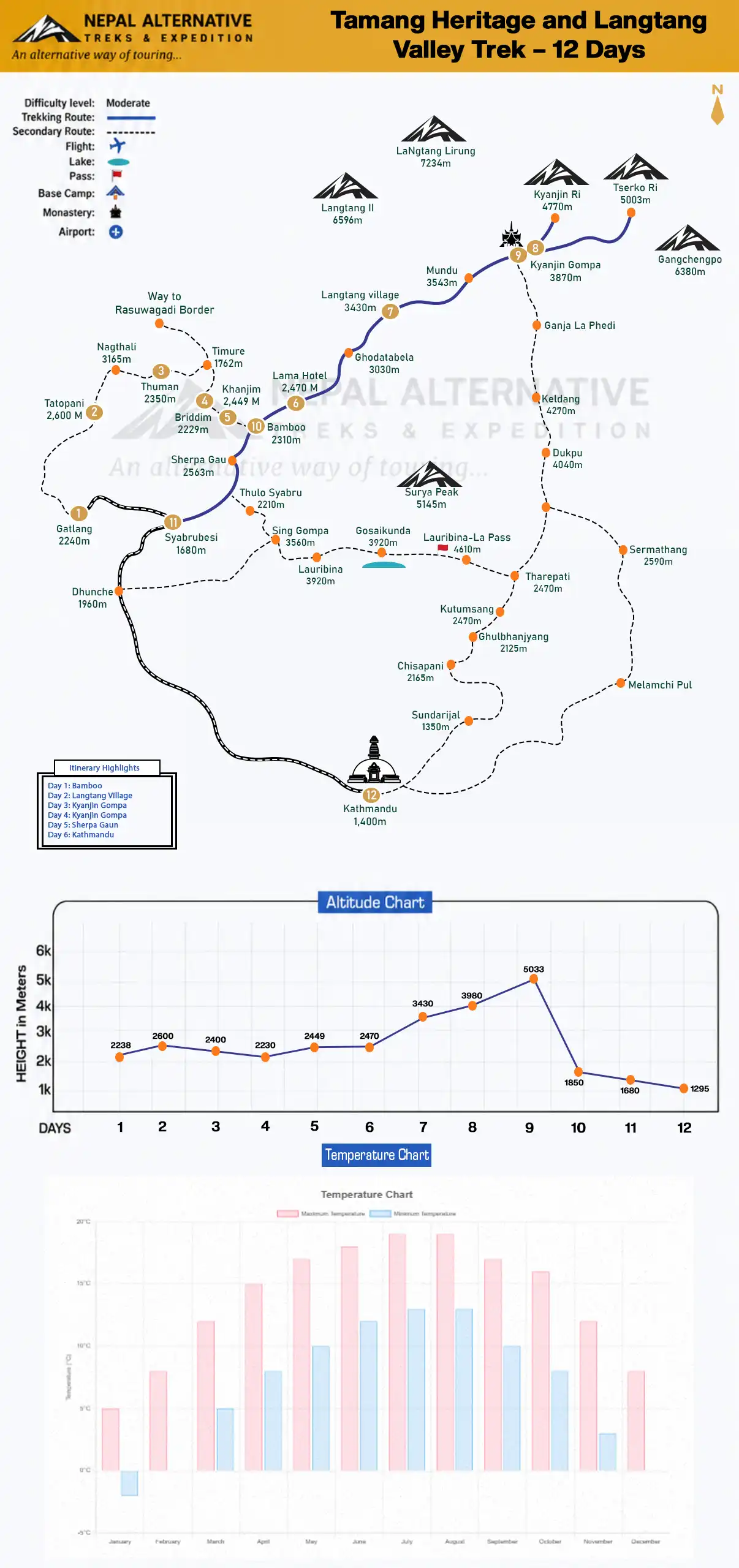
Monthly Temperature for Tamang Heritage and Langtang Valley Trek
January
-2°C to 5°C
-2°C to 5°C
February
0°C to 8°C
0°C to 8°C
March
5°C to 12°C
5°C to 12°C
April
8°C to 15°C
8°C to 15°C
May
10°C to 17°C
10°C to 17°C
June
12°C to 18°C
12°C to 18°C
July
13°C to 19°C
13°C to 19°C
August
13°C to 19°C
13°C to 19°C
September
10°C to 17°C
10°C to 17°C
October
8°C to 16°C
8°C to 16°C
November
3°C to 12°C
3°C to 12°C
December
0°C to 8°C
0°C to 8°C
Temperature on this trek changes greatly with altitude. Lower villages such as Gatlang, Tatopani, Thuman, Briddim, and Syabrubesi are warmer, while Langtang Village and Kyanjin Gompa are much colder, especially at night. The ranges below are estimated daytime temperatures around Kyanjin Gompa and the upper Langtang Valley, where trekkers feel the cold most strongly.
Route Map
Join our group departures
We do not have any scheduled group trips, but you are welcome to pick a date that suits you best.
Book a private trip on your own date.
Every journey we create is uniquely tailored to you. Share your interests and passions, and our travel experts will design an unforgettable adventure filled with extraordinary, one-of-a-kind experiences crafted just for you.
Additional Information
Cost of Tamang Heritage and Langtang Valley Trek
The Tamang Heritage and Langtang Valley Trek costs range from 720 to 780 per person. The cost is higher for those traveling in small groups (1-4), and it’s lower for those traveling in groups of 13-18. In general, the more you’re in a group, the more you’ll get a discount, and vice versa. This is because with a group, you’ll split every expense’s cost, from guide and porter to accommodation and transportation costs.
Besides the group size, the cost of the Tamang Heritage and Langtang Valley Trek depends on factors such as trip duration, chosen mode of transportation, add-ons, and overall trip customization.
The Langtang Valley Trek and Tamang Heritage Trail cost covers most of the necessary arrangements for the 12-day journey. It covers accommodation, three meals a day, a guide and porter, overland transportation, permits, and government charges. However, the cost excludes hotel accommodation and meals in Kathmandu, Nepal visa, your travel insurance, and any other food or drinks not included.
Who Is This Trek Best For?
The Tamang Heritage Trail and Langtang Valley Trek are best suited for travelers who want to experience both mountain adventure and local culture. Since it takes you to Kyanjin Gompa, Tserko Ri and Kyanjin Ri, or Langshisha Kharka as a day hike, it feels like a real Himalayan adventure and offers a unique glimpse into the culture of the Tamang people. Also, the journey takes you through less-crowded areas, where the entire route will be yours. Moreover, the trek showcases amazing sights of the Langtang range and other Himalayan peaks, offering an all-in-one experience.
Here’s a detail of who the Tamang Heritage Trail and Langtang Valley Trek are suited for:
First-Time Himalayan Trekkers
The Tamang Heritage and Langtang Valley Trek is suited for first-time trekkers in the Himalayas. For this trek, trekkers do not need to be expert climbers. If they are reasonably fit and regularly walk or exercise, they’re automatically capable of this journey. The trek involves about 5-7 hours of walking over 10 days across different terrain. If trekkers feel capable of it, they are suited for this adventure.
Who Love Culture
The Tamang Heritage Trek with Langtang Valley is perfect for people who want to learn about local people and their way of life while walking through the mountains. The Tamang Heritage Trail section takes you through villages such as Gatlang, Tatopani, Thuman, and Briddim. There, trekkers stay in local homestays and teahouses run by local families of the region. So, trekkers can learn about Tamang culture and Buddhist traditions and experience village life. Likewise, Langtang Valley is home to Tamang communities, with numerous monasteries, mani walls, and chortens, where trekkers can experience the region’s authentic culture.
Trekkers Who Prefer Less Crowds
For trekkers who prefer less busy trails, this trek is an ideal option. The Langtang and Tamang Heritage regions are quieter than the well-known Everest and Annapurna regions. Trekkers here find fewer travelers along the route, in teahouses, and at viewpoints, giving them a sense of owning nature.
Photographers and Nature Lovers
The Tamang Heritage and Langtang Valley Trek is best suited to trekkers who love photography and nature. The trek offers excellent photo opportunities as it takes you through views of mountain peaks, traditional Tamang villages, green forests, glaciers, yak pastures, river valleys, and Buddhist culture. Because the landscape changes continuously along the way, there are many opportunities for photography and nature watching. And the best part? All that beauty is raw, and no trekkers will be there to interrupt your views and photography.
Who This Trek May Not Be Suitable For:
People Looking for an Easy Walk
The Tamang Heritage and Langtang Valley Trek is not completely easy; it’s a moderately challenging trek. Although the trek is suitable for beginners, it is not for trekkers who have never taken on any physical challenges, such as walking or short hiking. Some days on the route are quite easy, but other days can be challenging due to high altitude and unpredictable changes in the weather. So, to those looking for an easy walk with minimal physical challenge, the trek might be for you.
People With Limited Time
The trek isn’t suitable for trekkers who have only a few days to spend. The journey takes about 12 days in a round trip, and trekkers with only a week to spend can choose either the Tamang Heritage Trail or the Langtang Valley Trek.
Who Prefer Luxury
This trek passes through remote mountain villages, so trekkers should not expect hotel-style comfort at every stop. Facilities like Wi-Fi, hot showers, electricity, and different food choices may not always be available, especially in smaller villages and higher parts of the trail. So, trekkers should be prepared accordingly. And to those who can’t compromise on basic facilities, avoid this trek.
Who Are Not Comfortable With High Altitude
Some parts of the Langtang Valley Trek take you to altitudes above 4,000 m. Trekkers who are not used to high elevation and have a previous record of altitude sickness should think twice before taking this trek.
Tamang Heritage and Langtang Valley Trek vs Other Nepal Treks
| Factor | Tamang Heritage and Langtang Valley Trek | Everest Base Camp Trek | Annapurna Base Camp Trek |
| Duration | 12 days | 12-14 days | 7-12 days |
| Max altitude | 4,773 m (Kyanjin Ri) to 5,033 m (Tserko Ri) | 5,555 m at Kala Patthar | 4,130 m at Annapurna Base Camp |
| Difficulty | Moderate | Moderate to challenging | Moderate |
| Daily walking | 5-7 hours | 6-7 hours | 5-7 hours |
| Access | Road Drive | Flight to Lukla | Road transfer from Pokhara |
| Altitude sickness risk | Moderate | Higher risk due to elevations above 5,000 m | Low to Moderate |
| Crowds | Low | High | Less crowded than EBC, more crowded than Langtang |
| Cultural focus | Strong with Tamang homestays and Buddhist villages | Strong Sherpa | Gurung and Magar villages en route |
| Scenery | Forests, glaciers, alpine meadows, and mountain peaks | Khumbu Icefall, Mount Everest, Ama Dablam, Lhotse, Cho Oyu, Makalu | 360° glacial amphitheater |
| Best suited for | First-timers wanting culture + moderate altitude challenge, fewer crowds | Trekkers who dream of standing at the base of Mount Everest and are ready to handle the challenges of high altitude | Beginners or time-limited trekkers wanting big mountain views with lower risk |
Why Langtang Trek Is Becoming a Popular Alternative to Everest and Annapurna
The Tamang Heritage and Langtang Valley Trek is a great option for trekkers who want to explore the Himalayas away from the busy trails of Everest and Annapurna. While Everest Base Camp and Annapurna Base Camp are very popular, they can feel crowded during spring and autumn. In contrast, the Tamang Heritage and Langtang route has fewer trekkers, more peaceful trails, and more time in traditional mountain villages.
One of the main reasons to choose this trek is its strong cultural side. Instead of walking mainly between trekking-focused villages, the Tamang Heritage Trail passes through communities such as Gatlang, Tatopani, Thuman, Briddim, and Khangjim. Here, trekkers can see local homes, Buddhist monuments, farming practices, traditional food, and the everyday lifestyle of the Tamang people. Staying in family-run lodges or homestays makes the trip feel more connected to the local community.
Furthermore, compared to the Everest region, the Langtang Trek is more budget-friendly. Langtang can usually be reached by road from Kathmandu, so there is no need to take an expensive domestic flight like the flight to Lukla for the Everest region. The shorter travel distance, road access, and generally lower trekking costs make Langtang more affordable than many Everest itineraries.
The mountain views are another major reason to choose this route. The trek takes you through green hills, terraced farmland, rhododendron forests, bamboo trails, river valleys, and open alpine landscapes. Kyanjin Gompa, Kyanjin Ri, Tserko Ri, Langshisha Kharka, and the Langtang Glacier provide close views of Langtang Lirung, Ganesh Himal, Dorje Lakpa, and other Himalayan peaks. Trekkers get the mountain atmosphere they expect from Nepal while also enjoying a route that feels less commercial.
Do we need Permits for Tamang Heritage and Langtang Valley Trek?
Yes, you need permits for the Tamang Heritage and Langtang Valley Trek. Since the route enters the Langtang region and passes through Langtang National Park, trekkers must carry the required documents before starting the trek.
For this 12-day Tamang Heritage with Langtang Valley Trek itinerary, you will need a Langtang National Park Entry Permit. This permit is required to enter Langtang National Park, including the Langtang Valley section of the trek. It is checked at trail checkpoints on the way to Syabrubesi, Lama Hotel, Langtang Village, and Kyanjin Gompa.
For foreign trekkers, the Langtang National Park Entry Permit costs NPR 3,000 per person. For citizens of SAARC countries, the fee is NPR 1,500 per person. Children below 10 years old are generally exempt from the national park entry fee.
You can arrange the permits through a registered trekking agency in Kathmandu. Or, if you are trekking independently, you can get them at the Nepal Tourism Board office in Bhrikutimandap, Kathmandu. The Langtang National Park permit can also be collected at the park entry point around Dhunche if needed, but arranging everything in Kathmandu before departure is easier and avoids delays during the road journey.
For this trek, it is best to carry your passport, passport copies, travel insurance details, and passport-size photos when arranging permits. If you are booking the trek through a local company, the agency usually handles the permit process.
Cultural Heritage and Local Lifestyle of the Tamang Community
The Langtang region is home to many Tamang communities. They live in villages such as Gatlang, Tatopani, Thuman, Briddim, Langtang Village, and Khangjim. These villages sit on green hills above river valleys, surrounded by terraced farms, forests, and mountain views. The Tamang people have lived in this part of Rasuwa for generations, and their culture remains an important part of the Langtang experience.
Tamang culture is strongly connected to Tibetan Buddhism. You will see prayer flags hanging between homes, carved mani walls beside the trail, white chortens at village entrances, and small monasteries used for prayers and community gatherings. Many families begin important occasions with Buddhist rituals and visit local monasteries during festivals. The sound of prayer wheels, incense in homes, and mountain prayer flags are common sights along the village trails.
Language is another important part of Tamang identity. The Tamang people have their own language, which many homes and villages along the heritage trail still speak. Nepali is commonly used for communication with visitors, but hearing it in local households, shops, and village gatherings adds to the cultural experience.
Travelers visiting during Sonam Lhosar, the Tamang New Year, may get a special chance to see local celebrations. Families clean their homes, put up new prayer flags, prepare traditional foods, visit monasteries, and gather with relatives and neighbors. The festival may include the sound of the damphu drum and the Tamang Selo dance, depending on the village and the time of the visit. Sonam Lhosar is usually celebrated around February or March, following the lunar calendar.
Likewise, life in the Langtang hills is simple and closely tied to farming and livestock. Families grow crops such as potatoes, maize, millet, and seasonal vegetables on terraced land, while many households also keep cows, goats, or yaks. Local stone houses, wooden balconies, small farm fields, and kitchen gardens are common throughout the villages.
Best Time to Trek To Do Tamang Heritage With Langtang Valley Trek
The best time for the Langtang Valley and Tamang Heritage Trek is during spring, from March to May, and autumn, from September to November. These months offer clearer skies, better mountain views, comfortable daytime temperatures, and safer walking conditions. Even though the weather in the Himalayas can change quickly at any time of year, spring and autumn are generally the most reliable seasons for this trek.
Spring: March to May
Spring is one of the most beautiful times to trek in the Langtang region. The lower trails around Gatlang, Tatopani, Thuman, Briddim, and Lama Hotel become green, while rhododendron forests begin to bloom.
Days are usually pleasant for walking, although mornings and nights can still be cold at higher places such as Langtang Village and Kyanjin Gompa. This season is a good choice for trekkers who enjoy flowers, green hills, and clear mountain views.
Autumn: September to November
Autumn is widely considered the best overall season for the trek. After the monsoon rain, the air is cleaner, the skies are usually clearer, and the views of Langtang Lirung, Ganesh Himal, Dorje Lakpa, and other peaks are often at their best.
The days are normally dry and comfortable for trekking, while evenings become colder as November approaches. Because of the stable weather and good visibility, autumn is also the busiest trekking period in the Langtang region.
Monsoon: June to August
The monsoon season brings regular rainfall, cloudy skies, muddy trails, and leeches in the lower forest sections. Mountain views are often hidden by clouds, and road travel from Kathmandu to Gatlang and Syabrubesi to Kathmandu can be affected by rain or landslides.
Trekking is still possible for experienced and flexible travelers, but it is not the best time for those hoping for clear Himalayan views. If trekking during monsoon, it is important to carry waterproof clothing, good trekking boots, rain covers, and extra travel days.
Winter: December to February
Winter is quieter and can offer clear mountain views, especially in December and early January. However, the temperature drops sharply at higher elevations, particularly around Kyanjin Gompa, Kyanjin Ri, and Tserko Ri.
Snow can make side hikes difficult or unsafe, and some lodges may have limited facilities during colder months. Winter is suitable for trekkers who are comfortable with cold weather and prefer fewer people on the trail.
| Season | Months | Trail Conditions | Best For |
| Spring | March to May | Mild days, blooming rhododendrons, occasional afternoon clouds | Flowers, greenery, culture, and mountain views |
| Autumn | September to November | Dry trails, clear skies, stable weather | Best overall views and comfortable trekking |
| Monsoon | June to August | Rain, mud, leeches, cloud cover, possible road delays | Experienced trekkers seeking quieter trails |
| Winter | December to February | Cold temperatures, possible snow at higher areas | Quiet trekking and clear winter views |
Tamang Heritage and Langtang Valley Trek Packing List
Pack light but carry enough warm clothing for Kyanjin Gompa and the upper Langtang Valley. The lower Tamang Heritage villages are warmer, but temperatures drop quickly after Lama Hotel, especially during mornings, evenings, and side hikes to Kyanjin Ri or Tserko Ri. A layered clothing system works best because you can add or remove layers as the weather changes.
Clothing
- 1-2 long-sleeve trekking shirts
- 1 set of thermal base layers for sleeping and cold days
- 1 fleece jacket or warm mid-layer
- 1 warm down jacket
- 1 waterproof and windproof jacket with a hood
- 1 lightweight rain poncho or rain cover
- 2 pairs of trekking pants
- 1 pair of thermal leggings or warm trousers
- 4-5 pairs of trekking socks, including warm wool socks
- 4-5 pairs of underwear
- Warm beanie or wool hat
- Sun hat or cap
- Buff, neck gaiter, or scarf
- Lightweight gloves
Footwear
- Waterproof trekking boots with good ankle support
- Lightweight sandals, slippers, or camp shoes for lodges
Good trekking boots are important because the trail includes stone steps, forest paths, uneven village trails, and long downhill sections. Trekking poles are also highly useful for reducing pressure on the knees, especially while descending from Kyanjin Gompa to Bamboo and Syabrubesi.
Personal Items and Toiletries
- Toothbrush and toothpaste
- Toilet paper and wet wipes
- Hand sanitiser
- Quick-dry towel
- Moisturizer for dry skin
- Sunscreen, SPF 30 or higher
- SPF lip balm
- Sunglasses with UV protection
- Reusable water bottles or hydration bladder with at least 2-litre capacity
- Water purification tablets, drops, filter, or purification bottle
- Snacks such as energy bars, nuts, chocolate, and dried fruits
- Earplugs for sleeping in busy teahouses
- Small notebook, book, cards, or downloaded entertainment for evenings
Health and Safety Items
- Personal prescription medicines
- Basic first-aid kit
- Blister plasters, tape, and antiseptic cream
- Painkillers and anti-inflammatory medicine, if suitable for you
- Oral rehydration salts
- Medication for stomach problems, only after medical advice
- Altitude medicine only if prescribed or recommended by your doctor
- Knee support or ankle support, if needed
Documents and Electronics
- Passport with a valid Nepal visa
- Passport photocopies
- Travel insurance details, including emergency helicopter evacuation coverage
- Cash in Nepali rupees for drinks, showers, Wi-Fi, charging, snacks, and tips
- Mobile phone and charging cable
- Power bank of at least 10,000 to 20,000 mAh
- Headlamp with extra batteries
- Camera, spare battery, and memory card, if needed
- Universal travel adapter
Frequently Asked Questions for Tamang Heritage and Langtang Valley Trek
1. Is the Tamang Heritage and Langtang Valley Trek worth it?
2. How long is the Tamang Heritage and Langtang Valley Trek?
3. How difficult is the trek?
4. What is the highest point of the Tamang Heritage and Langtang Valley Trek?
5. Do I need previous trekking experience?
6. Is there a risk of altitude sickness?
7. What permits are needed for this trek?
8. Can I combine this trek with Gosaikunda?
9. Do I need another permit for Gosaikunda?
10. What type of accommodation is available along the trek route?
11. Is hot water and Wi-Fi available on the trek?
12. What food is available during the trek?
13. What is the best time to do this trek?
14. Can families and older trekkers do this trek?
15. Do I need a guide and porter?
Related Trips
View Detail For Mera Peak Climbing With Heli Return – 10 Days

Mera Peak Climbing With Heli Return – 10 Days