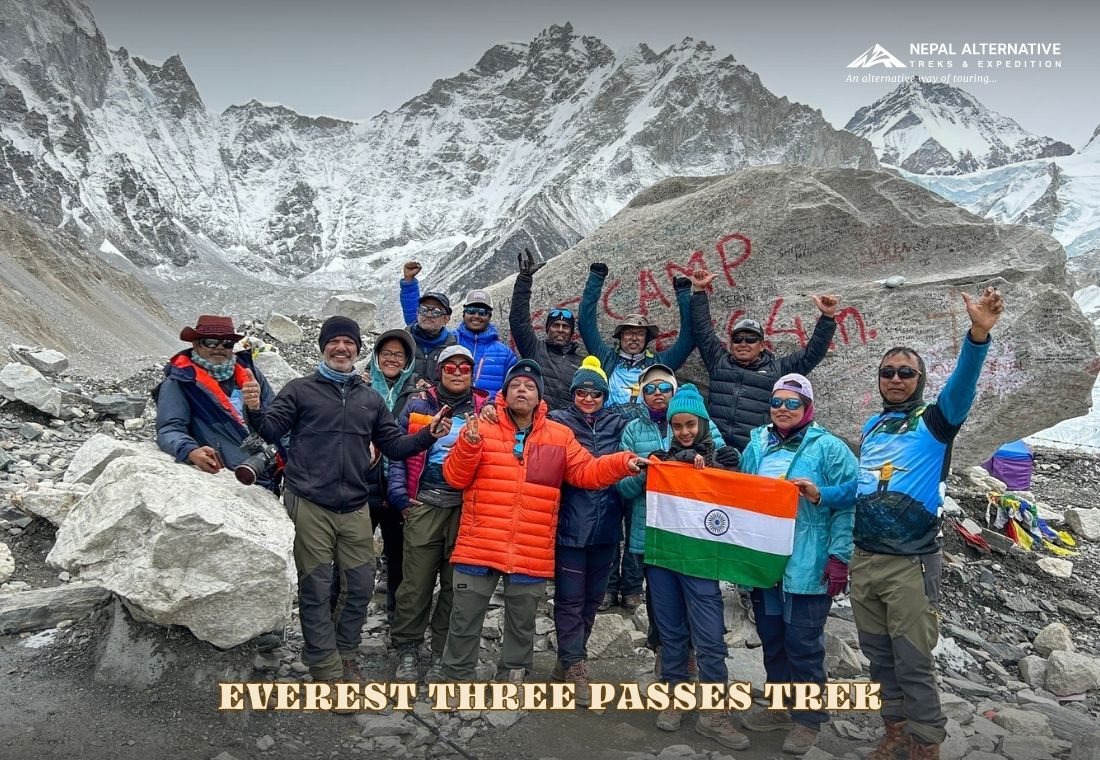
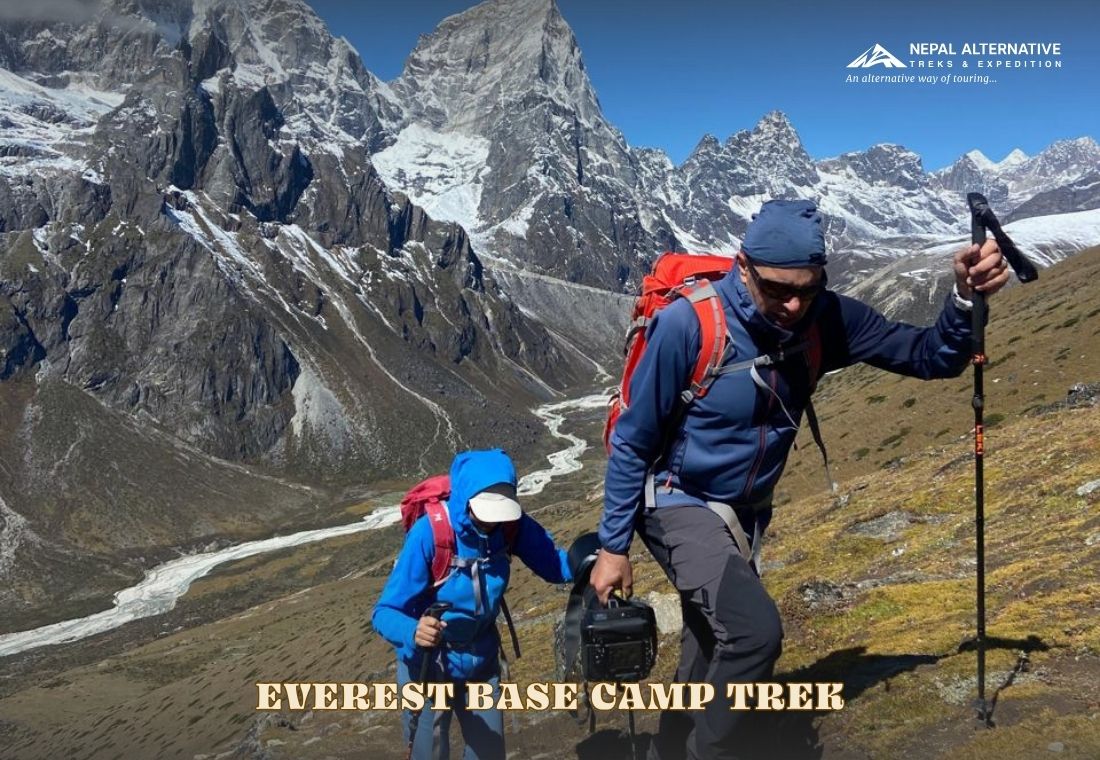
The Everest Base Camp with Gokyo Lake Trek is a complete circuit route in the Khumbu Valley that combines five major highlights within one adventure: Everest Base Camp, Kala Patthar, Cho La Pass, Gokyo Lakes, and Gokyo Ri. Similarly, the route is also known as an alternative to the classic Everest Base Camp trek. Because the trek follows a loop through the Khumbu and Gokyo valleys, you’ll walk on new trails most days instead of going back the same way to Lukla. This is one of the unique aspects of the standard Everest Base Camp trek.
The adventure begins with a 35-minute flight from Kathmandu to Lukla. From Lukla, the trail follows the Dudh Koshi River to Namche Bazaar, where you’ll spend a day acclimatizing with short hikes. The trek then continues through Debuche and Dingboche, with another rest day before reaching Lobuche and Gorak Shep. From there, you’ll make the final walk to Everest Base Camp (EBC).
After the EBC hike, you’ll hike to Kala Patthar, one of the best viewpoints for a close-up view of Mount Everest. The trail then crosses the challenging Cho La Pass and enters the Gokyo Valley. Here, you’ll visit the turquoise Gokyo Lakes and climb Gokyo Ri for stunning mountain views and Ngozumpa Glacier, the largest glacier in Nepal. The trek then descends through Dole and Namche Bazaar, returning to Lukla for a flight to Kathmandu.
Along the way, the trek passes through the UNESCO-listed Sagarmatha National Park. The national park is home to rich Himalayan biodiversity, including snow leopards, red pandas, and Himalayan thars. Likewise, it is home to peaks like Mount Everest (8,848.86 m), Lhotse (8,516 m), Nuptse (7,861 m), Ama Dablam (6,812 m), Makalu (8,481 m), and Cho Oyu (8,201 m).
Compared to the standard Everest Base Camp trail, this route takes you through a varied landscape. You’ll see turquoise glacial lakes, high mountain passes, forests, and glaciers instead of returning along the same trail. Along the way, you’ll also pass through traditional Sherpa villages such as Namche Bazaar, Tengboche, Dingboche, and Dole, where prayer flags, mani stones, and ancient monasteries provide deeper knowledge of the Everest region.
Everest Base Camp with Gokyo Lake Trek Highlights
Trek to Everest Base Camp (5,364 m), where you can catch a glimpse of some of Nepal’s highest peaks, including Cho Oyu (8,201 m), Lhotse (8,516 m), Makalu (8,481 m), Nuptse (7,861 m), and Ama Dablam (6,812 m).
Experience five major highlights in one trip: Everest Base Camp, Kala Patthar, Cho La Pass, Gokyo Lakes, and Gokyo Ri.
Trek to Gokyo Valley, where you can explore all six lakes of the Gokyo Lake system and climb Gokyo Ri for spectacular views of the Khumbu region.
Explore the flora and fauna of Sagarmatha National Park.
Experience the culture and traditions of the local Sherpa people of the Everest region and enjoy their local cuisine.
Hike to Nagarjun Hill (5,050 m) and Kala Patthar (5,545 m) for breathtaking panoramic mountain views.
Feel a sense of accomplishment standing at the base of the world’s highest peak at Everest Base Camp, and visit iconic viewpoints including Kala Patthar and Gokyo Ri.
Enjoy a scenic flight between Kathmandu and Lukla with breathtaking aerial views of the Himalayas.
Experience the spiritual atmosphere of the Tengboche Monastery with the stunning backdrop of Mount Ama Dablam.
Cross the challenging Cho La Pass at an elevation of 5,420 m above sea level.
Witness Ngozumpa Glacier, one of Nepal’s largest glaciers.
Everest Base Camp with Gokyo Lake Trek Difficulty
The Everest Base Camp with Gokyo Lake Trek is strenuous to challenging. It is even harder than the standard EBC trek because the route takes you to high altitudes for many days and involves crossing the Cho La Pass (5,420 m). Likewise, it includes other high points such as Kala Patthar (5,555 m), Everest Base Camp (5,364 m), and Gokyo Ri (5,357 m). Although the itinerary includes acclimatization days in places like Namche Bazaar and Dingboche, the thin air can still make trekking more difficult, and the risk of acute mountain sickness remains.
Furthermore, the trek takes 15 days and covers approximately 130–150 km. You will walk 5 to 8 hours a day across varied terrain, including forested trails (Phakding–Namche), stone steps (Namche–Debuche), rocky valleys and moraines (Dingboche–Lobuche–Gorak Shep), the icy glacier sections of Cho La Pass, and gradual descents through Gokyo, Dole, and Namche. The day you cross Cho La Pass is the most demanding. The ascent is steep, conditions can be snowy or icy, an early start is essential, and microspikes or crampons may be required during spring or late autumn.
Moreover, the weather at higher elevations can be cold and windy, and from November to March, Cho La Pass may be blocked by heavy snowfall. Teahouses along the route offer basic accommodation with limited facilities, especially at higher elevations. To enjoy this trek safely, you should have good physical fitness, proper trekking gear, and be prepared for long, challenging days on the trail.
Talk to a local trek expert
Get departure dates and a personalized itinerary via WhatsApp — usually a reply within a few hours.
15 Days Everest Base Camp with Gokyo Lake Trek Detailed Itinerary
Day 1
At Lukla Airport
At Lukla Airport
Mustard Flower
Mustard Flower
Phakding Village
Phakding Village
Rhododendron Flower
Rhododendron Flower
Fly to Lukla – Trek to Phakding (2,640 m)
Day 1 Facts
Trekking Time Average
8 km uphill hike
(3 hours)
Accommodation
Khumbu Traveler’s Guest House or Hotel Sherpa
Altitude
(2,640m / 8,745ft)
Included meals
Lunch, Dinner
The Everest Base Camp Trek with Gokyo Lake begins with a morning flight from Kathmandu to Lukla (approximately 35 minutes). During the flight, you can enjoy breathtaking aerial views of lush hills, dramatic landscapes, and the Himalayan terrain. Upon arriving in Lukla, you will begin your trek to Phakding.
Along the trail to Phakding, you will pass through the small village of Ghat, where you will stop for lunch. By the afternoon, you will arrive in Phakding, a village situated on the banks of the Dudh Koshi River. If time permits, you can explore the village and visit nearby attractions such as Rimishung Monastery before spending the night in Phakding.
Day 2
Tenzing hillary suspension bridge
Tenzing hillary suspension bridge
Jorsalle Waterfall
Jorsalle Waterfall
Tuktuk village
Tuktuk village
Namche Bazaar with Mt. Kongde
Namche Bazaar with Mt. Kongde
Trek to Namche Bazaar (3,440 m)
Day 2 Facts
Trekking Time Average
7.4-11 km uphill hike
(5-7 hours)
Accommodation
Sun Shower Hotel or Khumbu Lodge
Altitude
(3,440 m / 11,352 ft)
Included meals
Breakfast, Lunch, Dinner
After breakfast on the second day, you’ll begin trekking along the classic Everest Base Camp trail, following the banks of the Dudh Koshi River. The route winds through beautiful forests of pine, oak, and rhododendron, passing charming villages such as Monjo and Jorsalle. Monjo marks the entrance to Sagarmatha National Park, where your trekking permits will be checked. Along the way, you’ll cross several suspension bridges, including the iconic Hillary Bridge.
As the trail climbs more steeply toward Namche Bazaar, you’ll be rewarded with your first view of Mount Everest on a clear day. After several hours of hiking, you’ll arrive at Namche Bazaar, the vibrant Sherpa hub and a popular stop on the Everest Base Camp with Gokyo Lake trekking route. You’ll spend the night in a comfortable teahouse and enjoy a warm meal before continuing your adventure.
Day 3
Mt. Everest from Everest View hotel
Mt. Everest from Everest View hotel
Yeti Skull
Yeti Skull
Khumjung village
Khumjung village
Khunde village
Khunde village
Acclimatization/ Explore around Namche Bazaar
Day 3 Facts
Trekking Time Average
Excursion around
Accommodation
Sun Shower Hotel or Khumbu Lodge
Altitude
(3,440m / 11,352ft)
Included meals
Breakfast, Lunch, Dinner
Today is an acclimatization day in Namche Bazaar, allowing your body to adjust to the increasing altitude while giving you time to explore the area. Even if you feel well, this rest day is essential for reducing the risk of altitude sickness later in the trek. In the morning, you can take a short hike to the Everest View Hotel, where you’ll enjoy stunning views of Mount Everest and the surrounding Himalayan peaks, along with a panoramic view of Namche Bazaar.
Later, explore Namche Bazaar, one of the largest Sherpa settlements along the Everest Base Camp trail. You can visit the Sherpa Cultural Museum or the Sagarmatha National Park Museum to learn about the region’s history, culture, and unique mountain environment. Namche is also an excellent place to relax, purchase any last-minute snacks or trekking gear, and enjoy authentic Sherpa cuisine before continuing your Everest Base Camp with Gokyo Lake adventure.
Day 4
Tyangboche Monastery
Tyangboche Monastery
Tyangboche Stupa
Tyangboche Stupa
Debuche Village
Debuche Village
Trek to Debuche (3,820 m)
Day 4 Facts
Trekking Time Average
10-12 km uphill hike
(5-7 hours)
Accommodation
Hotel Good Luck or Rivendell Lodge
Altitude
(3,820m / 12,533ft)
Included meals
Breakfast, Lunch, Dinner
On the fourth day of the trek, you’ll hike from Namche Bazaar to Debuche. The trail passes through beautiful forests of rhododendron and oak before climbing a series of stone steps. Along the way, you’ll stop at the small village of Phunki Tenga for lunch and a short rest. Afterward, the trail ascends to the peaceful village of Tengboche, renowned for its spectacular mountain scenery.
Tengboche is home to the largest and most important monastery in the Everest region. You can visit Tengboche Monastery and, if your timing allows, attend the monks’ prayer ceremony for a memorable cultural experience. After exploring the monastery, you’ll continue on a gentle downhill walk to Debuche, where you’ll spend the night. Surrounded by tranquil forests and Himalayan peaks, Debuche offers a peaceful stop along the Everest Base Camp with Gokyo Lake trek.
Day 5
Pangboche Stupa
Pangboche Stupa
Pangboche Village
Pangboche Village
Somare village
Somare village
Dingboche village
Dingboche village
Trek to Dingboche (4,350 m)
Day 5 Facts
Trekking Time Average
9-12 km uphill hike
(5 hours)
Accommodation
Hotel Good Luck or Similiar category
Altitude
(4,350m / 14,355ft)
Included meals
Breakfast, Lunch, Dinner
The day begins with a trek to Dingboche, one of the developed settlements in the Khumbu/Everest region. You will start with an uphill climb through thick forests and beautiful streams before reaching the Imja Khola. After crossing a suspension bridge over this river, you will reach a small settlement called Pangboche, where you will stop for lunch.
After lunch, you will continue the trek. As you continue on your way to Dingboche, you will get an excellent view of Mt. Amadablam. Along the way, you will also pass through small villages such as Orsho and Somare before finally reaching Dingboche. Overnight in Dingboche.
Day 6
At Dingboche Sun set
At Dingboche Sun set
Acclimatize hike to Nangkartshang
Acclimatize hike to Nangkartshang
Picturesque Stone
Picturesque Stone
Acclimatization at Dingboche
Acclimatization at Dingboche
Acclimatization/Exploring around Dingboche
Day 6 Facts
Trekking Time Average
4 hours hours hike
Accommodation
Hotel Good Luck or Similiar category
Altitude
(4,350m / 14,355ft)
Included meals
Breakfast, Lunch, Dinner
Upon reaching Dingboche at an altitude of 4,350 m, you will take another acclimatization day to adjust to the environment. Rather than resting the whole day, you will go on a short hike to make the most of your time. Known as the “summer valley” of the region, Dingboche receives heavy monsoon rainfall that significantly impacts farming.
Begin your day with a hike to Nagarjun Hill, which is about 5,050 m high. From the top, enjoy fantastic views of mountains such as Amadablam, Lhotse, and the majestic Imja Khola Valley. After descending, return to Dingboche, where you can spend the rest of the day exploring local shops and bakeries or relaxing at our lodge.
Day 7
Mt. Tawache
Mt. Tawache
Thukla
Thukla
Everest climber’s memorial park
Everest climber’s memorial park
2 Nights 3 Days Lobuche Peak Climbing
2 Nights 3 Days Lobuche Peak Climbing
Trek to Lobuche (4,900 m)
Day 7 Facts
Trekking Time Average
8-9 km
(4.5 to 6 hours)
Accommodation
National Park Hotel or Similiar category
Altitude
(4,900m / 16,170ft)
Included meals
Breakfast, Lunch, Dinner
The seventh day of the Everest Base Camp with Gokyo Lake trek takes you from Dingboche to Lobuche. After breakfast, you will begin walking through open grasslands and rocky trails. The thick forests are now gone, replaced by small bushes and big stones. You will pass a small village called Thukla (also called Dughla), where you can stop to rest and enjoy lunch. From here, the Everest Base Camp with Gokyo Lake path gets steeper as you climb up the Thukla Pass.
After the pass, the trail becomes easier and follows a quiet river with great views of the Khumbu Glacier. By afternoon, you’ll reach Lobuche, which is higher up, so the air is thinner and things cost more. You’ll rest here before the exciting journey to Everest Base Camp on the famous EBC trail tomorrow.
Day 8
Lobuche Glacier
Lobuche Glacier
At Gorakshep
At Gorakshep
Sun Set from EBC
Sun Set from EBC
At Everest Base Camp
At Everest Base Camp
Trek to Everest Base Camp and then back to Gorak Shep (5,100 m)
Day 8 Facts
Trekking Time Average
15 km uphill hike
(7 hours)
Accommodation
Hotel Himalaya Inn or Similiar category
Altitude
(5,100m / 16,830ft)
Included meals
Breakfast, Lunch, Dinner
The day’s trek begins with a morning walk to Gorak Shep from Lobuche. Gorak Shep is one of the highest and most remote villages on the EBC trail, the last before EBC. The path is rocky and a little tough, but the mountain views are amazing. When you reach Gorakshep, you will check into a teahouse, get some rest, and have lunch. Then, you will get ready to hike to Everest Base Camp.
On your hike to the base camp, you can notice glaciers and the famous Khumbu Icefall. It takes about 2 hours of trek from Gorak Shep to reach Everest Base Camp. Once at the base camp, you will see giant mountains like Lhotse, Cho Oyu, and Makalu. The view of Everest itself is obstructed. Standing at Everest Base Camp (5,364 m) is a dream come true. You can take pictures, enjoy the views, and feel proud of our journey.
After spending some time there, make your way back to the teahouse in Gorakshep before it gets dark for an overnight stay.
Day 9
Trek to Dzongla (4,830 m)
Day 9 Facts
Trekking Time Average
10 km downhill hike
(7-8 hours)
Accommodation
Green Valley Lodge or Similar category
Altitude
(4,830m / 15,846ft)
Included meals
Breakfast, Lunch, Dinner
Your destination for the day is Dzongla village. Before you continue to Dzongla, take on a trek to Kala Patthar (5,644 m), the highest point on the iconic Everest Base Camp route. From this famous viewpoint, you can see the peaks of Everest and the surrounding peaks, such as Nuptse (7,861 m) and Changtse (7,543 m). The path may be steep and rocky, but it offers a big reward.
Once you have taken in the view, your journey to Dzongla continues. At this stage, the busy EBC trail is left behind as you join the quiet Gokyo trail. With its peaceful atmosphere, the trail features big rocks and open landscapes. The village of Dzongla lies just a short walking distance from Kala Patthar. Overnight stay at Dzongla.
Day 10
Trek to Thangnak (4,550 m)
Day 10 Facts
Trekking Time Average
16 km downhill hike
(7 hours)
Accommodation
Hotel Tashi Friendship or Similar category
Altitude
(4,550m / 14,927ft)
Included meals
Breakfast, Lunch, Dinner
The trail from Dzongla to Thangna is a challenging part of the Everest Base Camp trek via Gokyo Lakes, as you need to cross the high Cho La Pass (5,420 m). The pass is one of the most difficult sections of the trek to the Everest region. The Cho La Pass trail is a slippery pathway through frozen lakes and ice-covered rocks, with large boulders along the way, so you need to walk carefully under your trek leader’s guidance. Along the way, you will see colorful prayer flags, frozen lakes, and snowy mountain views.
After crossing the pass, you will hike downhill for a few hours to reach Thangnak village (also called Dragnag). The trail stays rough with loose rocks and steep parts, so you need to take your time. You will arrive in Thangnak by afternoon and can finally rest. You might also enjoy some tasty local Sherpa food before settling in for the night.
Day 11
Trek to Gokyo (4,750 m)
Day 11 Facts
Trekking Time Average
8 km uphill hike
(3 hours)
Accommodation
Thanka Inn or Similiar category
Altitude
(4,750m / 15,584 ft)
Included meals
Breakfast, Lunch, Dinner
Today’s trek is easier and shorter compared to the last few days. You walk for about 3 hours from Thangnak to reach Gokyo village, which sits near the stunning Gokyo Lakes. These lakes are the highest freshwater lake system in the world and hold significance to both Hindus and Buddhists. The trail to Gokyo is mostly uphill, but the peaceful lakes and mountain views make the walk enjoyable.
When you arrive in Gokyo, we’ll see the third lake, called Dudh Pokhari, right beside the village. In the warmer months, the area is full of green hills and birds, such as the pretty ruddy shelducks. During the winter, snow covers everything, turning it into a white wonderland. Many trekkers stop here to rest and enjoy the scenery before heading to the ascent of Gokyo Ri the next day.
Day 12
Trek to Dole (4,020 m)
Day 12 Facts
Trekking Time Average
12-14 km downhill hike
(6-8 hours)
Accommodation
Dole Resort or Similar category
Altitude
(4,020m / 13,189ft)
Included meals
Breakfast, Lunch, Dinner
Today, the trek starts with a hike up to Gokyo Ri viewpoint. From the viewpoint of Gokyo Ri, you can see some of the highest mountains in the world, like Mount Everest, Lhotse, Makalu, and Cho Oyu. You’ll also spot the giant Ngozumpa Glacier and views of the Gokyo Lakes below. The view from here is truly one of the best on the entire Everest Base Camp route via Gokyo Lakes trek.
After enjoying the amazing sights, you will trek back to Gokyo Village, have breakfast, and then walk downhill toward Dole Village. The path becomes easier as we go lower, and the rocky landscape slowly gives way to areas filled with green bushes and small plants. Once you reach Dole, you rest and enjoy a peaceful evening.
Day 13
Himalayan Thar
Himalayan Thar
Debuche Village
Debuche Village
Pheasant
Pheasant
Namche Bazaar
Namche Bazaar
Trek to Namche Bazaar (3,440 m)
Day 13 Facts
Trekking Time Average
14 km downhill hike
(5 hours)
Accommodation
Sun Shower Hotel or Khumbu Lodge
Altitude
(3,440m / 11,352ft)
Included meals
Breakfast, Lunch, Dinner
On day 13, you will continue on the return journey from the EBC and Gokyo Lakes trek and reach Namche Bazaar. You will start your day with a hearty breakfast, then descend back to Namche. You will descend the same route you took on the way up, passing through Phunki Tenga.
You can walk at your own pace as the trail gets easier. You will reach Namche Bazaar in the late afternoon, and you can either take some rest or explore the internet cafes, bakeries, and shops here. Overnight stay at Namche Bazaar.
Day 14
Dudhkoshi River
Dudhkoshi River
At Manju Village
At Manju Village
Phakding
Phakding
At Lukla
At Lukla
Trek to Lukla (2,800 m)
Day 14 Facts
Trekking Time Average
17-19 km downhill hike
(8 hours)
Accommodation
Ganesh Himal Hotel or Similiar category
Altitude
(2,800m / 9186ft)
Included meals
Breakfast, Lunch, Dinner
Today is the final day of the trek. You will trek back to Lukla, the starting point of the trek to Everest Base Camp with Gokyo Lakes. You will exit the Sagarmatha National Park and make your way downhill. The trail gets a bit steep, so watch your steps. After crossing the suspension bridge over the Dudh Koshi River, the trail becomes easier. Upon reaching Lukla, you can rest your sore legs.
Day 15
Lukla Airport
Lukla Airport
Boudhanath Stupa
Boudhanath Stupa
Pashupatinath Temple
Pashupatinath Temple
Kathmandu Durbar Square
Kathmandu Durbar Square
Fly to Kathmandu (1,295 m)
Day 15 Facts
Trekking Time Average
35 minutes Flight to Kathmandu
Altitude
(1,295m / 4,248ft)
Included meals
Breakfast
After breakfast, you will catch your flight back to Kathmandu. Witness the final glimpse of the Khumbu region one last time. You can rest after this grueling 15-day trek once you reach Kathmandu.
Please note that you’ll need to pay for your own accommodation, lunch, and dinner while staying in Kathmandu.
What’s Included
Tribhuvan International Airport transfer ( Airport – Hotel – Airport) in Kathmandu.
All meals during the trek (Breakfast, Lunch, Dinner).
Lodge accommodation( Twin share) during the trekking.
One experienced, well-trained, fluent English – speaking, friendly, and government-authorized trekking guide and required porters
1 Porter per 2 Trekkers and keep luggage weight under 10kg per person.
Guide’s food, accommodation, salary, insurance, transportation, and equipment.
Everest National Park fee and Pashang Lhamu Entry Fee.
Oxygen saturation check up every day, A trek map, first aid medicines, water purification, Trekking completion certificate, etc.
Government tax and service charge.
Assistance for Emergency Rescue Evacuation.
Public Liability Insurance.
What’s Not included
Hotel and Meals in Kathmandu.
Hard and soft table drinks such as tea/coffee, coke, fanta, mineral water, beer, hot shower, hot water, battery charge etc.
Personal Travel insurance.
International Flight Tickets.
Nepal Tourist Visa Fee.
Tips for guide and porter.( Highly suggested ).
Add-ons and Options
On this combined Everest Base Camp with Gokyo Lake Trek, these add-ons help you save time, recover better, and travel lighter through helicopter returns, porters, wellness options, sightseeing, and rental gear.
When you book your trek, you can add these extra services during the checkout process. After choosing your date under “Join Our Group Departure” or “Book the Trip”, you will see a list of optional add-ons. Simply pick the services you prefer and, if needed, increase the number (such as 2 porters instead of 1, or several hotel nights). Your selected add-ons will automatically be included in your final trip cost before payment.
Helicopter Return from Gorakshep to Kathmandu (USD 1,300 per person): Skip the long walk back with a scenic helicopter flight from Gorakshep to Kathmandu, saving time and energy after completing both the Everest Base Camp and Gokyo routes.
Gear Rent: We provide clean, quality trekking gear like jackets, sleeping bags, poles, crampons, and boots so you don’t need to buy or carry your own equipment. Down jacket (USD 15), sleeping bag (USD 15), poles (USD 15), and Crampons/Spikes (USD 15).
Private Porter (USD 300 per porter): A personal porter carries your backpack, helping you trek lighter and stay less tired on long, high-altitude trails.
Wellness & Recovery Session in Kathmandu (USD 100 for 90 minutes): Relax with spa, massage, sauna, steam, or Ayurvedic treatments to soothe muscles and recover after the trek.
Kathmandu Sightseeing (USD 30 per person): Visit famous heritage sites in Kathmandu, including Pashupatinath Temple, Boudhanath Stupa, Swayambhunath, Kathmandu Durbar Square, and Bhaktapur Durbar Square.
1-hour Everest Scenic Flight (USD 300 per person): Enjoy a 1-hour mountain flight to see Everest and the Himalayan range from the air, with private airport pick-up and drop-off in Kathmandu included. This is a scenic flight only with no landing.
Best Season For Everest Base Camp with Gokyo Lake Trek
January
-15°C to -5°C
February
-15°C to -5°C
March
-10°C to 0°C
April
-5°C to 5°C
May
0°C to 10°C
June
5°C to 15°C
July
7°C to 18°C
August
7°C to 18°C
September
5°C to 15°C
October
-5°C to 5°C
November
-10°C to 0°C
December
-15°C to -5°C
Note: Temperatures vary by altitude. Nighttime temperatures at Gokyo (4,790m) or Gorakshep (5,164m) can be significantly colder than in Namche Bazaar (3,440m) or Phakding (2,610m).
The best time to do the Everest Base Camp with Gokyo Lake Trek is during spring (March to May) and autumn (September to November). In spring, the days are warm and clear, with dry, comfortable trails. Temperatures range from 5°C to 20°C during the day and can drop to -5°C at night in higher areas. Autumn also offers cool, fresh air and clear skies, which means great views of Everest, Lhotse, and Cho Oyu. Daytime temperatures are slightly cooler than spring, and nights can get as cold as -10°C.
Winter (December to February) and the monsoon season (June to August) are not ideal. Winter brings very cold temperatures, and the monsoon season brings heavy rain, poor visibility, slippery paths, and frequent Lukla flight delays.
Everest Base Camp with Gokyo Lake Trek Route Map
Trail
Return Trail
The Everest Base Camp with Gokyo Lake Trek route map serves as a digital map to one of the beautiful trails in the Khumbu region. This high-quality map includes zoom-in and zoom-out features, as well as a downloadable option. Thus, trekkers on their journey can use it with confidence.
The Everest Base Camp with Gokyo Lakes route map shows the exact trail you’ll follow, combining the classic Everest Base Camp trek with a visit to the beautiful Gokyo Lakes and Gokyo Ri. Likewise, the route map features different colors and symbols to highlight important features along the trek. Different colors and symbols represent features, including the main trail, alternative routes, viewpoints, glacial lakes, suspension bridges, glaciers, and high mountain passes such as Cho La.
Major landmarks such as Gokyo Lakes, Ngozumpa Glacier, Gokyo Ri, Kala Patthar, and Everest Base Camp are clearly marked on the map. To make the icons and symbols easy to understand, the “Legend” plays a crucial role. It makes it easy for trekkers to read the map accurately and plan their days on the trail with confidence, even when they trek with a guide.
Our scheduled group tours offer fixed departure dates, providing an excellent opportunity for travelers to join our small group trips.
Note : Our fixed group departure dates, services and price is guaranteed even if the group numbers are 1 person to maximum 18 persons. We will provide a guide cum porter if there is only 1 person to operate the trek and one more assistant guide if group size is above 10 persons. And of course, guide cum porter will carry 10 kg luggage
Book a private trip on your own date.
Every journey we create is uniquely tailored to you. Share your interests and passions, and our travel experts will design an unforgettable adventure filled with extraordinary, one-of-a-kind experiences crafted just for you.
We love nepal and made 3 time visit to this beutiful country and rich culture. This time last year we came with 6 pax and visited Kathmandu , Pohkara and chitwan with a stay of 2 night in each place. We flew to Pohkara and got the van to chitwan…
We did the EBC trek with Tej. All staffs are very friendly and helpful. Dhan and Nauser are professional mountain guide but it should be better, if we could have trip briefing day by day in details. Anyway everthing is excellent. Thank uou for unforgotable experiences.
5 years ago we organised our first Trek with Tej the owner at Nepal Alternative. That time we did the Annapurna Base Camp Trek. Everything went smoothly and without a hiccup. This time we went back to Nepal for the Everest Base Camp Trek, and go in touch with Tej…
Absolut unique experience! There were only the two of us and our wonderful guide! The landscape is gigantic, people in Khumbu valley were everywhere friendly, always smiling, so we felt very welcomed! We did EBC, Cho La and Gokyo Ri, had great accomodations and food. We learned a lot about…
Prominent Landmarks on the Everest Base Camp via Gokyo Lakes Trek Adventure
Getting Into Lukla & Namche
Lukla and Namche Bazaar are the prominent hubs of the Everest region, attracting thousands of adventure seekers from around the world each year. Lukla is a stunning town in the region that serves as a gateway to the Khumbu Valley. Tenzing Hillary Airport, the world’s highest-altitude airport, at 2,860 m, is the major attraction of the village.
Moreover, Namche Bazaar is a popular town with modern facilities such as ATMs, cafes, and restaurants, and is also a key acclimatization point. The village’s attractions are the Sherpa Museum, the Saturday market, Khangba Ngingba, Nauche Gonda Visitor Center, Sherpa Culture Gallery, and Sherpa Himal Art.
Gokyo Valley
In the west of the Khumbu region, Gokyo Valley is a stunning, less crowded alternative route to the Everest Base Camp Trek. The valley consists of small villages with tea houses to cater to trekkers who need services during their adventure. The valley is popular for its view of Mount Cho Oyu, one of the eight-thousanders of the Himalayas. Turquoise Lakes, Gokyo Ri, Ngozumpa Glacier, and Sherpa culture are the key attractions located near the valley.
Gokyo Lake
Spanning from an elevation of 4,700 m to 5,000 m, the Gokyo Lakes are the “world’s highest freshwater lake system.” Thus, the Everest Base Camp via Gokyo Lake is highly recommended for trekkers who prefer to experience a blend of serenity and adventure. The lake features 19 small and 6 large lakes; the 6 are the major attractions. Moreover, the pristine turquoise waters, with a backdrop of Everest, Lhotse, Makalu, and Cho Oyu, create a stunning sight in the lake.
Cho La Pass
Chola Pass at 5,330 m is the ultimate highlight and a major reason for the trek to Everest Base Camp via Gokyo. Crossing to Chola Pass offers an amazing sight of glaciers, snow-covered peaks, and varied landscapes, making the journey worthwhile. Likewise, the pass’s high elevation adds to the trek’s adventure, making it ideal for adventure seekers.
Gorak Shep and Kala Patthar
Gorakshep is the last human settlement before the Everest Base Camp Trek. Similarly, Kala Patthar is the vantage point that lies above Gorakshep village, where trekkers hike after EBC. Both locations hold their own significance and key highlights of the Everest trek via Gokyo Lake. After reaching the Base Camp of Everest, trekkers spend a night at Gorak Shep, which has basic tea house facilities and stunning views. Likewise, Kala Pattar offers the closest view of the world’s highest peak, Mt.Everest (8,844.43 m), and is famous for its sunrise and sunset views.
Sagarmatha National Park
Sagarmatha National Park is a UNESCO World Heritage Site in the Eastern Himalayas of Nepal. The national park covers an area of 1148 sq km and is named after Mount Everest, the world’s highest peak, known in Nepali as “Sagarmatha.” The national park is home to diverse biodiversity. Thus, trekkers can spot various animals, birds, and plants during their EBC trek through the Gokyo Valley of the Sagarmatha National Park. Also, the park features a dense forest of rhododendrons and pine, along with deep valleys, glaciers, and rivers.
Tengboche Monastery
Tengboche monastery is the Buddhist spiritual hub of the Khumbu Valley, located at an elevation of 3,867 m above sea level. The monastery is the largest and most prominent in the region and lies on a hill with a stunning backdrop of Mount Ama Dablam. While passing through the monastery, you can learn about the Sherpas’ culture and traditions and even participate in daily worship, making the trek culturally enriching. Moreover, the monastery adds a spiritual and cultural significance to the Everest Base Camp Gokyo Lake Trek.
Cultural Insight of the Khumbu Region
The Khumbu region is equally renowned for its cultural insights as for its natural beauty. The region is home to the Sherpa people and their Buddhist culture and traditions. Likewise, the Sherpas are also known for their mountaineering skills and hospitality. Trekkers get a glimpse of the region’s culture on every step of the journey, with prayer flags fluttering in the sky and in the tea houses where they stay.
EBC Trek via Gokyo Lake Distance & Elevation
The EBC trek via Gokyo Lake takes 15 days on a round-trip, covering approximately 134–148 km. Here is a table that shows the duration from one point to another, along with Elevation gain:
S.N
Trekking Route
Distance Covered
Elevation Gain
1.
Lukla to Phakding
8 km
-160 m
2.
Phakding to Namche Bazaar
7.4-11 km
+800 m
3.
Namche Bazaar to Debuche
10-12 km
+380 m
4.
Debuche to Dingboche
9-12 km
+530 m
5.
Dingboche to Lobuche
8-9 km
+550 m
6.
Lobuche to Everest Base Camp to Gorakshep
15 km
+200 m
7.
Gorakshep to Dzongla
10 km
-270 m
8.
Dzongla to Thangna
16 km
-280 m
9.
Thangna to Gokyo
8 km
+200 m
10.
Gokyo to Dola
12-14 km
-730 m
11.
Dole to Namche Bazaar
14 km
-580 m
12.
Namche to Lukla
17-19 km
-640 m
Food, Accommodation, Drinking Water, and Other Services along the EBC with Gokyo Lake Trek
Nepal Alternative Treks takes care of our clients’ meals and accommodation throughout the Everest Base Camp and Gokyo Lake Trek. We manage your lodging at a high-quality accommodation point three times a day. However, the destination doesn’t offer a vast range of options like city areas do. Thus, tea houses are the only accommodation available in some locations.
Accommodation During EBC with Gokyo Lake Trek
Tea houses are small guesthouses made of wood, stone, clay, and tin, run by local Sherpa people. Yet, the tea houses vary in size and price, depending on the season and location. Likewise, the rooms are twin-sharing with wooden beds, mattresses, pillows, and blankets. Toilets are generally outside the rooms, with basic water. Additionally, facilities for hot water, electricity for charging devices, and internet are available, but at an extra cost.
Food During EBC with Gokyo Lake Trek
Tea houses serve meals from their menus. However, the remote location makes it difficult to supply food items. Bread, eggs, pancakes, porridge, and tea/coffee are options for a morning meal along the way to Everest via the Gokyo trek. Further, breakfast and dinner options include Dal Bhat, momos, Thukpa, fried rice, noodles, pizza, pancakes, soup, and snacks.
Drinking Water During EBC with Gokyo Lake Trek
Staying hydrated throughout the trek to the Everest region, including from Gokyo Lake to Everest Base Camp, is crucial. However, trekkers don’t need to worry about water scarcity, as it is available throughout the trail. Likewise, trekkers can get drinking water from streams, rivers, glacial melt, teahouses, and water stations. Yet, we suggest you carry a refillable water bottle and a water purification tablet to stay hydrated all along.
Communication & Internet Facilities during EBC with Gokyo Lake Trek
Staying connected throughout the trek to Everest via Gokyo is crucial. However, the remoteness of the trek makes communication and internet facilities quite scarce. Still, there are some ways to stay connected with your family or friends, including:
Local Sim
Using a local SIM card is the common way to stay connected during treks in Nepal’s Himalayas, including Everest. NCELL and NTC are the two local SIMs that provide network coverage in most of the villages along the route. Trekkers can easily and quickly get a SIM card in Kathmandu upon arrival for just USD 1-2. Moreover, all villages have network coverage for both SIMs. However, as you ascend, the signal becomes weaker, and coverage can be poor.
Internet Service
Mobile data and Wi-Fi are available for internet service in almost all villages along the route to EBC, including those near Gokyo Lake. Purchasing data from your local SIM provider helps you connect to the internet. Wi-Fi facilities are still available in tea houses, but at an extra cost. Also, Wi-Fi networks become less reliable as elevation increases. Moreover, all villages except Gorakshep have mobile data and Wi-Fi access. Gorakshep has Wi-Fi, but mobile data is unreliable.
Transportation & Routes Option for EBC with Gokyo Lake Trek
Reaching the starting point of the Everest Base Camp with the Gokyo Trek offers diverse transportation and route options. Yet, the options for transportation and route are interconnected, as your route determines your transportation and vice versa. One of the common and easy ways to get to the starting point of the trek, Lukla, is by flight. A direct flight from Kathmandu to Lukla takes just 45 minutes. However, the flight may convert from Ramechhap in the peak season; in such a case, travelers should first drive to Ramechhap and then fly towards Lukla.
Furthermore, a road option is also available for the journey to EBC via Gokyo. Yet, the road option is less popular and longer. Trekkers can choose between a local bus or a jeep for this route option. Jiri is the trek’s starting point if you take the driving route. The distance from Kathmandu to Jiri is 186.3km and takes 6-7 hours, passing through Shivalaya. From Jiri, the journey passes through Kenja, Junbesi, Nunthala, Bupsa, and Phakding, and follows the classic route to Everest Base Camp.
A helicopter ride to Lukla is another thrilling way to get to the Everest region’s gateway. Although the helicopter ride costs more than an airplane, it is a comfortable, convenient, and luxurious way to enter the Khumbu Valley. However, the helicopter takes the same duration as the aircraft. Further, a maximum of 5 people can fly in one helicopter, making it ideal for groups who prefer private time and want to experience luxury and comfort.
Elevation and Acclimatization on EBC with Gokyo Lake Trek
Elevation is the primary reason for the journey to Everest, with the Gokyo Valley Trek being demanding. The journey takes trekkers through the higher elevations of the Khumbu valley. As trekkers move to higher elevations, air pressure decreases, making breathing more difficult. Thus, altitude sickness is common while trekking to EBC via Gokyo Lake.
Similarly, Chola Pass (5,420 m), Gokyo Ri (5,357 m), Everest Base Camp (5,364 m), and Kalapatthar (5,644 m) are at high altitude, where the risk of altitude sickness is high.
Furthermore, acclimatization is the most effective way to reduce the risk of altitude sickness in the higher elevations throughout the trek. It helps adjust to the changed temperature and environment, so adding acclimatization days helps complete the trek securely and smoothly. Additionally, adopting a gradual ascent, staying hydrated, and eating nutritious food are effective ways to reduce the risk of altitude sickness.
Ways To Avoid AMS during EBC with Gokyo Lake Trek
As mentioned above, the risk of Acute Mountain Sickness (AMS) or Altitude Sickness is a significant concern throughout the trek. However, we have yet to discuss how to avoid its risks and complete the trek safely. Thus, here are some ways to avoid AMS during the Everest Base Camp Gokyo Lake Trek:
Ascend gradually and steadily to allow your body to adapt to changed temperatures and lower oxygen levels in higher elevations.
Stay hydrated as it ensures your body functions properly and effectively transports oxygen throughout the body system.
Avoid alcohol, smoking, and caffeine items as they harm your body’s ability to acclimatize and worsen the symptoms of AMS.
Eat a properly balanced diet of carbohydrates, protein, and essential minerals to give your body the energy and nutrients it needs to adapt to the higher altitude.
Select an itinerary with an acclimatization day to let your body adjust to higher elevations and a changed atmosphere.
If you experience symptoms of AMS, such as headache, shortness of breath, nausea, vomiting, fatigue, or dizziness, immediately inform your guide to stop ascending and descend if the conditions don’t improve.
Carry garlic and cloves throughout the trek in your mouth, as they help enhance blood flow and improve oxygen utilization. (Note: While these are popular local remedies in the Himalayas, they are not scientifically proven medical treatments for AMS.)
Required Permits for EBC with Gokyo Lake Trek
Trekking in Nepal’s Himalayas requires obtaining permits, including for the Everest Base Camp Trek with Gokyo Lake Trekking. The permit is mandatory paperwork issued by the local authorities and national park offices.
The trek to Everest Base Camp with Gokyo Lake requires a Sagarmatha National Park Permit and a Khumbu Pasang Lhamu Municipality Entry Permit. Obtaining permits ensures you are legally trekking through the area and respecting the region’s local rules and regulations.
The Sagarmatha National Park entry permit costs NPR 3,000 for foreigners and NPR 1,500 for SAARC nationals. The Khumbu Pasang Lhamu Rural Municipality Entry permit costs NPR 3,000 for all foreign citizens (including SAARC nationals).
Note: Children below 10 years are free for national park entry.
A typical day in the EBC with Gokyo Lake Trek
A typical day on the Everest Base Camp with Gokyo Lake Trek is all about experiencing nature’s beauty and cultural exploration in the Khumbu Valley. Each day begins with the sound of local mountain life and the crisp air of the Everest region. Trekkers generally wake up around 6:00 AM to pack their gear, though much earlier starts—around 3:00 AM to 4:00 AM—are required for the challenging pass-crossing on Cho La day and the sunrise climb up Kala Patthar. After a warm morning breakfast while enjoying the early light on the peaks, trekkers hit the trail for the morning session.
As you walk through diverse terrain, appreciating the rugged landscapes and taking in the mountain views, the trail brings you to a designated lunch stop around 11:00 AM or midday. The lunch break typically lasts around an hour, allowing plenty of time not just to eat a hearty meal, but also to rest, hydrate, and rejuvenate your body for the afternoon push. After this midday break, trekkers continue their journey toward the overnight stop.
Most daily trekking stages conclude around 3:00 PM or 4:00 PM after 5 to 6 hours of walking. Upon reaching the village, you will check into your tea house accommodation, drop your bags, and unwind. The late afternoon is your personal time to freshen up, read, chat with fellow travelers, or explore the local monasteries and viewpoints.
Dinner is served around 6:30 PM or 7:00 PM in the communal dining area, which is usually warmed by a central stove. It is the perfect social space to swap stories, discuss the route with your guide, and connect with other international trekkers. Because the body burns more energy adapting to high altitudes, hitting the sack early—typically by 8:30 PM or 9:00 PM—is highly recommended to secure enough rest for the next day’s high-altitude adventure.
Travel Insurance Required For EBC with Gokyo Lake Trek
Trekking at a high elevation in a remote location with limited emergency facilities is challenging and mentally disturbing. But travel insurance lets you have peace of mind and walk worry-free. Thus, buying travel insurance is crucial for high-altitude treks like Everest Base Camp with Gokyo Lake. Yet, we recommend you purchase travel insurance as you make bookings for the trip. Likewise, travel insurance is one of the mandatory documents needed for your trek in the Everest region.
Furthermore, trekkers should consider some things before purchasing travel insurance, including:
Purchase travel insurance that covers medical expenses
Make sure your travel insurance covers trip cancellation or any interruption.
Travel insurance should cover lost, stolen, or damaged luggage.
The travel insurance should cover emergency evacuation and should offer 24/7 service.
Consider purchasing from your own country, as it would be more reliable.
Fitness and experience requirements for EBC with Gokyo Lake Trek
While going on an EBC Trek via the Gokyo Valley, you must be physically and mentally fit. Most importantly, individuals with serious conditions like severe heart issues or uncontrolled blood pressure should consult a physician before attempting high altitudes. Prior experience trekking on rugged terrain and carrying a backpack is highly recommended. Similarly, being confident, determined, and passionate about the journey is important, alongside having a solid understanding of the trail’s environment. Here is a brief overview of the fitness and preparation required for the trek:
Fitness Requirement For EBC with Gokyo Lake Trek
The journey to EBC via Gokyo Lake passes through remote areas with steep ascents, descents, and long walking hours, requiring strong physical cardiovascular endurance. Trekkers should engage in cardiovascular training in the months leading up to the trip by building up to walking 5–6 hours daily, alongside activities like running, cycling, or swimming. Strengthening your legs with squats, lunges, and step-ups helps you navigate uneven terrain and steep hills. Ultimately, building structural endurance and preparing your body for a slow, steady pacing routine are essential for proper acclimatization.
Experience Requirement For EBC with Gokyo Lake Trek
For the Everest Base Camp and Gokyo Lake Trek, prior trekking experience is highly recommended. You should be familiar with multi-day hiking over uneven ground while managing a light daypack. Being mentally prepared is equally necessary; maintaining a positive mindset, realistic expectations, and steady determination are crucial for navigating basic teahouse comforts and completing the high-altitude journey smoothly.
Training and Preparation for the Everest Base Camp via Gokyo Lakes Trek
Trekking in higher elevations doesn’t come without challenges, thus requiring proper training and preparation. The preparation for the Everest Base Camp via the Gokyo Lakes trek involves a combination of structural strength, cardiovascular endurance, and mental readiness.
Physical Strength & Endurance
The trek to Gokyo and EBC is physically demanding, involving consecutive days of walking for 5 to 7 hours over rugged terrain, steep ascents, and taxing descents. To prepare effectively, trekkers should focus on building leg strength and core stability at least 8 to 12 weeks before departure. Incorporating exercises such as weighted squats, lunges, step-ups, and planks will help condition your muscles to handle steep Himalayan inclines and long downhill stretches while carrying a daypack.
Mental Fortitude
While physical fitness is vital, mental preparation is equally essential for navigating a demanding route like the Cho La Pass and high-altitude viewpoints. Approaching the trek with realistic expectations about basic teahouse amenities, unpredictable alpine weather, and the discomfort of thin air is key. Practicing consistency during tough training days and maintaining a positive, determined mindset will help you stay focused and calm during the long, challenging stretches of the trail.
Cardiovascular Fitness
Developing a robust aerobic foundation is one of the most critical aspects of preparing for the Khumbu region’s high altitude. Engaging in cardiovascular activities like jogging, cycling, swimming, and stair climbing for 30 to 45 minutes, three to five times a week, helps train your heart and lungs to utilize oxygen more efficiently. To complement gym workouts, it is highly recommended to go on weekly outdoor weekend hikes wearing your broken-in trekking boots and a weighted backpack to fully simulate the trail’s demands.
Alternative to Everest Base Camp with Gokyo Lake Trek
The Everest region has numerous trekking destinations, offering options for every type of traveler. While the trek to Everest Base Camp via Gokyo Lake is undoubtedly amazing and thrilling, its longer duration and challenging high-altitude terrain make it less suitable for some trekkers. Some of the excellent alternatives to the EBC trek with Gokyo Lake include:
Lower Solu Region Trekking
Lower Solu region trekking is the perfect destination for those who prefer to trek off the beaten path through the lower valleys of the Solukhumbu district. This area is home to traditional Sherpa communities, offering a deep glimpse into their Buddhist traditions, culture, and daily lifestyle away from the main tourist crowds. The journey to the Lower Solu region usually begins with a flight from Kathmandu to the airstrip at Phaplu or via a scenic drive. Mount Numbur (6,959 m) and Karyolung (6,511 m) are the major visual highlights of the trek. This trek typically takes 9 to 12 days to complete, depending on the specific route and chosen itinerary.
Everest Panorama Trek
The Everest Panorama Trek is another excellent, shorter alternative to the longer Everest Base Camp and Gokyo Lake Trekking routes. This trek is a great choice for travelers who want to witness the beauty of Mount Everest and the Khumbu region but prefer to avoid very high altitudes, strenuous pass crossings, or tight timeframes. The less demanding nature of this trail makes it ideal for beginners and families. The trek reaches its highest point at an elevation of 3,860 m at Tengboche, offering an excellent opportunity to experience the iconic Tengboche Monastery and panoramic mountain views within 7 to 9 days.
Ama Dablam Base Camp Trek
Another popular alternative focusing on one of the most beautiful mountains in the world is the Ama Dablam Base Camp Trek. The route to the base camp is stunning, offering glimpses of diverse alpine flora and fauna as you trek through the core of the Khumbu Valley. Reaching the pristine pasture at the base of Mount Ama Dablam (6,812 m) is the core highlight of this journey. The standard standalone trek takes 8 to 12 days to complete and offers astonishing views of Mount Everest, Mount Lhotse (8,516 m), Island Peak (6,189 m), and Ama Dablam itself. (Note: A standard Ama Dablam Base Camp trek is a moderate lodge-to-lodge trek that does not require crossing the challenging Kongma La Pass; however, the pass can be added as a high-altitude extension for advanced adventurers.)
Everest Base Camp via Gokyo vs Classic Everest Base Camp Trek
The Classic Everest Base Camp Trek is the most popular and direct route to Everest Base Camp. On the other hand, the EBC route combined with Gokyo Lake forms a complete circuit loop through the Khumbu Valley. This combined route experiences significantly less foot traffic than the classic EBC trail while offering a much more varied, stunning, and adventurous alpine experience.
Namche Bazaar, Tengboche Monastery, EBC, Khumbu Glacier, Kala Patthar
Gokyo Lakes, Ngozumpa and Khumbu Glaciers, Gokyo Ri, Cho La Pass, EBC, Kala Patthar
Scenery Variety
Classic Khumbu valley and iconic river-gorge views
Highly varied: pristine glacial lakes, active glacier crossings, and high-altitude mountain passes
Crowd Level
Very busy, especially during the peak spring and autumn seasons
Quieter and less crowded, particularly along the Gokyo Valley side
Technical Requirements
Non-technical. High physical fitness and basic trekking endurance are sufficient.
Non-technical but demanding; involves glacier trekking and steep pass descents where traction cleats/crampons are often required.
Cost
Slightly lower due to fewer days on the trail
Slightly higher due to the extended duration and additional logistics
Risk Factor
Standard high-altitude risk profile
Higher risk due to prolonged exposure above 4,000m and crossing an unmaintained glacier pass
Best For
First-time trekkers looking for the classic milestone route
Experienced trekkers seeking an adventurous, comprehensive circuit or highly fit individuals wanting to escape the main crowds
Why Choose Everest Base Camp via Gokyo Instead of the Classic EBC Trek?
Less Crowded Trails
Because the classic Everest Base Camp Trek is a bucket-list destination for global adventure seekers, its main trails can become exceptionally busy during peak seasons, particularly the stretch between Namche Bazaar and the standard base camp route. Teahouses fill up rapidly, and the foot traffic can occasionally detract from the wilderness experience. Choosing the route via the Gokyo Valley offers a spectacular alternative; it diverts from the main crowds into a quieter valley. This loop is ideal for trekkers seeking a peaceful, serene journey through the Khumbu region without sacrificing the ultimate milestone of reaching Everest Base Camp.
The Sacred Gokyo Lakes
The Gokyo Valley is home to a magnificent network of pristine, high-altitude glacial lakes that hold deep sacred significance for both Hindus and Buddhists. The small settlement of Gokyo sits directly on the shores of Gokyo Cho, also known as Dudh Pokhari (the third lake), framed by alpine pastures and towering peaks. This extensive freshwater system is one of the grandest highlights of the region, providing spectacular lakeside scenery and reflections of Cho Oyu that are completely missed on the standard, direct Everest Base Camp itinerary.
Cho La Pass
Serving as the high-altitude link between the Gokyo Valley and the traditional Everest Base Camp trail, the Cho La Pass stands at an elevation of 5,420 meters. Crossing this pass is a thrilling highlight for adventurous trekkers, requiring steady footwork over rock, scree, and seasonal ice. Navigating the pass adds a profound element of alpine adventure and physical accomplishment to the itinerary, rewarding trekkers with panoramic vistas that standard routes simply cannot duplicate.
Ngozumpa Glacier
On the combined circuit connecting the Gokyo Lakes to the Everest Base Camp trail, trekkers get the unique opportunity to cross the Ngozumpa Glacier, the longest glacier in the Himalayas. Walking across this immense expanse of ice and moraine involves navigating a changing landscape of rocky debris, deep crevasses, and striking meltwater pools. Traversing the lateral moraine of this active glacier provides a raw, unforgettable encounter with glacial geology that sets this loop apart from basic trekking routes.
What Happens If You Get Sick on Gokyo Trail and Need to Turn Back Early?
Altitude sickness can happen to anyone, no matter how well planned your trek is. Sometimes, trekkers may need to turn back before reaching Gokyo Lakes for their safety. If your body starts showing signs of trouble and rest or a short descent does not help, your guide will make the call to end the trek early. This is not up for discussion on our trips. Your guide watches for warning signs you might miss yourself, and their judgment always comes first, even if you still feel strong enough to push on.
If you need to return early, it’s important to understand what this means. Money already paid for flights, permits, accommodation, and staff cannot usually be refunded. You will also need to pay for your own hotel, meals, and transport in Kathmandu for the remaining days of your trip. This is exactly why every trekker should carry solid travel insurance that covers trip interruption and emergency evacuation. Whatever the reason for turning back, our team will be right there to help you get down safely, sort out transport, and find a place to stay in Kathmandu.
Gear List For Everest Base Camp with Gokyo Lake Trek
Proper packing for EBC with Gokyo Trekking helps to ensure your trek is safe and enjoyable. As the weather in the Himalayas is changeable and changes frequently, packing gear and equipment to suit all weather is essential. Further, overpacking and underpacking also cause trouble during the trek. So trekkers should consider packing the following gear and equipment for the Everest Base Camp with Gokyo Lake trekking:
Upper Body
Sun hat or cap
Beanie
Neckwarmer
Sunglasses
Headlamp
Torso
long sleeve T-shirts
Fabric base layer
Thermal tops
Hiking pants
Wool or fabric jacket
Windproof and waterproof jacket
Handwear
Wool liner gloves
Lower Body
Hiking pants
Thermal Trouser
Windproof and waterproof pants
Hiking shorts
Foot Wear
Waterproof trekking boots
3-4 pairs of woolen shocks
Extra Items
First Aid box
Trekking poles
Charger and power bank
Water bottle with water purification tablet
Sleeping bag
Duffle bag
Day pack
Toiletries
What People Ask About
Everest Base Camp With Gokyo Lake Trek
Is Everest Base Camp with Gokyo Lake Trekking safe?
Yes, it is entirely safe to undertake the Everest Base Camp with Gokyo Lake Trek. Like any high-altitude journey in the Himalayas, the route involves inherent risks such as altitude sickness and unpredictable alpine weather; however, these can be safely managed and avoided with proper precautions. Trekkers should always follow official safety guidelines, maintain a gradual acclimatization schedule, and stay on the designated trails to avoid potential hazards. With the right preparation, a reliable guide, and a steady pace, you can confidently enjoy a safe and rewarding adventure through the Gokyo and Khumbu valleys.
What is the duration of the Everest Base Camp with Gokyo Lake Trekking?
The standard duration for the comprehensive Everest Base Camp with Gokyo Lake Trek typically spans between 15 to 17 days. While trekkers can readily customize their itinerary to match their personal travel windows and preferences, it is essential to remember that this is a demanding, high-altitude circuit. The loop takes you well above 5,000 meters multiple times—including crossings of the rugged Cho La Pass (5,420 m) and climbs up Gokyo Ri (5,357 m) and Kala Patthar (5,644 m). Consequently, ensuring adequate built-in acclimatization days and rest windows is an absolute necessity when designing the itinerary to safeguard your health and secure a successful trek.
How difficult is the Everest Base Camp with Gokyo Lake Trekking?
The Everest Base Camp with Gokyo Lake Trek is a strenuous to challenging adventure that requires an excellent level of physical fitness and preparation. Trekkers must possess the cardiovascular stamina, core strength, and muscular endurance needed to navigate steep ascents and descents across narrow, uneven, and rocky alpine terrain. On average, you must be prepared to hike on these demanding, high-altitude trails for 5 to 7 hours a day, with even longer days required when crossing the rugged Cho La Pass (5,420 m) or summiting vantage points like Gokyo Ri and Kala Patthar.
Is there an age limit for the Everest Base Camp with Gokyo Lake Trekking?
There is no age limit for Everest Base Camp with Gokyo Lake Trekking, but you must be in good shape and healthy. Although there is no official age limit, trekking agencies can have their own safety limitations. They may have their own age limit to ensure that their trekkers are safe during the trek.
Do I need special permits for the Everest Base Camp with Gokyo Lake Trekking?
No, there is no need for special permits for Everest Base Camp with Gokyo Lake Trekking. However, you must obtain a Khumbu Pasang Lhamu Rural Municipality Permit and a Sagarmatha National Park Entry Permit. These permits are compulsory for trekking in the Everest region. You can get these permits through a registered trekking agency in Kathmandu.
Can I do the Everest Base Camp with Gokyo Lake Trekking solo?
You can take a solo Everest Base Camp with Gokyo Lake Trekking, but it is better to hire a guide. A guide helps you navigate unfamiliar terrain while ensuring you are on the right path. They have the expertise and knowledge of the region, so they can provide valuable insights. Furthermore, they are trained professionals who can provide first aid if necessary.
How can I prepare for the Everest Base Camp with Gokyo Lake Trekking?
You should physically and mentally prepare for the Everest Base Camp with Gokyo Lake Trekking. Start your preparation two to three months prior to the trek. Undertake exercises and training that help to boost stamina, strength, and endurance. Similarly, research your destination and familiarize yourself. It helps to build realistic expectations and build mental resilience.
What is the maximum altitude of Everest Base Camp with Gokyo Lake Trekking?
The altitude of 5550 meters where Kala Patthar sits is the maximum altitude of Everest Base Camp with Gokyo Lake Trekking. It is the highest point of the trek, while the Everest Base Camp is the second highest at 5364 meters. Kala Patthar is a famous vantage point that offers a grand view of Mount Everest, Lhotse, Nuptse, and other surrounding peaks.
Is there a risk of altitude sickness during the Everest Base Camp with Gokyo Lake Trekking?
Everest Base Camp with Gokyo Lake Trekking is a high-altitude trek with a risk of altitude sickness. Since you will be trekking to an altitude above 5000 meters, you must take adequate acclimatization days to help your body adjust to the growing altitude and helps to minimize the risk of altitude sickness.
What accommodations can I expect during the Everest Base Camp with Gokyo Lake Trekking?
There are primarily teahouses, lodges, and guest houses along the Everest Base Camp with Gokyo Lake Trekking route. These accommodations are basic, with facilities of beds, mattresses, pillows, and blankets. The rooms are on a shared basis with limited furniture. Likewise, these stays usually have shared bathrooms with communal dining halls.
Do I need to hire a porter for the Everest Base Camp with Gokyo Lake Trekking?
Hiring a porter for the Everest Base Camp with Gokyo Lake Trekking is not mandatory but highly advisable. Porters help carry the heavy luggage, relieving the physical strain on trekkers. You can focus on enjoying the trek baggage-free. Moreover, the reduced physical strain also aids in minimizing the risk of injuries and accidents during the trek.
Are there ATM services available along the Everest Base Camp with the Gokyo Lake Trekking route?
There are no ATM services available along the Everest Base Camp with Gokyo Lake Trekking except in Namche Bazaar. There are a few ATMs and banks from where you can withdraw cash. But other than that, there are no such services available along the trek route. So, trekkers must carry sufficient money for the trek. The local businesses prefer only cash for payment.
Is safe drinking water available during the Everest Base Camp with Gokyo Lake Trekking?
Safe drinking water is available during the Everest Base Camp and Gokyo Lake Trekking. You can buy bottled water in the shops and teahouses along the trek route, but it is best to carry your own thermal water bottle. You can refill it with boiled or filtered water in the accommodations. Similarly, you can also carry water purification tablets and portable filters.
Is the Cho La Pass difficult to cross?
Yes, crossing Cho La Pass (5,420 m) is one of the difficult sections in the entire Everest region. Although the Cho La pass crossing zoesn’tt require advanced technical climbing skills, steep sections, rocky inclines, or high-altitude glacier crossings, unpredictable weather makes it challenging.
How many hours do I need to walk each day during the trek?
During the Everest Base Camp Trek with Gokyo Lake journey, you have to walk an average of 5 to 7 hours per day. But on long days like pass crossings and viewpoint days, the duration can add up to 10 hours. Thus, your daily walking time depends on the distance, the elevation gain, your walking pace, and whether it is an acclimatization day or a pass-crossing day.
Can I customize or extend the Everest Base Camp with Gokyo Lake Trek itinerary?
Yes, you can customize or extend the Everest Base Camp with the Gokyo Lake Trek itinerary the way you want. However, each customization and each day’s extension comes with an extra cost.
How cold does it get at Gokyo Lake?
Gokyo Lake experiences a cold, high-altitude climate with seasonal temperature changes. In spring and autumn, daytime temperatures range from 5°C to 15°C (41°F to 59°F), while nights can drop to between -10°C and 0°C (14°F to 32°F). Winter is much colder, with daytime temperatures ranging from -5°C to 5°C (23°F to 41°F) and nighttime temperatures as low as -15°C to -25°C (5°F to -13°F).
Is helicopter evacuation available during the trek?
Yes, helicopter evacuation is available during the EBC with the Gokyo Lake Trek, subject to certain conditions. Evacuation is available if you experience severe altitude sickness, such as High Altitude Cerebral Edema (HACE) or High Altitude Pulmonary Edema (HAPE), or suffer a serious injury.
Do I need previous trekking experience for the Everest Base Camp with Gokyo Lake Trek?
No, previous trekking experience is not mandatory for the Everest Base Camp with Gokyo Lake Trek, but you need to be in excellent physical condition. As the trek is longer and more challenging than the classic Everest Base Camp trail, it is essential to have a solid level of cardiovascular fitness and mental determination to complete it, especially for beginners.
I’ve never hiked before, can I still do this trek?
Yes, with the right preparation. This route is more challenging than the standard EBC trek due to the Cho La Pass and extended altitude exposure, so we recommend building up your cardio fitness and doing a few multi-hour hikes before you arrive.
Let our local mountain experts craft a personalized itinerary around your schedule, fitness level, and travel goals — safe, authentic, and rooted in Nepal Alternative Treks’ trail experience.
Need assistance? Our travel expert Tej Bahadur Gurung is here to help! Please fill out the form below to initiate a chat and get your queries resolved quickly.


 Bangkok, Thailand5.0 /5