Trip Facts

Weather

Weather -10°C to 18°C

Duration

Duration 8 Days

Difficulty

Difficulty Moderate View Difficulty Detail

Accommodation

Accommodation Lodge

Meals Included

Meals Included Breakfast, Lunch, Dinner

Best Season

Best Season Sept, Oct, Nov, Mar, Apr, May

Transportation

Transportation Jeep

Daily Activity

Daily Activity Approx. 4 – 7 hours

Religion

Religion Buddhism

Ethnic People

Ethnic People Gurung, Magar

Geographic Terrain

Geographic Terrain Mountain, Forest, Village, Glacier, Hot Spring, Terrace

Region of Nepal

Region of Nepal Annapurna Region, Kaski

Max. Altitude

Max. Altitude 4,130 m / 13,550 ft

Short Annapurna Base Camp Trek via Poon Hill Overview

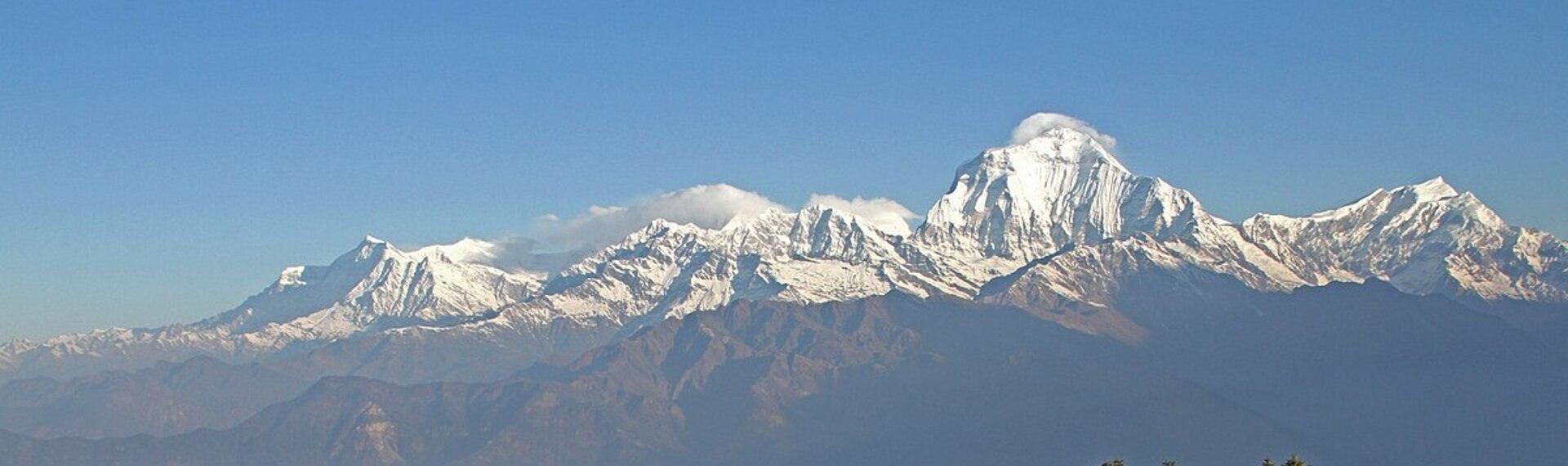
The Short Annapurna Base Camp Trek via Poon Hill is an 8-day journey into the Annapurna Conservation Area, the largest protected area in Nepal. The route reaches Annapurna Base Camp (4,130 m) at the foot of the Annapurna Sanctuary, a glacial basin surrounded by Annapurna I (8,091 m), Annapurna South (7,219 m), Hiunchuli (6,441 m), and Machhapuchhre, also called Fishtail (6,993 m). The trek begins near Pokhara and includes a sunrise climb to Poon Hill (3,210 m), where the Annapurna and Dhaulagiri ranges appear in one continuous line.

The trail traverses farmland, rhododendron and oak forest, and bamboo groves before opening into the high alpine zone above Deurali. The days at Poon Hill and Deurali give you the clearest mountain views of the trek, while the final push to base camp takes you around moraine and snow-covered ground at altitude. Descending to Jhinu Danda on the return, you can soak in natural hot springs beside the Modi Khola River, which eases tired legs before the last part back to the road.

This region is the homeland of the Gurung people, and the trek passes villages such as Ghandruk, one of the largest Gurung settlements in the Annapurna region. You can stay in family-run teahouses, eat dal bhat cooked on wood-fired stoves, and learn about Gurung history, including the long tradition of service in Gurkha regiments, directly from your hosts.

Comfort and cultural experiences are part of the design. Premium lodges with private rooms, hot showers, and better meals in the lower villages let you rest well between challenging days, while experienced guides and porters manage logistics, pacing, and altitude monitoring. This is a different experience from the Annapurna Circuit, which takes 12 to 21 days, crosses the 5,416 m Thorong La Pass, and moves through several climate and cultural zones from subtropical lowlands to the arid Manang and Mustang side.

The Annapurna Base Camp route is shorter, stays on one side of the range, and ends in a single glacial sanctuary, making it the better fit for a one-week itinerary. Nepal Alternative Treks organizes this 8-day route with licensed local guides, permit handling, and teahouse bookings throughout.

Highlights of Short Annapurna Base Camp Trek via Poon Hill

  • Stand at Annapurna Base Camp (4,130 m), surrounded by Annapurna I, Annapurna South, Hiunchuli, and Gangapurna
  • Take a scenic drive from Pokhara to Banthanti
  • Hike to Poon Hill (3,210 m) before dawn and watch the sunrise view over Dhaulagiri, Annapurna I, and Machhapuchhre.
  • Walk through rhododendron forests between Ghorepani and Tadapani
  • Explore the Gurung village of Chhomrong (2,170 m)
  • Enjoy a hot spring soak at Jhinu Danda, in a natural pool beside the Modi Khola
  • Pass through bamboo forest above Sinuwa, where you may see Himalayan langurs and, with luck, pheasants
  • Meet Gurung families in Ghandruk and other villages and learn about local farming, festivals, and Gurkha heritage firsthand
Annapurna Base Camp Trek with Poon Hill Difficulty

The Annapurna Base Camp Trek with Poon Hill is a moderately difficult trek in Nepal. The trail has no risky or technical parts, but it has long sections of stone steps. You walk 4 to 7 hours a day and cover about 8 to 15 km. Annapurna Base Camp is situated at 4,130 m, where the air is thin, and some trekkers feel sick from the height. Poon Hill (3,210 m) comes early, and the stop at Machhapuchhre Base Camp (3,700 m) gives your body time to adjust.

The weather changes fast at higher places, with cold mornings, clouds, and some snow near the base camp. Lodges are simple; hot water and phone charging cost extra, and mobile and internet signal is weak or missing in the upper villages. These small discomforts can feel stressful after several long days.

8 Days Short Annapurna Base Camp Trek via Poon Hill Itinerary

Day 1

Drive from Pokhara to Banthanti and Trek to Ghorepani (2,860 m)

Day 1 Facts

Trekking Time Average

Drive 55-60 km (2.5-3 hours)
Trek 3-4 km (2-3 hours)

Accommodation

Super View Lodge, Ghorepani

Altitude

2,860 m / 9,383 ft 

Included meals

Lunch, Dinner

Your day starts early in Pokhara, where a 4×4 jeep picks you up at your hotel. You’ll pass small farming villages before the road beyond Hile turns into a dirt-and-stone path that climbs the hills toward Ulleri. Hold on tight, because this part of the ride is rough and slow. The jeep finally stops at Banthanti, and your walk starts from there. This saves you from the steepest lower staircases and keeps your first day short.

At Banthanti, you’ll have a short rest and step straight into a thick old forest. You are already above 2,200 m, so the air feels cooler and fresher than it did in Pokhara. Small streams and little waterfalls can be seen somewhere out of sight. After a couple of hours, the trees open up, and you see the blue roofs of Ghorepani. This old crossroads village is home to the Magar people. You’ll walk through the village gates and up to the top of the ridge to check in at Super View Lodge.

Day 2

Morning Hike to Poon Hill and Trek to Chuile (2,300 m)

Day 2 Facts

Trekking Time Average

Trek 10-11 km (6-7 hours)

Accommodation

Mountain Discovery Lodge, Chuile

Altitude

2,300 m / 7,546 ft 

Included meals

Breakfast, Lunch, Dinner

Your day starts early, at 4:30 AM, when the sky is still dark. You leave your big backpack at the lodge in Ghorepani and take only a headlamp, a camera, and a warm jacket. The climb to Poon Hill (3,210 m) takes about 45 minutes on a stone staircase. At the top, a huge view opens in front of you, with more than 20 snow peaks spreading across the horizon. When the sun comes up, the Dhaulagiri range and the Annapurna range turn gold, pink, and glowing orange. After this best start, you walk back down for breakfast and pack your bag for the trek ahead.

From Ghorepani, you head east and climb toward Deurali Pass. Past the pass, the path drops into a forest with stone steps and streams running alongside. You reach the ridge village of Tadapani for lunch, then follow a steep trail down through oak and rhododendron trees. Soon the trees open up, and you reach Chuile, where you’ll spend the night.

Day 3

Trek from Chuile to Upper Sinuwa (2,340 m)

Day 3 Facts

Trekking Time Average

Trek 8-9 km (5-6 hours)

Accommodation

Hill Top Lodge, Upper Sinuwa

Altitude

2,340 m / 7,677 ft

Included meals

Breakfast, Lunch, Dinner

Your morning starts with a walk down from Mountain Discovery Lodge in Chuile by crossing terraced fields and small groups of trees. At the bottom of the valley, you’ll cross a long suspension bridge over the Kimrong Khola, a fast river with milky blue water. This is the lowest point of your day, and the trail turns straight up right after the bridge. You’ll walk past green fields of millet and corn and small farmhouses before climbing to Chhomrong, the largest Gurung village in this part of the Annapurna region.

Lunch in Chhomrong comes with a big surprise. Annapurna South (7,219 m) and Hiunchuli (6,441 m) stand so close and look even bigger than before. After your meal, you go down a long stone staircase to the bridge over the Chhomrong Khola, then start the last climb of the day through the forest. You pass Lower Sinuwa and keep going for about 45 more minutes until you reach Hill Top Lodge in Upper Sinuwa.

Day 4

Trek from Upper Sinuwa to Dovan (2,600 m)

Day 4 Facts

Trekking Time Average

Trek 7-8 km (4-5 hours)

Accommodation

Annapurna Approach Lodge, Dovan

Altitude

2,600 m / 8,530 ft

Included meals

Breakfast, Lunch, Dinner

Day 4 of the Annapurna trek takes you through dense forests, bamboo groves, and the river valley to Dovan. The path follows the side of the ridge and stays mostly flat, with a few stone steps on the way. This part of the forest is the start of the sacred upper valley, where local custom says no meat or farm animals should be brought in. After a couple of hours of walking, you’ll step into a long, damp stone staircase that drops towards Bamboo (2,310 m).

From Bamboo, you’ll walk into a thick forest, with the Modi Khola River flowing beside you. You cross wooden bridges and climb the final set of stone steps to reach Dovan, where you’ll spend the night at Annapurna Approach Lodge. A hot bowl of garlic soup is the local favorite here, and it is a good way to get your body ready for the higher ground tomorrow.

Day 5

Trek from Dovan to Deurali (3,230 m)

Day 5 Facts

Trekking Time Average

Trek 6-7 km (5-6 hours)

Accommodation

New Panorama Point Hotel, Deurali

Altitude

3,230 m / 10,597 ft 

Included meals

Breakfast, Lunch, Dinner

Your day begins with a walk up stone steps and over tree roots as the trail climbs slowly. As the valley gets narrower, the trees give way to rocky cliffs, and you can see waterfalls flowing down the rock faces from the snowy mountains above. After walking on a rocky path, you reach Himalaya (2,920 m), a small collection of lodges on the mountainside. Stop here for a cup of hot lemon tea and rest, because the air starts to feel thinner from this point on.

After Himalaya, the trees get shorter, and you cross a field of large stones. Soon you walk under Hinku Cave (3,120 m), a big rock that juts out over the trail. Porters, honey hunters, and early trekking groups used it as a place to sleep long before any lodges stood here. Past the cave, you go down to a wooden bridge, then follow the canyon floor before climbing the final stone steps to Deurali, a village situated between Hiunchuli and Machhapuchhre. This is your overnight stop for today.

Day 6

Trek from Deurali to Annapurna Base Camp (4,130 m)

Day 6 Facts

Trekking Time Average

Trek 7-8 km (5-6 hours)

Accommodation

Annapurna Sanctuary Lodge, Annapurna Base Camp

Altitude

4,130 m / 13,550 ft (sleep altitude)

Included meals

Breakfast, Lunch, Dinner

The trail follows the right side of the Modi Khola, and you walk over wide fields of river stone. Go slowly and keep a pace where you can still talk, because you are now above 3,500 m and the air has less oxygen. After a final climb up a ridge, the canyon opens, and you step onto the grassy flat of Machhapuchhre Base Camp (3,700 m). From the village, Machhapuchhre (Fishtail, 6,993 m) looks like a pyramid, but from here you see its real shape.

After a short rest at Machhapuchhre Base Camp, you start the last two hours of the walk. The path follows the Modi Khola and climbs the open valley floor. As you move forward, the mountains close in behind you until you are standing inside a full circle of snow peaks. Annapurna South (7,219 m) and Hiunchuli (6,441 m) stand on one side, and Annapurna I (8,091 m) fills the view straight ahead.

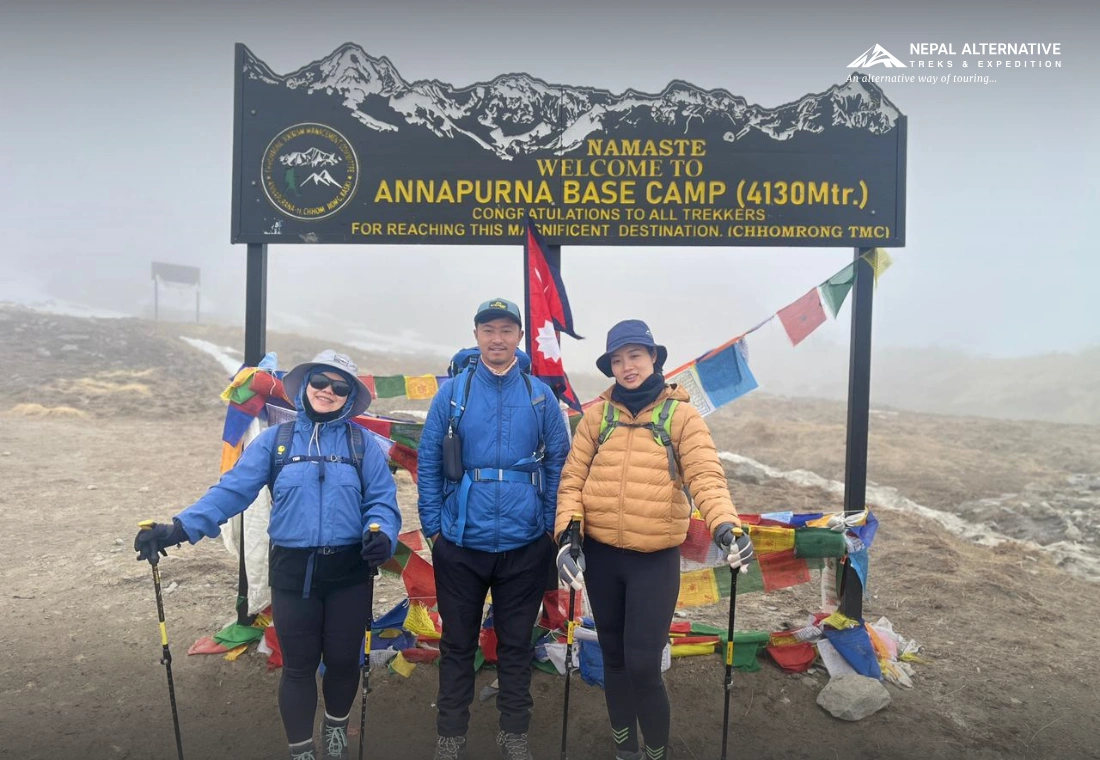
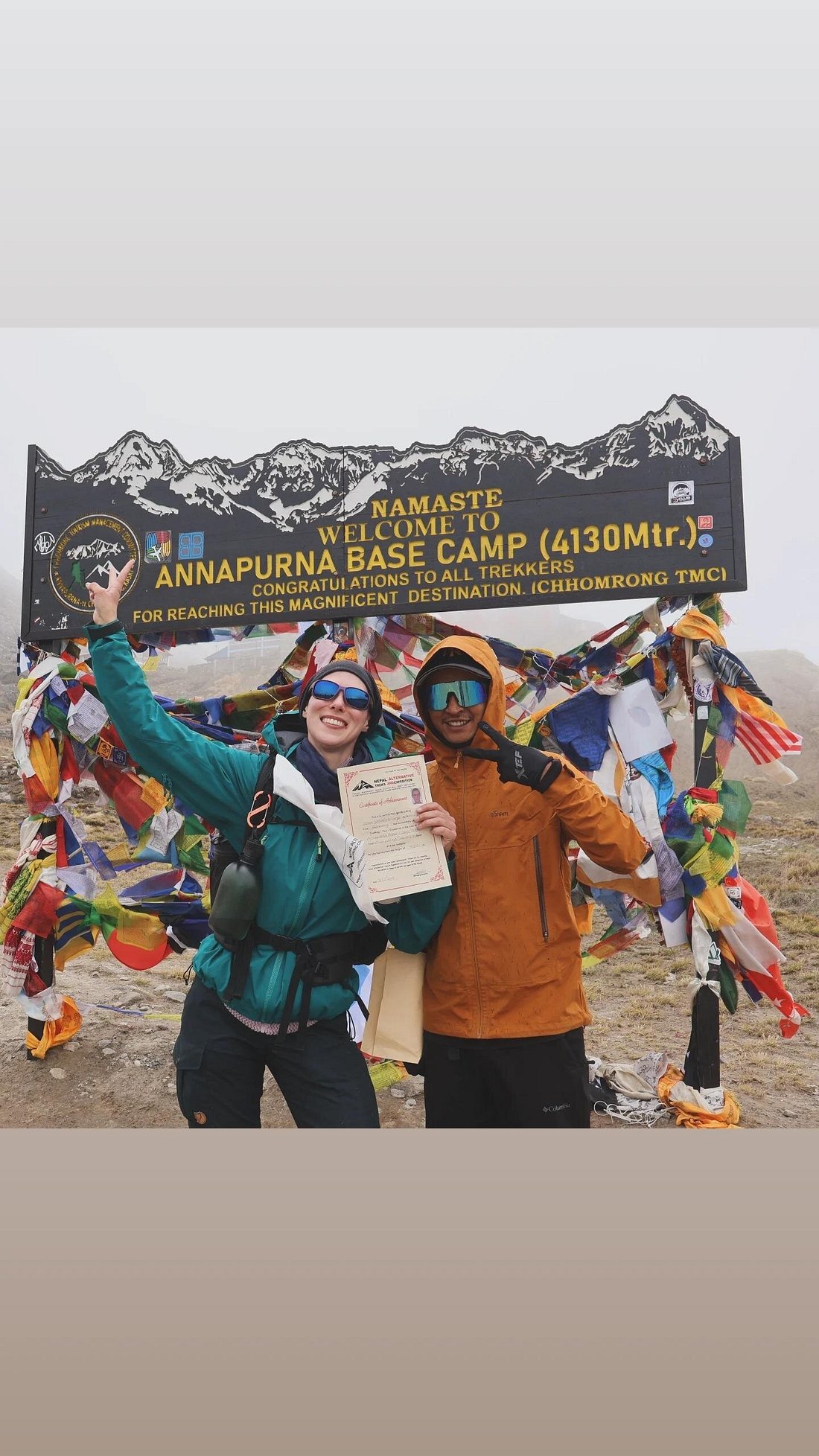
The final part takes you up a small hill decorated with colorful Buddhist prayer flags, where you pass through a gate and arrive at Annapurna Base Camp (4,130 m). In the late afternoon, stand in the middle of the valley and watch the sunset views. The huge rock of Annapurna I turns orange, pink, and gold as the light fades. After dark, the temperature falls below freezing and thousands of stars appear over the peaks.

Day 7

Trek from Annapurna Base Camp to Bamboo (2,310 m)

Day 7 Facts

Trekking Time Average

Trek 14-15 km (6-7 hours)

Accommodation

Trekking Guest House, Bamboo

Altitude

2,310 m / 7,579 ft

Included meals

Breakfast, Lunch, Dinner

Your day begins at 5:30 AM, before sunrise, as you watch the sunrise over the south face of Annapurna I (8,091 m). This is the best moment of the trek for your last group photos. After a hot breakfast, you pick up your daypack, set your trekking poles, and start the long walk down. You pass Machhapuchhre Base Camp, follow the Modi Khola and walk down the stone steps beneath Hinku Cave. At Deurali, you take a short break and enjoy a warm cup of tea.

From Deurali, you keep going down past Himalaya and Dovan. The trail follows the edge of the gorge, and you can see the white water of the Modi Khola far below. You cross small wooden bridges, and once you drop below 3,000 m you will notice that each breath comes easier. Late in the day, you walk through the bamboo forest and reach your lodge for the night. Enjoy a hot shower, have a warm dinner in the dining hall, and feel proud knowing you have completed the highest part of your trek.

Day 8

Trek from Bamboo to Jhinu Danda and Drive to Pokhara (822 m)

Day 8 Facts

Trekking Time Average

Drive 60 km drive (2.5-3 hours)
Trek 8-9 km hike (4-5 hours)

Accommodation

Self Hotel

Altitude

822 m / 2,697 ft

Included meals

Breakfast, Lunch

The route passes Upper Sinuwa and Lower Sinuwa and brings you out on a forest ridge. Turn around here for a final look at Chhomrong, with houses spreading on the other side of the valley. Then you go down a long stone staircase to the bridge over the Chhomrong Khola. You skip the big climb back up to Chhomrong and take the left path at the junction instead. It leads you to Jhinu Danda, a Gurung village high above the Modi Khola, with terraced fields of millet and corn all around it.

Leave your bags in the village and walk about 20 minutes down to the hot springs beside the Modi Khola. There are three stone pools with naturally warm water, and sitting in them is the best way to thank your legs for all those stairs. After lunch in Jhinu Danda, you walk the short trail to the road and cross the long Jhinu suspension bridge, one of the longest in the Annapurna region.

Your jeep waits on the other side and takes you through Birethanti and Nayapul, and onto the paved highway to Pokhara. By evening you reach Lakeside, where a hot shower, a soft bed and a cold drink are waiting for you at Hotel Self.

What do you get in the Trip?

What’s included

  • Lodge accommodation (double/twin sharing basis) during the trip.
  • All meals (breakfast, lunch, and dinner) along the trek.
  • One highly experienced, first aid-trained, fluent English-speaking, friendly, and government-authorized trekking guide and porters (one porter for two persons).
  • Guide/porter food, accommodation, salary, insurance, transportation, and equipment.
  • Overland transportation as mentioned in the itinerary.
  • Annapurna Conservation Area Project (ACAP) permit and necessary documents.
  • A trekking map, daily oxygen saturation check-up, beanie, first aid kit, water purification, fresh seasonal fruits, trekking completion certificate, company T-shirt, etc.
  • Government taxes and service charges.
  • Assistance with emergency rescue evacuation.
  • Public liability insurance.

What’s not included

  • Hotel accommodation and meals in Kathmandu/Pokhara.
  • Hard and soft drinks such as tea/coffee, Coke, Fanta, hot water, bottled water, beer, and bar drinks, as well as hot showers, device charging, laundry, and phone bills.
  • Personal travel insurance.
  • International flight tickets.
  • Nepal tourist visa fee.
  • Tips for guides and porters (highly suggested).

Add-ons and Options

Add-ons support your Short Annapurna Base Camp with Poon Hill trek with easy travel, essential gear, city tours, rafting, flights, and Pokhara stays. These add-ons can be included directly when you reserve your trek.

Go to the Join Our Group Departure or Book the Trip area, select the departure date you prefer, and continue through to checkout. On the checkout screen, you will see a menu of optional extras such as transport upgrades, trekking gear rental, sightseeing tours, and adventure experiences. You’re free to pick as many as you want and to increase the quantity for each option, so they are all added to your booking total before you confirm payment.

List of available add-ons:

  • Kathmandu to Pokhara by VIP Sofa Tourist Bus (USD 15 per person one way / USD 30 round trip): Travel by tourist bus with sofa-style seats between Kathmandu and Pokhara.
  • Private Vehicle Transfers Kathmandu to Pokhara (car USD 100, jeep USD 150, van USD 200): Use private cars, jeeps, or vans for more comfortable travel between Kathmandu and Pokhara.
  • Gear Rental (sleeping bags USD 10, jackets USD 10, Crampons/Spikes USD 10, poles USD 10): Rent essential trekking gear like sleeping bags, warm jackets, a pair of crampons/spikes, and a pair of walking poles instead of buying everything yourself.
  • Pokhara Sightseeing (USD 30 per person): Explore Pokhara’s lakeside, viewpoints, and key attractions with a guided tour.
  • Rafting at Trishuli River (USD 45 per person): Add a Trishuli rafting day for extra adventure around your trek.
  • Kathmandu City Tour (USD 30 per person): Visit temples, Durbar Squares, and markets in Kathmandu with a local guide.
  • Kathmandu to Pokhara by Flight (USD 120 one way / USD 240 round trip): Fly between Kathmandu and Pokhara to shorten travel time.
  • Paragliding in Pokhara (USD 90 per person for 45 minutes): Enjoy tandem paragliding over Pokhara with views of the Annapurna range.
  • Zipline in Pokhara (USD 80 per person): Try a zipline ride in the Pokhara area for a short, exciting add-on.
  • Pokhara to Kathmandu by Private Transport (car USD 100, jeep USD 150, van USD 200): Return from Pokhara to Kathmandu in a private vehicle for a smoother road journey.
  • Hotel Accommodation in Pokhara (USD 50 per night for a double/twin share room with breakfast): Stay in a comfortable Pokhara hotel with breakfast included before or after your ABC trek.
  • Everest Aerial Tour 1 hour (USD 300 per person): Take a 1-hour aerial tour around Everest, including private airport transfers from your hotel in Kathmandu. This is a scenic, in-air tour without a landing.

Route Map

Trail
Return Trail

Join our group departures

We do not have any scheduled group trips, but you are welcome to pick a date that suits you best.

Book a private trip on your own date.

Every journey we create is uniquely tailored to you. Share your interests and passions, and our travel experts will design an unforgettable adventure filled with extraordinary, one-of-a-kind experiences crafted just for you.

Private Booking
Additional Trip Information

Mountain Views During Short Annapurna Base Camp Trek via Poon Hill

This trek puts a different Himalayan view in front of you almost every day, from the panorama at Poon Hill to the snow-covered peaks that surround Annapurna Base Camp. The views change with the route, so the order below follows how they appear day by day.

  • Ghorepani village: From Ghorepani, the northern horizon opens and gives you a first full look at the Dhaulagiri and Annapurna South.
  • Poon Hill panorama: At sunrise, you can see more than 20 peaks at once from the Dhaulagiri range across the Nilgiri peaks to the Annapurna massif.
  • Machhapuchhre from Chuile: On the descent from Poon Hill to Chuile, you can look at the west face of Machhapuchhre (Fishtail).
  • Chhomrong and Upper Sinuwa: Past Chhomrong, you can see Annapurna South and Hiunchuli.
  • Machhapuchhre Base Camp approach: Beyond MBC, the valley becomes wider, and Machhapuchhre stands right in front of you.
  • Sunrise at Annapurna Base Camp: You stand inside a ring of ice and snow while the sun lights the south face of Annapurna I in gold.

Traditional Gurung and Magar Villages On the Route 

The trek starts in Magar country. The Magar are one of the oldest groups living in the hilly region of Nepal, and their homes sit on the high ridges around Poon Hill. Ghorepani gets its name from two Nepali words: “ghore” means horse and “pani” means water. Long ago, mule and horse traders stopped here to rest and water their animals. Look for older Magar women in long skirts and velvet blouses. Many wear large gold nose rings and necklaces of coral and amber, and each piece is passed down in the family.

After Poon Hill, the trail drops into the land of the Gurung, who also call themselves Tamu. Their villages are small groups of stone and wooden houses with slate roofs, such as Chuile and Tadapani. Chhomrong is the largest of them. Families dry grain and spin wool in the courtyards, and elders weave bamboo baskets and checkered wool blankets by hand. Inside the teahouse dining rooms, you will see old photos and medals on the walls. They show fathers, grandfathers, and sons who served as Gurkha soldiers in the British or Indian army. Ask your host about them, because most families are happy to share the story behind each picture.

Why Combine Poon Hill With Annapurna Base Camp?

Poon Hill is a smart way to start the Annapurna Base Camp trek because it helps your body get used to the height before the hardest days. Going straight to Annapurna Base Camp can make you feel sick from the thin air, with headaches, tiredness, or poor sleep. On this route, you spend your first nights around Ghorepani and climb Poon Hill (3,210 m) early on. You sleep at moderate height and then go higher, which is the way trekkers are advised to adjust.

The two places also give you very different mountain views. Poon Hill is a large viewpoint, where you see more than 20 peaks from the Dhaulagiri range to the Annapurna range. Annapurna Base Camp is the opposite. You stand at the bottom of a huge bowl, close to walls of ice and rock that stand about 4,000 m above you. On the way, the land keeps changing too. You pass farmland, rhododendron and oak forests, damp bamboo woods, and finally the bare ground near the glacier. Because both routes use the same trail through the Modi Khola valley, the Poon Hill part adds only two or three days. For that small extra time, you see much more of the mountains, the villages, and the way of life on the trail.

Why This Trek Appeals to Both First-Time and Experienced Trekkers

This 8-day trek is easy enough for beginners and enjoyable even for those who have already explored other popular trekking routes in Nepal. Both groups get the same payoff: a close look at Annapurna I from inside the Sanctuary.

  • Slow height gain: Poon Hill (3,210 m) comes before Annapurna Base Camp (4,130 m), so first-timers can see how their body handles the height early on.
  • Comfortable teahouse stays: Every night is spent in a village lodge with a bed and a hot meal, so no tent or camping gear is needed.
  • Easy-to-follow trail: The path follows stone steps and clear forest tracks, with no slippery rock or narrow ridges.
  • Shorter walking time: Jeep access up to Banthanti helps beginners skip the steepest lower staircases and fit the trek into 8 days.
  • Fast reward for experienced hikers: You stand below the 8,000 m wall of Annapurna I about six days after leaving Pokhara, which is far quicker than most big base camp treks.
  • Light packing: Because lodges are found along the whole route, seasoned trekkers can carry a small pack and cover long days.
  • Local culture on the trail: Magar and Gurung villages in the first half of the walk add stories, food, and traditions that mountain routes do not offer.

Permits, Regulations, and Entry Requirements for the Annapurna Region

If you plan to trek to Annapurna Base Camp via Poon Hill, make sure you have all the required permits and documents before starting your journey. Check the table below for more information.

Requirement / Rule Details & Costs Important Info
Annapurna Conservation Area Permit (ACAP)
  • Foreign Nationals: NPR 3,000 (~USD 20)
  • SAARC Nationals: NPR 1,000 (USD 7)
  • Children Under 10: Free
  • Mandatory single-entry permit.
  • Must be printed as a physical hard copy before the trek.
Where to Apply & Acquire
  • Nepal Tourism Board (NTB) or NTNC offices in Kathmandu or Pokhara.
  • Online application via the official NTNC e-Permit Portal.
  • Cannot be obtained on the trail.
  • Trying to buy it at a checkpoint results in a 100% fine penalty.
Required Application Documents
  • Original passport and photocopy
  • Two passport-sized photographs
  • Cash in Nepalese rupees (NPR)
  • If applying online, high-resolution digital copies are needed.
  • Card payment or foreign currency is rarely accepted.
Main Checkpoint Verification
  • Birethanti (trail entry/exit)
  • Chhomrong (Sanctuary gate)
  • You must present your original physical ACAP permit and passport at each gate.

Which season is Best for the short Annapurna Base Camp Trek via Poon Hill?

The best seasons for the Short Annapurna Base Camp Trek via Poon Hill are Spring (March to May) and Autumn (September to November), which offer the most stable weather and clear views of the mountains.

Season Months Weather & Temperatures Highlights
Spring (Best) March, April, May
  • Days: 10°C to 20°C
  • Nights: -8°C
  • Blooming rhododendron forests
  • Fully clear mornings
Autumn (Best) September, October, November
  • Days: 12°C to 20°C
  • Nights: -3°C to -4°C
  • Top mountain visibility after the monsoon
  • Busiest peak months need advance booking
Winter (Challenging) December, January, February
  • Days: 5°C to 10°C
  • Nights: -10°C to -15°C
  • Complete solitude
  • Extreme sub-zero cold and high avalanche risk at ABC
Monsoon (Avoid) June, July, August
  • Days: 20°C to 25°C
  • Daily rainfall
  • Slippery stone stairs, leeches, and blocked views
  • Road blockages and landslide delays

Altitude and Acclimatization During the Trek

The highest point of this trek is Annapurna Base Camp (4,130 m), where the air holds about 60% of the oxygen you get at sea level. The trail builds up to this height in steps. You first climb Poon Hill (3,210 m) and then sleep lower in Ghorepani (2,860 m), which gives your body an early taste of thin air with little risk. The up-and-down path from Chhomrong to Sinuwa keeps your heart and legs working continuously. After Deurali (3,230 m), the air thins faster, so Machhapuchhre Base Camp (3,700 m) works as a key stop.

A few simple habits keep you safe and comfortable. Walk slowly enough that you can chat with a friend. Drink 3 to 4 liters of water each day and eat rice, lentils, and other filling meals such as dal bhat, because your body needs extra fuel at height. Mild headaches and tiredness are common, so rest and sip water when they appear. Tell your guide right away if you have a strong headache, dizziness, or nausea. If these signs do not fade, the safest choice is to walk down to a lower village, where most people feel better quickly.

Packing List for ABC with Poon Hill Trek

Pack light, because most of the route is stone steps and you will carry your daypack each day. This list covers the essentials for an 8-day teahouse trek.

Category Items to Pack
Clothing 2 to 3 quick-dry T-shirts, 1 warm fleece, 1 light down jacket, 1 waterproof rain jacket
Legs 2 trekking trousers, 1 pair of thermal leggings, 1 pair of shorts (optional)
Footwear Broken-in trekking boots, 3 to 4 pairs of wool socks, 1 pair of light sandals or shoes
Head and Hands Sun hat, warm wool cap, light gloves, scarf or neck buff
Backpack Daypack (25 to 30 L), rain cover, waterproof bags for clothes
Sleeping Sleeping bag rated to about -10°C (can be rented in Pokhara)
Walking Aids Trekking poles
Light and Power Headlamp with spare batteries, power bank, charging cable
Water 1 to 2 reusable bottles (1 L each), water purification tablets or filter
Sun Care Sunglasses with strong UV cover, sunscreen (SPF 50), lip balm
Health Personal medicines, headache tablets, blister plasters, hand sanitizer, toilet paper, wet wipes
Toiletries Small towel, toothbrush and toothpaste, soap, quick-dry towel
Documents and Money Passport, trekking permits (arranged by your trek company), travel insurance papers, Nepali rupees in cash
Extras Camera or phone, book or cards, snacks such as nuts and chocolate, small notebook

FAQs

Related Trips

View Detail For Gokyo Lake Trek with Helicopter Return
Luxury Annapurna Gurung Trek Banner
Gokyo Lake Trek with Helicopter Return
Difficulty: Moderate to Challenging
View Trip Details
View Detail For Luxury Annapurna Gurung Trek
Luxury Annapurna Gurung Trek Banner
Luxury Annapurna Gurung Trek
From $2,190.00
Difficulty: Easy to Moderate
View Trip Details
View Detail For Mera Peak Climbing With Heli Return – 10 Days
Mera Peak Climbing With Heli Return Banner
Mera Peak Climbing With Heli Return – 10 Days
Difficulty: Moderate
View Trip Details
Recommended by 100% of travelers
Sign up to our newsletter

Stay up to date with the latest news,
announcements, and articles.

Newsletter
We respect your privacy. Unsubscribe at any time.
Click To Chat