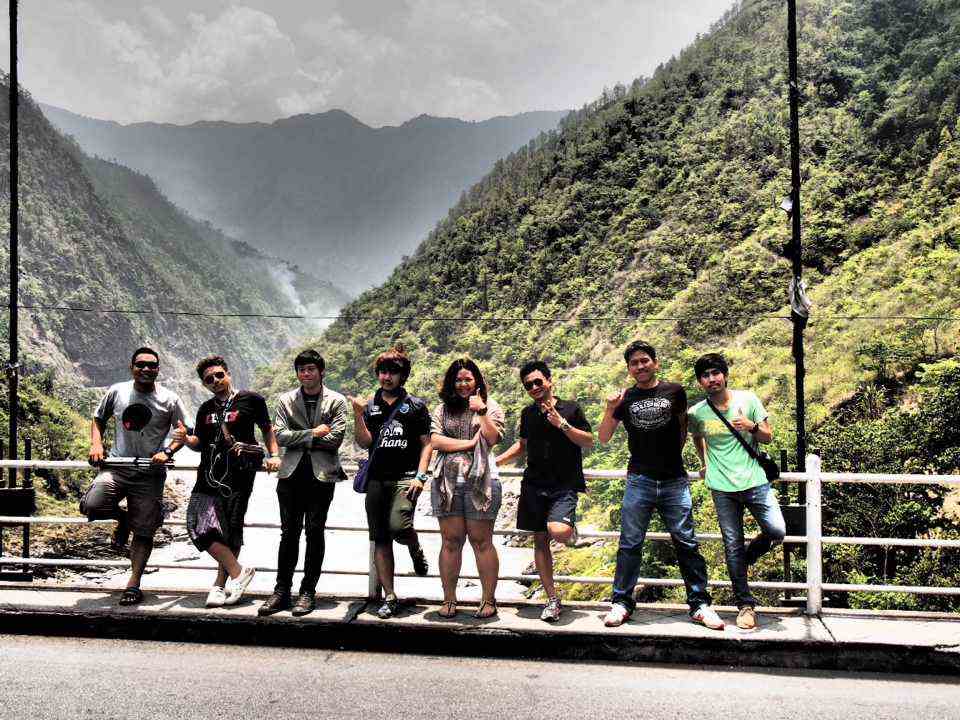
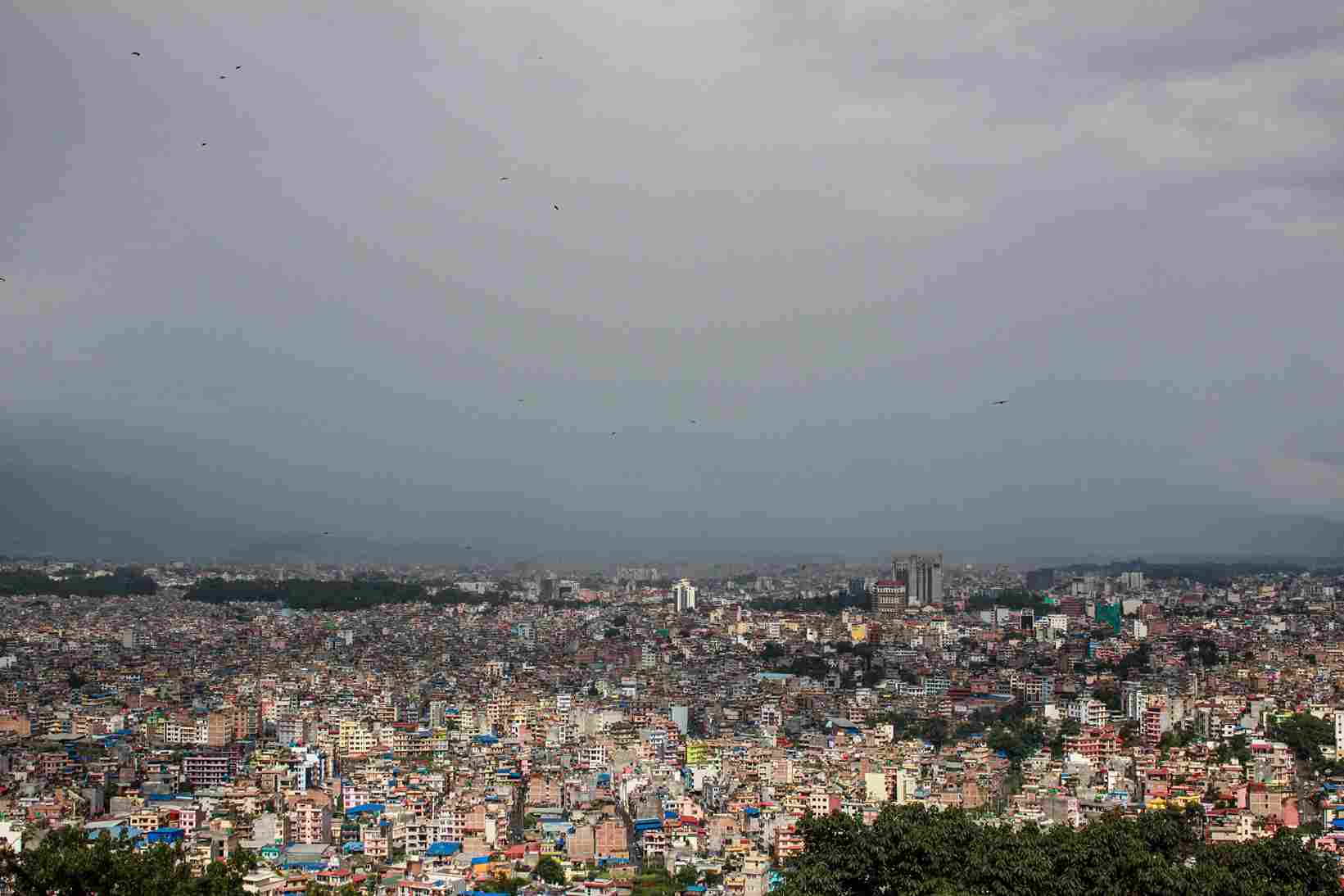
The Annapurna Circuit Trek is a popular trekking route for exploring the entire Annapurna massif. The journey doesn’t just take you through the mountain villages and mountain life but also ensures you connect with it deeply. In just one trip and within 11 days, you’ll walk through warm valleys with green rice fields, visit old trading villages, trek through rhododendron forests, deep river gorges, and eventually reach Thorong La Pass (5,416 m).
The Annapurna Circuit Trek lies within Nepal’s Annapurna region and passes through the Annapurna Conservation Area. The mountain views are the highlights of the trek, featuring the Annapurna, Dhaulagiri, Machhapuchhre (Fishtail), and Nilgiri mountain ranges from almost every step of the walk.
The Annapurna Circuit Trek is done in a counter-clockwise direction, which is safer and allows for better acclimatization to the altitude. Likewise, the trek is designed for adventure seekers who want a combination of mountain views, varied scenery, a unique cultural experience, and a true sense of exploration.
Ready to encircle Annapurna Massif?
Send us an inquiry, and we will reply within 12 hours with available departure dates for 2026, group size options, and the booking form.
Cross one of Nepal’s high mountain passes, Thorong La Pass, at 5,416 m.
Enjoy stunning views of the entire Annapurna massif, Dhaulagiri, Machhapuchhre (Fishtail), Gangapurna, and many other peaks from up close.
Stand above the Kali Gandaki Gorge, the deepest gorge in the world, which sits between the mountain peaks of Annapurna and Dhaulagiri.
Experience the rich culture and traditions of Tibetan-influenced communities and enjoy their warm hospitality.
Visit the famous pilgrimage site for Hindus and Buddhists, the Muktinath Temple, known for its spiritual significance.
Trek through dense forests of rhododendrons, oaks, and firs before reaching arid alpine valleys and high mountain passes.
Annapurna Circuit Trek Difficulty
The Annapurna Circuit is a strenuous trek. The trek doesn’t involve any technical climbing, but its high altitude, varied landscape, and long trekking days make it challenging. The ultimate physical and mental challenge of the Annapurna Circuit route is Thorong La at 5,416 m (17,769 ft), where thin air and steep sections make trekking tough.
Additionally, the terrain constantly changes, from slippery ice after Thorong La Pass to rocky, uneven trails and endless uphill sections. Each day involves walking 5–7 hours across varying elevations, often going up and down continuously. The weather is another challenge of the Annapurna Circuit Trek, as it changes quickly, with warm, sunny mornings turning cold and snowy by afternoon. Despite the tough conditions, the trek is manageable with good preparation and a strong mindset.
11 Days Annapurna Circuit Trek Itinerary
Day 1
Team READY
Team READY
Dal Bhat
Dal Bhat
Marshyangdi River
Marshyangdi River
Besisahar
Besisahar
Ready for Annapurna Circuit Trek
Ready for Annapurna Circuit Trek
Team Ready for Annapurna Circuit trek
Team Ready for Annapurna Circuit trek
Drive to Besisahar (860 m)
Day 1 Facts
Trekking Time Average
160 km Drive
(6 hours)
Accommodation
Gateway Himalayan Resort or Similar category
Altitude
(860m / 2,805ft)
Included meals
Lunch, Dinner
The first day of the Annapurna Circuit journey begins not by foot but by road. Leaving Kathmandu’s bustle behind, you’ll travel west along the Prithvi Highway. As the drive continues, the scenery gradually changes from the busy city to terraced fields, small villages, and lush green hills.
After several hours of driving, you’ll reach Dumre. Up to this point, the journey follows a smooth highway. Beyond Dumre, the road becomes narrower and rougher, winding along the Marsyangdi River and the mountainside. Expect a bumpy but scenic drive with views of cascading waterfalls, rushing rivers, and forested hills. After another 1–2 hours from Dumre, you’ll arrive at Besisahar, the gateway to the Annapurna region.
Upon arrival in Besisahar, check in to Gateway Himalayan Resort, enjoy a hot meal or drink, and relax. Have dinner at the hotel before getting an early night’s rest in preparation for the trek ahead.
Day 2
Jeep drive to Chame
Jeep drive to Chame
Chamje Waterfall
Chamje Waterfall
Taal village
Taal village
View from Chame
View from Chame
Drive to Chame (2,710 m)
Day 2 Facts
Trekking Time Average
80 km Drive
(Avg 5 hrs)
Accommodation
Four Seasons Hotel or Similar category
Altitude
(2,710 m / 8,891 ft)
Included meals
Breakfast, Lunch, Dinner
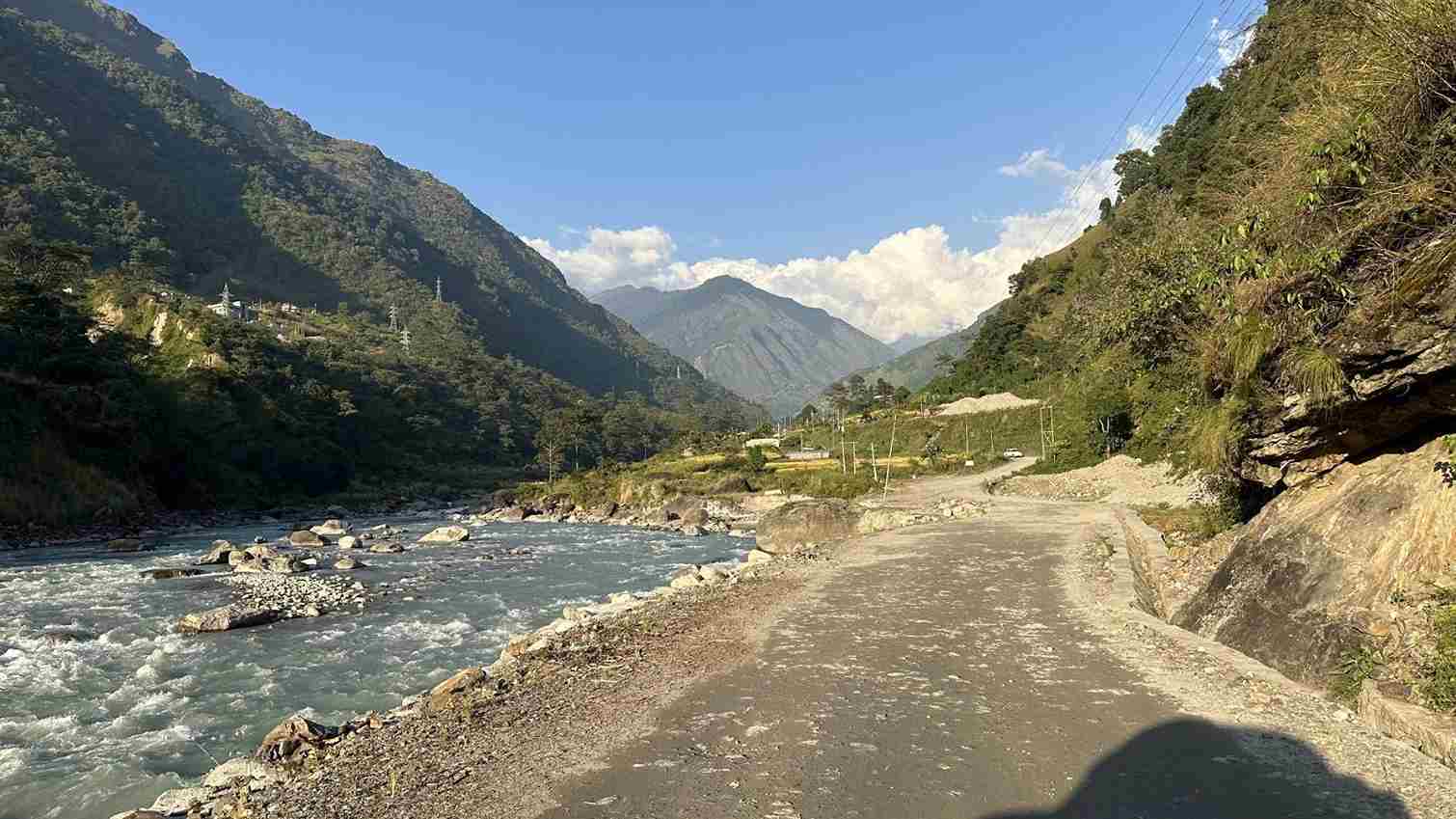
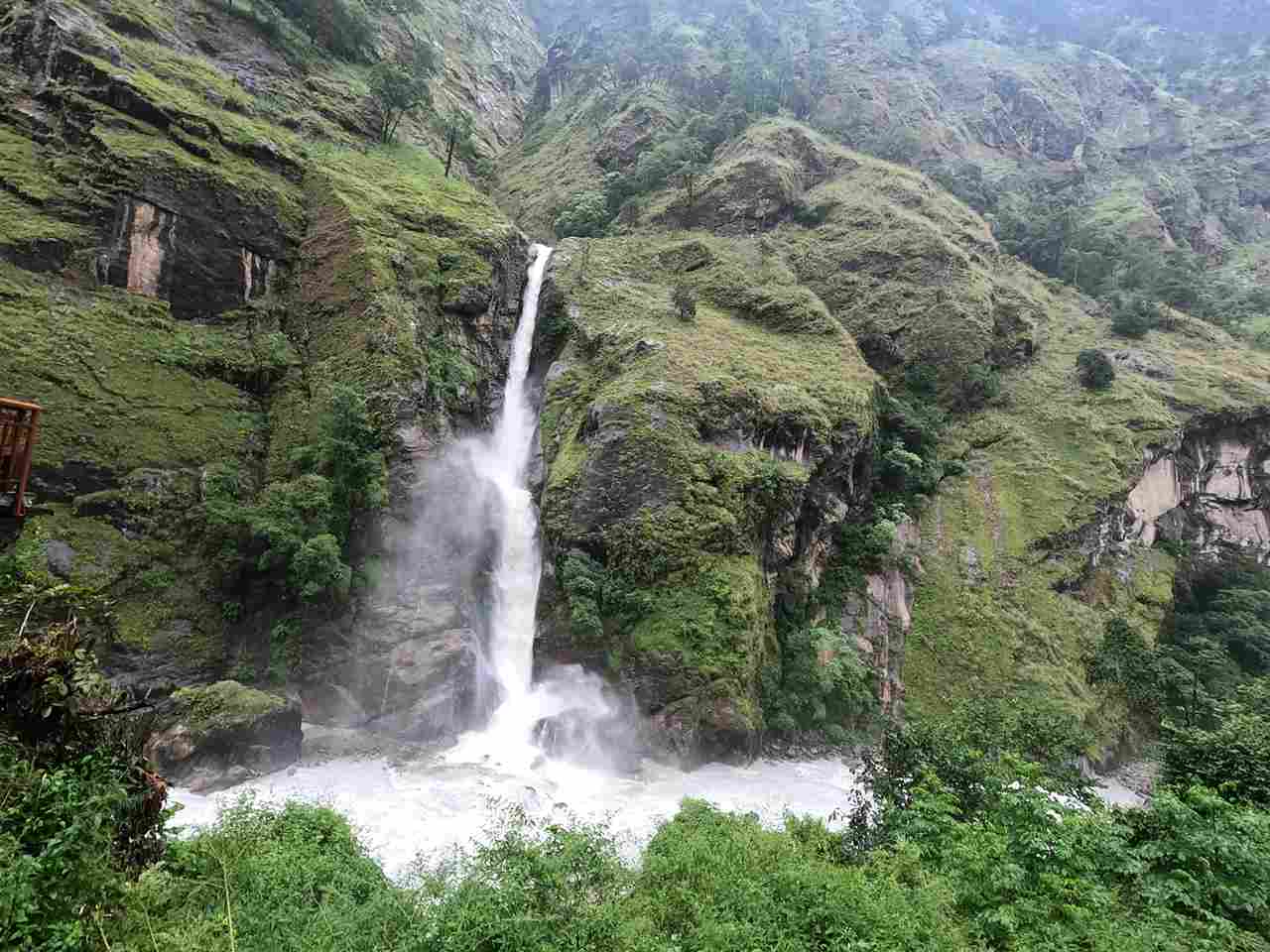
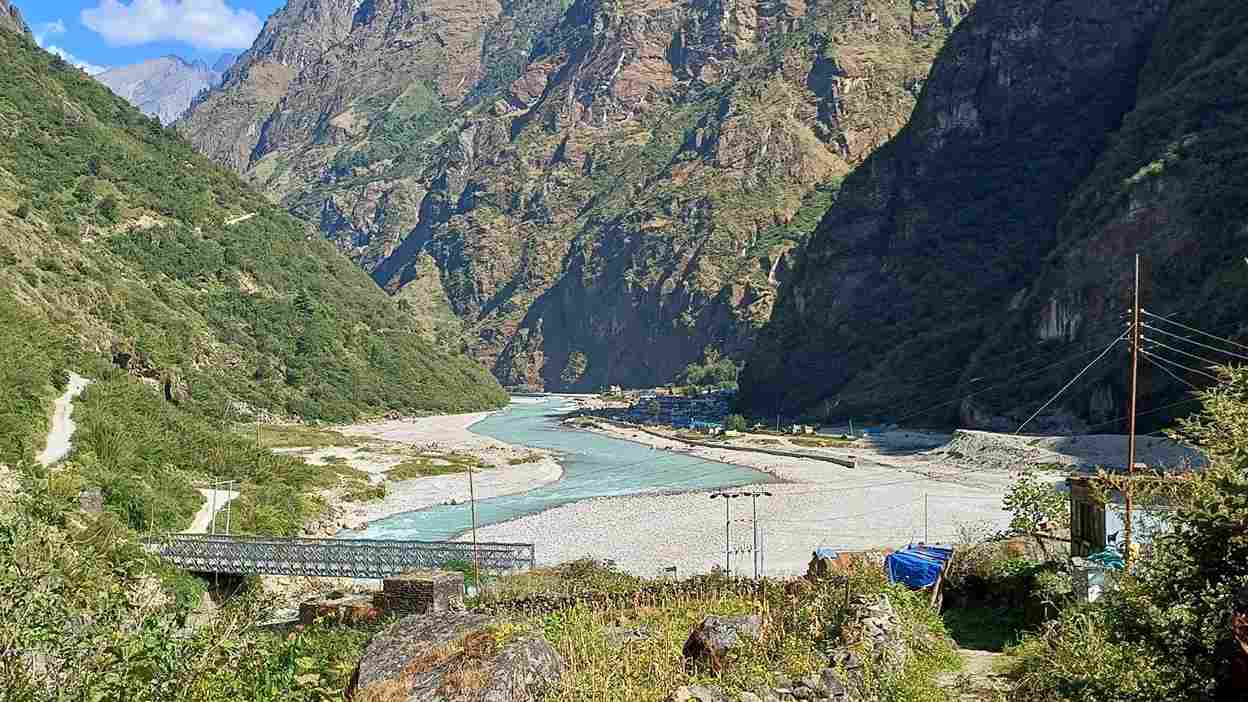
Wake up with a crisp Himalayan wind and the chirping sound of birds. Have breakfast at your hotel and pack your bag. It’s also a drive day that takes you to Chame from Besisahar. As the drive begins, you see the Marsyangdi River flowing through narrow valleys, dense forests, and mountain landscapes. The road is rough in some sections, winding along cliffs and riverbanks, but the constant scenery doesn’t give a chance to focus on that part.
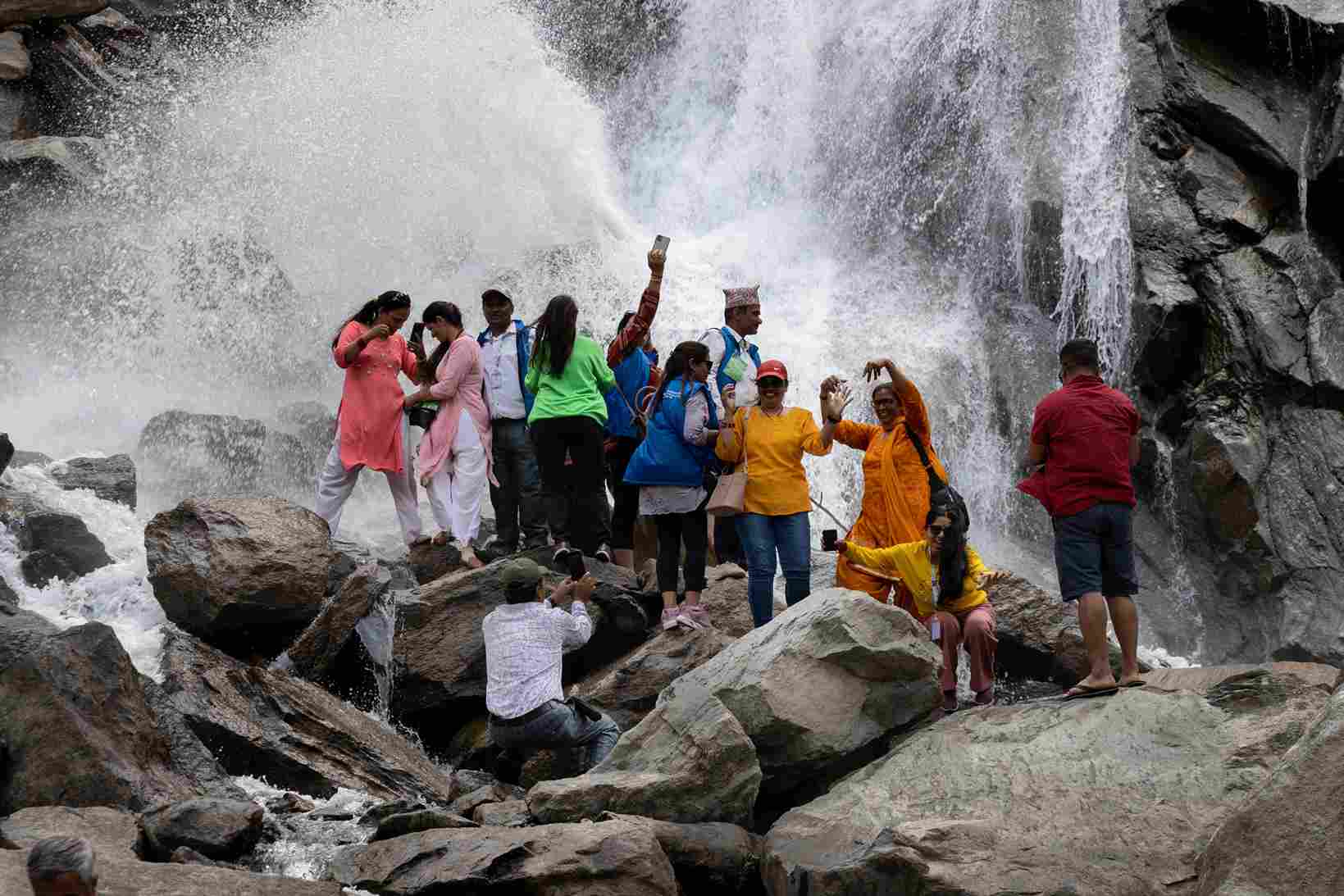
By midday, you reach Taal, a beautiful village located on an ancient lakebed. There, you’ll stop to have lunch while enjoying mountain views and the Marsyangdi River. After lunch, the drive continues, and you start to experience altitude gain. Before reaching Chame, you’ll pass impressive waterfalls and see mountains coming into view, which signal your arrival in the Himalaya.
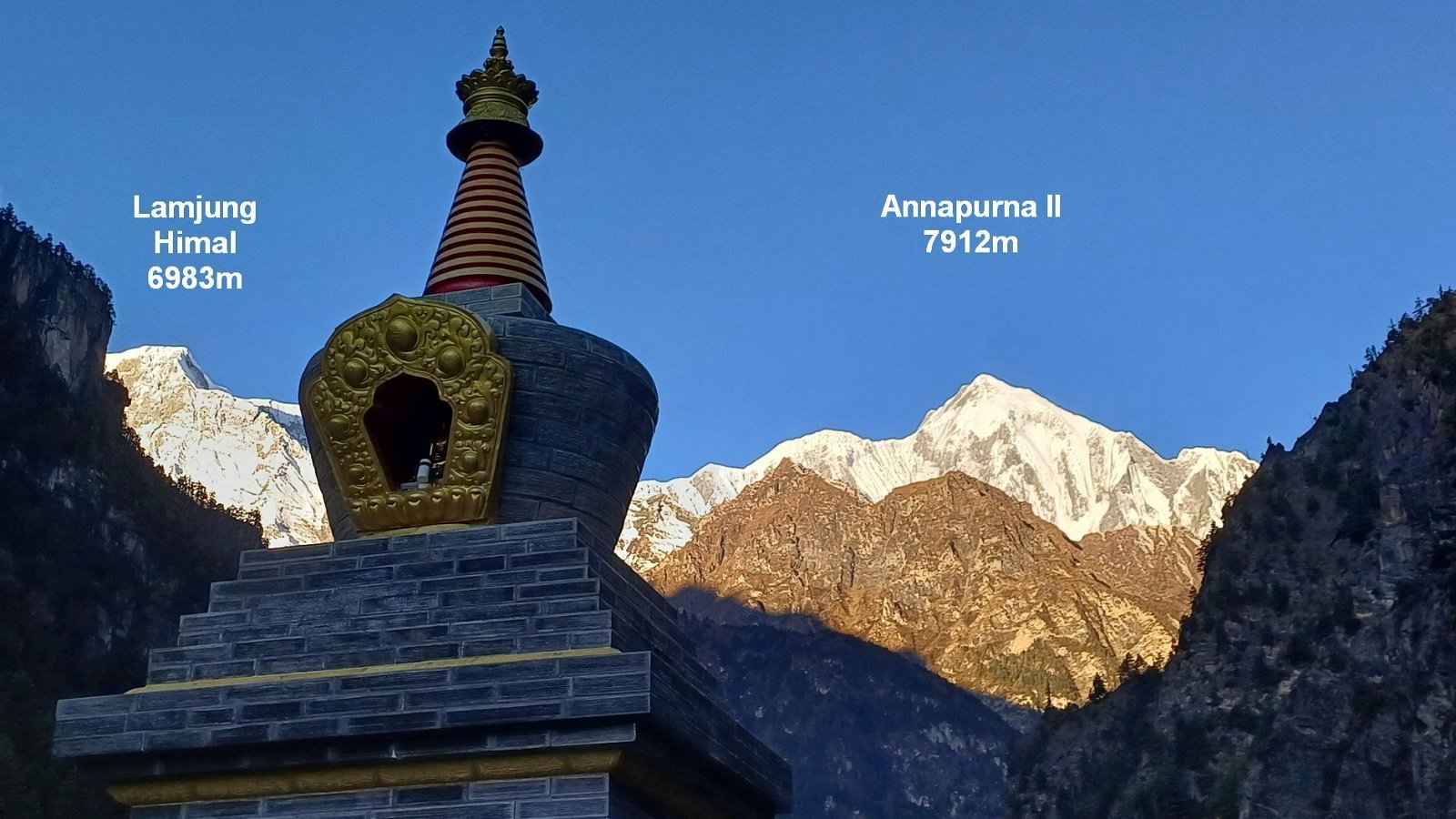
At Chame, you’ll stay at the Four Seasons Hotel and have dinner there. Rest well and enjoy the mountain atmosphere as you take in views of Lamjung Himal (6,983 m) and Annapurna II (7,937 m) from the village on clear days. Sleep well, as from tomorrow on, you begin your official trek.
Day 3
At Lower Pisang
At Lower Pisang
Dhikur Pokhari Cliff
Dhikur Pokhari Cliff
Souvenir Shop
Souvenir Shop
Upper Pisang Village
Upper Pisang Village
Trek to Upper Pisang (3,300 m)
Day 3 Facts
Trekking Time Average
15 km
(6 hours)
Accommodation
Mandala Hotel or Similar category
Altitude
3,300 m / 10,827 ft)
Included meals
Breakfast, Lunch, Dinner
After enjoying a delicious breakfast at Chame, you will start the first day of the trek. As the trek begins, you walk alongside the Marsyangdi River, which winds through pine forests, small streams, and views of mountain peaks in the distance. Along the way, you’ll pass through Bhratang, a small village known for its apple orchards and beautiful scenery. If you want, you can take a short break in the village while enjoying the mountain atmosphere.
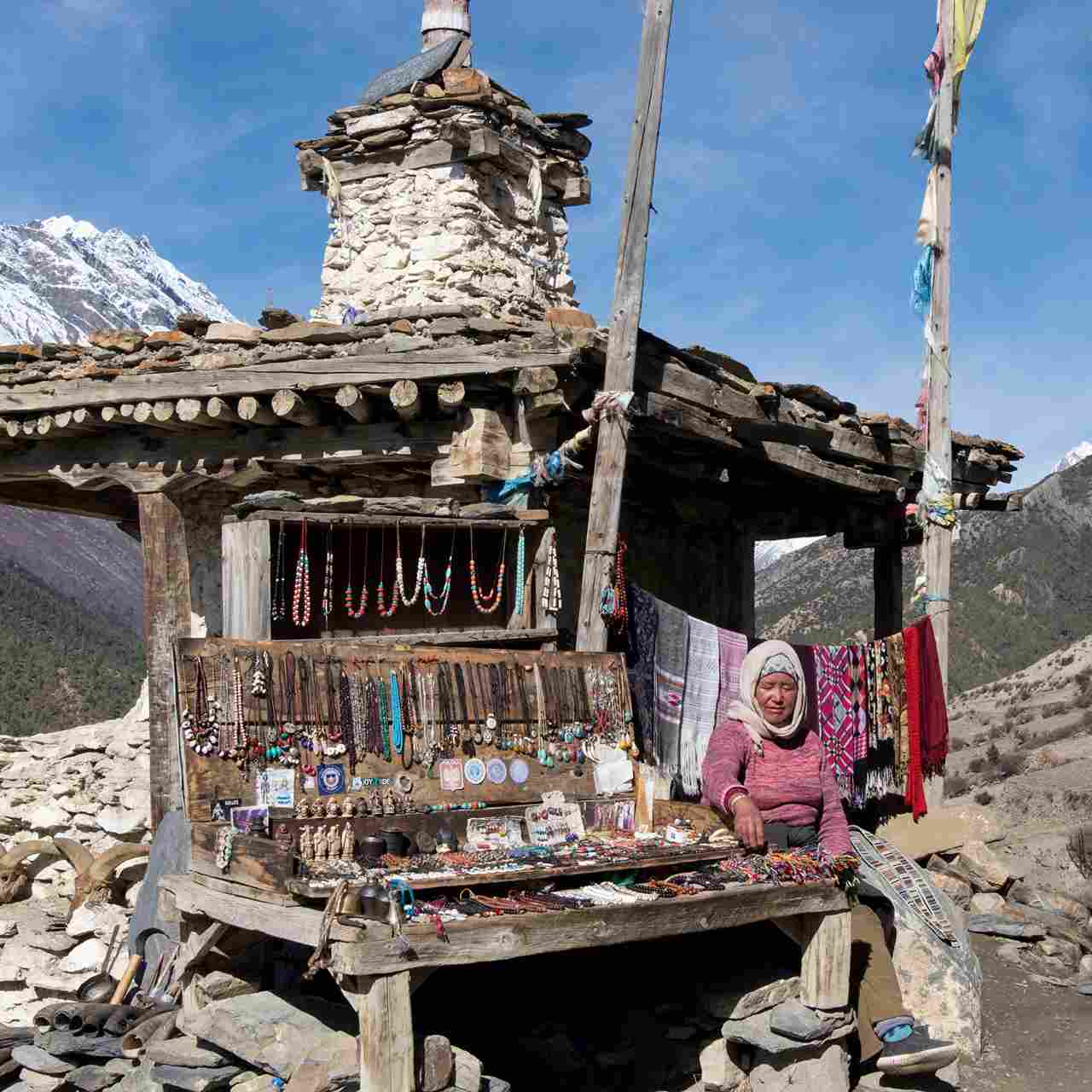
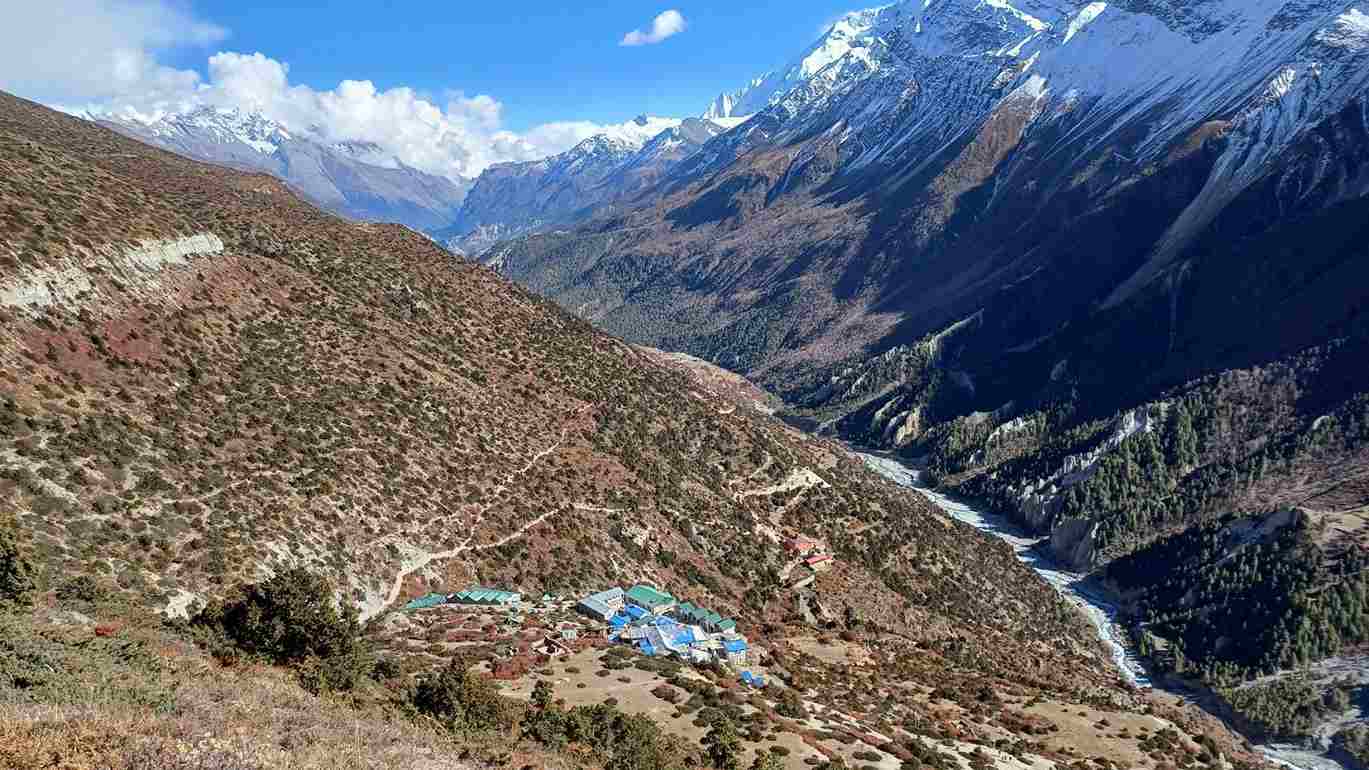
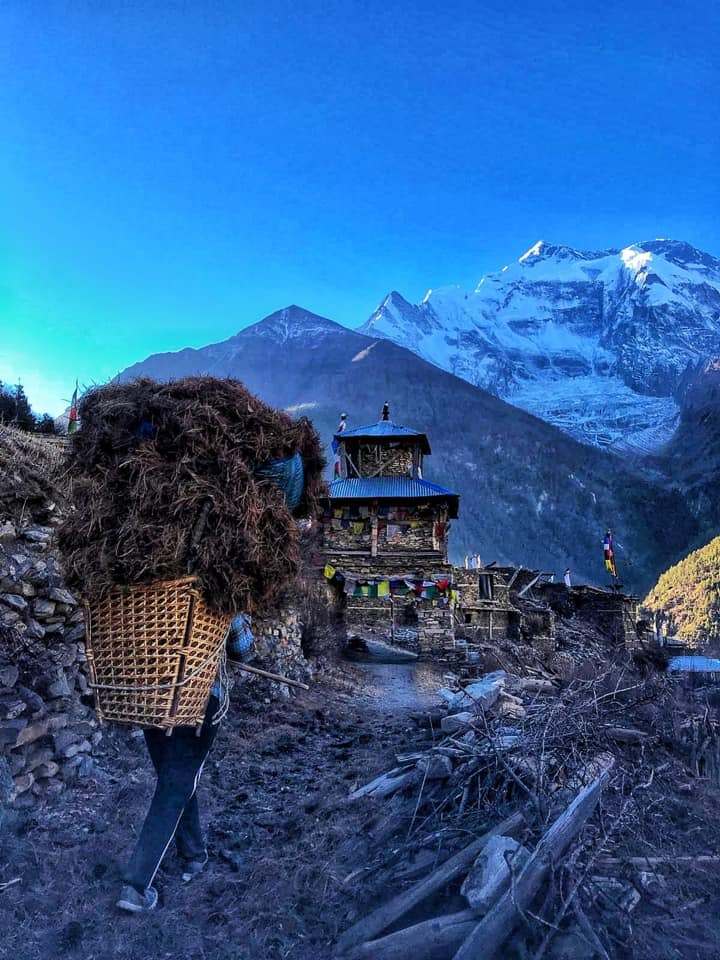
Continuing the trek from Bhratang, you’ll descend to Dhikur Pokhari and cross suspension bridges, following the river valley. From Dhikur Pokhari, the trail climbs again, taking you to Lower Pisang. Beyond, you experience the changing landscape. You feel that the forest becomes thinner and the views of the Annapurna range start to appear. As you get to Pisang, prayer flags, mani walls, and a stone-built home, and mountain peaks will surround you. Stay overnight at the teahouse of Upper Pisang.
Day 4
Marshyangdi and Annapurna II
Marshyangdi and Annapurna II
At Humde Village
At Humde Village
At Braga Village
At Braga Village
Manang Village
Manang Village
Trek to Manang (3,500 m)
Day 4 Facts
Trekking Time Average
16 km Uphill Hike
(6 hours)
Accommodation
Hotel Tilicho or Hotel Gangapurna
Altitude
(3,500 m / 11,483 ft)
Included meals
Breakfast, Lunch, Dinner
Start your morning with a hearty breakfast at the Mandala Hotel in Upper Pisang. As you leave the village, stunning sights of the mountain will be in front of you. The trail gives you a look over the Marsyangdi Valley below and the peak of Annapurna II right in front of you. Starting the trek, the trail splits into two options: a lower valley route and a higher trail that passes through Ghyaru and Ngawal. The higher route is common because it offers uninterrupted Himalayan views that the lower path simply cannot match.
Ngawal is the first major stop on the route and a great place to have lunch. The village is small and has a traditional Tibetan feel, with stone houses, flat roofs, colorful prayer flags, and a peaceful atmosphere. After lunch, the trail becomes gentler and continues west along the mountainside. You’ll pass through Ghyaru village before descending to Humde. The village of Humde is home to one of Nepal’s highest airstrips at 3,325 m, used for emergency evacuations.
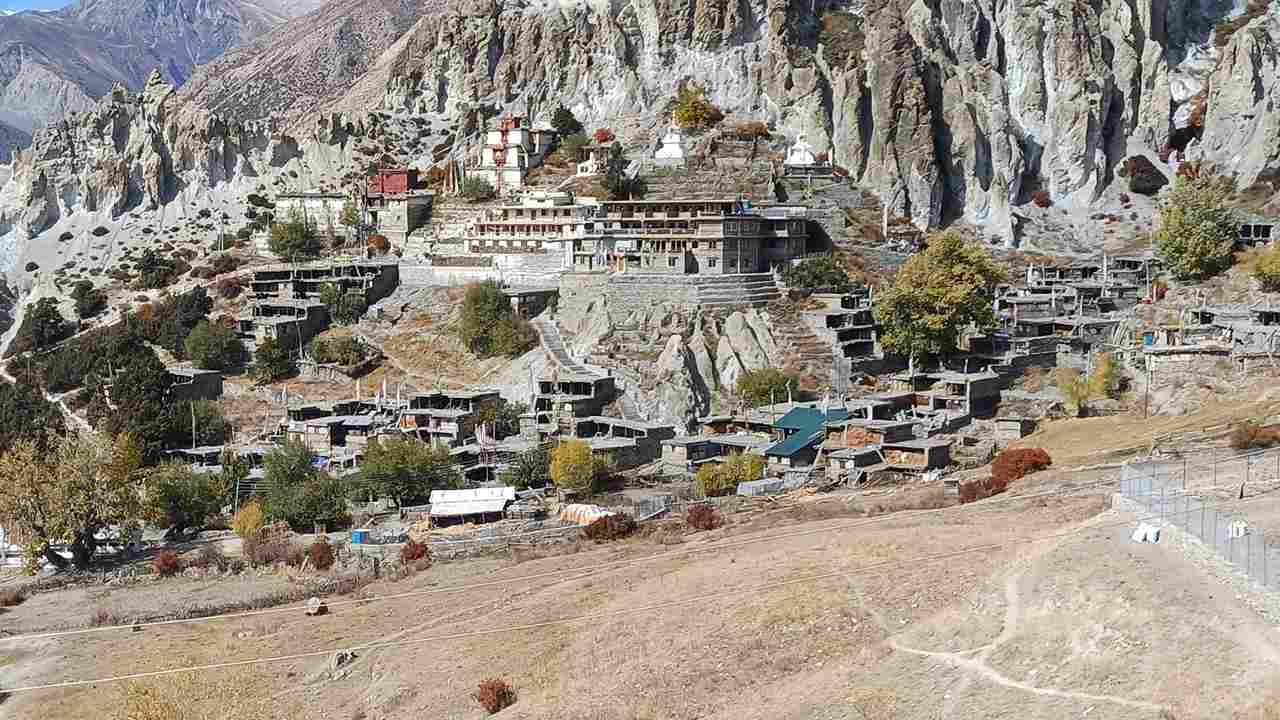
From there, the trail becomes much flatter as you enter the Manang Valley. Before reaching Manang, take some time to visit Braga (3,519 m). The village is home to a 500-year-old monastery that sits on a cliff above the settlement. After the monastery visit, get to Manang and settle in your overnight point. On the day’s walk, what you’ll notice most is the transition from dense rhododendron and oak forests to blue pine and harsh mountain conditions. Overnight and dinner at Hotel Tilicho/Hotel Gangapurna.
Day 5
Manang Village
Manang Village
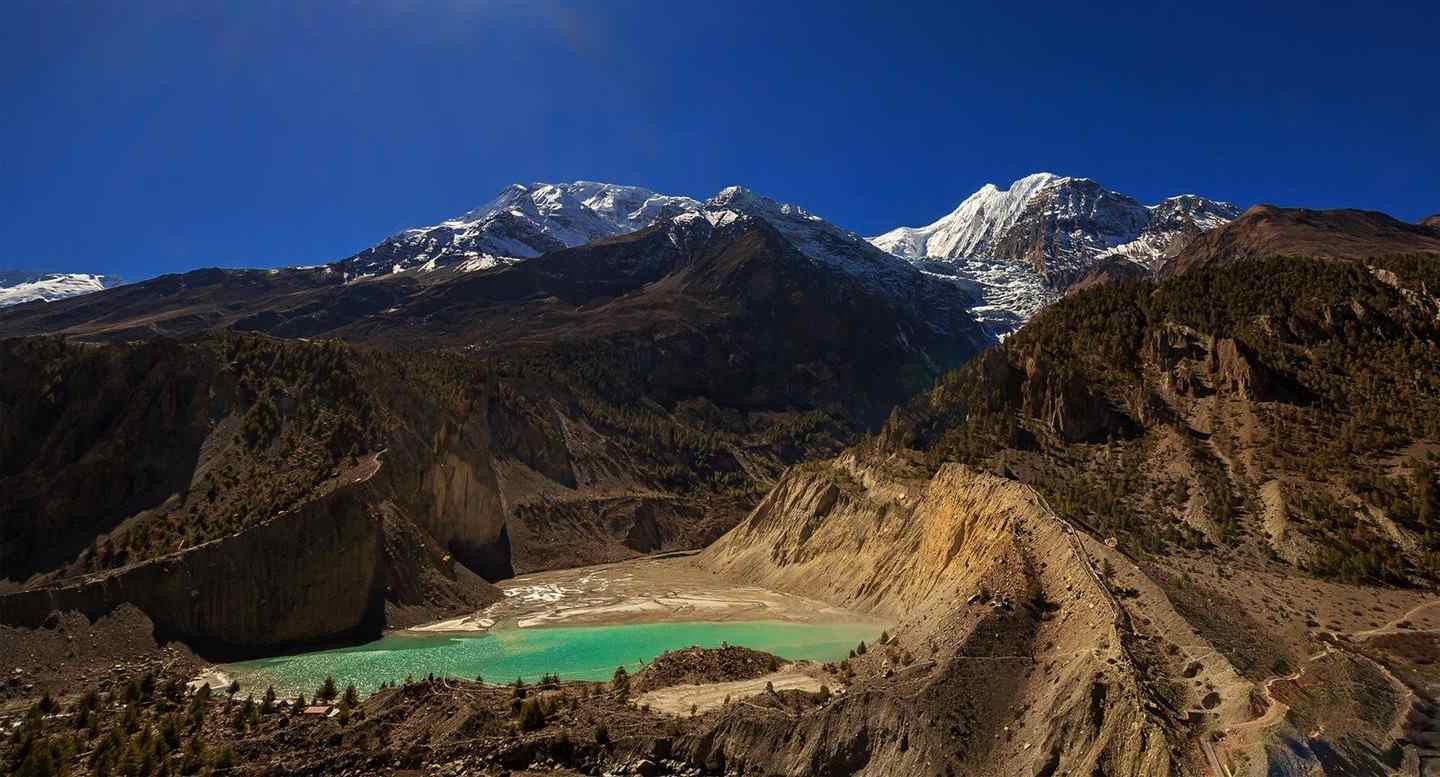
Gangapurna Lake
Gangapurna Lake
Braga Village
Braga Village
Ice Lake
Ice Lake
Acclimatization Day at Manang
Day 5 Facts
Trekking Time Average
Day excursion
Accommodation
Hotel Tilicho or Hotel Gangapurna
Altitude
(3500m./11550ft.)
Included meals
Breakfast, Lunch, Dinner
By the time you wake up in Manang, your body has been adjusting to higher elevations for four days continuously. The air here contains about 65-67% of the oxygen available at sea level. So, the fifth day is an acclimatization day, during which you’ll adjust to the higher altitude and atmosphere and prepare for the upcoming climb.
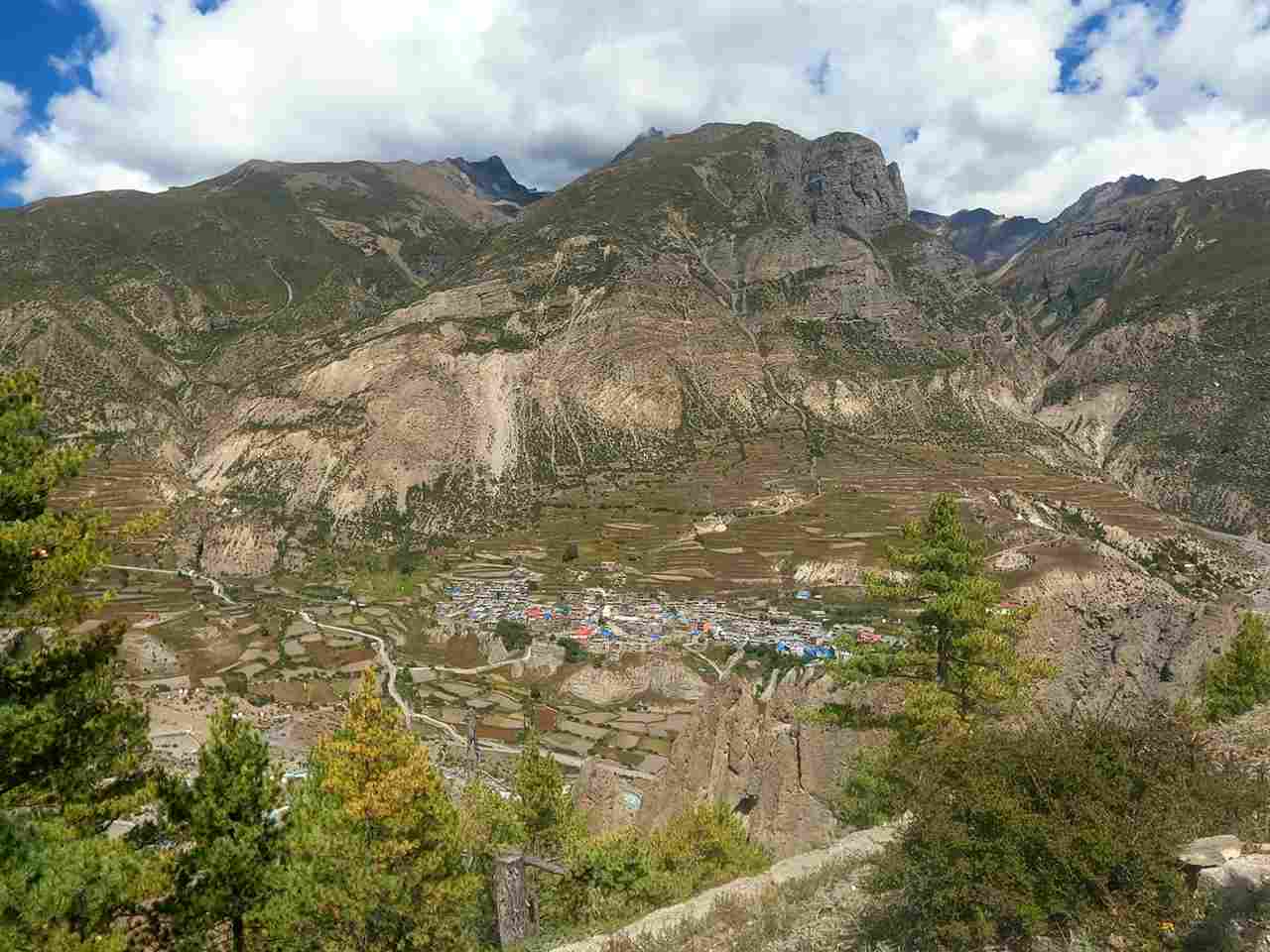
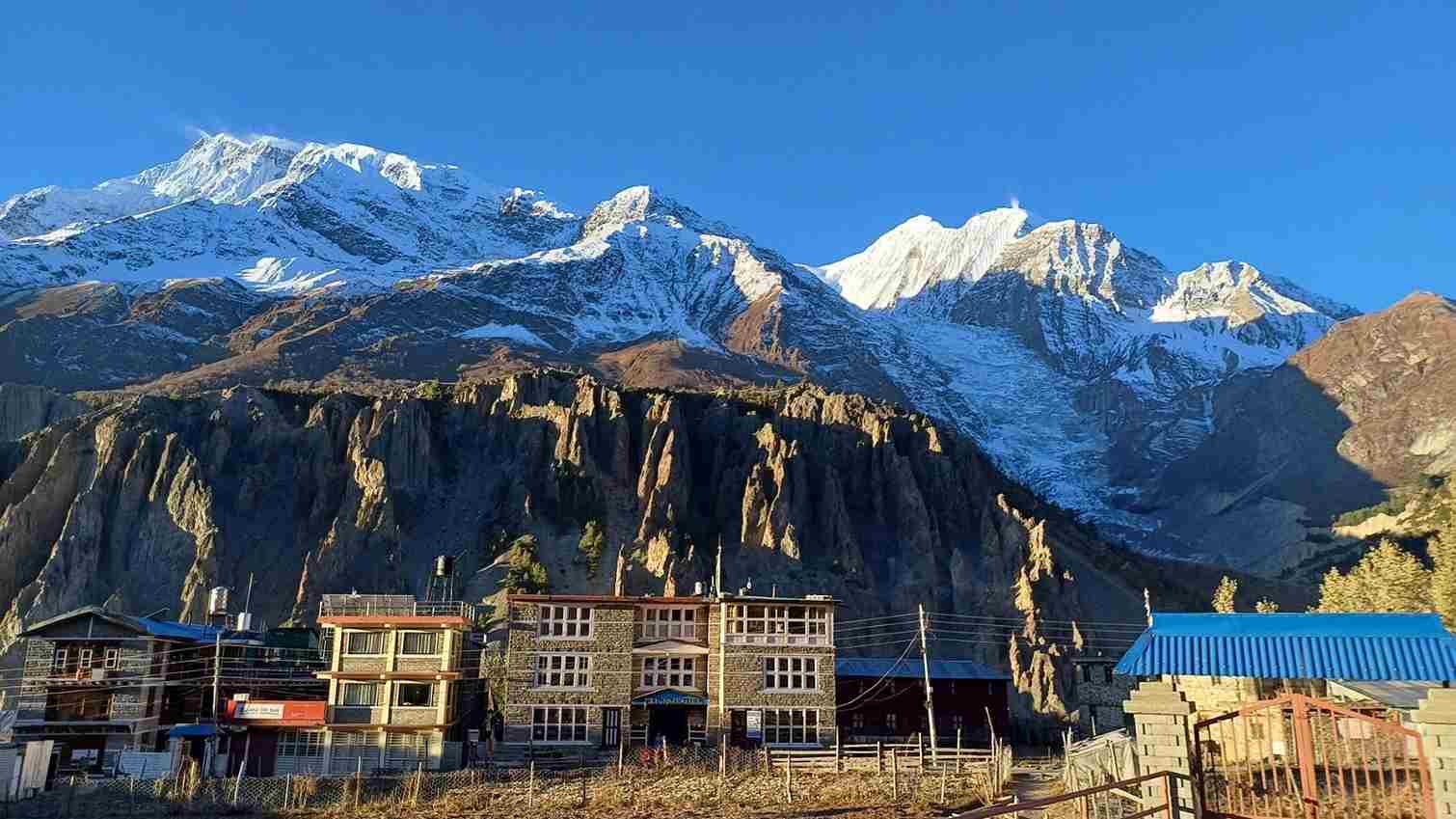
Manang is a beautiful town surrounded by Annapurna III (7,555 m) and Gangapurna (7,455 m). It is home to the ethnic communities of the Tibetan and Gurung people. Likewise, the village is the largest and most developed village on the trek after Chame. It has a range of facilities, including bakeries, Wi-Fi (usually slow but usable), and gear shops for any last-minute essentials.
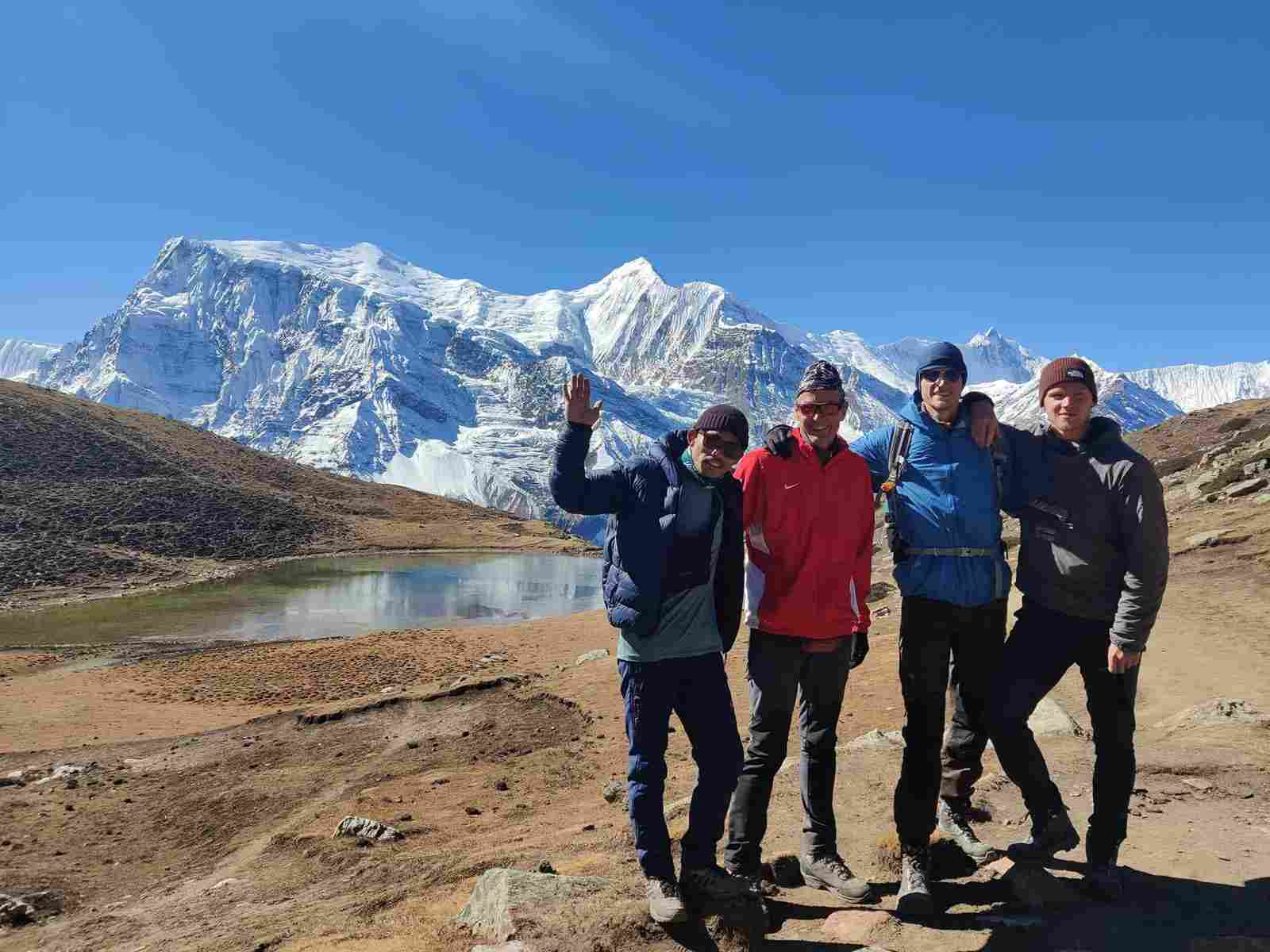
Start your morning at the Himalayan Rescue Association (HRA) Health Post in Manang to attend a daily altitude sickness briefing, which is generally held at 11:00 AM. If you’re up for an adventurous hike, you can head to Gangapurna Lake (3,540 m) and Ice Lake (4,620 m). While Ice Lake lies 16-17 km from Manang, Gangapurna is a short adventure that covers 2-3 km in a round trip. After your day excursion, you will return to the village and stay overnight in Manang.
Day 6
Heading towards Ledar
Heading towards Ledar
Yak Kharka
Yak Kharka
Ledar
Ledar
Mt. Gangapurna View
Mt. Gangapurna View
Trek to Ledar (4,110 m)
Day 6 Facts
Trekking Time Average
10 km
(4 hours)
Accommodation
Dhading Laxmi Hotel or Similar category
Altitude
(4,110 m / 13,484 ft)
Included meals
Breakfast, Lunch, Dinner
After acclimatization day at Manang, you leave the village both excited and a little serious. Although today’s walk is not very long, it should not be taken lightly. As you leave Manang, you head northwest, following the Marsyangdi River upstream. You’ll walk witnessing brown bushes, sandy glacial rocks, prayer flags tied between stones, and huge mountains all around you.
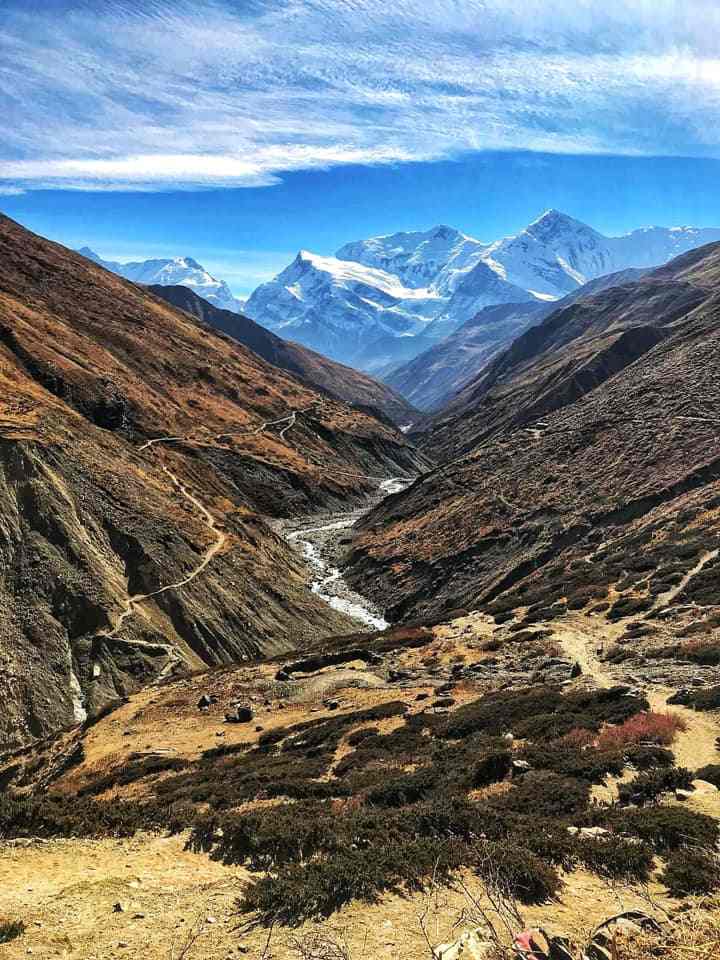
About 30 minutes into the walk, you reach a small place called Tenki and cross a wooden bridge over a small stream. Along the way, you’ll get clear views of Annapurna III (7,555 m) and Gangapurna (7,455 m) to the south, with glaciers looking very close. To the north, you’ll see a sharp, dry ridge that marks the border with the Tibetan plateau.
After about 2 to 2.5 hours of walking, you reach Yak Kharka. This is a good place to stop for lunch. While eating, you can look back down the valley toward Manang. From here, you can clearly see how much height you’ve already hiked. While most trekkers stay at Yak Kharka, you will walk a further 45 minutes to Ledar, where you will rest overnight. Overnight at the Dhading Laxmi Hotel.
Day 7
Thorong Phedi
Thorong Phedi
Thorong Peak
Thorong Peak
Thorong High Camp
Thorong High Camp
Thorong Phedi
Thorong Phedi
Trek to Thorong Phedi (4,400 m)
Day 7 Facts
Trekking Time Average
6 km
(4 hours)
Accommodation
Thorong Phedi Base Camp Lodge or Similar category
Altitude
(4,400 m / 14,436 ft)
Included meals
Breakfast, Lunch, Dinner
Wake up early in Ledar. Have a proper breakfast before leaving the village. It is a shorter day in terms of distance, but the elevation gain affects your health, so leave Ledar early and walk slowly on trail. As you leave Ledar, you’ll hike along the north side of the Jarsang Khola river. You follow the river uphill through a landscape that becomes drier and emptier as you walk. The path is rocky and uneven, which can be tiring but not difficult.
As you gain altitude, the valley becomes narrower, with steep sides on both sides. At this point in the trek, the scenery is stunning, with shades of rust, grey, and brown, and no plants. Additionally, the wind is funneled through the valley and can be very cold, so keep your jacket on until you’ve warmed up from walking.
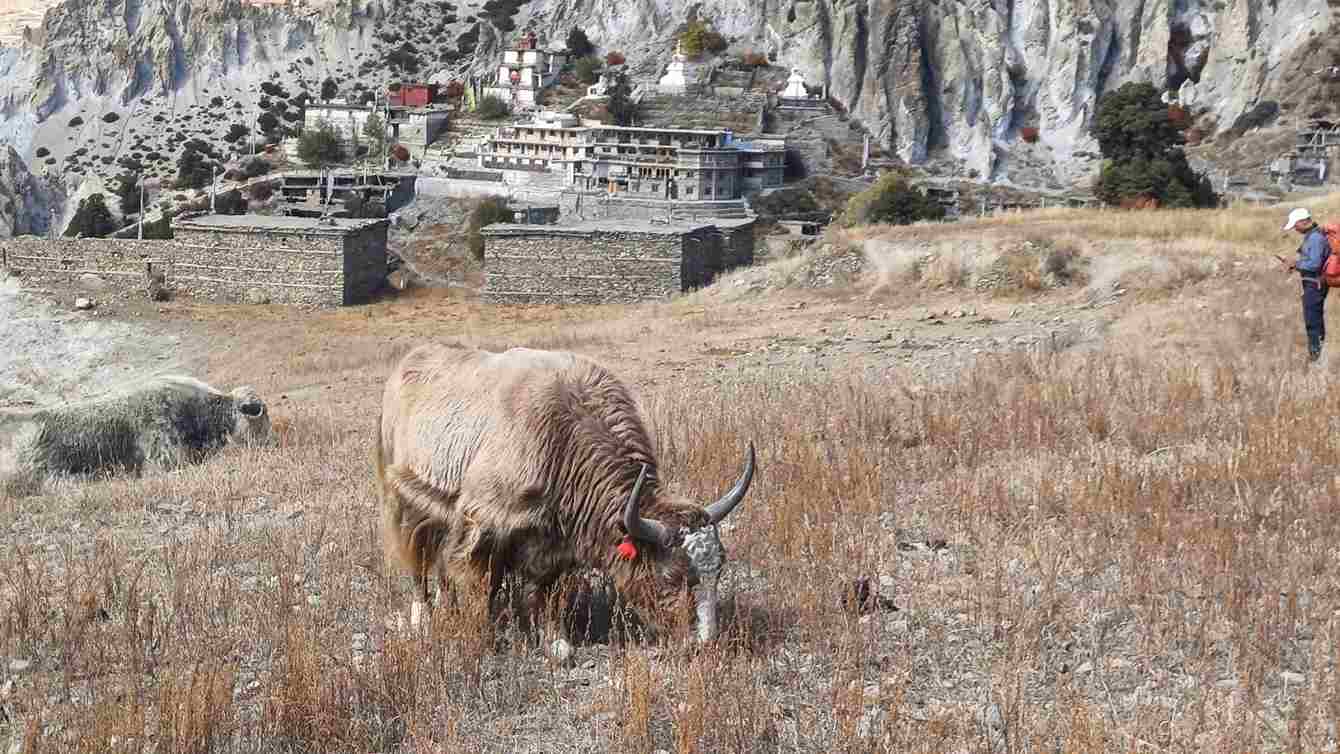
The route passes through the small settlements of Tengi and Gunsang. Between these villages, the trail crosses grazing areas where yaks feed. Seeing a herd of yaks moving across the hills at around 4,400 meters, with mountains in the background, is one of the most memorable sights on the trek.
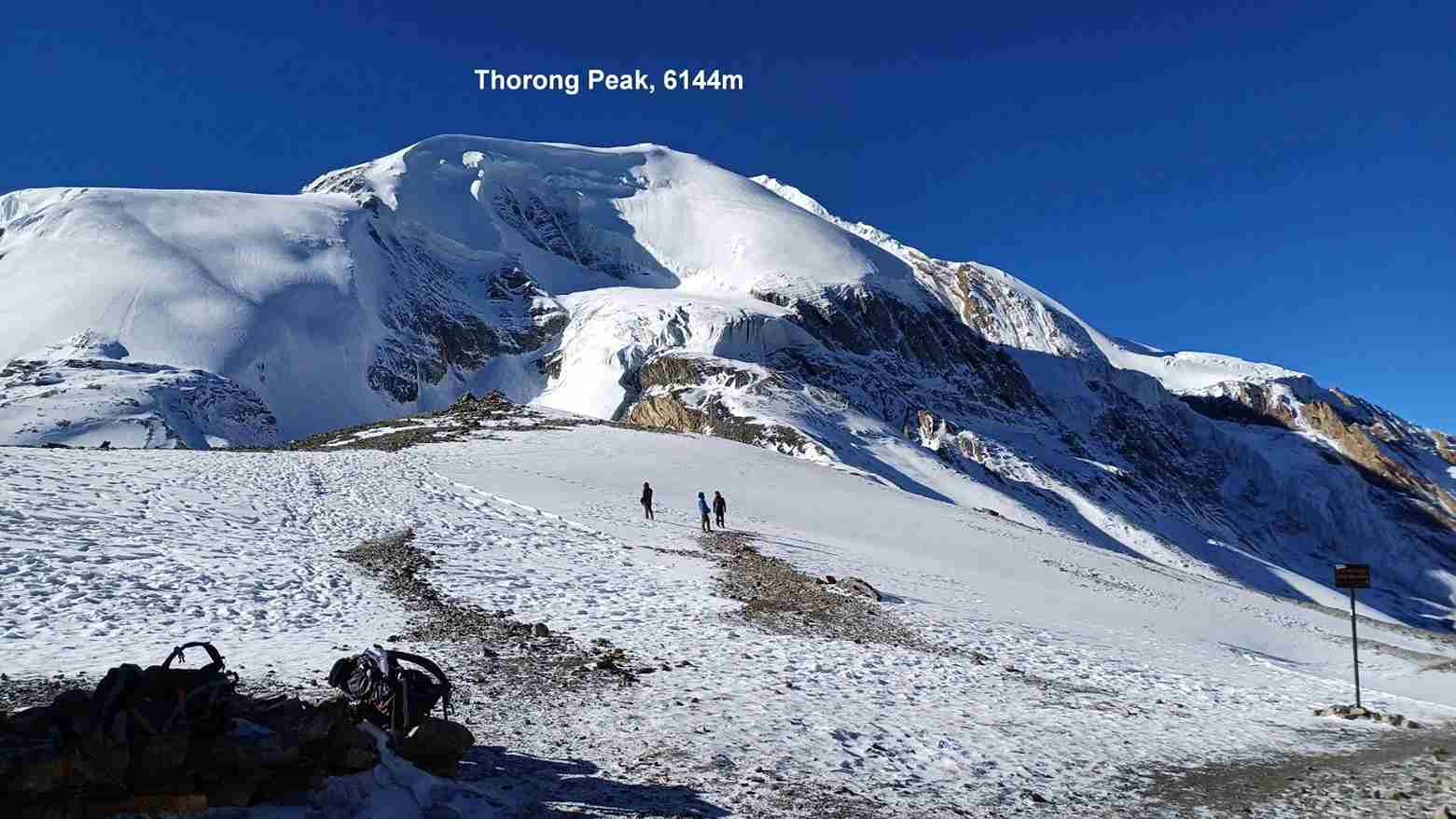
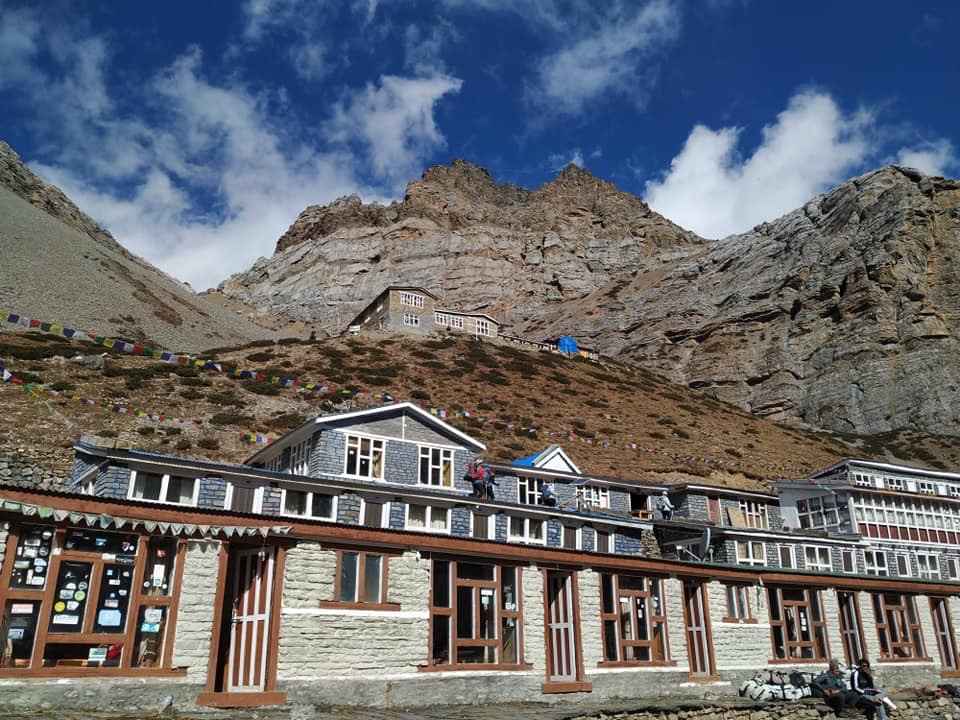
After a while of trekking, you reach Thorong Phedi. The views from Thorong Phedi toward the pass are stunning. On a clear day, you can see the winding trail leading all the way up to Thorong La Pass. The day’s overnight and dinner at Thorong Phedi Base Camp lodge.
Day 8
Thorong Phedi to Thorong La pass morning breifing by guide Amar
Thorong Phedi to Thorong La pass morning breifing by guide Amar
Thorong High Camp
Thorong High Camp
Thorong La Pass Route
Thorong La Pass Route
Thorong La Pass 5416m.
Thorong La Pass 5416m.
Muktinath
Muktinath
Hike to Muktinath (3,800 m) via Thorong La Pass (5,416 m)
Day 8 Facts
Trekking Time Average
18 km Up/downhill
(10 hours)
Accommodation
Town House or Similar category
Altitude
(3,800 m / 12,468 ft)
Included meals
Breakfast, Lunch, Dinner
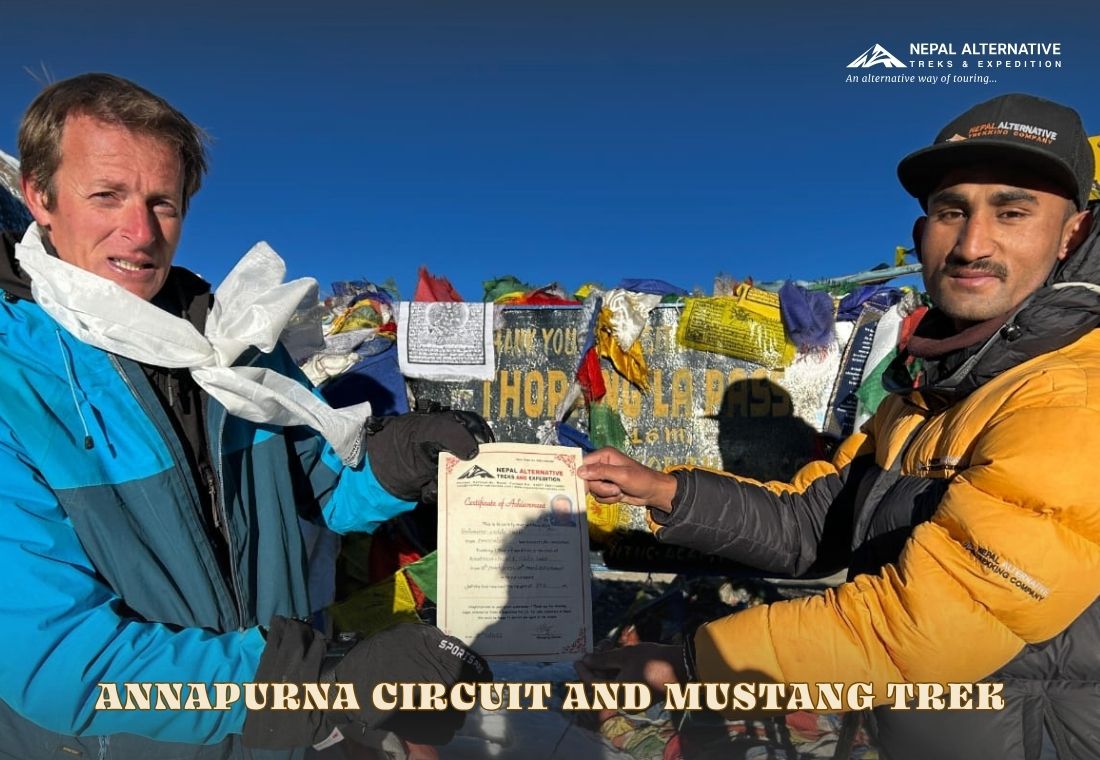
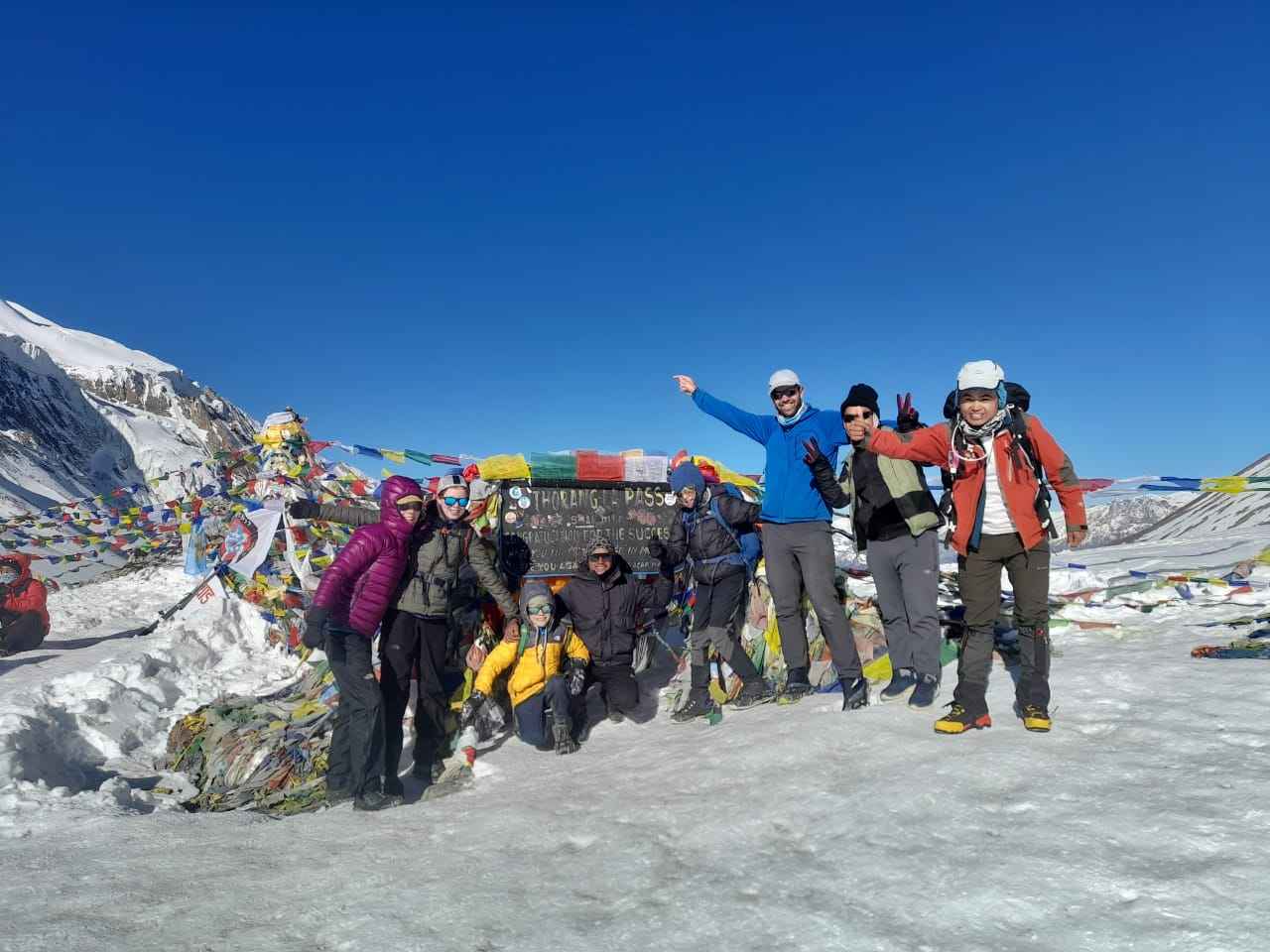
Today is the most exciting and toughest day of the trek. You will cross the highest point of the whole journey, Thorong La Pass, which is 5,416 m high. Today, your alarm rings when the outside is still dark, and the temperature is cold. Don’t stay in bed too long, get dressed quickly, put on all your warm clothes, eat a little food even if you don’t want to, and start walking. The early start to the day has a reason: you must cross the Thorong Pass in the morning before the strong afternoon winds arrive.
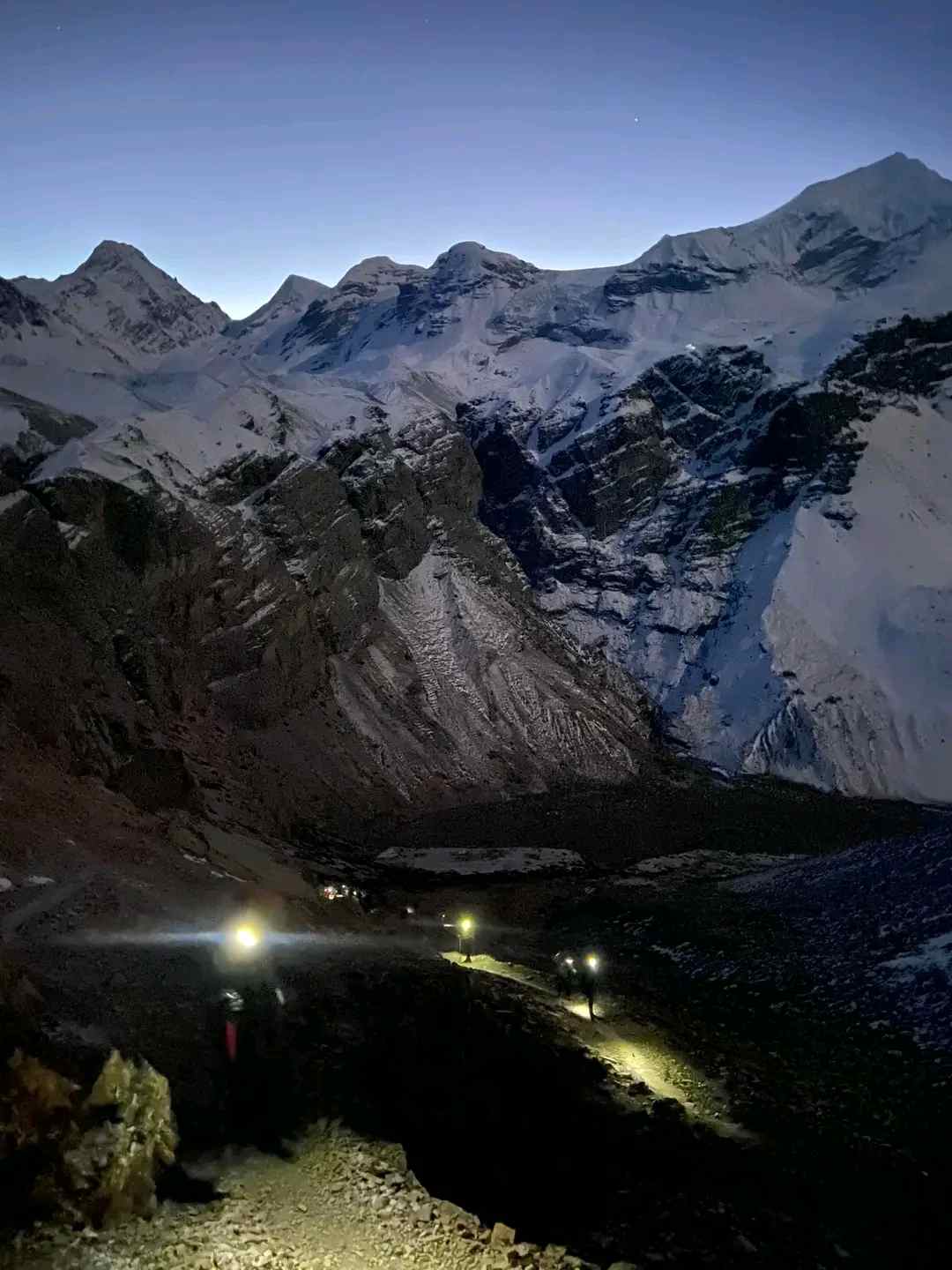
Put on your headlamp, grab your trekking poles, and step outside at around 4:00 AM. The trail starts steeply and continues uphill through switchback routes on a wide and rocky slope. In the darkness before sunrise, you’ll notice the lights of other trekkers’ headlamps moving towards the pass, reassuring you that even in that early hour, you’re not alone on the trail.
The last 30 minutes before reaching the pass are the toughest. At this point, staying mentally focused is more important than being physically strong. When you see the prayer flags ahead, and the trail finally becomes flat, it marks that you’ve reached the pass.
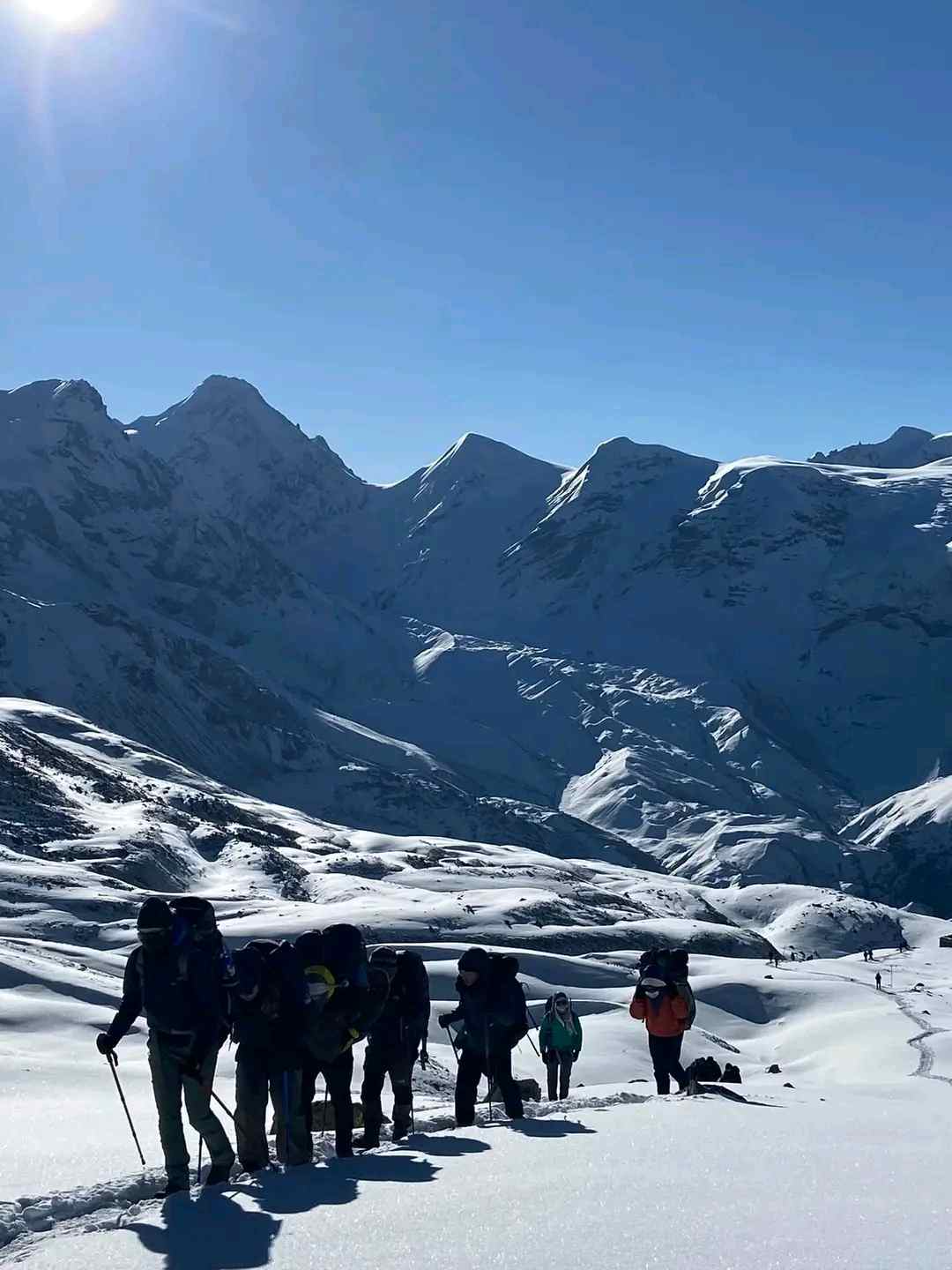
From the top of Thorong La Pass, the view is amazing. You can see the Annapurna and Gangapurna mountains and the dry, brown land of Mustang. If the sky is clear, you can even see the Tibetan mountains. Take your time to capture and enjoy the beautiful views. Later, you will walk downhill for many hours on a steep and rocky path until you reach Muktinath. Overnight and dinner in Muktinath.
Day 9
Dhaulagiri View from Muktinath
Dhaulagiri View from Muktinath
Lubra Village
Lubra Village
Following Kaligandaki river
Following Kaligandaki river
Marpha village
Marpha village
Drive to Marpha (2,713 m) / Optional Trek to Marpha Via Lubra Village
Day 9 Facts
Trekking Time Average
24 km – 2 hours by drive
24-27 km taking 7-9 hours to trek
Accommodation
Hotel Paradise or Similar category
Altitude
(2,713 m / 8,952 ft)
Included meals
Breakfast, Lunch, Dinner
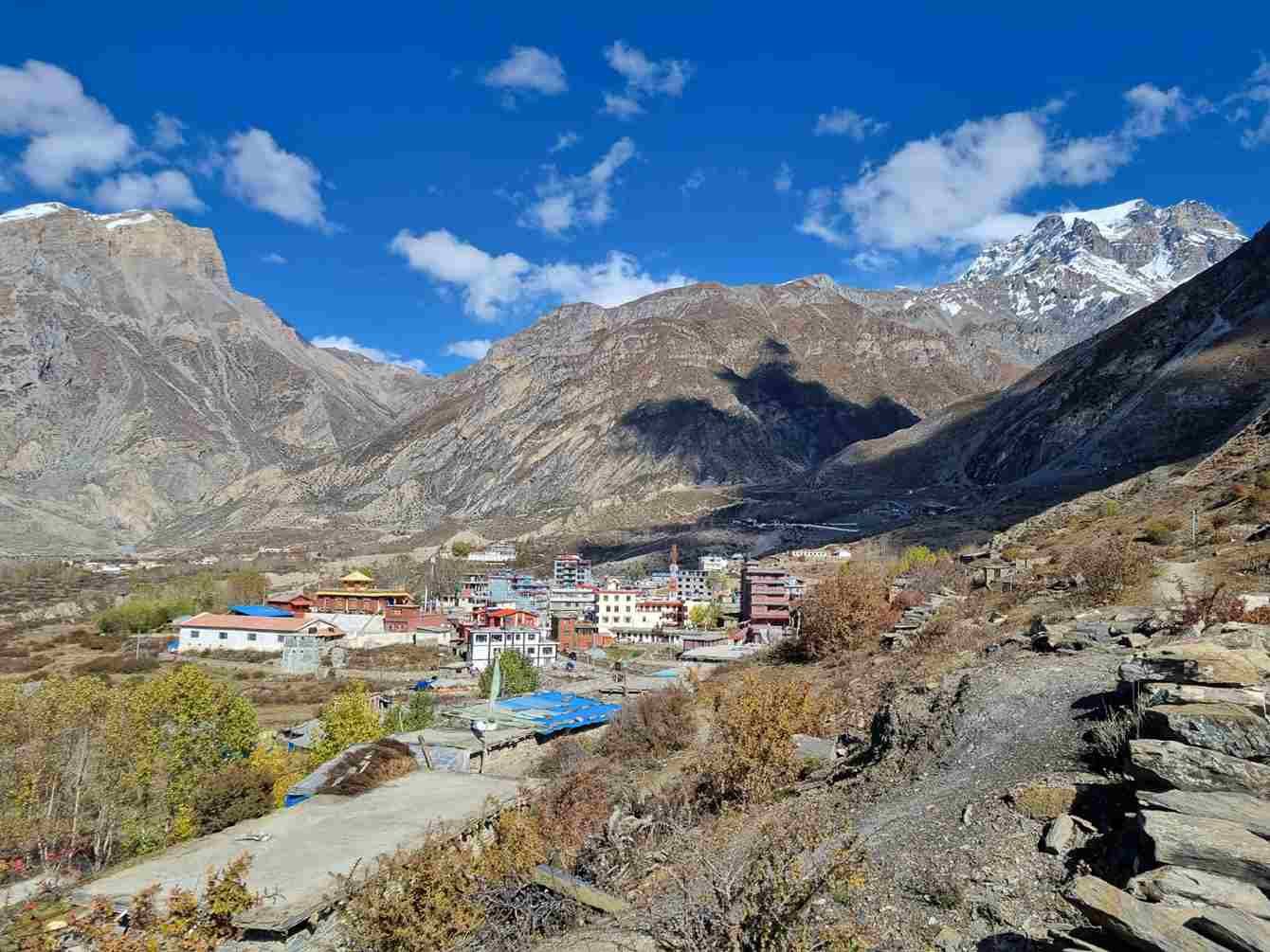
The day starts with a visit to the Muktinath Temple, a sacred temple for both Hindus and Buddhists. It is believed that visiting this temple brings good luck and blessings. You can also see the famous 108 water taps, where people take a quick bath, even in the cold, for spiritual cleansing. Likewise, you can visit the Jwala Mai Temple. After exploring the temple, have your morning meals begin your journey towards Marpha Village. However, getting to Marpha from Muktinath offers two options: by jeep or on foot.
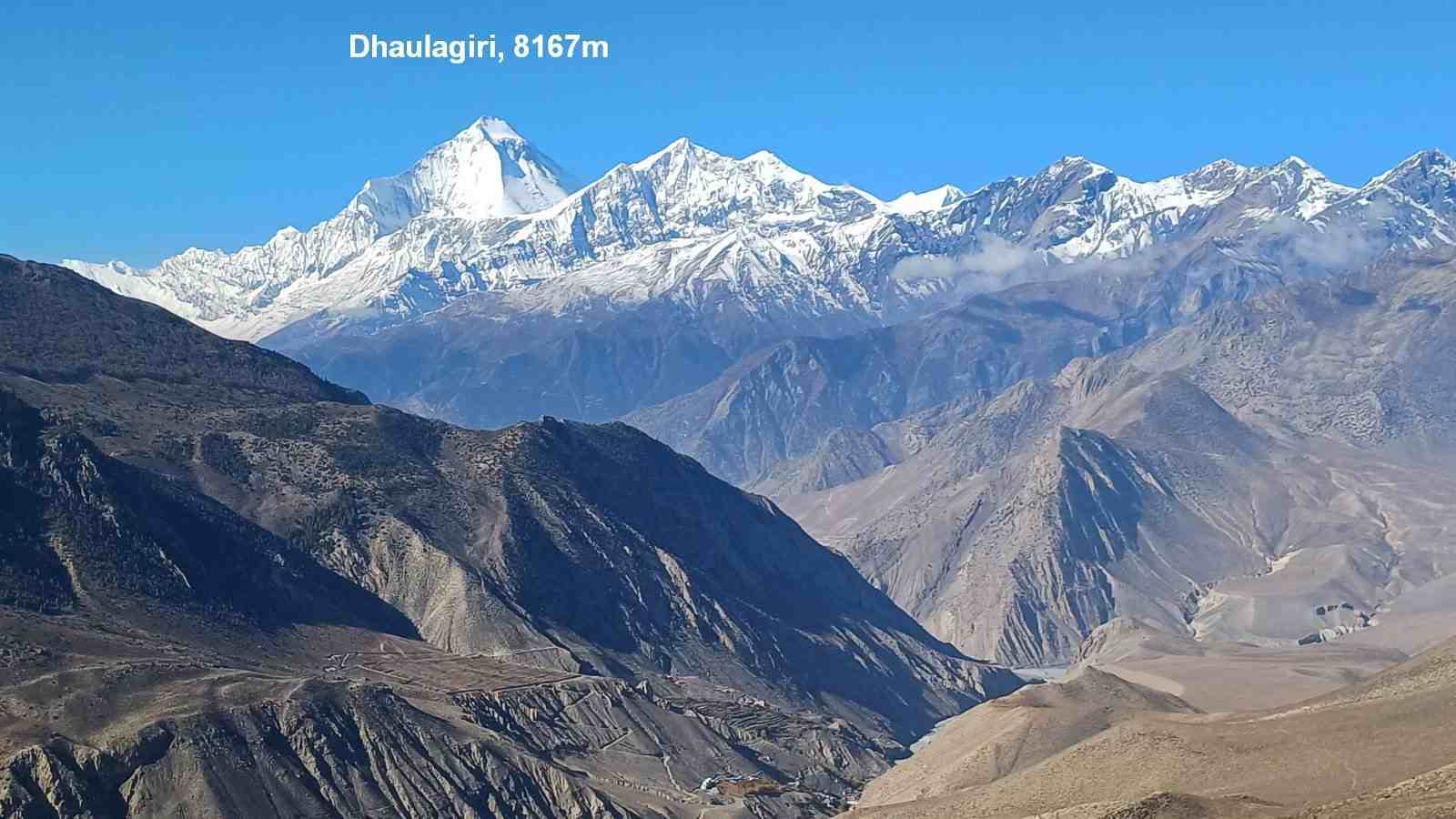
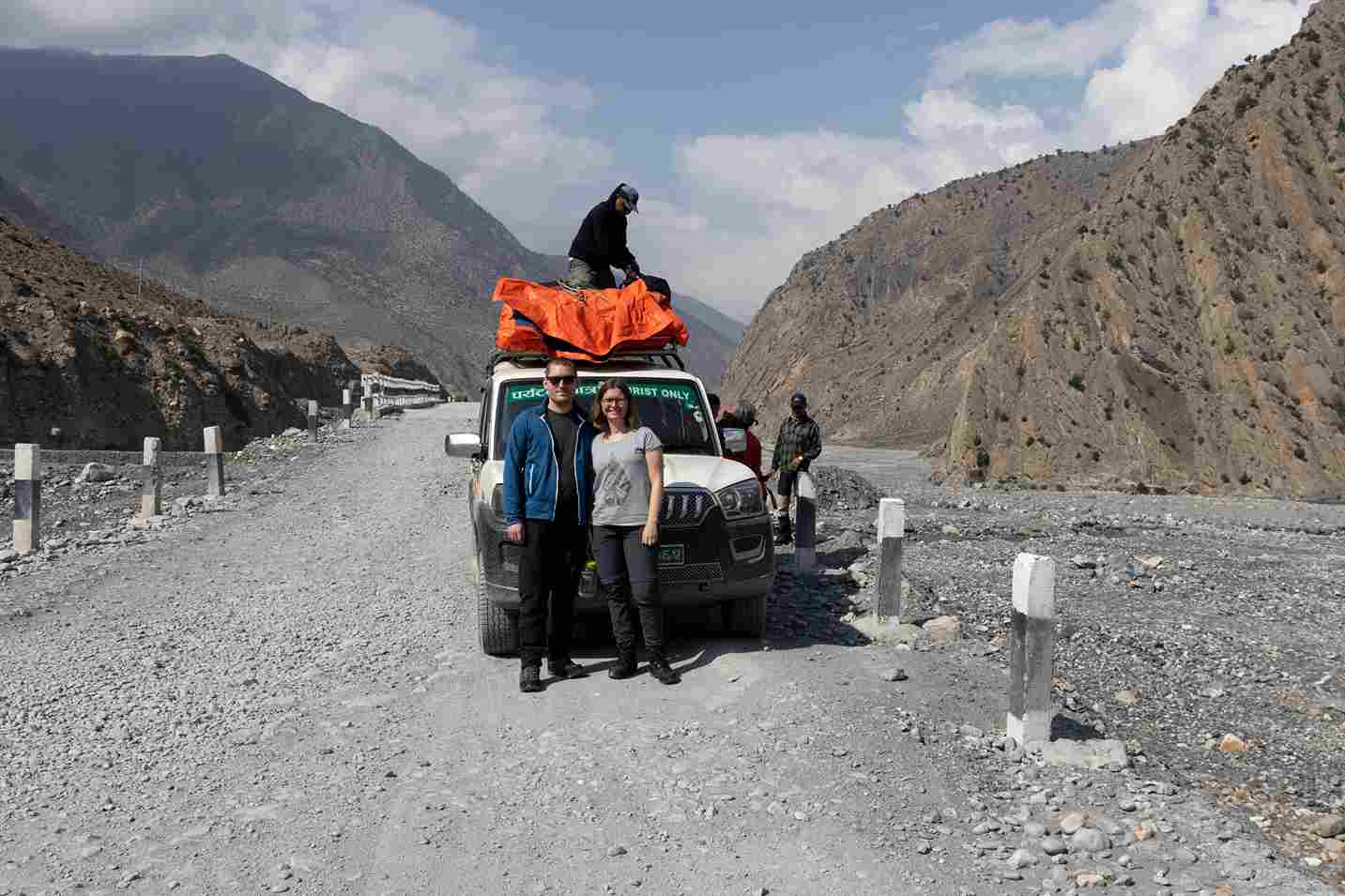
If you choose the drive option, you’ll take a jeep from Muktinath to Marpha. The route descends through the unique landscapes of Lower Mustang, passing through Kagbeni and Jomsom before reaching Marpha. Along the way, you can enjoy stunning views of the arid Mustang terrain, the Kali Gandaki River, and peaks of the Dhaulagiri and Annapurna ranges through your window seat.
If you choose the trek option, you must leave Muktinath early, as it is a long way on foot, but it is worth experiencing the lower section’s deep beauty in Mustang. As you leave Mustang, you walk through a barren plateau and descend to Khingar village. Continuing the trek, you reach the Eklobhatti/Tetang area, where you experience an arid highland landscape that gives way to a more vegetated valley.
After an hour of walking, you get to the trail junction where you leave the main Annapurna Circuit trail and turn right (west) toward Lubra Village. Although this walk adds 30 to 45 minutes to the journey, it is one of the most culturally significant sections of the trek. Lubra Village is one of the last remaining Bon communities in Nepal, where you can explore an ancient Bon monastery.
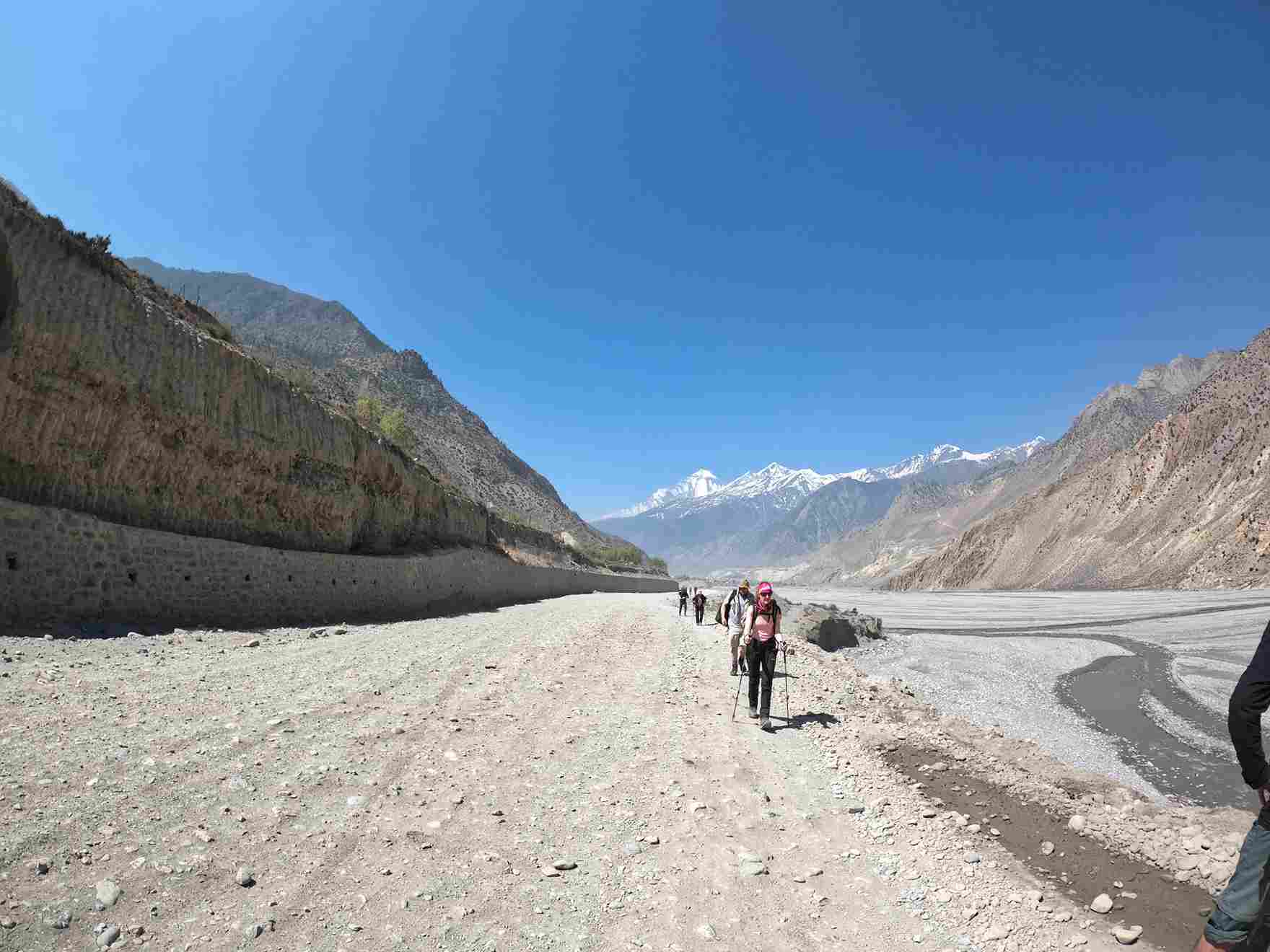
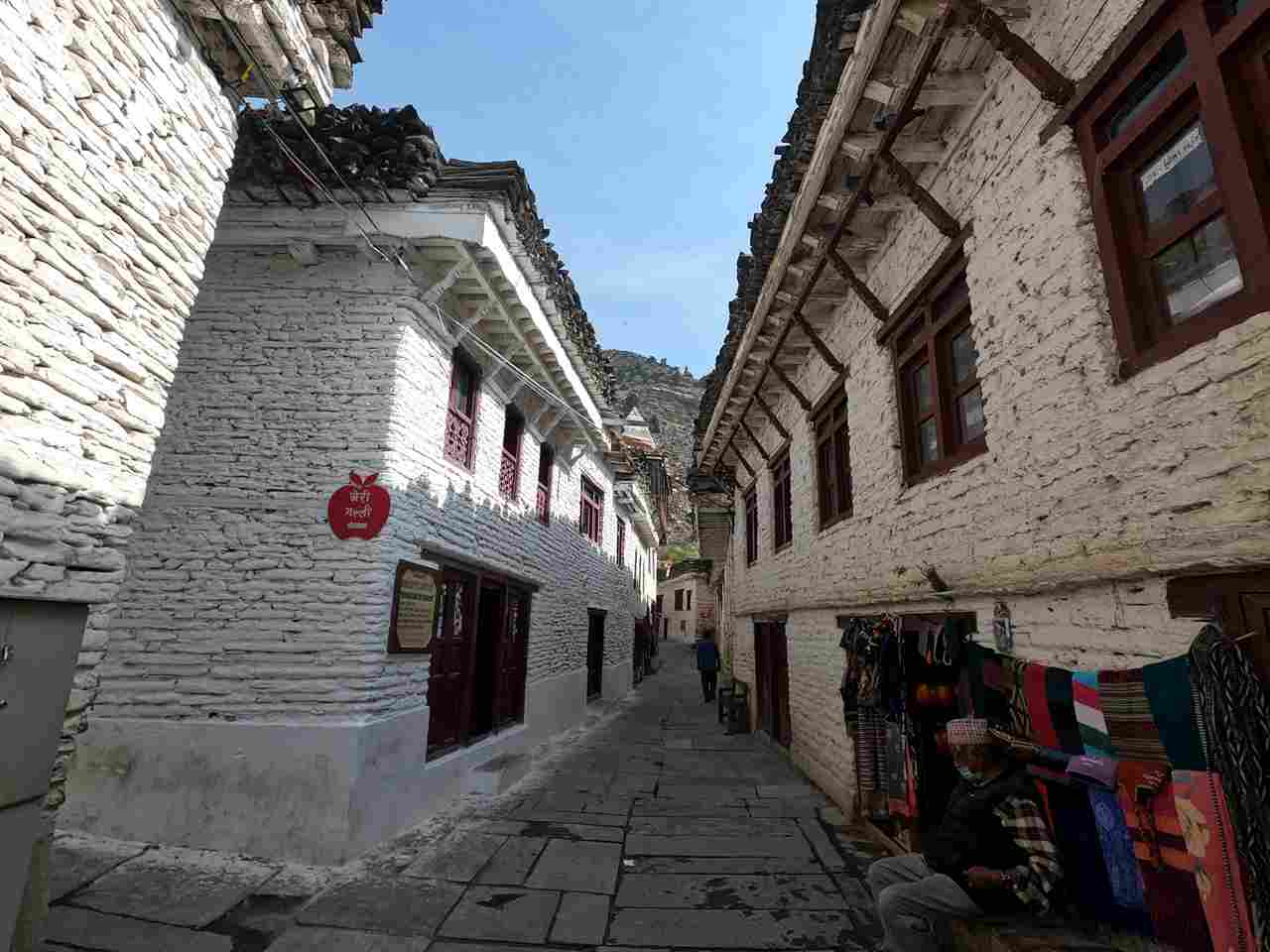
After exploring Lubra, rejoin the main trail and continue descending through the Kali Gandaki Gorge, the deepest gorge in the world. Soon, you’ll reach Jomsom. After a short stop there, you’ll reach Marpha, often called the Apple Capital of Nepal. You can taste apple pie, apple cider, apple brandy, and dried apples. You will spend the night in Marpha, relaxing and enjoying the peaceful village atmosphere.
Day 10
Marpha
Marpha
Jeep to Pokhara
Jeep to Pokhara
Rupse Waterfall
Rupse Waterfall
Fewa Lake, Pokhara
Fewa Lake, Pokhara
Drive to Pokhara (820 m)
Day 10 Facts
Trekking Time Average
160 km (Avg 8 hours Drive)
Accommodation
Hotel Kausi
Altitude
(820 m / 2,706 ft)
Included meals
Breakfast, Lunch
Today is the longest drive of the entire journey and marks the end of the Annapurna Circuit trekking section. Have an early breakfast while taking in views of the Annapurna and Dhaulagiri ranges, then be on the road by 7:00-8:00 AM. From Marpha, the jeep takes you south through the Kali Gandaki Valley and soon reaches Tukuche. The journey then continues through Kobang and Larjung.
As you get closer to Ghasa, the valley becomes narrower. Here, you enter the Kali Gandaki Gorge, with the slopes of Dhaulagiri on one side and the Annapurna mountains on the other. After Ghasa, the scenery starts to change into a greener landscape. After spending days in the cold, dry high mountains, the fresh smell of plants and damp earth feels very different.
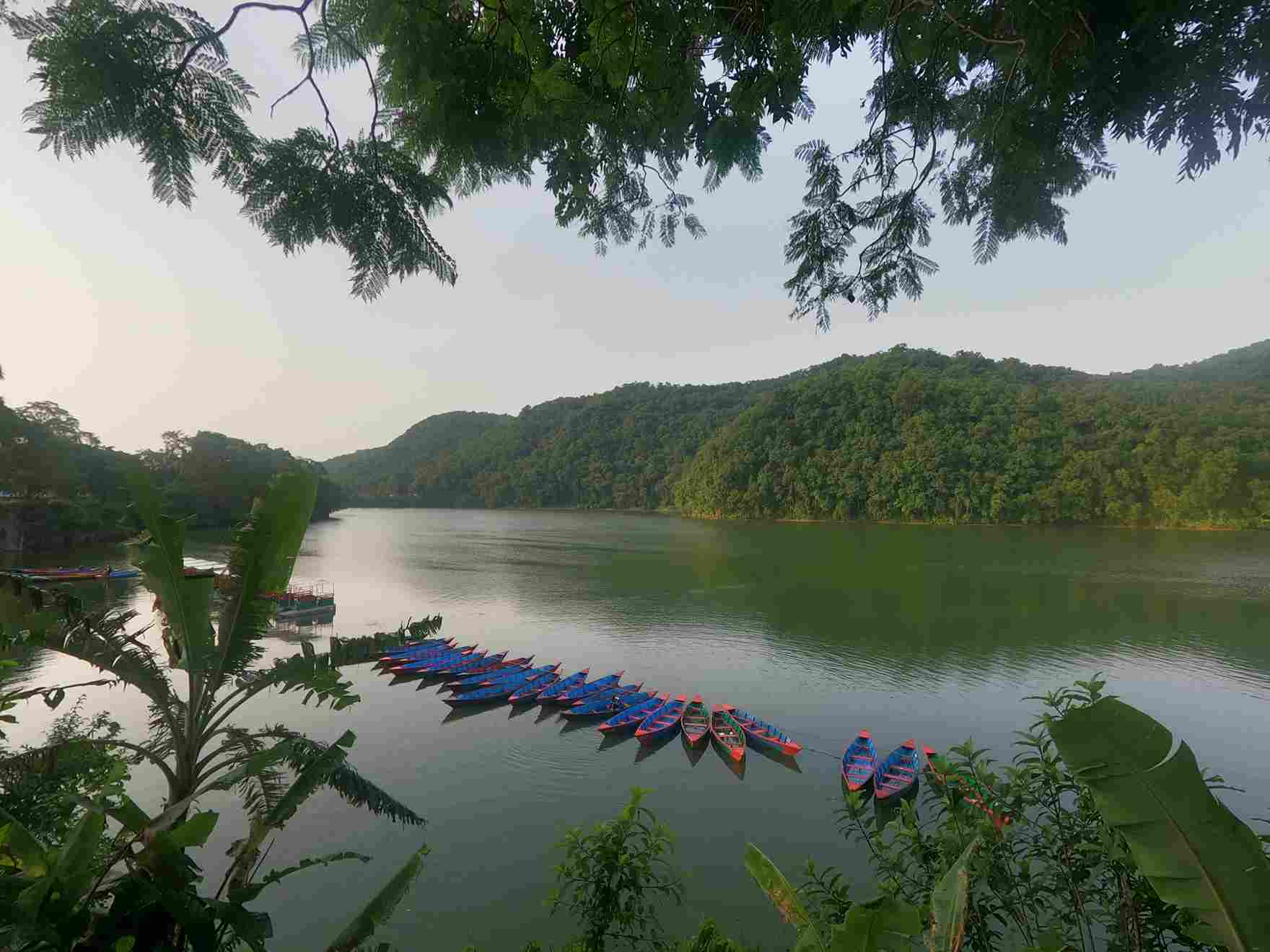
The road passes through Dana, Tatopani, and Beni. From Beni, the road becomes smoother as it joins the paved Beni-Pokhara Highway. Within 2-2.5 hours of drive from Beni, you get to Pokhara. After reaching the city, you can enjoy a short boating ride around Phewa Lake in the evening or the following day. Additionally, you can explore the area around Pokhara Lakeside. You will stay overnight in Pokhara.
Day 11
Fewa Lake
Fewa Lake
Swyambhunath Stupa
Swyambhunath Stupa
Kathmandu City
Kathmandu City
Drive to Kathmandu (1,295 m)
Day 11 Facts
Trekking Time Average
200 km Drive
(6 hours)
Altitude
(1,295m / 4,273ft)
Included meals
Breakfast
Start your day with a breakfast near the beautiful Phewa Lake in Pokhara. On a clear morning, the Annapurna range and Machhapuchhre reflected in Phewa Lake is one of the iconic views from the city. After the morning meal, you will take a tourist bus back to Kathmandu along the Prithvi Highway. The road follows the Trishuli River through the sections filled with hills and forests. The section of the river is popular for white-water rafting, so you may see rafts and kayaks from your window.
Along the way, you pass through towns of Dumre, Mugling, and Kurintar. Mugling is the main halfway stop and a common place for lunch. It sits where the Trishuli and Marsyangdi rivers meet. After Mugling, the highway turns toward Kathmandu and takes you through towns of Malekhu, Gajuri, Galchhi, Nagdhunda, Thankot, and finally to your day’s destination.
Once you reach Kathmandu, you’ll have time to explore Thamel, a tourist area full of shops, cafes, and markets. It’s a great place to buy souvenirs or just relax after your long trek. Additionally, you can experience the nightlife of Thamel in the city. This brings your 11-day Annapurna Circuit adventure to a happy end.
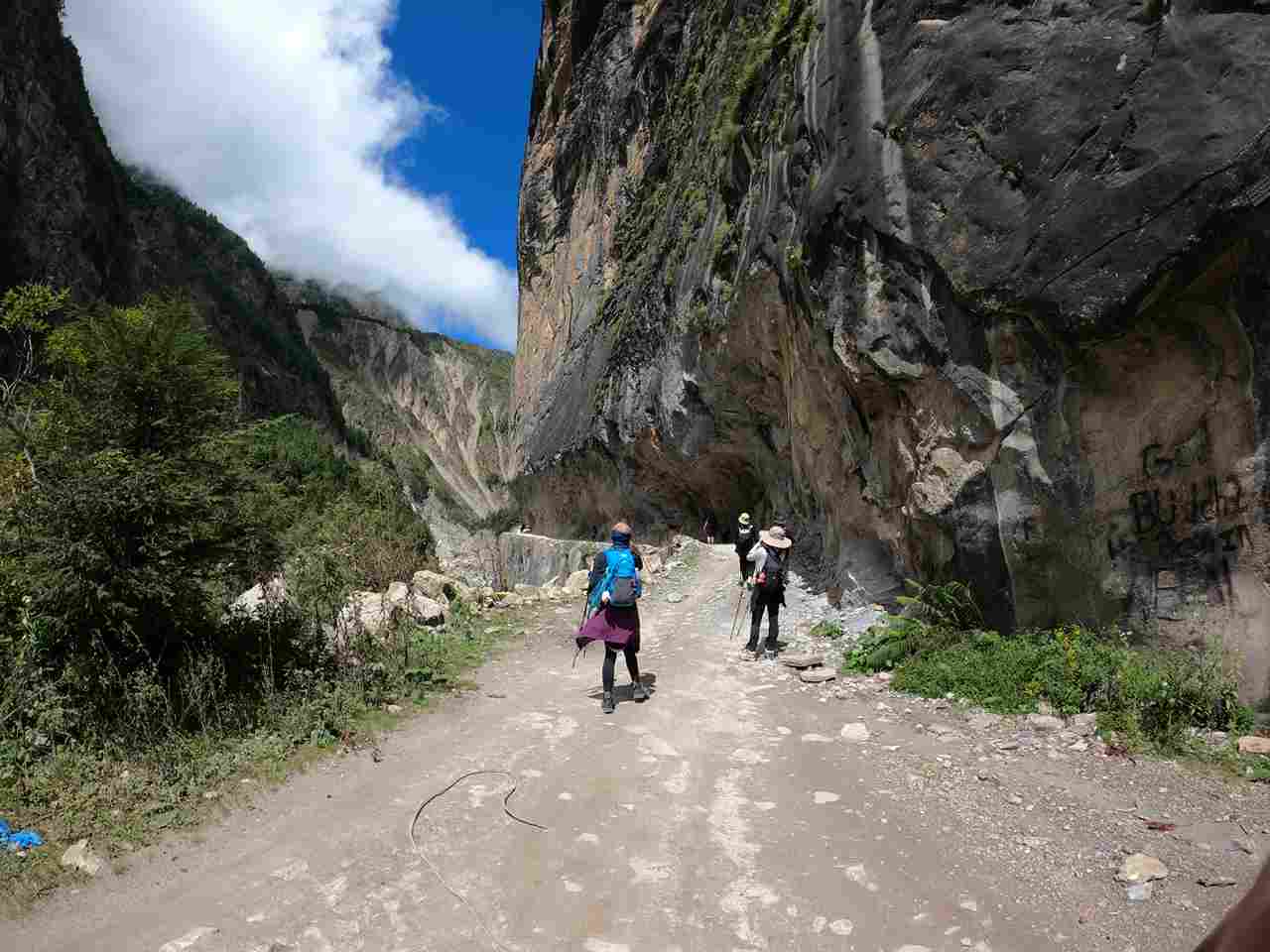
Note: In recent years, many parts of the classic Annapurna Circuit have become vehicle roads, so trekkers often have to walk on dusty roads with jeeps and motorbikes. To solve this, TAAN (Trekking Agencies’ Association of Nepal) created the NATT (Natural Annapurna Trekking Trails). These are marked walking paths that avoid the roads and follow the old, proper trekking trails through villages, forests, and high ridges.
Our Annapurna Circuit trek itinerary follows the NATT route properly. It covers all the villages shown on the NATT trail (such as Besisahar, Chame, Upper Pisang, Manang, Ngawal, Yak Kharka, Thorong Phedi, etc), so you walk mostly on real trekking paths and avoid road sections as much as possible. This makes the trek quieter, safer, more scenic, and more cultural, with better mountain views.
Planning your trek?
WhatsApp us for fixed departures, private dates, and a tailored itinerary.
Pick up at Tribhuwan International Airport and transfer to the hotel in Kathmandu.
One-night hotel (Hotel Kausi) accommodation in Pokhara.
Lodge (twin-share basis) accommodation will be provided during the trek.
All meals (breakfast, lunch, and dinner) along the trek.
One highly experienced, first aid-trained, fluent English-speaking, friendly, and government-authorized trekking guide.
1 porter per 2 trekkers. Please keep luggage weight under 10 kg per person.
Guide/porter’s food, accommodation, salary, insurance, transportation, and equipment.
Overland transportation as mentioned in the itinerary.
Annapurna Conservation Area Project (ACAP) permit and necessary permits.
A trekking map, duffle bag, oxygen saturation check-up every day, trekking completion certificate, company T-shirt, etc.
Government tax and service charge.
Assistance for emergency rescue evacuation.
Public Liability Insurance.
What’s Not included
Hotel accommodation and meals in Kathmandu.
Hard and soft table drinks such as tea/coffee, Coke, Fanta, mineral water, beer, and dessert.
Extra costs such as battery charging, hot showers, laundry, phone bills, and bar bills.
Personal travel insurance.
International flight tickets.
Nepal tourist visa fee.
Tips for guides and porters (highly suggested).
Add-ons and Options
These add-ons support your classic Annapurna Circuit Trek with private transfers, strong gear, flights, and upgrading options in Pokhara and along the high route.
How to add these add-ons:
Click “Book the Trip” on the Annapurna Circuit Trek page.
Select your preferred departure date.
On the checkout page, choose your add-ons for transport, gear, sightseeing, flights, and lodge upgrades.
List of add-on options:
Private Vehicle Transfers Kathmandu to Besisahar: Start your trek with a smooth ride from Kathmandu to Besisahar in a private car (USD 100), jeep (USD 150), or coaster bus (USD 200) for a direct and comfortable journey.
Gear Rental (Sleeping bag USD 11, jacket USD 11, Crampon/Spike USD 11, pole USD 11): Keep your luggage light by renting essential gear such as sleeping bags, jackets, crampons/spikes, and trekking poles suited to high-altitude trails.
Pokhara Sightseeing (USD 30 per person): Join a guided tour of Pokhara’s lakeside, viewpoints, and main landmarks after your trek.
Rafting at Trishuli River (USD 45 per person): Add a day of white-water rafting on the Trishuli River for extra adventure on your way to or from the mountains.
Kathmandu City Tour (USD 30 per person): Explore Kathmandu’s temples, heritage squares, and local markets with a knowledgeable guide as a cultural add-on.
Pokhara to Kathmandu by Flight (USD 120 per person): Fly from Pokhara to Kathmandu to save time and avoid a long road journey after your trek.
Jomsom to Pokhara by Flight (USD 169 per person): Fly directly from Jomsom to Pokhara to avoid a long, bumpy drive at the end of the circuit.
Marpha to Pokhara by Private Jeep (USD 150): Travel from Marpha to Pokhara by private jeep for a more comfortable and flexible ride.
Paragliding in Pokhara (USD 90 per person for 45 minutes): Add a 45-minute paragliding experience over Pokhara for bird’s-eye views of mountains and lakes.
Zipline in Pokhara (USD 80 per person): Try a high-speed zipline ride near Pokhara for a short, thrilling add-on to your trip.
Pokhara to Kathmandu by Private Transport (car USD 100, jeep USD 150, coaster bus USD 200): Return from Pokhara to Kathmandu in a private car, jeep, or coaster bus for a smoother road journey.
Upgrade Hotel Accommodation (5-star) in Pokhara (USD 180 per night for double/twin share with breakfast): Treat yourself to a 5-star stay in Pokhara, including breakfast, to relax properly after your days on the trail.
Upgrade Lodge Accommodation during Trek – Mountain Lodges of Nepal (MLN) (USD 450 per person, double/twin share on AP plan): Add a lodge upgrade package that includes 1 night in Chame, 2 nights in Manang, and 1 night at Lo Mustang Resort in Muktinath, all on a full-board basis.
Everest Morning Flight 1 hour (USD 300 per person): Start the day with a 1-hour Everest morning flight and private airport transfers in Kathmandu. The plane stays airborne for views and does not land.
Weather at ACT Trek
January
-15°C to 5°C
February
-12°C to 7°C
March
-10°C to 15°C
April
-5°C to 20°C
May
-2°C to 22°C
June
2°C to 20°C
July
5°C to 18°C
August
5°C to 17°C
September
-2°C to 18°C
October
-8°C to 15°C
November
-15°C to 12°C
December
-20°C to 4°C
The weather along the Annapurna Circuit Trek can vary greatly due to the diverse topography and elevation changes throughout the route. Encompassing altitude from the subtropical lower area of Besisahar at 800 m all the way up to Thorong La Pass at 5,416 m, the journey takes you through multiple climate zones in just a week. Likewise, your journey begins in a warm river valley and, by the end, it turns to freezing winds and sub-zero temperatures.
Spring and Autumn: The Prime Trekking Times
Spring (March to May) and Autumn (September to November) are the best seasons for the Annapurna Circuit Trek for valid reasons. Both seasons come with a combination of stable weather, clear skies, and comfortable temperatures that make the long days of the Annapurna trek ideal.
During spring, the lower forests between Bhulbhule and Chame seem stunning with rhododendron bloom. During this time, the temperature ranges from -10°C to 22°C. Similarly, autumn comes with the clearest visibility of the year. As it comes after the monsoon season, all the dust will be washed away, keeping nature clear and fresh. Temperatures are generally similar to spring, but nights in October at High Camp (4,925 m) can become extremely cold, especially when it’s windy.
Monsoon/Summer and Winter: The Low Season
Monsoon/summer (June-August) is one of the warmest times in the Annapurna Circuit, especially in the lower areas. The temperature during the season can range from 18°C to 2°C. The season brings greener conditions on the lower Annapurna section with less crowd, but it comes at a cost with continuous rain. Likewise, rainfall increases the risk of landslides on sections between Jagat and Dharapani. Leeches below 2,500 m are also a challenge for monsoon/summer trekking in the Annapurna Circuit.
Winter trekking (December-February) in the Annapurna Circuit feels peaceful and stunning in the lower sections. However, crossing Thorong La Pass is the real challenge due to heavy snowfall in the pass area. Additionally, the Annapurna Circuit faces the coldest temperature of the year, ranging from -20°C to 7°C.
Our scheduled group tours offer fixed departure dates, providing an excellent opportunity for travelers to join our small group trips.
Note : Our fixed group departure dates, services and price is guaranteed even if the group numbers are 1 person to maximum 18 persons. We will provide a guide cum porter if there is only 1 person to operate the trek and one more assistant guide if group size is above 10 persons. And of course, guide cum porter will carry 10 kg luggage
Book a private trip on your own date.
Every journey we create is uniquely tailored to you. Share your interests and passions, and our travel experts will design an unforgettable adventure filled with extraordinary, one-of-a-kind experiences crafted just for you.
Wonderful trekking with professional and friendly guide and porter Fantastic trekking, first of all because of the beautiful surroundings and beautiful views. In addition, guide Sanjay and porter Surya have completed this trek for us. Guide Sanjay has thought along with us enormously and provided customization in the route, allowing…
Annapurna Circuit I booked a trek with nepal alternative treks (NAT) with a custom itinerary. Mr. Tej was very helpful from day one and he could accommodate all my requests. He was also very helpful in arranging flights, ensuring the updated times were passed back to me and my guide.…
We have only good memories and bright emotions after this adventure! We were part of a group of 5 people. Our aim was to trek around Anapurna. The company organised everything to a good standard. There were some nuances with the transport (it is important to specify your physical parameters),…
Annapurna circuit tour from 03-13.04.2024 Good company, excellent guide (Thall) and support staff. Some unpleasant experience with logistics, but in general we were satisfied.
How Road Construction Since the 1980s Changed the Annapurna Circuit Trekking Experience
The Annapurna Circuit was once an ancient trade route linking mountain villages with the outside world. Till late 1970s, foreigners haven’t been allowed to walk through the route. After 1980, it was officially opened for outsiders. At that time, roads were not built, and the entire Annapurna Circuit was 260 km, taking 23 days to complete.
Road construction to the Annapurna Circuit began in the early 1980s, first at Dumre and Pokhara, and later extended towards the Marsyangdi River valley and Muktinath on the Kali Gandaki side. With the expansion of the road network, the route to the Annapurna Circuit also changed. The trek’s starting point used to be Dumre, but now shifted to the Marsyangdi Valley.
The roads also brought major changes to local villages, transforming how people lived and connected with the outside world. During the 1980s and 1990s, the Annapurna Circuit gained worldwide recognition, driven by the growth of trekking infrastructure, more lodges, and teahouses. Before these developments, the trek was extremely challenging as there were no transportation options, and trekkers had to pass through remote villages while carrying camping gear.
Since 1980, the circuit’s road condition has faced the biggest change between 2004 and 2009, when major road construction took place. During the period, the Nepalese Government constructed roads on both the eastern side (Chame-Manang) and the western side (Pokhara-Muktinath). Due to this development, only about five of the original twenty-three trekking days remained completely free of roads.
To keep the trekking experience special, the Government of Nepal and the Annapurna Conservation Area Project (ACAP) have been working on alternative trails jointly since 2010. These new alternatives are the Natural Annapurna Trekking Trails (NATT), which follow the paths locals have used for ages. They are well-marked and safe for travel.
Safety and Security on Annapurna Circuit Trek While Going With US
Your safety is our number one priority. From the start of your trip to the very end, we plan everything carefully so you can trek without worry. Our excellent reviews on TripAdvisor show the trust and satisfaction of past travelers. Our safety plan is based on three things: an experienced guide, a carefully planned itinerary, and strong emergency support.
Expert Guides: Our guides know the Annapurna region’s trails, villages, and even the changing mountain weather very well. They are first-aid trained too, so they can handle common trekking problems. They also check your oxygen level every day and watch for early signs of altitude sickness.
Acclimatization and Safe Itinerary: Trekking at high altitude takes time, so our itinerary plan includes an acclimatization day in Manang. We stay two nights there, with a short hike to higher ground during the day and sleep at a lower altitude at night. This helps your body adjust slowly and safely. Further, each day is paced carefully to reduce the chance of altitude sickness.
Emergency Support: We are ready for unexpected things that happen during the trek. Our guides carry radios or satellite phones in case there is no mobile service. They also carry a full first-aid kit for small problems like sprains or blisters. If there is a serious emergency, like strong altitude sickness, we can arrange a helicopter rescue and work with your insurance to get you help quickly.
Permit and Travel Insurance for the Annapurna Circuit Trek
Permit for ACT
To trek the Annapurna Circuit, you need an Annapurna Conservation Area Permit (ACAP). Since the trek lies within the conservation area, it is mandatory to get this permit. You can get it from the Nepal Tourism Board offices in Kathmandu or Pokhara by filling out a form (either online or in person). If you book this trek with us, we will handle the paperwork for you, and the permit cost is included in the package price.
The ACAP permit costs:
NRs 1,000 for SAARC nationals.
NRs 3,000 for Non-SAARC nationals.
Children under 10 years old don’t need to pay.
Payment Method:
If you pay online, there’s a small extra charge (2.9% for the payment gateway). Also, if you get this permit at the checkpoint, the double fee applies, so it’s better to get it in either Kathmandu or Pokhara. Remember to always carry your permit, as officials will check it at various points along the trail, including Birethanti and Chhomrong.
Note:TIMS card (Trekkers’ Information Management System) is no longer required for the Annapurna Circuit Trek.
Travel Insurance
For a high-altitude trek like the Annapurna Circuit, Travel Insurance is mandatory and highly recommended. Since you will walk up to 5,416 m, where altitude-related sickness is common, it is best to get travel insurance. Likewise, at this elevation, unforeseen medical issues or emergencies may arise. At such times, insurance helps cover emergency medical evacuation costs. Travel insurance also covers baggage losses, trek cancellations, and postponements. Having said that, when getting travel insurance, make sure that your insurance company has ticked all your trekking-related policies, such as rescue missions, medical expenses, and loss of personal equipment.
Major Stops and Attractions on the Annapurna Circuit Trek
During the Annapurna Circuit Trek, you will trek through diverse landscapes, villages, important religious sites, acclimatization hubs, and a high mountain pass of the Annapurna region. Each stop around the way offers a unique experience, be that cultural immersion or stunning mountain views. Now let’s take a look at those major stops and attractions:
Chame Village (2,710 m) – The starting point of the Annapurna Circuit Trek
The drive from Besisahar takes you to Chame. It is the administrative headquarters of the Manang district. The village lies on the eastern side of the Annapurna Conservation Area. There, you can rest, prepare, and get the first taste of the higher terrain here. Surrounded by dense pine forests, fields of potatoes, maize, buckwheat, and barley (which vary by season), and towering cliffs, Chame feels like a natural amphitheater.
At Chame, you can already spot the summits of Annapurna II, Annapurna IV, and Lamjung Himal rising above the valley. Likewise, you can see a stunning view of the winding Marsyangdi River through the valley below. Sunsets and sunrises in Chame are especially stunning, painting the mountains in hues of gold and crimson.
Upper Pisang (3,300 m) – Balcony of the Annapurnas
Walking through the forest area and alpine terrain from Chame, you reach Upper Pisang. It is a beautiful Tibetan-influenced village that doubles as one of the best viewpoints on the circuit. Here, you are rewarded with a sweeping view of Annapurna II, Annapurna IV, Pisang Peak, Lamjung Himal, and Tilicho Peak. Also, the view of Lower Pisang lying in the valley below offers a striking contrast. Its stone houses, fluttering prayer flags, monasteries, and stupas give a serene, spiritual atmosphere. Many trekkers consider Upper Pisang one of the most photogenic stops of the trek.
Manang (3,550 m) – Cultural and Acclimatization Hub
The Manang village sits between the gorgeous mountains. It is one of the most memorable stops on the Annapurna Circuit. Surrounded by tall cliffs and snowy peaks, this village has a desert-like setting that feels very different from the lush valleys below. You will stay here for two nights to acclimatize to the higher altitude before continuing up the Annapurna Circuit trail.
There are many places to visit in Manang. These include Gangapurna Lake, Manang Culture Museum, Ice Lake / Kicho Tal, Parken Gompa, Milarapa Cave, Braga Gompa, etc. Also, the people of Manang dress in Tibetan-style clothing. Both men and women wear woolen garments to protect themselves from the cold weather. You can also witness the festival celebration if you get there during the festive season. Major festivals celebrated here include Yartung and Toran La.
Thorong La Pass (5,416 m) – High Mountain Viewpoint
Thorong La Pass is the toughest challenge and the highest point of the Annapurna Circuit Trek. At 5,416 m, it is also one of the highest trekking passes in the world. The ascent to the pass is demanding. However, once you reach the top, you can see a splendid view of the entire Annapurna III, Dhaulagiri, Thorong Peak, Khatungkang, Yakawa Kang, and other surrounding peaks.
Similarly, you can also witness stunning landscapes from the top, which is a grand view of the world’s deepest valley, the Kali Gandaki Valley. Snow-covered trails, barren highland deserts, and endless mountain walls stretch in every direction, creating a sense of awe that makes Thorong La a defining moment of the trek.
Muktinath (3,800 m) – Sacred Pilgrimage in Mustang
Descending from Thorong La brings you to Mustang, where you can visit Muktinath, a sacred site revered by both Hindus and Buddhists. Pilgrims from all over South Asia visit to bathe in the 108 water spouts and pay homage to the eternal flame at the Muktinath Temple. It is believed that bathing here cleanses one’s sins.
Beyond its spiritual atmosphere, Muktinath offers incredible views of the Annapurna and Dhaulagiri ranges, Nilgiri, and Tilicho Peak. The contrast of reddish-brown cliffs, barren hills, and patches of green vegetation along the Kali Gandaki River creates scenery unlike anywhere else on the trek. Muktinath blends spirituality with natural beauty, making it a cultural and scenic highlight.
Accommodation in Annapurna Circuit Trek
The Annapurna Circuit Trek is a popular route with well-established accommodation options. Hence, there are plenty of tea houses, lodges, homestays, and guest houses available on the route. All accommodations in the Annapurna Circuit provide basic facilities such as beds, blankets, and pillows. You will not find luxurious stays on the trekking routes. Most rooms are shared, with communal bathrooms. These bathrooms are usually squat-style. However, you can find rooms with attached bathrooms in the lower regions.
The rooms have no heating, so you should bring sleeping bags. Usually, these places have one massive stove in a communal dining space for heating. Almost all stays have electricity facilities, but those that don’t may have solar panels. During cloudy and overcast days, there may not be electricity available. The accommodations offer services such as internet, hot showers/water, and electronic device charging, etc., for an additional cost.
Our agency has arranged the accommodations for our 11-day Annapurna Circuit Trek package. We arrange your stay at local lodges at each stop on our trek. The lodge accommodation is shared. As you move to higher elevations, the accommodations are less luxurious, with only basic facilities. Nonetheless, they are comfortable. Note that accommodation in Kathmandu is not included in this package.
Meals During Annapurna Circuit
Healthy and hearty meals are available at the teahouses and lodges along the Annapurna Circuit Trek route. The menu offers a variety of options, from traditional Nepali cuisine to Tibetan and Western delicacies. However, the menu will become limited as you move to higher altitudes. Almost all ingredients are produced locally and fresh, so you don’t have to worry about hygiene.
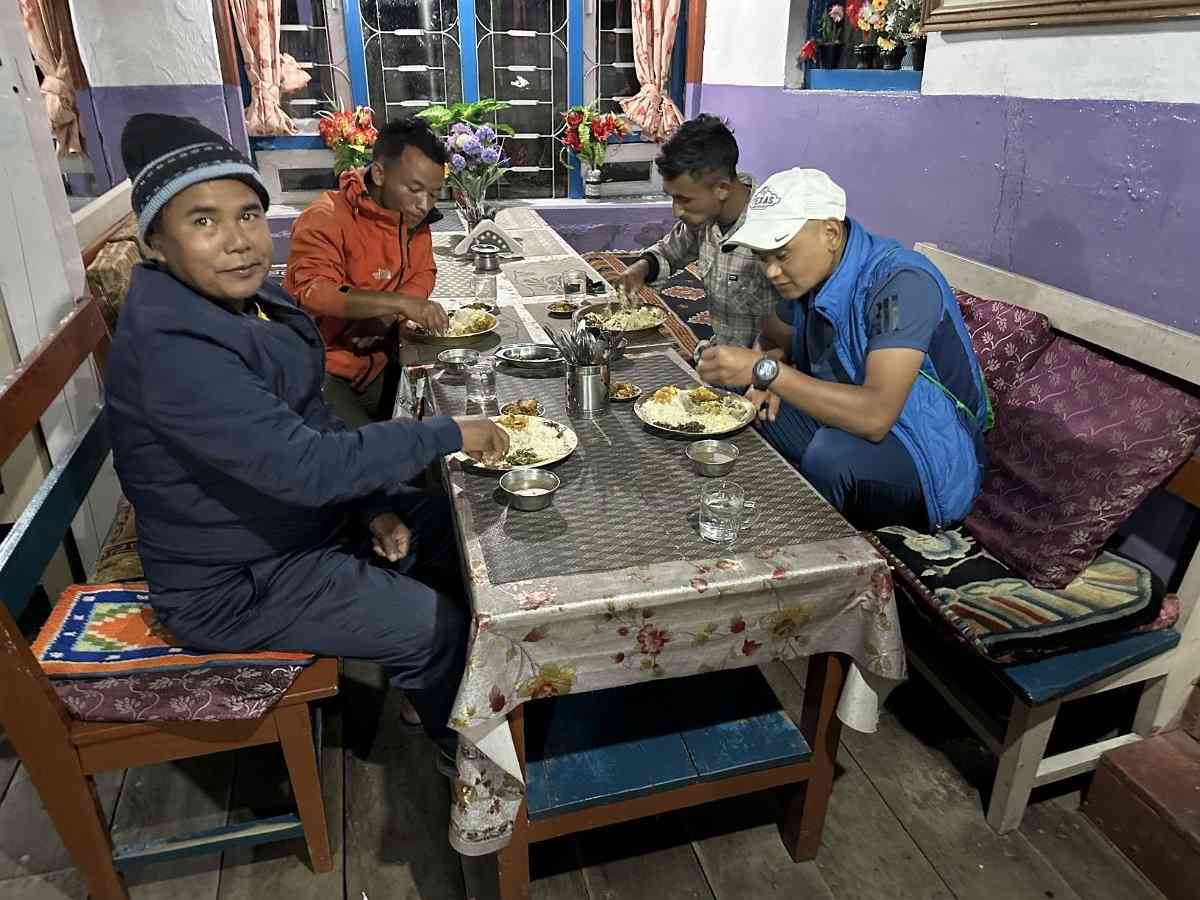
You will find breakfast options such as eggs, toast, porridge, pancakes, bread (Tibetan/Indian), soups, tea (black/milk/green), and coffee. For lunch and dinner, you will mostly find options like Dal Bhat (assortment of rice, lentil soup, vegetables, curries, and pickles), thukpa, chowmein, fried rice, soup, momo, noodles, pasta, pizza, burger, chapati, curries, and desserts like rice pudding, apple pie, etc.
We provide meals three times a day, including breakfast, lunch, and dinner, as you wish. The meals are healthy and in sufficient quantities. We also provide healthy Nepali and Western food during the 11-day Annapurna Circuit Trek.
Note:We do not provide any meal facilities in Kathmandu and Pokhara. The package also includes no soft or hard drinks during the trek, except for tea or coffee with the meal. If you have any dietary restrictions, please let us know when booking.
Annapurna circuit Elevation & Distance
The Annapurna Circuit Trek covers a total of 65 km. However, the distance depends on the itinerary and transportation options chosen:
Trekking Distance: 65 km (40 miles)
Total Distance (Trek and Drive Combined): 689 km (428 miles)
Driving Distance Only: 624 km (388 miles)
Take a look at the itinerary and the maximum elevation and duration during Nepal Alternative Treks’ 11 Days Annapurna Circuit Trek:
Day
Itinerary
Overnight Elevation
Distance
1
Drive to Besi Sahar
860 m/ 2,805 ft
160 km
2
Drive to Chame from Besisahar
2,710 m/ 8,891 ft
80 km
3
Trek to Upper Pisang from Chame
3,300 m/ 10,827 ft
15 km
4
Trek to Manang from Upper Pisang
3,500 m/ 11,483 ft
16 km
5
Acclimatization day
–
–
6
Trek to Ledar from Manang
4,100 m/ 13,484 ft
10 km
7
Trek to Thorong Phedi from Ledar
4,400 m/ 14,434 ft
6 km
8
Trek to Muktinath via Thorong La Pass
3,800 m / 12,468 ft
18 km
9
Drive to Marpha from Muktinath
2,713 m/ 8,952 ft
24 km
10
Drive to Pokhara
820 m/ 2706 ft
160 km
11
Drive to Kathmandu
1,295 m/ 4,273 ft
200 km
Highest Elevation on the Trek
The highest elevation on the entire trek is Thorong La pass at 5,416 m above sea level. However, the highest place where you’ll spend a night is 4,400 m at Thorong Phedi. At those altitudes, proper acclimatization and staying hydrated are mandatory to reduce the risk of acute mountain sickness.
Changing Elevation That Makes Annapurna Circuit Special
The Annapurna Circuit involves significant elevation change throughout the adventure. Starting from 800 m from dense forest and river valley, you reach an elevation above 5,000 m in a rugged mountain landscape and again descend to the lower arid landscape of Mustang. This changing elevation is indeed one of the challenging parts of the trek, but it also creates an incredible variety of scenery. In fact, the landscape’s diversity is one of the reasons the Annapurna Circuit is among the world’s most celebrated trekking adventures.
How to Prepare for the Annapurna Circuit Trek
As the Annapurna Circuit is a challenging journey in the Himalayas, it requires proper preparation in order to ensure a safe, comfortable, and enjoyable experience. The preparation not only includes physical preparation but also mental preparation and packing the right gear.
Prepare Your Body, Especially for Thorong La Pass
One of the toughest parts of the Annapurna Circuit is the ascent to Thorong La Pass. Besides, trekking from Chame to Pisang, descending from Thorong La to Muktinath, and challenging terrain also require proper fitness to safely complete the journey. You must be able to ascend and descend steep, narrow paths across varied terrain.
To prepare for those challenges:
Practice hiking uphill for 4-6 hours continuously.
Walk up staircases or steep hills carrying a daypack.
To improve lung capacity, include cardio exercises such as running, cycling, or swimming.
Practice squats and lunges that help you to strengthen your legs, which help during the long descent from Thorong to Muktinath.
Train for Continuous Trekking Days
Annapurna Circuit takes 11 days to complete, out of which you must walk for 6 days in the region and the other drive. Walking continuously for 6 days with limited recovery time might be harsh on your body. So, prepare yourself for continuous walking days, ready to repeat the effort for over a week.
Include preparations:
Back-to-back weekend hikes.
Walk 10-15 km on consecutive days.
Walk with a loaded backpack.
This preparation is valuable on sections between Upper Pisang, Manang, Yak Kharka, and Thorong Phedi, where daily elevation gains increase.
Mental Preparation
You must be mentally prepared for the Annapurna Circuit Trek and its challenges. Because as much as the trek is physically challenging, it is mentally draining, especially if it is your first Himalayan experience. Hence, you must have strong mental resilience and a positive mindset to participate in the trek.
The best way to prepare mentally is to research the difficulty of the Annapurna Circuit Trek. You must also learn about the possible challenges and events that can occur during the journey. Trekkers must understand that the Himalayas are unpredictable, and the weather at higher altitudes can change at any time. So, you must be prepared for any unforeseen events. Additionally, you need strong determination to complete the trek successfully.
Mental preparation helps when:
Walking for several hours through the windswept landscapes of Manang.
Spending cold nights at Yak Kharka and Thorong Phedi.
Starting the Thorong La crossing before sunrise in freezing temperatures.
Adapting to changing weather and basic tea-house facilities.
Pack for Annapurna’s Diverse Climate Zones
The Annapurna Circuit takes you through diverse climatic zones within a short span of time. Thus, trekkers should pack a variety of clothing suited to the Annapurna region’s diverse climatic zones.
Essential Packing includes:
Lightweight trekking shirts for lower elevations around Chame and Pisang.
A fleece jacket for cool evenings in Manang.
A down jacket for overnight stays above 4,000 m.
Waterproof dress for unexpected rain in the lower region or snow in the higher region.
Thermal base layers for the Thorong Phedi and High Camp area.
Trekking boots with ankle support for rocky sections between Chame and Upper Pisang, loose gravel paths near Thorong La, and the long downhill section to Muktinath.
Extra Personal Expenses
When budgeting for the Annapurna Circuit Trek, most trekkers consider permit, accommodation, food, and transportation costs. But if you book through an agency, those costs are covered in your trek package. What adds to the cost of the trek are additional personal expenses incurred during the journey.
The personal expenses include:
Bottled water: NPR 100-300 per bottle, gets more expensive with an increase in altitude.
Hot drinks (tea, coffee, lemon honey): NPR 100-250 per cup.
Energy drinks and juice: NPR 200-500 per bottle at higher elevations.
Phone/camera charging: NPR 100-300 per charge.
Hot shower: NPR 200-500 per shower.
Wi-Fi: NPR 100-400 per hour or per session.
Souvenirs and Shopping: USD 20-25.
Snacks and Extra Food: NPR 500-1100.
Guide and porter tips: USD 100-200.
We Offer Last-Minute Bookings and Multiple Departures
If you are thinking of making an immediate for Annapurna Circuit Trek, we have your back. Nepal Alternative Trek provides last-minute bookings and multiple departures. The cost of the booking will remain the same for last-minute bookings as for regular packages. Contact us 24 hours before you wish to set off for the trek. We will make the arrangements and provide you with an online briefing for the trek.
Annapurna Circuit Trek Vs Annapurna Base Camp Trek for 2026/27
Both the Annapurna Circuit and the Annapurna Base Camp Trek are well-known and most preferred destinations of the Annapurna region of Nepal. But, confused about which one to choose for your 2026 adventure?
Here is a detailed comparison between the world-class trek destinations: Annapurna Circuit and Annapurna Base Camp Trek to help you choose the right trek:
Feature
Annapurna Circuit Trek
Annapurna Base Camp Trek
Trek Type
Circular trekking route around the Annapurna massif
Out-and-back trek to Annapurna Base Camp
Duration
10-12 days
6-8 days
Maximum Altitude
5,416 m (Thorong La Pass)
4,130 m (Annapurna Base Camp)
Difficulty
Strenuous
Moderate
Scenery
Diverse landscapes, deserts, valleys, forests, and mountains
Dense forests, waterfalls, villages, and mountain views
Annapurna I, Machhapuchhre, Hiunchuli, Annapurna South
Cultural Experience
Strong Tibetan-influenced culture in the Manang and Mustang regions
Gurung and Magar villages with traditional lifestyles
Weather Variation
Significant climate changes from subtropical to alpine desert
More stable mountain climate
Risk of Altitude Sickness
Higher due to elevation above 5,000 m
Moderate due to lower maximum altitude
Side Trips
Tilicho Lake, Ice Lake, Muktinath
Jhinu Danda Hot Springs
Crowd Level
Moderate
Generally busier due to shorter duration
Cost
Higher because of longer duration
Lower because of shorter duration
Fitness Requirement
High
Moderate
Suitable For
Experienced trekkers seeking adventure and diverse landscapes
Intermediate trekkers with limited time
Overall Experience
A complete Himalayan journey with varied landscapes and cultures
A direct route to the Annapurna Sanctuary
Typical Day in the Annapurna Circuit Trek
The Annapurna Circuit is among the journeys where your typical day starts early. On the journey, you wake up before sunrise, hearing the wind outside or smelling wood smoke from the teahouse kitchen. In higher places like Manang or Thorong Phedi, you have to wake up in very cold, close to freezing, which is one of the difficult parts of the trek.
You’ll have breakfast by 6:00 AM in the shared dining room. After breakfast, you hit the trail by 7:00 AM. The early morning hours on the trail are generally the most enjoyable. The air is fresh and cool, the mountain views are at their clearest, and the paths are peaceful before more trekkers arrive later in the day. After 2-3 hours of trek, most trekkers take a break at a small teahouse along the way. These stops are not only for food and rest but for staying hydrated and removing a layer as the rising sun makes the temperature hot.
By midday, you’ll reach lunch point, where you’ll rest and recharge your body with a hearty meal. The afternoon walk after lunch is shorter, lasting about 2-3 hours. However, temperatures are warmer, the trail is busier, and tiredness from the morning’s hike starts. By 5:00 PM, you get to the day’s destination and enjoy your evening watching stunning sunset. Dinner is served early on the Annapurna Circuit, between 6:00 and 7:00 PM. After a full day of trekking, most trekkers head to bed by 8:00 PM, marking the end of the day.
Sample Typical Day in Annapurna Circuit at a Glance
Time
Activity
5-5:30 AM
Wake up, layer up, pack a bag
6:00 AM
Breakfast at the teahouse
7:00 AM
Start trekking
10-10:30 AM
First trail break
12:30 PM
Lunch at the village teahouse
2:00 PM
Resume trekking
4:30 PM
Arrive at the day’s destination, check in
5:00 PM
Shower, rest, witnessing sunset
6-7:00 PM
Dinner
8:00 PM
Sleep
Contact us today to book your Annapurna Circuit Trek for 2026. Want to talk with experts about the itinerary, fitness requirements, or booking? Get in touch with us directly via info@nepalalternativetreks.com! Our teams are ready to assist you.
What Trekkers Mostly Ask About Annapurna Circuit Trek
Can you see Mount Everest during the Annapurna Circuit Trek?
You cannot see Mount Everest during the Annapurna Circuit Trek, as Mt. Everest lies in the Everest region and Annapurna Circuit is in Annapurna region of Nepal. The Everest region is in the northeastern part of the country, while the Annapurna is in the central part of the country. They lie in different regions, so you should take Everest Base Camp trek to see Mount Everest to see closely.
How difficult is the Annapurna Circuit Trek?
The Annapurna Circuit is a strenuous trek that will push your physical limits. The trekking trails go through subtropical forests to alpine meadows on rough and rugged terrains. Similarly, you must ascend and descend on steep and narrow pathways and cross several suspension bridges. The average trekking hour per day is between 4 to 6 hours.
Can beginners participate in the Annapurna Circuit Trek?
Annapurna Circuit Trek is a challenging journey but requires no prior experience, and beginners can participate. However, beginners as well as trekkers of all levels should make adequate preparations to take part in the adventure. They must prepare physically and mentally to overcome the challenges of the Annapurna Circuit Trek.
What fitness level is necessary for Annapurna Circuit Trek?
Trekkers must have a reasonable fitness level for the Annapurna Circuit Trek. They must have the strength, stamina, and endurance to trek uphill and downhill trails on varied terrains. Similarly, they should be able to hike 4 to 6 hours a day. In addition to their fitness level, trekkers must also have strong mental resilience to complete the trek successfully.
Do I have to hire a guide for Annapurna Circuit Trek?
Yes, you must hire a guide for the Annapurna Circuit Trek, as it has made it mandatory. As of April 2023, the government of Nepal and the Nepal Tourism Board announced this new rule jointly. You must hire a licensed guide through a registered trekking agency. Hiring a guide helps to make the trek safe and enhance the trekking experience.
Annapurna Base Camp Trek vs Annapurna Circuit Trek, which is harder?
The Annapurna Circuit Trek is harder than the Annapurna Base Camp Trek as it takes longer and has more challenging trails. The Annapurna Circuit Trek takes 12 to 22 days, while the Annapurna Base Camp takes 7 to 10 days. The trails of the Annapurna Circuit are more demanding, with steeper and more challenging terrains. The maximum altitude is also higher.
Can you see Mount Everest during the Annapurna Circuit Trek?
You cannot see Mount Everest during the Annapurna Circuit Trek, as the world’s highest mountain lies in the Everest region of Nepal. The Everest region is in the northeastern part of the country, while the Annapurna Circuit Trek is in the central part of the country. They lie in different regions, so you must travel to the Everest region to see Mount Everest.
Do I need a special permit for the Annapurna Circuit Trek?
There is no need for a special permit for the Annapurna Circuit Trek since it does not lie in a restricted area. However, you will need two trek permits: a TIMS (Trekkers Information Management System) card and an ACAP (Annapurna Conservation Area Entry Permit). You can obtain these permits through a registered trekking agency in Kathmandu or Pokhara.
What is the highest point of the Annapurna Circuit Trek?
Annapurna Circuit Trek’s highest point is at the Thorong La Pass. It sits at an altitude of 5416 meters above sea level and is also the most challenging part of the trek. Upon reaching the top of the pass, you can witness the grand view of the Annapurna and Gangapurna ranges. Similarly, you can also get a view of the semi-arid landscape of the Mustang.
Is there a risk of altitude sickness during the Annapurna Circuit Trek?
Yes, there is a risk of altitude sickness during the Annapurna Circuit Trek since it takes you to an altitude above 5000 meters. Due to the high altitude, trekkers can experience various altitude-related symptoms like nausea, headache, dizziness, shortness of breath, etc. To minimize the risk, trekkers must take adequate acclimatization and rest days.
Are there ATM facilities available along the Annapurna Circuit Trek route?
You will not find any ATM facilities along the Annapurna Circuit Trek route, as it takes you to remote and rural areas of Nepal. These areas lack proper infrastructure, and the shops and accommodations do their business in cash. Hence, trekkers must carry sufficient cash for personal expenses during the trek. You will not find any ATM facilities along the Annapurna Circuit Trek route, as it takes you to remote and rural areas of Nepal. These areas lack proper infrastructure, and the shops and accommodations do their business in cash. Hence, trekkers must carry sufficient cash for personal expenses during the trek.
Is travel insurance necessary for Annapurna Circuit Trek?
Travel insurance is mandatory for all high-altitude treks in Nepal, including Annapurna Circuit Trek. The insurance should cover high altitudes of up to 6000 meters, altitude sickness, medical bills, emergency expenses, and helicopter rescue operations. Similarly, the insurance must also cover trip postponement/ cancellation and luggage loss/damage.
Can I use WiFi/ internet during the Annapurna Circuit Trek?
Yes, you can use WiFi/ internet during the Annapurna Circuit Trek, as most accommodations provide these services. However, they will charge additional costs, and the internet connectivity is relatively poor. It is not suitable for heavy data-intensive work, but it is enough to communicate with your friends and family back home.
Where can I buy trekking gear for the Annapurna Circuit Trek?
You can buy trekking gear for the Annapurna Circuit Trek at Thamel in Kathmandu. There are numerous shops in the area that sell high-quality and branded trekking gear. Similarly, you can also find shops with affordable price ranges. If you do not want to buy expensive gear, you can also rent them, which is a budget-friendly option.
Let our local mountain experts craft a personalized itinerary around your schedule, fitness level, and travel goals — safe, authentic, and rooted in Nepal Alternative Treks’ trail experience.
Need assistance? Our travel expert Tej Bahadur Gurung is here to help! Please fill out the form below to initiate a chat and get your queries resolved quickly.








 Quito, Ecuador5.0 /5
 London, UK5.0 /5