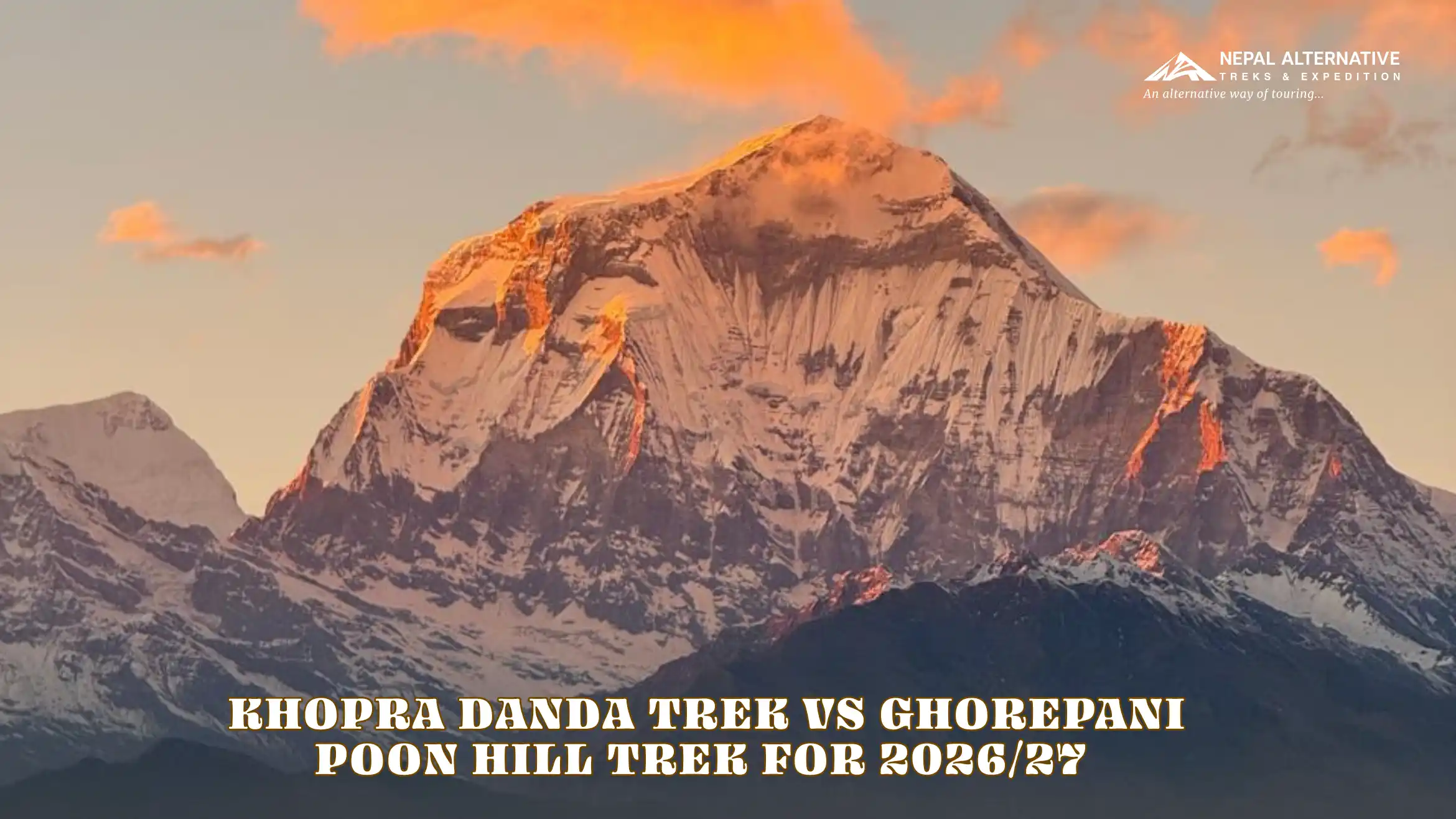
Picture yourself standing on a mountain ridge at dawn, watching the first golden rays of sunlight up the Annapurna and Dhaulagiri mountains. Now imagine the moment with almost no one else around. This is what choosing between the Ghorepani Poon Hill Trek vs the Khopra Danda Trek feels like.
Both treks take you through the Annapurna Conservation Area via terraced fields, colorful rhododendron forests, and traditional Magar and Gurung villages. However, they offer very different experiences. While Ghorepani Poon Hill is one of Nepal’s most popular short treks with easy access, developed trails, and beginner-friendly conditions, Khopra Danda Trek is a peaceful, underrated, and less-traveled one.
In this detailed comparison of Ghorepani Poon Hill vs Khopra Danda Trek, you’ll find the key differences between the two treks. By the end, you’ll have a clear understanding of which Annapurna trek best matches your expectations and choose the one that best suits your travel style and goals.
| Comparison Factor | Ghorepani Poon Hill Trek | Khopra Danda Trek |
| Trek Duration | 4 days | 6 days |
| Maximum Elevation | 3,210 m (Poon Hill) | 3,660 m (Khopra Ridge), 4,660 m (Khayer Lake optional) |
| Difficulty Level | Easy (4-6 hours walking day). Suitable for beginners, families & older trekkers. Hardest section: 3,300+ stone steps from Tikhedhunga to Ulleri) | Easy to Moderate (Longer days, steeper ascents & higher elevations.) |
| Best For | Beginners, families, first-time trekkers | Experienced trekkers seeking solitude |
| Crowd Level | High, one of Nepal’s most popular short treks | Low; significantly fewer trekkers throughout the year |
| Mountain Views | Sunrise views over the Annapurna and Dhaulagiri ranges | Closer views of Annapurna South, Dhaulagiri, Nilgiri, and Fang Peak |
| Cultural Experience | Popular Gurung and Magar villages | Authentic Gurung and Magar rural villages with deeper local interaction |
| Accommodation | Comfortable teahouses with hot showers, Wi-Fi, and varied meal options | Basic teahouses and community lodges with limited facilities |
| Overall Trek Cost | USD 250-280 per person | USD 420-480 per person |
| Accessibility | Easily accessible with well-developed trekking infrastructure | Less accessible due to remote trail sections |
| Trail Condition | Well-maintained trails and stone staircases | More rugged and less-developed trekking paths |
| Location Highlights | Poon Hill sunrise, rhododendron forests, Ghandruk village | Khopra Ridge, Khayer Lake, Dobato viewpoint, remote mountain landscapes |
| Overall Experience | Short, accessible, and iconic Himalayan trek | Remote and off-the-beaten-path adventure |
| Best Choice For | Travelers with limited time, budget, or trekking experience | Adventure seekers wanting authentic culture and fewer crowds |
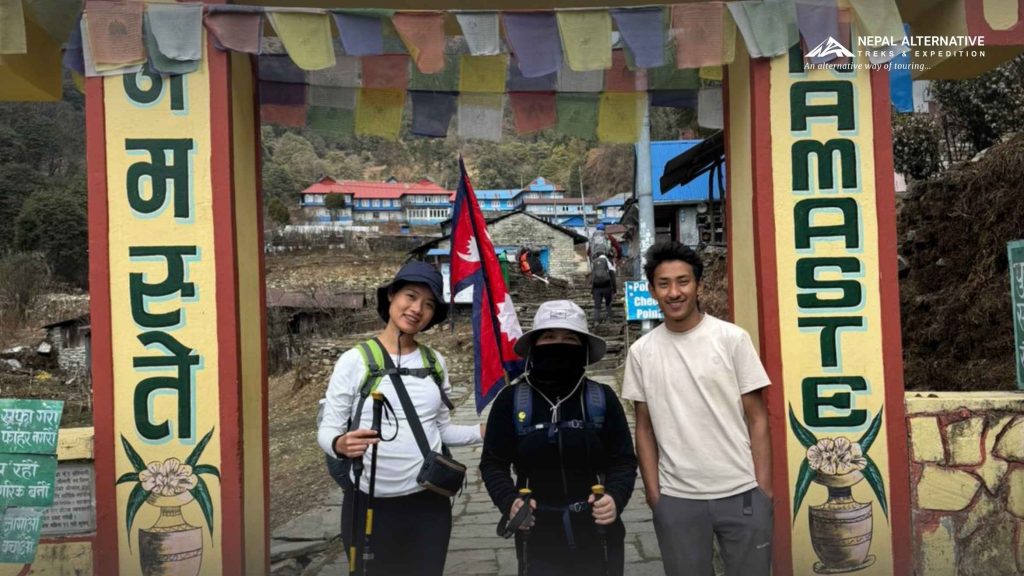
Comparing Poon Hill And Khopra Danda Trek
Both Poon Hill and Khopra Danda Trek showcase the beauty of the Annapurna region, but they attract different types of trekkers. Some travelers prioritize accessibility and comfort, while others seek peace and a more off-the-beaten-path experience. Understanding how these routes differ in terms of accommodation, cost, difficulty, cultural experiences, and scenery can help you choose the trek that best matches your expectations.
Accommodation
| Poon Hill Trek | Khopra Danda Trek |
| Due to the popularity of the Poon Hill route, it has well-established accommodation points in villages such as Ulleri, Ghorepani, and Ghandruk. You can find a range of teahouses that match your preference. Most teahouses along the Poon Hill route offer comfortable rooms, hot showers, Wi-Fi, and a variety of meal options. Expect to pay around USD 5-10 per room and USD 3-7 per meal during the trek. | The Khopra Danda route is comparatively remote and less commercialized, as seen in the accommodation points along the trek. Along the route, accommodation includes community-run lodges, especially at Khopra Ridge and Dobato, and basic teahouses in other locations. While the facilities are sufficient for trekkers, they are simpler than those found on the Poon Hill route, with simple rooms, shared bathrooms, and limited hot water. On the Khopra route, expect USD 5-8 per room. |
Cultural Experience
| Poon Hill Trek | Khopra Danda Trek |
| The Poon Hill route passes through several well-known Gurung and Magar settlements. So expect to get opportunities to experience local traditions, architecture, and hospitality of the communities. Gurung and Magar villages like Ghandruk and Ghorepani are welcoming but heavily touristed. | The trek to Khopra Danda passes through quieter villages where traditional lifestyles remain unchanged. You’ll walk through rarely-visited villages like Swanta, Nangi, and Chistibung, where traditional Magar and Gurung life continues undisturbed. On the route, you’ll enjoy more personal interactions with local residents and gain deeper insight into community hospitality, culture, and tradition, and rural Himalayan life. |
Cost & Duration
| Poon Hill Trek | Khopra Danda Trek |
| The Poon Hill Trek is a short adventure that can be completed in a 4-day round-trip itinerary. So, its short duration makes it the best short adventure near Pokhara. Its shorter duration means fewer expenses for accommodation, meals, guide and porter services, and transportation. Additionally, the route follows a well-established trail with easy access to villages and facilities, helping keep overall costs relatively low. The Poon Hill Trek generally costs between USD 250 and 280 per person. | Khopra Danda takes about 6 days to complete. The longer trekking duration naturally increases expenses, as you spend more nights in teahouses and require additional meals and support services. The route to Khopra also passes through more remote areas, where transporting supplies and maintaining lodges is more challenging, contributing to slightly higher costs. Additionally, the Khopra Danda Trek costs USD 420-480 per person. |
Difficulty & Beginner Suitability
| Poon Hill trek | Khopra Danda Trek |
| Poon Hill is one of Nepal’s easiest and most beginner-friendly treks. Thus, it is suitable for first-time trekkers, families, older travelers, and trekkers with limited mountain experience. The route to Poon Hill is well-maintained, with a daily walking time of 4-6 hours, and the maximum altitude is 3,200 meters. The most challenging part of the trek is the 3,300+ stone steps from Tikhedhunga to Ulleri, which is still manageable with proper pacing. | Khopra Danda Trek is an easy-to-moderate adventure. It involves longer trekking days, steeper ascents, and higher elevations (3,660 m at Khopra Ridge, 4,000 m+ if extending to Khayer Lake), so it is best suited for moderately experienced trekkers rather than complete beginners. |
Location Highlights
| Poon Hill Trek | Khopra Danda Trek |
| The trek to Poon Hill is best known for its iconic sunrise viewpoint over the Annapurna and Dhaulagiri ranges. The route passes through Gurung and Magar villages, such as Ghorepani and Ghandruk, dense rhododendron forests, and terraced farmlands. Ghandruk is one of the highlights of the journey, with the largest Gurung settlement, a museum, and broad valley views. | The Khopra Danda Trek, on the other hand, takes trekkers deeper into the region, making it ideal for those interested in trekking in the Annapurna region away from busy trails. The Khopra Danda Trek highlights include a vantage point that provides closer and more uninterrupted views of peaks such as Dhaulagiri, Annapurna South, Nilgiri, and Fang. The trek also includes an optional hike to Khayer Lake, a sacred alpine lake at a higher elevation. Dobato is another high-altitude meadow with close-up Himalayan views and a community lodge. Moreover, Swanta is a rarely-visited traditional Magar village on the return trek route. |
Crowd Level
| Poon Hill Trek | Khopra Danda Trek |
| As Poon Hill is one of the most famous short treks, it attracts thousands of trekkers each year. Around 30,000 foreign tourists visit the Poon Hill-Ghorepani area each year, generating around Rs 5.4 million in local entry fees. | The trekking trail to Khopra Ridge remains relatively off the beaten path compared to other Annapurna treks. The destination experiences 10-20 times fewer visitors than Poon Hill due to its remoteness and its underrated status. |
Khopra Danda vs. Ghorepani Poon Hill: Which Annapurna Trek is Better?
It would not be fair to declare either Khopra Danda or Ghorepani Poon Hill the “better” trek, as both offer unique experiences and appeal to different types of travelers. So, rather than determining which trek is objectively better, it is fair to identify which one aligns with your interests, fitness level, schedule, and travel expectations. Without a doubt, both treks showcase the beauty of the Annapurna region within the Annapurna Conservation Area, but they suit slightly different types of trekkers.
Ghorepani Poon Hill Trek
Ideal trekker profile
- Age 16-60; any fitness level
- First-time or occasional trekker
- 4-5 days availability
- Budget-conscious traveler
- Families, couples, solo beginners
- Wants iconic sunrise photos
Trek to Ghorepani Poon Hill is suitable for travelers with limited time, experience, or budget who want an easy beginning to the Himalayas. It offers everything many first-time visitors imagine Nepal to be like, from sunrise views to rhododendron forests and traditional mountain villages, in a short time and with less preparation. Additionally, this trek is budget-friendly due to its shorter duration and easy accessibility from Pokhara.
Its major highlight is the famous Poon Hill sunrise viewpoint, from which you can enjoy views of the rising sun illuminating the peaks of Annapurna, the Dhaulagiri range, and surrounding peaks. Additionally, the Gurung and Magar villages, rhododendron forests, and comfortable teahouse facilities make it the best short trek in Nepal.
If your priority is a short, accessible, and beginner-friendly trek with iconic sunrise views, the Ghorepani Poon Hill Trek is your better fit.

Khopra Danda Trek
Ideal trekker profile
- Age 20-55, moderate to good fitness
- Some previous trekking experience
- 7-10 days available
- Mid-range budget, values experience over comfort
- Solo adventurers, small friend groups, repeat Nepal visitors
- Seeks solitude and authentic encounters
Khopra Danda is a great choice for trekkers who have already seen Nepal’s popular mountain route and want a different experience. It is best suited for trekkers who ask not “what does Nepal look like?” but “What is life in the mountains really like away from the busy tourist routes?” The trek can be an unforgettable adventure for those who can spend a few extra days and are comfortable with basic accommodation. In return, you’ll enjoy wider mountain views, peaceful routes, and a chance to experience local village life that hasn’t been heavily influenced by tourism.
The highlight of the Khopra Danda Trek is close-up views of Annapurna South, Dhaulagiri, Nilgiri, and surrounding peaks. For those seeking an additional challenge, the optional hike to the sacred Khayer Lake adds another memorable part to the journey.
If you’re looking for a longer adventure away from the crowds, with peaceful paths and beautiful remote scenery, choose the Khopra Danda Trek as it suits you better.
FAQs
Can I combine Khopra Danda and Poon Hill Trek?
Yes, you can combine Khopra Danda and Poon Hill Trek in the Annapurna region; in fact, it is one of the most popular variations that connects the routes naturally. The combined route starts with a trek from Nayapul to Ghorepani, followed by a hike to Poon Hill, and takes you to Swanta, connecting you to the Khopra Ridge Trek. After completing the trek, the trek returns via Tatopani.
Which trek offers better mountain views, Poon Hill or Khopra Danda?
Khopra Danda offers better views of the mountains than Poon Hill. While Poon Hill is famous for its sunrise and sunset views, Khopra Danda provides closer, less crowded, and wider views of major Himalayan peaks, including Dhaulagiri, Annapurna South, Nilgiri, and Machhapuchhre.
Among Khopra Danda and Ghorepani Poon Hill, which trek is better?
Whether the Khopra Danda or the Ghorepani Poon Hill trek is better depends on what type of adventure you’re seeking, as both treks offer different trekking experiences. Ghorepani Poon Hill can be a better option for first-time trekkers seeking a shorter and easier route, while Khopra Danda can be better for those looking for a peaceful trail, a longer adventure, and a deep mountain experience.
Is the Khopra Danda Trek more difficult than the Ghorepani Poon Hill Trek?
Yes, the Khopra Danda Trek is more difficult than the Ghorepani Poon Hill Trek because it involves longer walking days, steeper ascents, and higher elevations than Poon Hill, making it moderately challenging.
What is the best time to trek Khopra Danda and Ghorepani Poon Hill?
The best times to trek Khopra Danda and Ghorepani Poon Hill are during the spring (March to May) and autumn (September to November) seasons. During the seasons, the weather is stable, the skies are clear, and the mountain views are at their best.