Nepal trekking is not completely easy, especially because high altitude can make the journey more demanding. However, some routes are less difficult than others, and we call them beginner-friendly treks. These treks are suitable for beginners, families, and older hikers. Still, one trek doesn’t suit everyone. Your ideal trek depends on several factors, like:
Altitude tolerance: How high can you comfortably go without risking altitude sickness?
Available days: How many total days (including travel) can you commit?
Fitness level: Can you walk 4-5 hours daily, or are you ready for 6-7 hours with steep climbs?
Scenery priorities: Do you want sunrise panoramas, close-up 6,000 m peaks, Everest views, or cultural immersion?
Season: When are you traveling? (Spring and autumn offer the best conditions for all beginner treks.)
This guide breaks down the top beginner-friendly treks by these factors and recommends the best option for each type of first-time trekker.
1. Ghorepani Poon Hill Trek — Best Overall for Beginners
Max altitude: 3,210 m (Poon Hill)
Duration: 4 to 5 trekking days (7 days total with travel to and from Kathmandu)
Difficulty: Easy to moderate
Best season: Spring (March to May), Autumn (September to November)
Daily walking: 4 to 6 hours on well-maintained trails
Altitude risk: Very low; most trekkers have no issues at 3,210 m
The Ghorepani Poon Hill trek is widely considered the easiest entry point to Himalayan trekking. It starts from Nayapul or Birethanti (both reachable by a 1.5-hour drive from Pokhara) and follows well-maintained trails. The trail passes through lush rhododendron forests (spectacular in spring when they bloom), terraced farmland, and traditional Gurung and Magar villages.
Likewise, the development of more solar-powered charging and better Wi-Fi in Ghorepani has also made it more beginner-friendly. Further, a new road now allows trekkers to drive closer to Ulleri, shortening the trek to 3 to 4 days if time is tight (though this skips some scenic forest sections).
Key highlights:
Sunrise at Poon Hill: One of the best sunrise panoramas in Nepal, offering views of Annapurna I-IV, Dhaulagiri, Nilgiri, and Machhapuchhre, all visible from a single viewpoint.
Low altitude risk: At 3,210 m, Poon Hill stays below the threshold where acute mountain sickness becomes common. Most trekkers experience no altitude symptoms.
Comfortable teahouses: Warm lodges with hot showers, varied menus, and reliable Wi-Fi in Ghorepani.
Cultural experience: Stay in traditional Gurung and Magar villages, learn about local farming practices, and experience warm Himalayan hospitality.
Best for: First Himalayan trek, couples, families, travelers with limited vacation time (under 7 days total).
Beginner profile match:
Altitude tolerance: Low (under 3,210 m)
Available days: 5-7 total
Fitness level: Basic (can walk 4 to 6 hours daily)
Scenery priority: Sunrise panoramas over 8,000 m peaks
Season flexibility: Works in both spring and autumn
2. Mardi Himal Trek— Best for Mountain Views
Max altitude: 4,500 m (Mardi Himal Base Camp)
Duration: 4 to 6 trekking days
Difficulty: Easy to moderate (requires reasonable fitness)
Best season: March to May, September to November
Daily walking: 5-6 hours with steep sections.
Altitude risk: Moderate (4,500 m requires proper acclimatization)
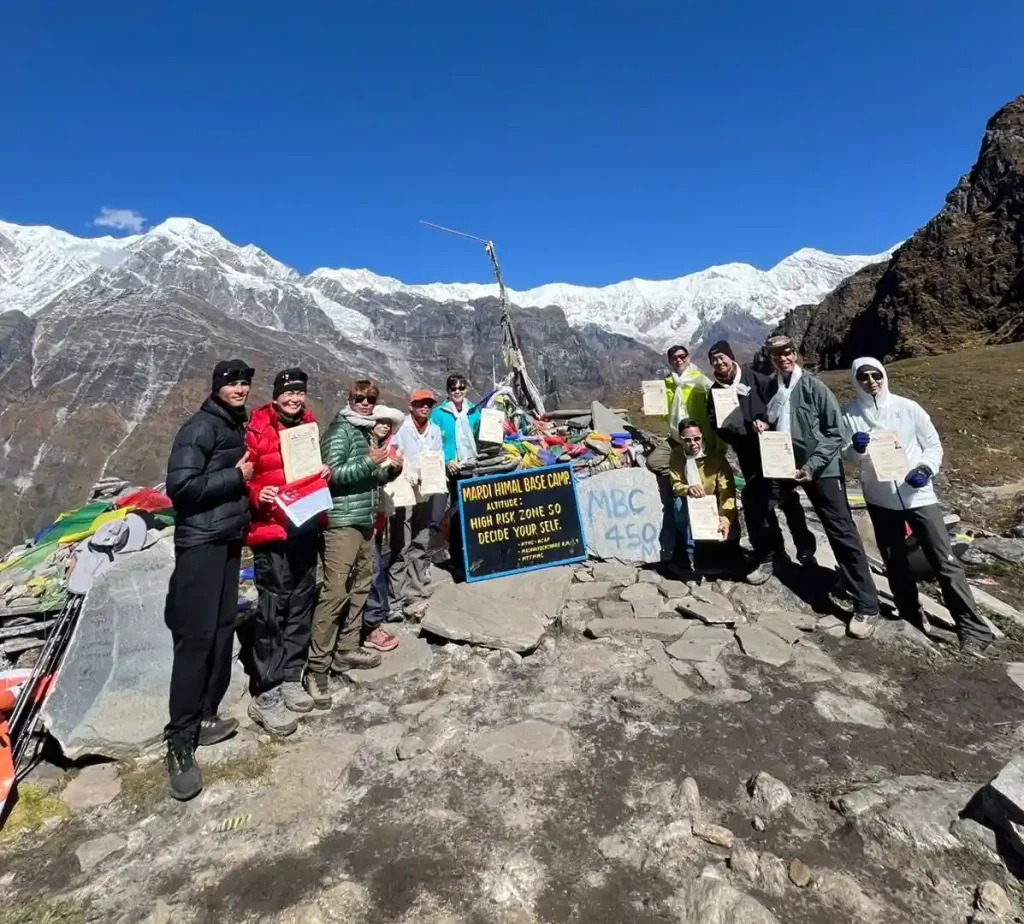
Mardi Himal Trek has surged in popularity since 2023 as a shorter, more dramatic alternative to Annapurna Base Camp. It starts from Dhampus or Deurali (both 2–3 hours from Pokhara). The trail starts in lush forests at 1,800 m and climbs to alpine ridgelines above 3,500 m, where Machhapuchhre (6,993 m) dominates the skyline. From High Camp and Base Camp, you’re eye-level with the fishtail peak, which is one of the most photogenic mountains in Nepal.
This trek is a beginner-friendly or easy trek in Nepal because the trail has been widened and marked more clearly after monsoon damage in 2024. Also, helicopter landing zones have been established near High Camp for faster evacuations. New lodges at Low Camp (3,150 m) and High Camp (3,550 m) have been developed further since 2024, improving comfort and options for rest.
In terms of difficulty, the trail includes steep ascents (especially from Forest Camp to Low Camp) and reaches 4,500 m at Base Camp, which is higher than Poon Hill and with a greater altitude risk. Thus, it’s beginner-accessible for reasonably fit trekkers who can handle 5–6 hours of walking per day with significant elevation gain.
Key highlights:
Close-up 6,000 m+ peaks: The ridge walk above 3,500 m offers some of the closest views of 6,000 m+ peaks available on any beginner trek.
Short itinerary: Can be done in 4 to 6 days.
Forest-to-alpine transition: Dramatic landscape change from dense rhododendron forests to open alpine ridgelines.
Cultural experience: Pass through traditional Gurung villages and learn about local farming and herding practices.
Best for: Fit first-timers who want dramatic mountain views without committing to a 10+ day trek.
Beginner profile match:
Altitude tolerance: Moderate (up to 4,500 m)
Available days: 4 to 6 total.
Fitness level: Moderate (can walk 5-6 hours with steep climbs)
3. Everest View Trek— Best Beginner Trek for Everest Views
Max altitude: 3,880 m (Everest View Hotel)
Duration: 5 to 7 trekking days
Difficulty: Easy to moderate
Best season: March to May, September to November
Daily walking: 5 to 6 hours on well-maintained trails.
Altitude risk: Moderate (3,880 m is higher than Poon Hill, but the gradual ascent from Lukla (2,840 m) allows for natural acclimatization.
Lukla flight: Requires a flight to Lukla
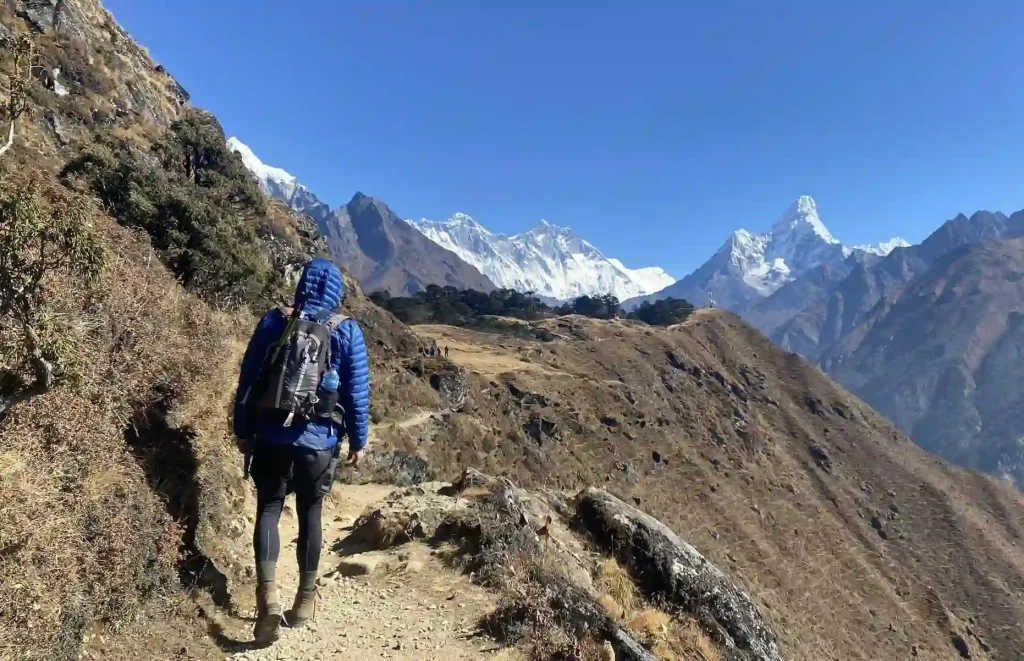
The Everest View Trek (also called Everest Panorama Trek) lets you experience the Khumbu region, home to Everest, Lhotse, and Ama Dablam, without the 12 to 14 day commitment of Everest Base Camp. It starts with a scenic flight to Lukla (2,840 m) and follows the classic EBC trail to Namche Bazaar (3,440 m), from where we hike up to Everest View Hotel. The trail follows the Dudh Koshi River valley, passes through pine and rhododendron forests, crosses suspension bridges, and traditional Sherpa villages.
In terms of difficulty, the trek requires 5–6 hours of walking on well-established trails. The altitude risk is higher than Poon Hill, as 3,880 m is higher than Poon Hill, but the gradual ascent from Lukla (2,840 m) allows for natural acclimatization.
Key highlights:
Everest views: Everest View Hotel offers clear views of Everest, Lhotse, Ama Dablam, and Thamserku on good weather days.
Sherpa villages: Stay in traditional Sherpa settlements like Namche Bazaar and Phakding to experience authentic Himalayan culture.
Shorter than EBC: 5 to 7 days vs. 12 to 14 days for Everest Base Camp, making it feasible for travelers with limited vacation time.
Best for: Beginners who want to experience the Everest region without the physical demands of EBC.
Beginner profile match:
Altitude tolerance: Moderate (up to 3,880 m)
Available days: 5 to 7 days total (including Lukla flight)
Fitness level: Moderate (can walk 5 to 6 hours daily)
Scenery priority: Everest region without EBC commitment
Season flexibility: Spring and autumn only
4. Langtang Valley Trek — Best for a Longer First Trek
Daily walking:5-7 hours with steeper sections between Lama Hotel and Langtang Village
Altitude risk: Moderate to high. 4,773 m requires proper acclimatization. Most itineraries include a rest day in Kyanjin Gompa (3,870 m) before ascending to Kyanjin Ri
The Langtang Valley Trek is the longest of the beginner-friendly options. It rewards trekkers with diverse scenery, Tamang culture, and some of the closest views of Langtang Lirung (7,227 m). The journey starts from Syabrubesi (1,503 m), which is reachable by a 6-hour drive from Kathmandu. From there, the trail passes through subtropical forests, alpine meadows, and glacial valleys. Langtang Valley itself is a wide, U-shaped glacial valley with views of Langtang Lirung dominating the skyline. From Kyanjin Ri, you get a 360-degree panorama of 7,000 m+ peaks and glaciers.
The fact that the trail has been rebuilt in sections damaged by the 2015 earthquake, with new bridges and clearer signage, and the opening of new teahouses in Kyanjin Gompa have made this trek one of the options as a beginner-friendly trek.
Key highlights:
Tamang culture: The Tamang people have a distinct Tibetan-influenced culture. Visit ancient monasteries, traditional stone villages, and learn about local Buddhist traditions.
Wildlife opportunities: Langtang National Park is home to red pandas, musk deer, Himalayan black bears, and over 300 bird species. But you may not see all of them, and sightings are rare.
Close-up 7,000 m peaks:Kyanjin Ri (4,773 m) offers stunning views of Langtang Lirung (7,227 m), Yala Peak, and surrounding glaciers.
Best for: Beginners with reasonable hiking fitness who want a longer, culturally rich trek.
Beginner profile match:
Altitude tolerance: Moderate to high (up to 4,773 m)
Available days: 8 to 10 total
Fitness level:Moderate to good (can walk 5-7 hours with elevation gain)
Scenery priority: Mix of mountain views, culture, and wildlife
Season flexibility: Spring and autumn only
Solo Trek Langtang Valley
5. Khopra Ridge Trek — Best Quiet Beginner-Friendly Trek
Max altitude: 3,660 m (Khopra Danda)
Duration: 6 to 8 trekking days
Difficulty: Easy to moderate
Best season: March to May, September to November
Daily walking:5-6 hours with some steep sections (especially the climb to Khopra Danda)
Altitude risk: Low to moderate. 3,660 m is manageable for most beginners with proper pacing
The Khopra Ridge Trek (also called Khopra Danda Trek) is a newer, less-crowded alternative to the classic Annapurna routes. It starts from Ghandruk or Tadapani (both reachable from Pokhara). The trail passes through rhododendron forests (spectacular in spring), terraced farms, and traditional villages before climbing to Khopra Ridge. From the ridge, you get panoramic views of Annapurna South (7,219 m), Dhaulagiri (8,167 m), Nilgiri, and Machhapuchhre, one of the best 360-degree vistas in the Annapurna region.
What makes this trek beginner-friendly and easy trek is that its difficulty is manageable for most trekkers. Also, new community lodges have opened along the ridge, improving accommodation quality. The trail has also been marked more clearly after monsoon damage in 2024.
Key highlights:
Fewer crowds: The trail sees significantly fewer visitors than Poon Hill or Annapurna Base Camp, offering a more peaceful experience.
Panoramic views: Khopra Ridge and Mulde View Point (3,637 m) offer some of the best 360-degree mountain views in the Annapurna region.
Community teahouses: The trail is supported by community-run lodges, which provide authentic hospitality and support local economies.
Optional Khopra Lake extension: Many trekkers combine Khopra Ridge with a visit to Khopra Lake (4,660 m), a sacred alpine lake that requires an additional 2-3 days and better fitness.
Best for: Beginners who want stunning views without the crowds of classic routes.
Beginner profile match:
Altitude tolerance: Moderate (up to 3,660 m)
Available days: 7-9 total
Fitness level: Moderate (can handle some steep sections)
Scenery priority: Panoramic mountain views without crowds
Season flexibility: Spring and autumn only
6. Helambu Trek — Best Short Trek for Beginners
Max altitude: 3,490 m (Tharepati)
Duration: 5 trekking days
Difficulty: Easy to moderate
Best season: March to May, September to November
Daily walking: 5-6 hours on rolling terrain with some steep sections
Altitude risk: Low to moderate. 3,490 m is manageable for most beginners
The Helambu Trek is one of the shortest and most accessible treks from Kathmandu, making it ideal for travelers with limited time. It starts from Sundarijal (1,450 m), just a 1-hour drive from Kathmandu, and follows rolling hills through rhododendron forests, terraced farms, and traditional Hyolmo villages. From Tharepati, you get views of Langtang Lirung (7,227 m), Jugal Himal, and Dorje Lakpa.
As of 2026, the trail has been improved with better signage and new lodges in Tarke Ghyang and Sermathang. A new road extension also lets trekkers drive closer to Tharepati, shortening the trek to 4–5 days if time is tight.
Key highlights:
Proximity to Kathmandu: No flights required, and it is just a short drive to the trailhead.
Hyolmo culture: The Hyolmo people have a distinct Tibetan-influenced culture. Visit ancient monasteries, traditional villages, and learn about local Buddhist traditions.
Shorter commitment: 5 days total, making it feasible for travelers with limited vacation time.
Mountain views: While less dramatic than Annapurna or Everest, you’ll still see Langtang Lirung, Jugal Himal, and Dorje Lakpa from Tharepati.
Best for: Beginners with limited time who want a cultural trek near Kathmandu.
Beginner profile match:
Altitude tolerance: Moderate (up to 3,490 m)
Available days: 6 to 8 total
Fitness level: Basic to moderate (can walk 5-6 hours daily)
Scenery priority: Cultural experience over dramatic mountain views
Season flexibility: Spring and autumn only
Quick Decision Guide: Which Trek Matches Your Profile?
If you…
Choose this trek
Have 5–7 days total and want the safest, easiest first Himalayan trek
Ghorepani Poon Hill
Are reasonably fit and want dramatic close-up mountain views in 4–6 days
Mardi Himal
Want to experience the Everest region without committing to EBC
Everest View
Have 8–10 days and want culture + scenery + wildlife
Langtang Valley
Want stunning views without the crowds of classic routes
Khopra Ridge
Are based in Kathmandu and have limited time
Helambu Circuit
How Difficult Are Beginner Treks in Nepal?
Beginner treks in Nepal are achievable for first-time Himalayan trekkers, but “beginner-friendly” does not mean easy or effortless. You should be prepared for several hours of walking each day, uphill and downhill terrain, basic mountain accommodation, and, in some areas, the effects of altitude.
The following are some aspects that contribute to the difficulty of the beginner treks:
Long walking hours: Most beginner treks involve around 4-6 hours of walking per day. On some routes, such as Langtang, Khopra Ridge, and Mardi Himal, a few days can take 6-7 hours. The time depends on your pace, weather, and trail conditions.
Uphill and downhill sections: Most treks include a lot of steady climbs. For example, the Ulleri stairs on the Poon Hill trek are long and tiring. The climb from Forest Camp to Low Camp on Mardi Himal is also steep. Further, long descents can be just as demanding as climbs because they put sustained pressure on your knees and thighs. Trekking poles can help significantly.
Elevation gain: On challenging days, total elevation gain can range from roughly 500 to 1,000 m. However, the most important figure for altitude safety is your sleeping elevation: how high you sleep each night, not simply how much you climb during the day.
Uneven trails and stairs: Trails on popular beginner routes are well used, but they are still mountain paths. They are not smooth roads. You may walk on stone steps, rocks, tree roots, muddy paths, and uneven ground. Good hiking boots with traction and time to walk carefully are more important than speed.
Suspension bridges: Suspension bridges are common on routes such as Everest View and Langtang. They are normally sturdy and regularly crossed by trekkers and local people, but they can move slightly when people walk across them. Thus, this can feel scary at first for first-time trekkers. Also, the height can feel intimidating for first-timers.
High Altitude: Altitude can affect anyone, including fit trekkers. Poon Hill is around 3,210 m and usually has a lower chance of altitude problems. Everest View (3,880 m) and Khopra Ridge (3,660 m) are higher, so you need to walk slowly and give your body time to adjust. Mardi Himal and Langtang go much higher, so proper rest days and a slow plan are important. On the Langtang trek, Kyanjin Gompa is about 3,870 m, while the optional hike to Kyanjin Ri goes up to around 4,773 m.
Carrying a daypack: If you hire a porter for your main luggage, you will carry only a daypack with water, snacks, rain gear, warm layers, sunscreen, valuables, camera/phone, and personal first-aid supplies. But if you don’t hire a porter, you will have to carry both your daypack and main luggage.
Consecutive trekking days: Easy treks in Nepal often involve 4 to 8 consecutive days of walking. Walking every day can be tiring, even if each day does not feel too hard at first. Your legs may feel sore, and you may get tired because of poor sleep, cold weather, or altitude.
Teahouse conditions: Most beginner routes use teahouses rather than camping. These teahouses provide simple rooms, shared bathrooms on many routes, limited hot showers, basic charging facilities, and colder nights as you go higher. The facilities are part of the adventure, but comfort levels are lower than in cities.
Best Time for Beginner Treks in Nepal
The best times for beginner treks in Nepal are spring (March to May) and autumn (September to November). These seasons offer stable weather, clear skies, and moderate temperatures.
Spring (March to May):
Pros
Cons
Rhododendron blooms: Forests are spectacular with red, pink, and white rhododendron flowers.
Busier trails: Popular routes like Poon Hill and Mardi Himal see more trekkers.
Warmer temperatures: More comfortable at higher altitudes compared to autumn.
Warmer at lower elevations: Can feel hot during midday walks below 2,000 m.
Clear skies: Generally stable weather with good mountain visibility.
Autumn (September to November):
Pros
Cons
Best visibility: Clear skies and excellent mountain views after the monsoon.
Colder at higher altitudes: Nights can be freezing above 3,500 m, especially in November.
Stable weather: Less chance of rain or snow compared to spring.
Busiest season: October to November is peak trekking season, so teahouses fill up quickly.
Festive season: Experience local festivals like Dashain and Tihar in October.
Likewise, the seasons to avoid for trekking in Nepal are Monsoon (June to August) and Winter (December to February). During monsoon, frequent heavy rain makes paths muddy and dangerous, clouds and fog also obscure mountain views, and Lukla and other mountain flights are frequently canceled. In Winter, nights can drop below -10°C above 3,500 m, snow covers higher trails, and there is less daylight for walking.
Beginner Trekking Costs in Nepal
Trekking in Nepal can be cheap or expensive depending on the route, whether you hire a guide or porter, where you stay, what you eat, and how you travel. Everest treks usually cost more than Annapurna or Langtang treks because flights and food are more expensive.
That said, here are the main costs you should plan for when trekking in Nepal:
Permits: Most treks need at least one permit. The cost depends on the trekking area. For example, Annapurna region treks like Poon Hill, Mardi Himal, and Khopra Ridge need the Annapurna Conservation Area Permit (ACAP). It costs NPR 3,000 per person for foreign nationals and NPR 1,000 for SAARC nationals. Likewise, the Langtang Valley trek requires a Langtang National Park permit, which costs NPR 3,000 per person for foreign nationals and NPR 1,500 for SAARC nationals. The Everest View trek requires the Sagarmatha National Park permit, which costs NPR 3,000 per person for foreign nationals and NPR 1,500 for SAARC nationals. The Everest region also requires a local Khumbu entry fee, which costs NPR 3,000 per person. Likewise, for the Helambu Trek, you need a Shivapuri- Nagarjun National Park permit, which costs NPR 600 for SAARC nationals and NPR 1,000 for foreigners.
Teahouse rooms: A basic room on the trail usually costs around NPR 800 to 1,500 per night. Rooms are simple, often with two beds, blankets, and shared bathrooms. Also, some teahouses offer a free or very cheap room if you eat all your meals at their lodge. This is common on busy trekking routes, but do not expect it everywhere.
Meal prices: Dal bhat can cost around NPR 600 to 1,200, depending on the place and altitude. Other food, such as noodles, pasta, momos, pizza, pancakes, eggs, or fried rice, often costs around NPR 500 to 1,000. Prices increase by 20-50% above 3,500 m due to transportation costs.
Guide cost: A licensed trekking guide usually costs around USD 25 to 35 per day. This normally includes the guide’s food, accommodation, and insurance, but confirm this before booking. A guide helps with the route, permits, language, local information, and dealing with altitude problems. Also, it is normal to tip your guide at the end of the trek if you are happy with their work. Around 10-15% of the guide’s total payment is common, but tipping is your choice.
Porter cost: A porter usually costs around USD 20 to 25 per day. A porter carries your main bag, so you only need to carry a small daypack with water, snacks, warm clothes, and personal items. One porter usually carries around 15 to 20 kg. If your porter does a good job, it is normal to give a tip at the end of the trek. Around 10-15% of the total porter cost is common.
Kathmandu to Pokhara: For Annapurna treks such as Poon Hill or Mardi Himal, you first need to reach Pokhara. A tourist bus from Kathmandu to Pokhara usually costs around NPR 1,500 to 2,500. Flights are faster but cost much more.
Transport to trailhead: From Pokhara, you may need a jeep, taxi, or local bus to reach the trailhead. Local buses are cheaper but slower and less comfortable. Private jeeps cost more but are useful if you are in a group. Likewise, for the Langtang trek, you need to travel from Kathmandu to Syabrubesi. Public buses are the cheapest choice. A private jeep is faster and more comfortable, but it can cost around NPR 15,000 to 20,000 for the whole vehicle. Similarly, for the Everest View trek, you fly from Kathmandu or Ramechhap to Lukla. This is one of the highest costs of an Everest trek, costing more than USD 250, depending on the season and flight route.
Gear rental prices: You can rent trekking gear in Kathmandu or Pokhara if you do not want to buy everything. All items like a down jacket, sleep bag, a pair of trekking poles, and a pair of crampons) cost around USD 1 per day each.
Travel insurance: Travel insurance costs USD 80 to 300 for a 2-to 3-week trek. Get travel insurance that covers trekking in Nepal. It should cover medical treatment, emergency helicopter rescue, and the highest altitude on your trek.
Extra costs to remember: Keep extra money for hot showers, phone charging, Wi‑Fi, bottled water, tea and coffee, snacks, laundry, tips, donations, and transport delays. These small costs can add up during the trek.
What Fitness Level Do You Need for a Beginner Trek?
You need a basic to moderate fitness level for a beginner trek in Nepal.
Ghorepani Poon Hill: Basic to moderate fitness is enough. Expect around 4 to 6 hours of walking on most days. The Ulleri stairs are the hardest part for many first-time trekkers. You should be able to walk uphill and climb several flights of stairs without needing long breaks.
Mardi Himal: Moderate fitness is best. Most days involve around 5 to 6 hours of walking, with steep climbs, forest paths, stone steps, and some narrow ridge sections near the top. It is possible for beginners, but only if they prepare before the trip.
Everest View Trek: Moderate fitness is needed. You will usually walk around 5 to 6 hours a day, often uphill and downhill. The main challenge is not technical climbing; it is walking at higher altitude, where you may feel tired more quickly.
Langtang Valley: Moderate to good fitness is helpful. Some days can take 5 to 7 hours, especially on the climb from Lama Hotel toward Langtang village and Kyanjin Gompa. The higher altitude also makes the trek feel harder.
Khopra Ridge: Moderate fitness is needed. Expect 5 to 6 hours of walking on most days, with some steep uphill sections. It is a good choice for people who have done a few long hikes before.
Helambu: Basic to moderate fitness is usually enough. Most days involve around 5 to 6 hours of walking. The trail has ups and downs, but it is generally less demanding than higher routes such as Mardi Himal or Langtang.
How to Prepare for the Beginner-Friendly Treks?
To prepare for the beginner-friendly treks in Nepal, do this:
Start 4-6 weeks before your trek: Walk, jog, cycle, or do any activity that raises your heart rate for 30-60 minutes, around 4-5 times a week. Walking is the best choice because it is closest to what you will do on the trek.
Do longer walks at weekends: Slowly build up to walks or hikes that last 2-3 hours. Try to walk on hills, rough paths, or uneven ground if possible. You do not need to walk fast. You just need to keep moving for a long time without getting too tired.
Practice stairs and hills: Nepal treks have many uphill sections and stone stairs. Use stairs at home, in a park, at a gym, or in an apartment building. Walking uphill will help your legs and lungs get ready.
Practice walking downhill too: Downhill walking can be hard on your knees and thighs. If possible, include downhill paths in your practice hikes. Trekking poles can make downhill walking easier and reduce pressure on your knees.
Train your legs: Simple exercises are enough. Try squats, lunges, and step-ups on a stair or bench. Do 3 sets of 10 to 15 repetitions a few times each week. Stronger legs will help you on steep climbs and long descents.
Train your core: A strong core helps you stay balanced on rough trails and carry a backpack more comfortably. Planks, dead bugs, and simple twisting exercises are good options.
Do not ignore your upper body: You do not need heavy gym training, but light weights or resistance bands can help your shoulders and back. This is useful when carrying a daypack or using trekking poles.
Do a few long practice hikes: Before your Nepal trip, try to complete at least 2-3 full-day hikes lasting around 4-6 hours. This is the best way to see how your body feels after a long day of walking.
Use your trekking boots before the trip: Wear the boots you plan to take to Nepal on your practice walks. New boots can cause blisters, so break them in before your trek.
Practice with your backpack: Walk with the daypack you will use on the trek. Start with a light load and slowly add weight. If you hire a porter, you will only carry water, snacks, warm clothes, rain gear, and personal items. A daypack of around 5-8 kg is common, though keeping it lighter is better if possible.
Test food and water: Use your practice hikes to learn how much water you drink, what snacks give you energy, and whether your shoes, socks, and backpack feel comfortable.
Common Mistakes First-Time Trekkers Make
First-time trekkers in Nepal often make avoidable mistakes that can ruin their experience or even put them at risk. Here are the most common pitfalls and how to avoid them:
Mistakes
Solution
Choosing a trek only because it looks beautiful: Some trekkers choose a route from photos without checking its altitude, walking days, steepness, or difficulty.
Choose a trek based on your fitness level, available time, and ability to handle altitude. For example, Poon Hill is generally more suitable for beginners than Mardi Himal, which has steeper climbs and reaches a higher altitude.
Ignoring the risk of altitude sickness: Some people climb too quickly or believe altitude sickness will not affect them.
For a first trek, choose lower routes such as Poon Hill or Helambu. If trekking higher, walk slowly, take rest days, and watch for headache, nausea, dizziness, or breathing difficulty. Descend if symptoms become worse.
Carrying a backpack that is too heavy: Beginners often bring many unnecessary items, making long walking days much harder.
Pack only essential items, such as 2–3 liters of water, snacks, warm layers, rain gear, sunscreen, a phone or camera, and a first-aid kit. Consider hiring a porter for your main bag if needed.
Wearing new or unsuitable shoes: Some trekkers wear brand-new boots, sneakers, sandals, or shoes without good grip and ankle support.
Wear comfortable trekking boots that fit properly, have strong grip, and support your ankles. Use them on short walks before the trek to avoid blisters and foot pain.
Thinking downhill walking will be easy: Long descents can be very tiring and can put heavy pressure on your knees.
Practice walking downhill before your trip if possible. Use trekking poles to improve balance and reduce strain on your knees during descents.
Walking too fast at the beginning: Some people try to keep up with faster trekkers or guides and become exhausted early in the day.
Walk slowly and keep a steady pace. You should be able to talk comfortably while walking. A slower pace saves energy and helps your body adjust to altitude.
Not drinking enough water: Trekkers may forget to drink regularly, especially in cold weather or at high altitude.
Drink around 3–4 liters of safe water each day. Carry purification tablets or a filter bottle if needed. Avoid too much alcohol and caffeine because they can dehydrate you.
Start with an easier trek, such as Poon Hill or Helambu. After gaining experience and learning your fitness level, you can plan a longer and more challenging trek.
Conclusion
The best beginner trek in Nepal is not necessarily the shortest route or the one with the most famous view. It is the trek that fits your available time, current fitness, comfort with altitude, and the kind of experience you want from your first trek in the Himalayas.
That said, the Ghorepani Poon Hill Trek is the safest all-round choice. It is short, well-supported by teahouses, relatively low in altitude, and gives you an unforgettable Annapurna–Dhaulagiri sunrise. Choose Mardi Himal if you are reasonably fit and want closer, more dramatic mountain views in a short time. If Everest has always been the goal, the Everest View Trek gives you Sherpa culture, Namche Bazaar, and Everest scenery without the longer commitment of Everest Base Camp.
Trekkers with more days and stronger walking fitness can consider the Langtang Valley Trek, especially for its Tamang culture, glacial valley landscape, and deeper Himalayan feel. If you would rather avoid the busiest trails, Khopra Ridge offers quieter paths, community-run lodges, and wide Annapurna and Dhaulagiri panoramas. For a short cultural escape from Kathmandu without a mountain flight, Helambu is a practical first trek.
Frequently Asked Questions
What is the best beginner trek in Nepal?
The Ghorepani Poon Hill Trek is widely considered the best beginner trek in Nepal. It offers stunning sunrise views over the Annapurna and Dhaulagiri ranges, stays below 3,500 m (minimizing altitude risk), and has well-established teahouse infrastructure. It’s ideal for first-time trekkers, families, and travelers with limited vacation time (5 to 7 days total).
Which trek is easiest in Nepal?
The Ghorepani Poon Hill Trek is the easiest trek in Nepal for beginners. At 3,210 m maximum altitude, it has the lowest altitude risk of any popular beginner Himalayan treks. Daily walking is 4 to 6 hours on well-maintained trails, and teahouses are available every 2 to 3 hours. The only challenging section is the Ulleri stone staircase, but even this is manageable for most healthy adults.
Is Nepal trekking suitable for first-time trekkers?
Yes, Nepal trekking is highly suitable for first-time trekkers. There are several beginner-friendly, easy treks in Nepal that don’t require technical climbing skills or advanced fitness. Teahouse infrastructure is well-developed, trails are clearly marked, and local guides are experienced in supporting first-timers. The important thing comes down to choosing the right trek for your fitness level, available days, and altitude tolerance.
How fit do I need to be for a beginner trek in Nepal?
You need basic fitness for beginner treks in Nepal. If you can walk for 4 to 6 hours per day at a steady pace, you’re ready for treks like Poon Hill, Helambu, or Everest View. For more challenging treks like Mardi Himal or Langtang, you should be able to handle 5 to 7 hours of walking with significant elevation gain. Preparation should include cardio (walking, jogging, cycling), stair training, and 2-3 long weekend hikes before your trip.
What is the best short trek in Nepal for beginners?
The Ghorepani Poon Hill Trek (4-5 days) and Helambu Trek (5 days) are the best short treks in Nepal for beginners. Poon Hill offers the best mountain views and lowest altitude risk, while Helambu is ideal for travelers based in Kathmandu who want a cultural trek without flights. Both treks can be completed in under a week total (including travel).
Is Mardi Himal suitable for beginners?
Yes, Mardi Himal is suitable for beginners, but it is not easy. It reaches 4,500 m at Base Camp, which is higher than Poon Hill (3,210 m) and with a greater altitude risk. The trail includes steep ascents (especially from Forest Camp to Low Camp) and requires 5-6 hours of walking per day. It’s suitable for reasonably fit first-timers.
Is Poon Hill easier than Mardi Himal?
Yes, Poon Hill is easier than Mardi Himal. Poon Hill reaches 3,210 m (vs. 4,500 m for Mardi Himal), has more gradual elevation gain, and better-established teahouse infrastructure. The only challenging section on Poon Hill is the Ulleri stone staircase, while Mardi Himal includes sustained steep climbs throughout. For first-time trekkers or those with limited fitness, Poon Hill is the safer, easier choice.
With an experience of almost two decades, founder Mr. Tej Bahadur Gurung has established Nepal Alternative Treks as a widely recognized and reliable tourism operator. His degree in Tourism Studies and devotion to the sector has given him in-depth knowledge about trekking, climbing, cultural, and geological aspects of the country. He is a pioneer in introducing the concept of ‘off-beaten tracks’ and ‘alternative routes’ as well as treks and tour packages surrounding it.
Let our local mountain experts craft a personalized itinerary around your schedule, fitness level, and travel goals — safe, authentic, and rooted in Nepal Alternative Treks’ trail experience.
Need assistance? Our travel expert Tej Bahadur Gurung is here to help! Please fill out the form below to initiate a chat and get your queries resolved quickly.