Safety update: our trekking groups are safe, and our routes are running as planned. Read full flood notice.

Safety update: our trekking groups are safe, and our routes are running as planned. Read full flood notice.
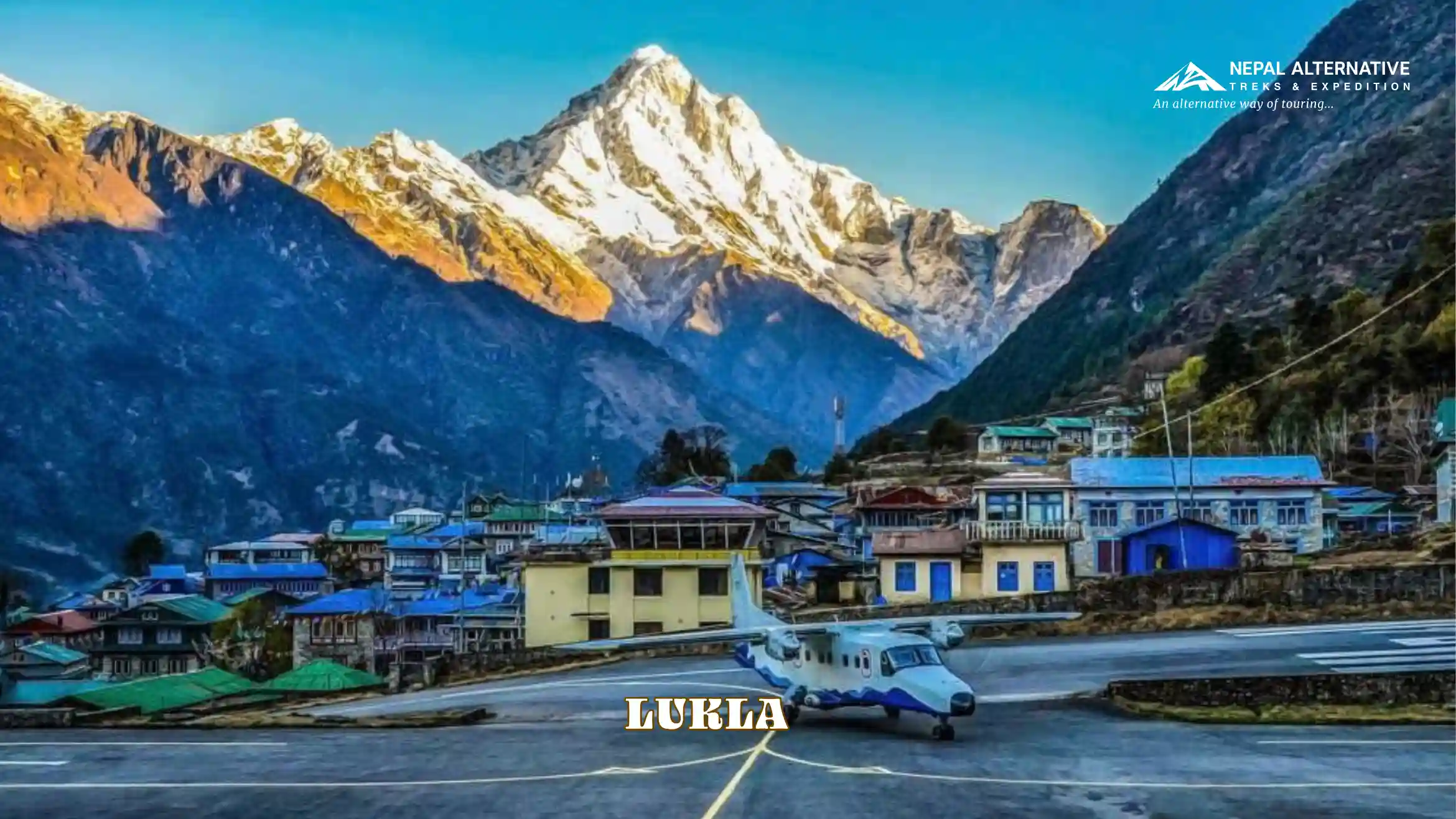
Lukla is a Sherpa village in Solukhumbu, in the Khumbu of eastern Nepal, and the usual air gateway for Everest region treks. The settlement sits at about 2,860 m. Every group that treks to Everest Base Camp, Gokyo Lakes, or the Everest Three Passes lands at Tenzing Hillary Airport, walks the short bazaar, and starts downhill toward Phakding the same day or the next morning.
Below, we will discuss Lukla in more detail. We will cover how to get to Lukla from Kathmandu, the best time to visit Lukla, and what you can do there. So, let’s get started.
Lukla is in Koshi Province, Solukhumbu District, Khumbu Pasang Lhamu Rural Municipality, Khumbu region (Everest region) of northeastern Nepal. The village lies above the Dudh Koshi Valley, on the southern approach to Sagarmatha National Park.
The Lukla elevation is about 2,860 m (9,383 ft) above sea level. Tenzing Hillary Airport (famously known as Lukla Airport) sits at roughly the same height as the village. Kathmandu is around 1,400 m, so travelers gain a significant amount of altitude in one short flight to Lukla.
There is no direct road into Lukla from Kathmandu. Goods and supplies here come by air or on porter and pack-animal backs from the south. Travelers who choose not to fly can approach Lukla on foot from places such as Jiri, Phaplu, Salleri, or Thamdanda.

Lukla is called the gateway to Everest because it is the main starting point for treks in the Khumbu. The trail from Lukla connects with the routes to Everest Base Camp, Namche Bazaar, Tengboche, Gokyo Lakes, Island Peak, and the Everest Three Passes.
Before the Lukla Airport route became common, Everest expeditions and trekkers often started much farther south, including from Jiri. That approach is still possible, but it adds several days of walking. Flying to Lukla makes the journey into the Everest region much shorter.
However, Lukla itself does not offer a clear summit view of Mount Everest. The mountain lies farther north in the Khumbu. Most trekkers see Everest later from viewpoints around Namche Bazaar, Hotel Everest View, or Kala Patthar. For first-time visitors, it helps to think of Lukla as the beginning of the mountain journey. The real trek starts once you leave the airport area and follow the trail toward Phakding.
The main Everest trail starts just beyond the village. It descends through Chheplung and follows the Dudh Koshi Valley toward Phakding. This first day can feel easier because of the downhill trail, but trekkers should still walk slowly after arriving at altitude.
Similarly, Lukla is also an important supply point for the Khumbu. Aircraft carry trekking food, lodge supplies, building materials, fuel, and emergency equipment, or they bring them up from the lower valleys. Once you leave Lukla, there are no roads north toward Namche Bazaar or Everest Base Camp.
Tenzing Hillary Airport, also called Lukla Airport, is a small mountain airport with the IATA code LUA. It is named after Tenzing Norgay and Sir Edmund Hillary, the first climbers to summit Mount Everest. The airport sits at 2,860 m above sea level and has one paved runway, designated 06/24. According to Nepal’s Civil Aviation Authority, the runway measures 527 m long and 30 m wide, with an uphill gradient of about 11.7 percent.
Lukla Airport is not a large international terminal with spacious waiting halls, cafés, and multiple departure gates. It is a compact, practical airfield built to handle short take-off and landing aircraft. After landing, passengers usually collect their luggage near the apron and can walk a few minutes to Lukla’s main bazaar.
The runway is short, steep, and surrounded by mountainous terrain. Aircraft land uphill and take off downhill. Its uphill slope helps aircraft slow down after landing, while the downhill direction assists departing aircraft as they accelerate toward the valley. One end of the runway meets a hillside, while the other faces a steep drop toward the valley. Because of this surrounding terrain, pilots have very little room to correct their approach once the aircraft is committed to landing. There is no ILS in the way a big international airport has an ILS.
Only captains who already have mountain-airstrip hours fly paying passengers in here. Flights generally use STOL aircraft, such as the Twin Otter or Dornier, which are designed to operate from short runways. Flights usually operate in the morning because Himalayan weather often becomes less stable later in the day. Clouds, rain, fog, or strong winds can delay or cancel flights. This is why trekkers should keep extra time in Kathmandu before and after an Everest region trek. Also, during busy trekking months, flights may operate from Manthali Airport in Ramechhap instead of Kathmandu.
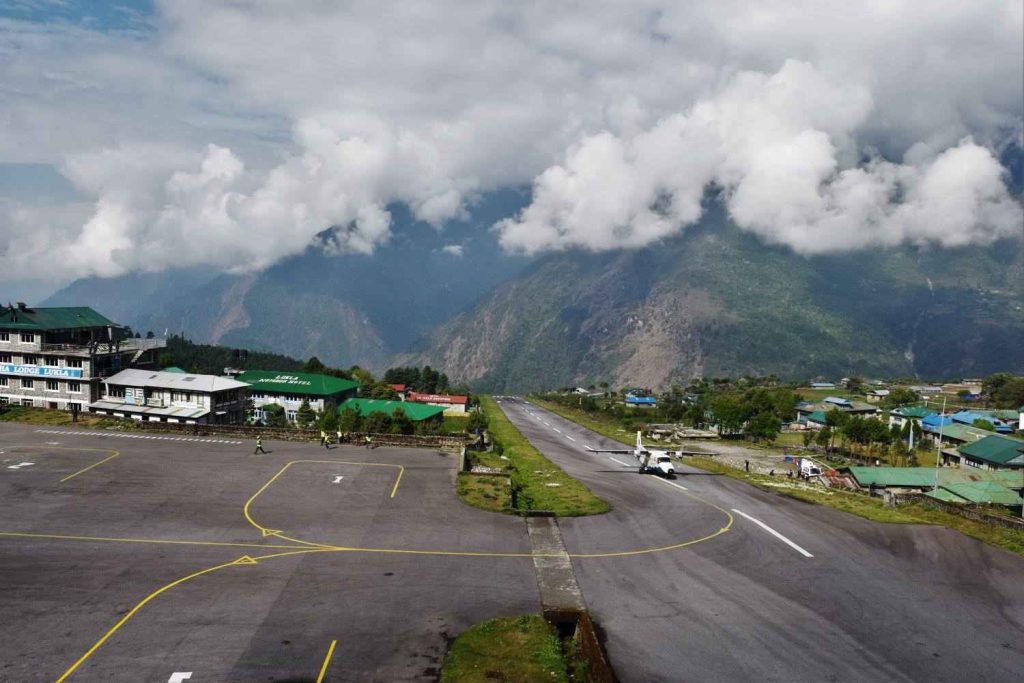
Yes, the Lukla airport is safe given that the flights operate in suitable weather with experienced crews. The “one of the most dangerous airports in the world” label is a media headline that focuses on the short sloping runway, the cliff at one end, and past accidents in poor weather.
In normal operations, flights are scheduled for the morning, when the weather in the Khumbu is usually most stable. If the valley is in the clouds, if visibility is low, or if wind and rain make the approach unsafe, flights are delayed or canceled.
There are four practical ways to reach Lukla: a flight from Kathmandu to Lukla when that sector is open, a flight from Ramechhap (Manthali) to Lukla in the busy trek months, a helicopter when the twin is stuck, and an overland walk from Jiri, Phaplu, Salleri, or Thamdanda.
When flights operate from Kathmandu’s Tribhuvan International Airport Domestic terminal, the flight takes about 25 to 35 minutes. Flights usually leave early in the morning because mountain weather becomes less stable later in the day.
In peak trekking months (March to May and late September to November), many Lukla flights are moved to Manthali Airport in Ramechhap to reduce congestion in Kathmandu. In the off-season, flights are more likely to use Kathmandu again. Always confirm your departure airport and reporting time shortly before travel. This pattern has held for several years.
During the busy seasons, most Lukla flights operate from Manthali Airport in Ramechhap. The flight time is shorter, often around 20 minutes, but the road transfer from Kathmandu takes about 4 to 5 hours each way. To reach Ramechhap and catch the flight, trekkers either leave Kathmandu very early in the morning and drive to Ramechhap the same day, or stay overnight in Ramechhap and fly the next morning.
This is why we offer a dedicated Everest Base Camp Trek via Ramechhap for that transfer. If your dates fall in April, May, October, or November, assume Manthali until the ticket is confirmed. Pack a warm layer for the night drive. Keep your passport, insurance, and a change of clothes in the cabin bag. Checked bags on this sector are small.
A helicopter is used when fixed-wing flights are canceled and your schedule cannot move, or as a planned exit on the Everest Base Camp Trek with Helicopter Return. Helicopters are still weather-dependent. They are more expensive than a Twin Otter flight.
If you are interested only in a scenic flight or a short Everest helicopter tour, that is a different product. We can advise which option matches your time and budget.
You can reach Lukla without using the airport. This is the right choice if you dislike small aircraft, want a longer trek, or want to reduce the risk of weather-related flight delays. But one disadvantage is that overland approaches are slower than a direct flight. But still, they are safer for acclimatization and avoid the risk of being stuck at the airport due to flight delays.
When the aircraft lands, it rolls uphill and stops on the short runway. You step onto the small apron, collect your bags from a trolley, and walk a few minutes into Lukla’s bazaar. Your guide and porters usually meet you near the airport. The first impression of Lukla is a busy mountain street lined with tea houses, lodges, prayer flags, small shops, and the noise of the next arrival. It is a working hill town, not a hidden village.
If you are starting your trek the same day, the normal plan is to walk to Phakding, which sits lower than Lukla. That is kinder than sleeping at 2,860 m after a 1,400 m jump. If the flight was late or you feel tired or have a headache, it is better to rest in Lukla and start walking the next morning.
Permits are checked on the trail toward Monjo and the Sagarmatha National Park gate, not at the airport. Your trekking agency arranges the Khumbu Pasang Lhamu Rural Municipality permit and the Sagarmatha National Park permit in Kathmandu before you fly. For current permit details, see our Everest Base Camp Trek Permit page.
Lukla is a small service village for trekkers. You can sleep, eat, buy a hat, and send a message. But it is not a full-service town like Kathmandu.
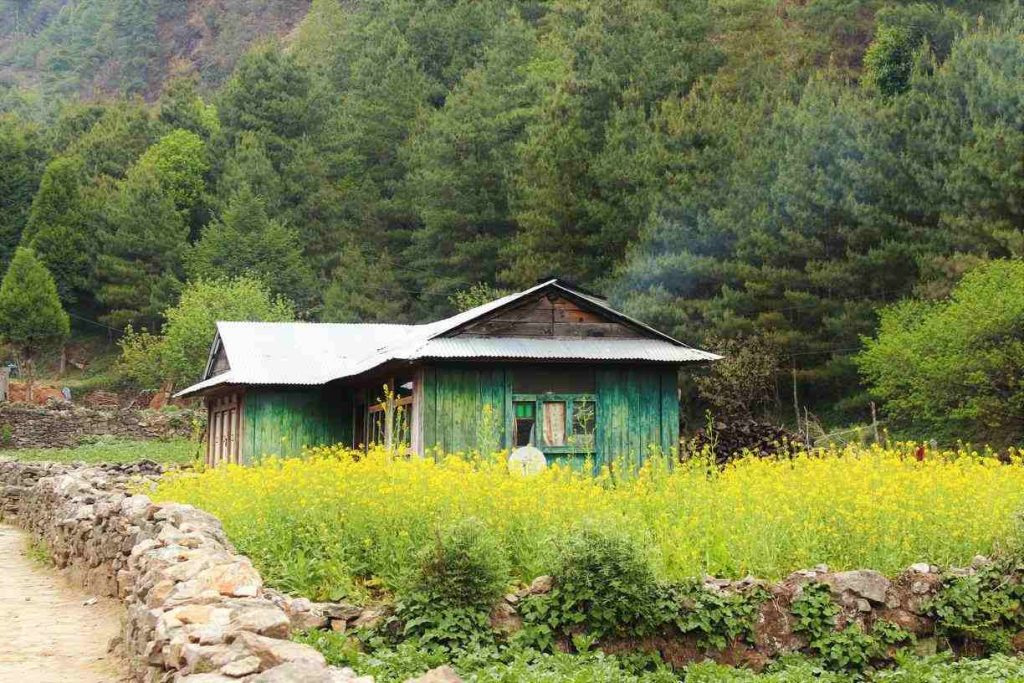
Most trekkers do not spend a full sightseeing day in Lukla. If you have a spare morning, you can use it for short, gentle walks. These short walks help you adjust to altitude without overexertion. For a proper village day with better mountain views, plan your time in Namche Bazaar or at Hotel Everest View later in the trek.
At Lukla, you can walk through the bazaar and along the prayer-flag lines above the lodges. You can also visit the Pasang Lhamu memorial gate at the start of the trail north. Take a short walk toward Chheplung or down toward Surke if you have extra time and feel well. Visit the small monastery above the village and sit quietly. Walk around the mani walls and chortens, keeping to the left as local custom asks. Bakeries and coffee shops line the street by the airport fence. They are useful on the last morning while you wait to see if the twin is flying.
The best time to visit Lukla for trekking is October to November (autumn) and March to May (spring). During these months, skies are often clearer, flights are more reliable, and temperatures are moderate. These are also the busiest months, so lodges in Lukla and Namche fill quickly.
Monsoon (June to early September) means clouds on the hill, wet stone, and more canceled treks. Lukla can be visited in this season, but you must accept more delays and limited views. Winter (December to February) is cold but often clear. Wind and fog can still delay flights. The trail is quieter, but nights are very cold, and some high passes may be snow-covered. Fine for people who already know this trail. Not a first-trek default.
Altitude begins to matter as soon as you land in Lukla at 2,860 m. Some people feel a mild headache, shortness of breath, or tiredness, especially after arriving from sea level the day before.
Thus, walk slowly on the first day, drink enough water, eat light meals, avoid alcohol on the first night, and tell your guide immediately if you feel unwell. Travel insurance is not optional on this trail. It must cover trekking to the height of your itinerary, helicopter evacuation, and trip delay and cancellation.
Always keep one or two spare days on each side of your trek. This buffer is for weather delays, flight cancellations, and unexpected changes. It is a normal part of planning an Everest trek, not a sign that something is wrong.
Your time in Lukla depends mainly on your flight arrival time, weather conditions, and how well you feel after landing at 2,860 m. Most Everest Base Camp trekkers do not need a full sightseeing day here. Instead, Lukla is usually the point where you meet your trekking team, organize your bags, and begin the walk toward Phakding.
Typical arrival day (EBC start):
Late flight or first-time arrival feeling the altitude:
Extra day if the outbound flight is canceled:
Last night of the trek:
If this is your first trek, read our Everest Base Camp Trek for Beginners guide before worrying too much about the runway. The stairs and altitude after Namche are the bigger challenge.
The Kathmandu to Lukla flight takes about 25 to 35 minutes when that sector is operating. In peak seasons, many flights depart from Manthali in Ramechhap after a 4-5 hour road transfer, and the flight from there is around 20 minutes. Always confirm your departure airport and reporting time shortly before travel.
Yes, you need local entry permits when arriving in Lukla to trek further into the Khumbu region. To trek north from the village, you need a Khumbu Pasang Lhamu Rural Municipality permit and a Sagarmatha National Park permit.
Yes. You can reach Lukla without taking a flight. The classic option is to travel by road to Jiri and follow the old Everest approach route through villages such as Bhandar, Sete, Junbesi, Nunthala, and Bupsa before joining the main trail near Lukla. A shorter overland approach is possible from the Solukhumbu side. Travelers can drive toward Phaplu, Salleri, or the roadhead around Thamdanda, then trek toward Lukla through Surke and nearby villages.
Lukla’s elevation is about 2,860 m (9,383 ft).
Lukla flights leave from Ramechhap in the busy seasons (Spring and Autumn). Kathmandu’s domestic terminal cannot handle all Lukla rotations, so flights are moved to Manthali Airport in Ramechhap.
If your Lukla flight is canceled, you’ll wait for the next suitable weather window, consider a helicopter if you can’t move your international tickets, and use the spare days you have kept. Cancellations are normal in the monsoon and can happen in other seasons too.
You do not get a clear view of Everest’s summit from the Lukla Airport tarmac. From the runway, you’ll see closer Khumbu walls, including Kongde Ri. Everest lies farther north.
Lukla to Namche Bazaar is 2 walking days, with Phakding in between. Lukla to Everest Base Camp is not a distance you should treat as a single number on a road map. The trail is about 65 km of walking each way depending on the variant, spread over many days with height gain.
Carry your passport, insurance papers, medicines, sunglasses, sun cream, a warm layer, a spare T-shirt, and any device you cannot lose in your hand luggage for the Lukla flight. Weight limits on this sector are tight.
Need assistance? Our travel expert Tej Bahadur Gurung is here to help! Please fill out the form below to initiate a chat and get your queries resolved quickly.