The mountains may be the reason you come to Annapurna Base Camp, but the culture is what makes the trail feel alive. Most of the local culture on the Annapurna Base Camp Trek sits in the first and last days.
In Ghandruk, stone houses climb the hillside in neat tiers. Grain dries in courtyards, smoke drifts from kitchen windows, and Gurung families greet trekkers from the doorways of teahouses they have run for generations. A few days later, the villages disappear. Above Chhomrong, the trail enters the Annapurna Sanctuary, a place the Gurung people have long regarded as sacred ground. That contrast is the cultural heart of the ABC trek: living villages below, and a mountain sanctuary above.
This guide explains who lives along the trail, what you can see in each place, and how to be a welcome guest. If you know where to look, a 7-day trek can show you a lot more than mountain views.
Who Lives Along the ABC Trail
The Gurung people are the main community on the Annapurna Base Camp trekking route. They call themselves Tamu, and their own language is Tamu Kyi, a Tibeto-Burman language. Most Gurungs also speak Nepali, and younger people often speak English with trekkers. Kaski District, where the trail runs, has one of the highest shares of Gurung people in Nepal.
You will also pass Chhetri and Brahmin families in the lower villages, especially on the drive from Pokhara and the walk out from Jhinu Danda. These are Nepali-speaking Hindu communities, and many of them farm the terraces along the lower Modi Khola.
You may see references to Magar and Thakali culture in ABC trek guides, but be careful with the details. Magar communities are more strongly associated with the Ghorepani–Poon Hill side of the region, while the Thakali homeland lies in the Kali Gandaki valley near Jomsom, on the Annapurna Circuit. You might enjoy a Thakali-style dal bhat in a teahouse, but the standard ABC route does not pass through Thakali villages.

Ghandruk: The Best Place to See Gurung Village Life
Ghandruk is the largest and oldest-feeling village on the trek, and it is the place to spend your time if culture matters to you. It sits at 2,012 m in Kaski District, and the 2021 census counted 5,316 people in 1,228 households. Most of them are Gurung.
Its old core is a maze of stone steps, narrow lanes, and slate-roofed houses built from rock of the hillside. In the afternoon, look for the courtyards in front of the houses, where families dry grain, sort firewood, and sit in the sun.
The small Gurung Museum in Ghandruk is worth half an hour. Its displays of traditional dress, farming tools, kitchen vessels, and household objects give context to the village around you. The village also has the Meshram Baraha temple, a local shrine that shows how Hindu and older local beliefs mix here.
Ghandruk has a second story worth knowing. In 1986, the Annapurna Conservation Area Project started as a pilot in Ghandruk before it grew to cover the whole region. The idea was that local people, not outside agencies, would manage their forests and tourism. The lodge committees, forest rules, and trail fees you see on the trek grew out of that pilot. This is also why the conservation permit you carry pays for trails and schools in villages like this one.
Chhomrong: The Last Village Before the Sanctuary
Chhomrong begins with a staircase. Chhomrong sits at about 2,130 m and is the last large Gurung village on the way to base camp. It is a Gurung village built in steps down a steep hillside, so most of what you see from the trail is stone staircases and lodge terraces.
Most teahouses in Chhomrong are run by local families, so take a few minutes to talk with your host. Ask how long the lodge has been in the family, which fields they farm, or where their children study. These small conversations often reveal more about Gurung village life than any museum.
Chhomrong also marks a change in the trek. Above it, Sinuwa is a small village, and Bamboo, Dovan, Himalaya, and Deurali are primarily lodge stops that exist for trekkers. Beyond Chhomrong, building and development is more tightly controlled under Annapurna Conservation Area rules, and camping is limited to designated sites.

The Annapurna Sanctuary as Sacred Ground
The basin at the top of the trek is called the Annapurna Sanctuary for a reason. The Gurung people have long held the whole area to be sacred. The Sanctuary was believed to be the home of gods from Hinduism and Buddhism, as well as older local gods of the land.
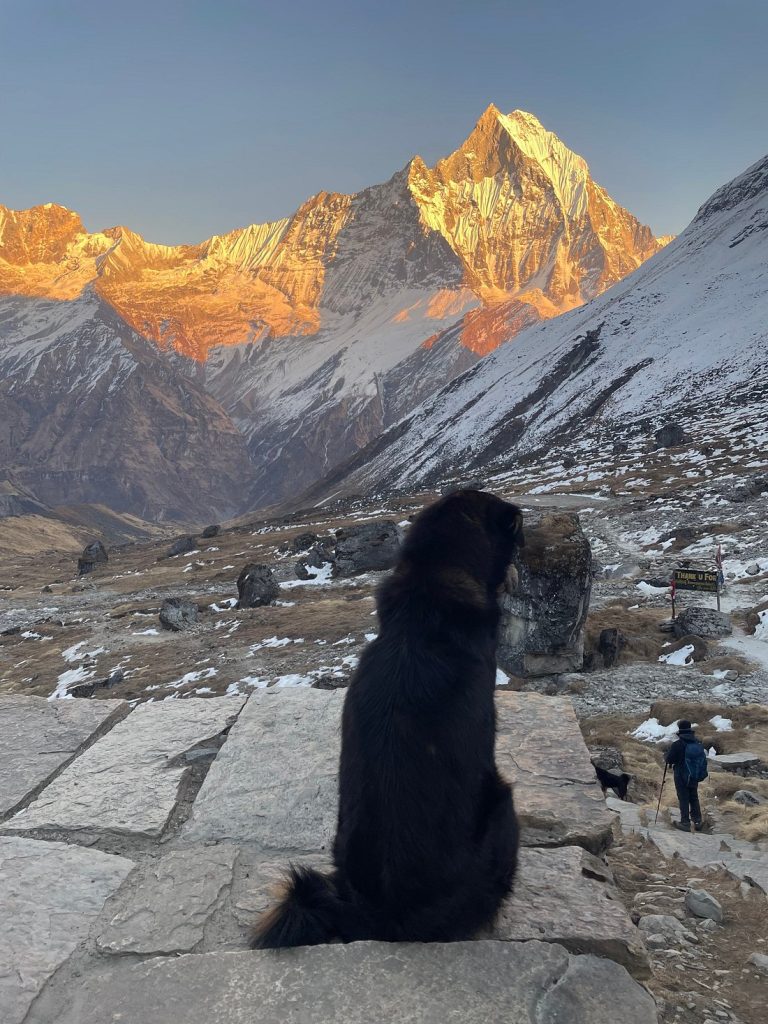
The mountains are not just scenery here; they are believed to be inhabited by gods. Machhapuchhre, the Fishtail peak above the trail, is the clearest example. Local communities regard it as holy, and it is associated with the god Shiva. No climbing permit has been issued since 1957, when a British expedition stopped roughly 50 m below the summit at the request of the king. No one has officially stood on its summit since.
That reverence also shapes what you eat above Chhomrong. Gurung custom long kept meat and eggs out of the Sanctuary. Although practices have eased over time, many lodges still serve vegetarian food, and some ask trekkers not to carry meat upward.
Trail tip: Order dal bhat, thukpa, or another vegetarian meal above Chhomrong. Save the chicken curry for Jhinu Danda on the way down.
Gurung Faith, Language and Social Life
Gurung religious life in the Annapurna region is deliberately hard to put in one box. It is a mix, and you see the mix on the trail. In the 2021 census, about half of Gurungs identified as Buddhist, roughly a third as Hindu, and about a tenth as followers of Bon. Many families also keep their own Gurung priests, called pachyu and ghyabri, for ceremonies such as funerals.
In practice, this means a Buddhist prayer flag, a Hindu shrine and a local spirit stone can stand on the same hillside. You will see mani walls (stones carved with prayers), small chortens (Buddhist shrines) and prayer flags on ridges and bridges.
Village social life once centered on the Rodhi, a house where unmarried young people gathered in the evening to sing, dance, work, and share food. Ghandruk had Rodhi houses, and researchers have recorded how they have faded with migration and modern life. If you hear a group singing in a village at night, ask your guide whether it is a Rodhi gathering or a cultural performance arranged for visitors.
Similarly, traditional dress is now most visible at festivals, weddings, and cultural programs. Women wear the cholo blouse, patuka waistband, and ghalek, and men wear the kachhad wrap. The bhangra, a handwoven wrap traditionally made from nettle fiber, is another distinctive Gurung garment.
Festivals You May See on the Trek
The main Gurung festival is Tamu Lhosar, the Gurung New Year, held on the 15th of the Nepali month Poush, in late December or early January. Families gather, people wear traditional dress, and villages hold dances and feasts. This falls in winter, so you will trek in cold, clear weather if you want to see it.
Most trekkers come in autumn, which is festival season across Nepal. Dashain and Tihar fall in late September to November, depending on the lunar calendar. During Dashain, families in the hills put up bamboo swings and elders give tika (a mixture of rice, yogurt, and vermilion) and blessings to the young. Dashain lasts for 15 days.
Likewise, Tihar, the five-day festival of lights, follows in October or November, with oil lamps, garlands, songs, and rituals honoring animals and family bonds. Some lodges may close briefly while families celebrate, so check your itinerary if you plan to trek during Dashain and Tihar.
Maghe Sankranti, in mid-January, is an important festival for the Magar community. If your itinerary includes Poon Hill in winter, you may encounter celebrations in Magar villages on that side of the Annapurna region.
Food in a Gurung Teahouse
Teahouse menus on the trail look long, but most meals come back to dal bhat: rice, lentil soup, a vegetable curry, and pickle. Your host will offer a second helping. It is fine to accept it, and it is fine to say no with a small wave of the hand.
Look for Gurung bread, a round fried bread served with honey or curry, often at breakfast. Lower down, some families serve dishes made from millet and buckwheat, crops grown on the terraces you walk past. Ask whether the lodge makes a local dish that day. Not every lodge does, and the answer tells you what the family grows. Above Chhomrong, as explained above, expect a vegetarian menu.
The Gurkha Connection on ABC Trek Trail
In many Gurung homes, the most important photograph on the wall is not of a mountain. It is a framed photo of a soldier in uniform. Gurung and Magar men have served in the Gurkha regiments of the British and Indian armies for generations. Britain first recruited Nepali soldiers in 1815, and Gurkhas fought in both World Wars. Magars alone received 5 of the 13 Victoria Crosses Gurkhas won in those wars.
This history shaped the villages you walk through. It is also why some older men in Ghandruk speak good English. If an elder tells you he served, ask where. The answer might be Hong Kong, Malaysia, Brunei, or somewhere much farther from the Annapurna hills.
The Magar Side: Ghorepani and Poon Hill
If your trek starts with Poon Hill, as on our ABC trek with Poon Hill, you walk through a different community first. Villages around Ulleri and Ghorepani are home to many Magar families, and the route passes through both settlements on the 10-day ABC trek with Poon Hill.
Poon Hill is said to take its name from the Pun, a Magar clan of the area. Ghorepani’s name means “horse water”. It was a rest stop where traders watered their horses. Since roads replaced that trade route, tourism has become the main income. Most Magars follow Hinduism, with Buddhist and older local practices mixed in, and the Magar language you may hear is Magar Dhut.
Etiquette That Earns a Welcome
Most people on the trail live with trekkers every season, and they are patient with cultural mistakes. Still, a few small gestures show respect and often lead to warmer conversations.
- Walk clockwise around chortens and mani walls. Keep them on your right. This is how Buddhists move around sacred objects.
- Take your shoes off before you enter a home, a kitchen, or a shrine. Many lodges ask you to leave boots at the dining room door.
- Ask before you take a photo of a person, especially an elder or a child. A smile and a raised camera is enough to ask. If they shake their head, put the camera down.
- Give and receive with the right hand, or with both hands for something important, such as money or a gift.
- Dress with your shoulders and knees covered in the villages. Shorts are fine on the trail, but not when you sit in a family’s kitchen.
- Do not step over people, food, or fire. Walk around them instead.
- Learn two words: Namaste for hello and Dhanyabad for thank you.
- Do not give sweets or money to children. It teaches them to beg from trekkers. If you want to help, give to the school or a local fund through your guide.
How to Add More Culture Into a 7-Day ABC Trek
A 7-day ABC trek moves quickly. Most of your day is spent walking, so the cultural experience depends on where you slow down. The choices below give you more time with people.
- Spend an extra night in Ghandruk: Our 7-day ABC Trek itinerary drives to Ghandruk and continues to Chhomrong on the same day, leaving limited time to explore the old village, museum, and evening life. Adding a night turns Ghandruk from a photo stop into a place you actually get to know. Ask us when you book.
- Try a homestay: Some local families rent rooms in their homes. You eat with them and see how the house works. Homestays are one of the accommodation options along the ABC route and are especially valuable for travelers who want direct contact with local life. Our guide to accommodation on the ABC trek explains the options.
- Trek with a local guide: A Gurung guide can introduce you to people, translate conversations, and explain the meaning behind shrines, food customs, and village traditions.
- Time your trek with a festival: Autumn brings Dashain and Tihar. Late December brings Tamu Lhosar.
- Choose a village trek: If culture matters more than base camp, the Ghandruk Trek gives you more village time in fewer days. You can read more about the village in our Ghandruk Village guide.
Frequently Asked Questions
Are Gurungs and Gurkhas the same?
No. Gurung is an ethnic group, and Gurkha refers to Nepali soldiers serving in the British and Indian armies. Many Gurkhas are Gurung, but Gurkhas also come from Magar, Rai, Limbu, and other communities.
Can I wear Gurung dress for photos?
In Ghandruk, some families and the Gurung Museum may let visitors try on traditional dress, usually for a small fee. Accept the offer when it is made; do not borrow festival clothing uninvited.
Do I need to speak Nepali?
No. Guides and many lodge owners speak English. Still, a few Nepali greetings make interactions warmer.
When is the best time to experience local culture on the ABC trek?
October and November offer good weather and the Dashain–Tihar festival period. For Tamu Lhosar, plan for late December or early January. The 10-day ABC-with-Poon-Hill itinerary suits travelers who want to include Magar villages such as Ulleri and Ghorepani, as well as the Gurung sections of the ABC route. Our guide to the ABC trek in November covers trail conditions that month.