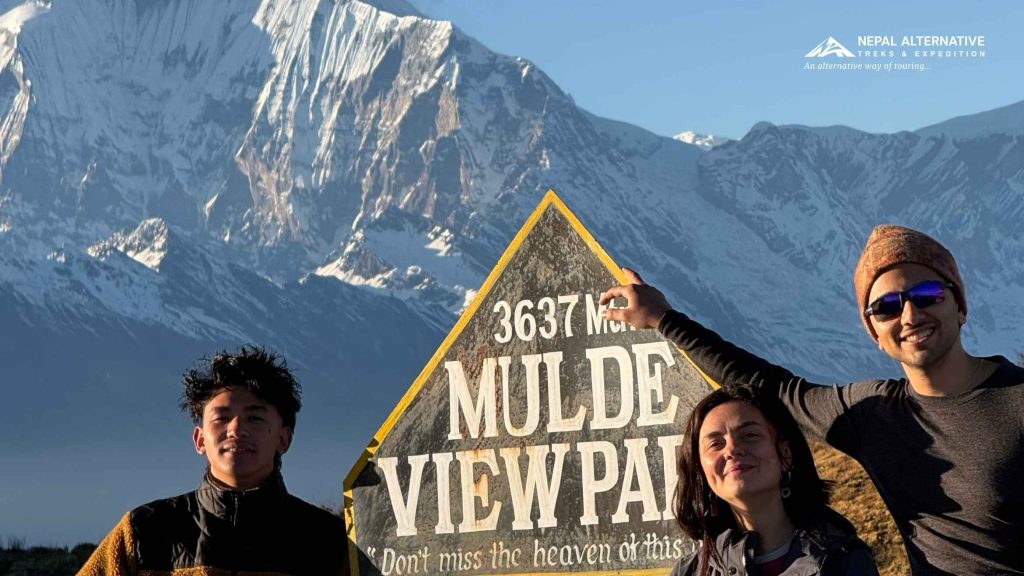
If I were sending someone to Khopra Danda for the first time, I’d say: go in October or the first two weeks of November for clear mountain views, or late March to early April for blooming forests, as these are the best times to trek Khopra. After walking the route myself, staying in the teahouses, crossing rhododendron forests, and watching the weather shift in the mountains, I can say that each season in Khopra Danda offers a different experience. Some months offer crystal-clear Himalayan views, while others bring blooming rhododendron forests, peaceful pathways, or snowy landscapes, creating a completely different trekking experience in every season.
I still remember the first morning I woke up at Khopra Danda. As the sun rose, its rays scattered across the peaks of the Annapurna and Dhaulagiri ranges, while cold mountain air flowed across the ridge. At that moment, I understood how the entire journey to Khopra Danda changes completely with the season you choose.
If you are planning the Khopra Danda trek for the first time, this blog will give you practical seasonal insights that most travelers only get after reaching the trail.
Table of Contents
Season-by-season breakdown
After trekking to Khopra Danda multiple times in different seasons, I can confidently say that the time you choose significantly changes the entire feel of the journey, just like any major trek in Nepal. The Khopra Ridge experiences four distinct seasons, each with unique trekking conditions and its own set of advantages and disadvantages.
Spring (March to May)
I still get goosebumps remembering my spring trek. The trail from Ghorepani towards Khopra Ridge was a rhododendron paradise with bright red, pink, and white flowers everywhere. I had seen photos before, but being there in person felt completely different. Likewise, everything feels fresh during the season, with greenery, air, and the scent of blossoms spread across the Annapurna Conservation Area.
Furthermore, days are generally pleasant, with temperatures ranging between 10°C and 18°C at lower elevations, though nights at Khopra Danda are cold, below 5°C. Mornings are mostly clear, making spring the best season to trek and enjoy the mountain views. By afternoon, warmer weather brings clouds up through the valleys, so it’s better to visit viewpoints early in the day for the clearest scenery.
Benefits of Trekking During Spring
Blooming rhododendron forests throughout the trail, especially between Ghorepani and Khopra Danda.
Stable temperatures for comfortable trekking
Excellent mountain visibility during mornings
Perfect condition for photography and nature lovers
Green forest in the lower villages like Swanta and Chistibung
Balanced crowd levels compared to the peak autumn season
Autumn (September to November)
Autumn is undoubtedly the peak trekking season and one of the finest times to trek in Nepal. After experiencing Khopra Danda during this time, I completely understand why trekking in the season is called the best.
Right after the monsoon rain clears the dust from the atmosphere, the Mount Dhaulagiri and Annapurna ranges come in their clearest form. I still remember standing near the ridge and feeling like the Himalayas were almost touchable because the visibility was so clear, especially the stunning views of the Annapurna range.
In addition, the weather during autumn stays stable. Days are dry with clear skies, and trail conditions are generally safer compared to the rainy season. During this time of the year, the daytime temperatures range from 10°C to 20°C, while nighttime temperatures can drop to 0°C to 10°C.
Benefits of Trekking During Autumn
Crystal clear visibility of Mount Dhaulagiri, Annapurna South, Hiunchuli, and Nilgiri.
Unlike spring, autumn usually offers clear skies throughout the day.
Dry and good condition trail with no mud and no chances of slipping.
Perfect trekking temperatures that stay warm during the day, cold and refreshing at night.
Amazing views of sunrise and sunset from Khopra Ridge.
Winter (December to February)
I did a late-December winter trek to Khopra, and the landscape looked completely different, covered in snow and with extra-peaceful surroundings. I personally experienced that winter trekking in Khopra is different from spring and autumn. This season gave me some of the most emotional moments on the mountain. At times, I felt completely alone with the Himalayas.
However, winter brings extreme cold and snowfall challenges. Days in winter are short, and darkness falls fast. Also, some narrow sections of the routes are blocked due to heavy snowfall, making walking difficult. Moreover, cold weather conditions require heavier gear, which adds extra weight to the backpack.
The temperature on the Khopra trekking trail during winter can be chilly, with daytime temperatures ranging from 0°C to 10°C and nighttime dropping below freezing, sometimes reaching -10°C at higher altitudes. Thus, I recommend winter trekking to only experienced trekkers with proper winter gear and an experienced trek guide.
What to Expect During Winter
Cold mornings and freezing nights, especially near Khopra Ridge
Fewer trekkers and peaceful trails
Occasional snowfall at higher elevations around Khopra Ridge and Khayer Lake
Limited teahouse availability due to extreme cold
Shorter daylight hours
Risk of frostbite and hypothermia above 3,000 m
Clear views of mountains, covered in full snow
Summer/Monsoon (June to August)
I won’t lie: the summer/monsoon trek to Khopra Danda is the hardest. From June to August, the Khopra Danda trail is heavily affected by the South Asian monsoon rains. The pathways become muddy and slippery, leeches are everywhere in the lower sections, and clouds hide the mountain peaks. Landslide risk increases, especially on steeper sections.
Having said that, this season also shows a completely different side of the region. The lower part of Khopra Danda becomes green, waterfalls appear everywhere, and the forests feel fresh. Late September is one of the better times during the monsoon season. By the third or fourth week, the monsoon begins to fade, the clouds get clearer, and you can get some bright and beautiful mornings. Some trekkers choose late September on purpose to enjoy the fresh views after the rains while avoiding the busy October season.
Still, summer is considered the least recommended season for the Khopra Danda trek because weather conditions remain unpredictable. That said, the temperature during this season is warm with daytime temperatures ranging from 15°C to 25°C and nighttime temperatures between 10°C and 15°C.
The less trodden Khopra Danda trek We just came back after a rewarding trek to Khopra ridge (Khopra Danda, as it's called in Nepal) in the Annapurna region. It's a less trodden trail in an otherwise highly crowded Annapurna region. It has trails going through traditional villages, pristine forests, leading…
Excellent agency that organized almost the whole trip to Nepal, providing the transfer from the airport to the hotel, booking hotel in Kathmandu and Pokhara, guide and driver to visit Kathmandu and its surroundings, driver to visit the surroundings of Pokhara, guide for the 6 days of trekking I did…
All OK In November last year we visited the beautiful country of Nepal with CK Nepal Alternative trek with expedition Kathmandu. We completed the Mohare and Khopra Danda trek. We were thrilled by the beautiful landscape, passing through the villages. Our porters were very kind and willing to advise and…
Amazing 6-day trekking to Khayer Lake Excellent experience. Preparing our trip to Nepal, we inquired with several trekking companies. Tej was very quick to reply and eager to help. He was flexible in adjusting the plans and composed a personal itinerary for our Khopra Dandra & Khayer Lake trek. On…
Great well-planned trip and helpful with all questions beforehand I had such a wonderful experience on my 6-day trip to Khopra Danda. Throughout the planning phase, Tej was very helpful in answering all my questions and help me pick the best trail given my constraints and my priorities, and made…
Crowd Levels and Teahouse Availability of Khopra Danda Trek During Each Season
One thing I genuinely appreciated about the Khopra Danda trek was that it never felt as overcrowded as other commercialized treks in the Annapurna region. Still, depending on the season you choose, the experience with crowds and teahouse availability can feel very different.
Spring Season – Balanced Crowds and Active Teahouses
Spring is when Khopra Danda feels like a peaceful alternative to the busier trekking routes. In March, the trail feels quiet and uncrowded, teahouse owners are welcoming after the long winter, and finding a room is generally easy. By April, more trekkers start arriving, but the trail still doesn’t feel too busy or crowded.
During my spring trek, I met travelers from different countries almost every evening in the dining halls. Yet the crowds never felt overwhelming; it felt like the mountains belonged only to us.
In addition, teahouses between Ghorepani and Khopra are spaced at a good distance, about a day’s walk apart, in places like Deurali, Bayeli Kharka, and Khopra Danda village. During spring, they are all usually open and fully running, so finding a place to stay is not a problem.
What Spring Feels Like
Moderate crowd levels
Teahouses fully open and well stocked
Friendly trekking atmosphere with fellow hikers
Easier to find accommodation compared to autumn
Comfortable balance between peacefulness and social experience
Autumn Season – Peak Trekking Season with Busy Teahouses
All teahouses along the route are fully operational in autumn. During the season, Khopra Danda is most active, with trekkers from all over the world. Due to the inflow of trekkers, teahouses become busier, especially in October and early November. Even though Khopra Danda is quieter than routes like Everest Base Camp or Annapurna Base Camp, autumn still sees the highest number of trekkers throughout the year.
I remember arriving at one teahouse after sunset and seeing the dining room packed with trekkers sharing stories, charging cameras, drying clothes, and planning the next day’s walk. The atmosphere felt exciting and energetic, but it also reminded me why booking in advance was necessary during the autumn trek.
What Autumn Feels Like
Highest crowd levels of the year
Teahouses are busy during October
More interaction with international trekkers
Need for earlier room arrangements during peak weeks
Winter Season – Peaceful Trails but Limited Services
Winter completely changes the mood of the trek. Some days, I walked for hours hearing nothing except the wind and my own footsteps. Personally, winter felt more raw and authentic. There were fewer distractions, less crowds, and a stronger connection with the mountains. For those trekkers who enjoy silence, winter can be the best time to go trekking in Khopra Danda.
However, the silence along the route also means fewer operational teahouses at higher elevations. Some accommodation points close during the season because of heavy snow, freezing weather, and fewer trekkers. The teahouses that stay open still provide warm food and a place to sleep, but the facilities can be simpler than during the busy trekking months.
One suggestion for trekkers planning the Khopra Danda trek in winter is to avoid the upper section of Khopra Ridge during the season without first confirming the status of the teahouses.
What Winter Feels Like
Very low crowd levels
Temporarily closed teahouses in some sections
Peaceful and isolated trekking atmosphere
More personal interaction with teahouse owners
Monsoon Season – Empty Trails and Unpredictable Teahouse Availability
Monsoon brings the lowest crowd levels of the year to Khopra Danda, and teahouse operations reflect that. As a result, teahouse operations become less predictable. During this season, you should not expect a full menu, hot showers, or guaranteed rooms unless you contact the teahouse in advance.
From June to August, many lodges along the upper part of the route operate with fewer staff and shorter opening hours. In places like Bayeli Kharka or Khopra Danda village, you might reach a lodge and find the kitchen closed or the owner busy working in the fields. Sometimes a family member will still welcome you, light the fire, and cook a meal, because the hospitality of Nepalese people never disappoints. Moreover, by the third or fourth week of September, many teahouses start reopening as lodge owners prepare for the busy October trekking season.
Before I left for Khopra Danda, I did what most people do: I searched for a cost, found completely different price estimates from multiple sources, and left more confused. Then I found the truth that the cost of this trek doesn’t have a single answer. It has a seasonal answer.
Spring Season Cost
Although it is a peak season, the cost of the Khopra Danda Trek in spring is reasonable. This is because of the flexibility, as teahouse owners are excited to welcome guests after the slow winter season. Personally, I felt spring gave the best balance between cost, scenery, and comfort.
Teahouse costs in spring:
Room per night: NPR 200-500
Dal bhat: NPR 500-650 per plate
Other meals: NPR 350-600
Hot shower: NPR 200-300
Guide and porter rates in spring:
Licensed guide: USD 28-38 per day
Porter: USD 18-23 per day
Autumn Season Cost
Autumn is the most expensive time to trek to Khopra Danda because it is the peak trekking season. Teahouse room prices increase, guide and porter charges are at their highest, and flights to Pokhara, the main starting point for the trek, become much more expensive during the busy October trekking and festival season. That said, many trekkers still consider autumn worth the extra cost because the weather is stable and the mountain views are exceptionally clear.
Teahouse costs in autumn:
Room per night: NPR 300-600
Dal bhat: NPR 550-700 per plate
Other meals: NPR 400-650
Hot shower: NPR 200-300
Device charging: NPR 100-200 per device
Guide and porter rates in autumn:
Licensed guide: USD 30-40 per day
Porter: USD 20-25 per day
Winter Season Cost
Winter is the season when the trek costs less, and your preparation gets more expensive. Trekking Khopra Danda in winter without proper cold-weather equipment isn’t just uncomfortable, but it can be dangerous. I remember spending extra on quality cold-weather gear before the trek, but honestly, it was completely worth it. For a winter trek, it’s essential to have a good four-season sleeping bag, an insulated down jacket, thermal base layers, crampons, and waterproof outer layers.
Teahouse costs in winter:
Room per night: NPR 100-300 (often free with meals)
Dal bhat: NPR 400-550 per plate
Menu options are limited
Hot shower: Often unavailable or cold
Guide and porter rates in winter:
Licensed guide: USD 25-32 per day (negotiable)
Porter: USD 15-20 per day
Gear rental costs to factor in (Pokhara):
Down jacket: NPR 300-500 per day
Sleeping bag (4-season): NPR 300-500 per day
Crampons: NPR 200-300 per day
Trekking poles: NPR 150-250 per day
Summer Season Cost
The monsoon is technically the cheapest time to trek in the Khopra region, as tourism activity drops significantly. But the lower base cost comes with risks. Heavy rain can delay transportation, force itinerary changes, or require unexpected overnight stays. In some cases, poor weather conditions may even increase your expenses if plans shift suddenly.
Ritika Ghale , from Dhading is an experienced, fluent English-speaking, friendly, smiling and knowledgeable female guide.
She has been guided to the Everest regions, Mardi Himal, Annapurna Circuit and Langtang Trekking. She has 10 years of experience guiding in the Himalayas. She is dynamic and bold character with deep knowledge of ethnic and indigenous cultures. She has good records with past groups.
Need assistance? Our travel expert Tej Bahadur Gurung is here to help! Please fill out the form below to initiate a chat and get your queries resolved quickly.


 India5.0 /5
 Italy5.0 /5