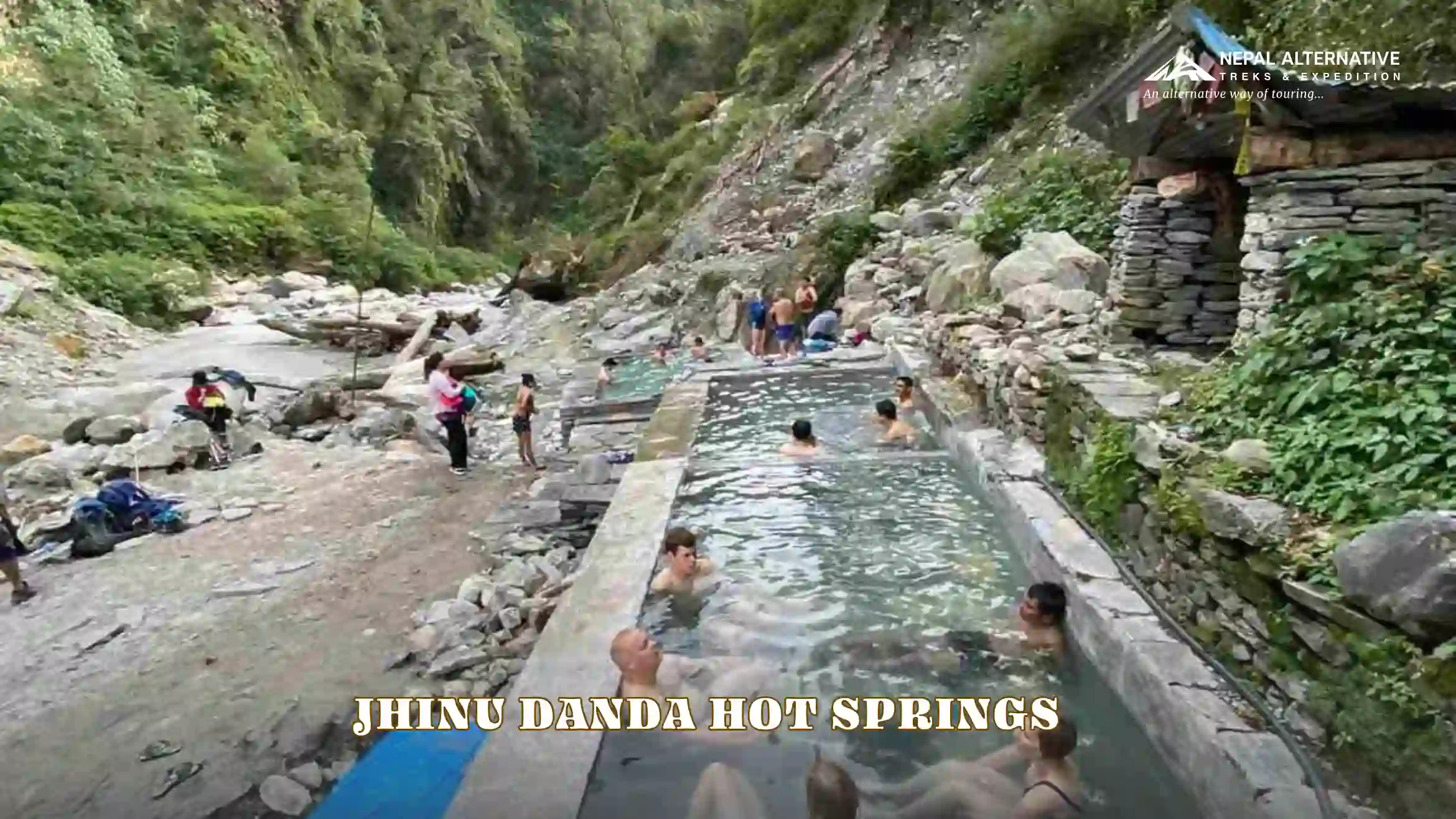
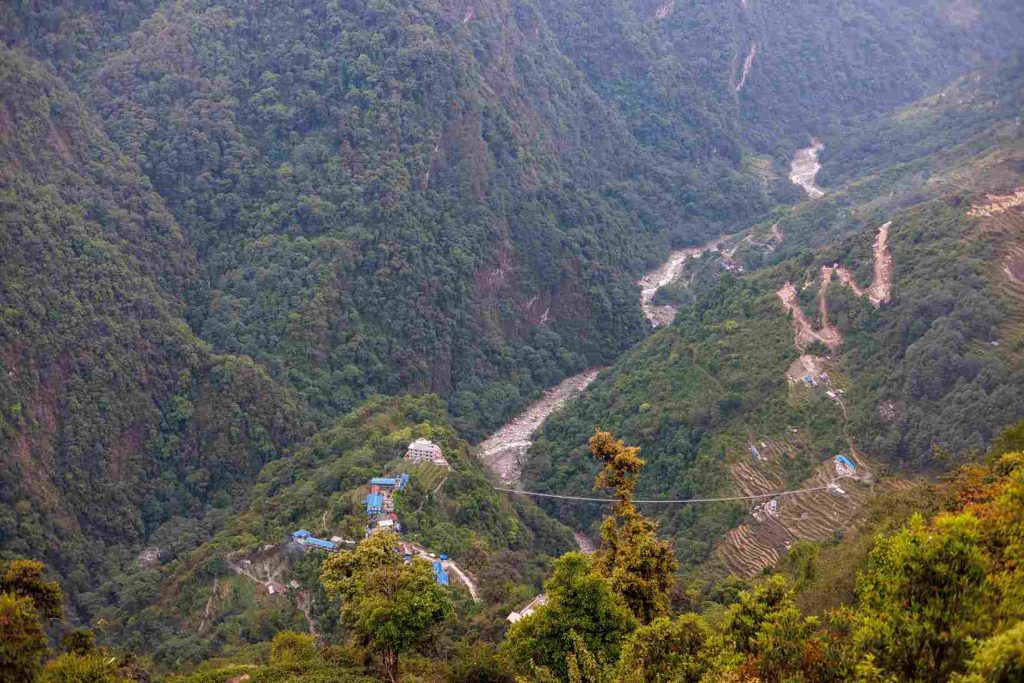
Jhinu Danda Hot Spring is a set of natural stone pools supplied by geothermal water on the bank of the Modi Khola River, roughly 15 to 20 minutes downhill from Jhinu Danda village in the Annapurna Conservation Area of Nepal. The hot water comes from deep underground and collects in three connected pools with different temperatures and sits at an elevation of about 1,780 m.
Jhinu Danda itself is a small Gurung village situated on a hill above the Modi Khola valley in Kaski District, Gandaki Province. The village is a standard overnight stop on the Annapurna Base Camp (ABC) trek and the Ghandruk loop, with teahouses, lodges, and a view of Hiunchuli and Machhapuchhre. The hot spring is not in the village itself. It is down in the river canyon, reached by a stone staircase that drops through forest to the riverbank.
Locals believe the mineral content helps with muscle and joint pain, though this is a traditional belief rather than a clinically confirmed claim, and no formal medical body has verified it.
Where Jhinu Danda is Situated on the Map
|
Detail |
Information |
|
Village elevation |
Approx. 1,780 m (5,840 ft) |
|
Hot spring elevation |
Slightly lower, by the Modi Khola riverbank |
|
District |
Kaski, Gandaki Province, Nepal |
|
Nearest large village |
Chhomrong (uphill), Ghandruk (downhill route) |
|
River |
Modi Khola |
|
Protected area |
Annapurna Conservation Area |
|
Walk from village to spring |
15 to 20 minutes downhill |
How to Get to Jhinu Danda
There is no road to the hot spring itself, so every visitor arrives on foot. Three routes cover almost all trekkers.
Via the Annapurna Base Camp Trek
If you are trekking to Annapurna Base Camp, Jhinu Danda appears on your itinerary on the way down, after you descend from Bamboo or Sinuwa through Chhomrong. This is the most common way people explore the springs, arriving tired and grateful after the high point of the trek.
Via the Ghandruk Loop
A shorter trek around Ghandruk village includes Jhinu Danda as a separate stop, without continuing up to Annapurna Base Camp. You reach it by descending from Ghandruk through Landruk and across the river, then climbing to the village. It takes around 4 to 5 hours depending on your speed and fitness level.
Via Poon Hill and Tadapani
Trekkers doing the Poon Hill sunrise trek sometimes extend their route through Tadapani and down to Jhinu Danda before heading back to Ghandruk or out to Nayapul. The village is about 12 to 14 kilometers from the roadhead at Nayapul, and most people reach it on the second, third, or final day of a multi-day itinerary rather than as a single day trip.
What to Expect at the Pools
The Pools Themselves
There are three connected stone pools at different temperatures, built into the riverbank, just a short climb from the main trail. The highest pool is closest to the river itself, close enough that the sound of the Modi Khola is constant while you soak. Water temperature varies by pool and by season, warmer in winter and cooler when the river runs high during monsoon.
One visitor, Jonah Lucas, who reviewed the springs after a trek through the area, wrote that the pools were “quite nice after trekking all day” even with a couple of other small hiking groups around. That matches what most visitors report: modest, unpolished pools that do their job well.
Facilities and Donations
There are basic changing areas near the pools, and during busier trekking seasons a local caretaker sells snacks and drinks. A small donation is customary to maintain the site, since there is no formal entry fee for the pools themselves, separate from the conservation area permit you already need to trek here. Bring a swimsuit, a lightweight towel, and small denomination Nepali rupees for the donation box.
If you’re planning a longer Annapurna itinerary and want to enjoy the hot spring without rushing, our guides at Nepal Alternative Treks can plan the route around it. We time your descent so you reach Jhinu Danda with enough daylight to enjoy a relaxing soak instead of a quick five-minute dip before dinner.
Best Time to Visit the Hot Spring
The best time to visit Jhinu Danda Hot Spring is from October to November and March to May, when the weather is clear and trails are in good condition. Look at the table below for clearer information.
|
Season |
Month |
What to Expect |
|
Autumn |
October–November |
Clear skies and safe trails, but the hot spring can be crowded |
|
Spring |
March–May |
Blooming rhododendrons and mostly dry trails. |
|
Winter |
December–February |
Fewer crowds and a warm soak in the cold weather, but longer nights and shorter days |
|
Monsoon |
June–September |
Heavy rain, slippery trails, and possible landslides; access to the hot spring may be limited |
Permits and Fees You Will Need
Jhinu Danda lies inside the Annapurna Conservation Area, so you need an ACAP permit before you reach the trailhead. There is no separate ticket for the hot spring beyond the customary donation mentioned earlier.
|
Category |
ACAP Permit Fee |
Notes |
|
Foreign nationals |
NPR 3,000 (approx. USD 20) |
Single entry, valid for the whole conservation area |
|
SAARC nationals |
NPR 1,000 (approx. USD 8) |
Passport from a SAARC member country required |
|
Nepali citizens |
Free |
National ID required |
|
Children under 10 |
Free |
Applies regardless of nationality |
Permits are issued in Kathmandu or Pokhara through the Nepal Tourism Board and Annapurna Conservation Area Project offices, or online through the official ACAP portal. If you’re traveling with us, we’ll take care of the permit process for you.
Tips for Visiting the Hot Spring
- Go at dusk or early morning if you want fewer people in the pools, since midafternoon is when most descending groups arrive.
- Bring cash in small notes for the donation box and any snacks sold on site.
- Pack a quick dry towel rather than a bulky one, since you still have to climb back up to the village afterward.
- Check water levels in monsoon before planning around the lower pool, since a swollen Modi Khola can limit access.
- Respect the site as a shared local resource. It is maintained by the community, not a hotel amenity.
Why the Water Is Warm
Deep under the Himalayas, two huge pieces of the Earth’s surface are pushing against each other. One is slowly sliding beneath the other, and all that grinding and squeezing generates heat far below the ground. This is different from hot springs in places like Iceland or Japan, where volcanoes do the heating. Here, the warmth comes from the mountains themselves. This is the same basic process that feeds hot springs at Tatopani and dozens of other sites across the mid-hills of Nepal.
Rain and melted snow from the high peaks go deep into the ground, where hot rocks warm the water. Warm water is lighter than cold water, so it wants to rise. It climbs back up through open cracks until it finds a way out. At Jhinu Danda, a large crack in the rock meets the deep valley of the Modi Khola River, and the water bubbles up right beside the riverbank at a 35 to 40 degrees Celsius. On its long journey, the water picks up minerals from the rocks it passes. That is why the pools are so loved by trekkers.

How Jhinu Danda Compares to Other Nepal Hot Springs
Nepal has several trekking route hot springs, and trekkers doing longer circuits sometimes compare Jhinu Danda against the more famous Tatopani springs on the Annapurna Circuit.
|
Natural Hot Spring |
Route |
Elevation |
Best For |
|
Jhinu Danda |
Annapurna Base Camp, Ghandruk loop |
Approx. 1,780 m |
Trekkers finishing the ABC or Ghandruk trek |
|
Tatopani |
Annapurna Circuit |
Approx. 1,190 m |
Circuit trekkers, larger and more developed pools |
|
Chame |
Annapurna Circuit (upper section) |
Approx. 2,710 m |
Circuit trekkers wanting a soak at higher altitude |
Jhinu Danda tends to be smaller than Tatopani, with three pools instead of a larger developed bathing area, but its location directly on the ABC route means far more trekkers pass through it each season.
Is Jhinu Danda Hot Spring Worth the Detour
For most people trekking to Annapurna Base Camp, Ghandruk, or Poon Hill, the honest answer is yes. It is not a resort spa. What it offers is simple: a warm soak by a loud river after days of cold mornings and trekking, and for trekkers with sore knees, it can be a perfect way to relax after the trek.
If you’re planning your trek and want to include the hot spring in your itinerary, get in touch with Nepal Alternative Treks. We’ll help you plan a comfortable itinerary that gives you enough time to enjoy Jhinu Danda.
Common Questions About Jhinu Danda
Is the Hot Spring Free to Enter
There is no official entry ticket for the pools. You can leave a small donation for the caretaker who maintains the site, on top of the ACAP permit already required to trek in the region.
Can You Visit Jhinu Danda Without Trekking to Annapurna Base Camp
Yes, shorter Ghandruk loop treks and some Poon Hill add-on trips reach Jhinu Danda without continuing up to base camp.
Can you actually drink the water coming out of the Jhinu Danda hot springs?
Yes, you can safely drink it, though its high mineral content gives it an earthy taste. Local elders and guides believe the high concentration of calcium and bicarbonate helps digest heavy trail meals like Dal Bhat.
Does the hot water source span across both sides of the river?
No, the hot water is only found on the Jhinu side of the Modi Khola. The hot spring comes from underground heat, while the water just across the river stays very cold.
Does the pool temperature remain constant throughout the day?
No, the temperature of the pools actually fluctuates based on recent rainfall. While the underground sources are at a constant temperature, heavy rain seeps into the shallow stone basins and naturally mixes with the geothermal water before it can drain.
Why does the water look cloudy or murky instead of crystal clear?
The water naturally looks cloudy and slightly milky because minerals quickly settle when the hot, calcium-rich water reaches the air and cools. This cloudy look shows that the water has many minerals, not that it is dirty.