Safety update: our trekking groups are safe, and our routes are running as planned. Read full flood notice.

Safety update: our trekking groups are safe, and our routes are running as planned. Read full flood notice.
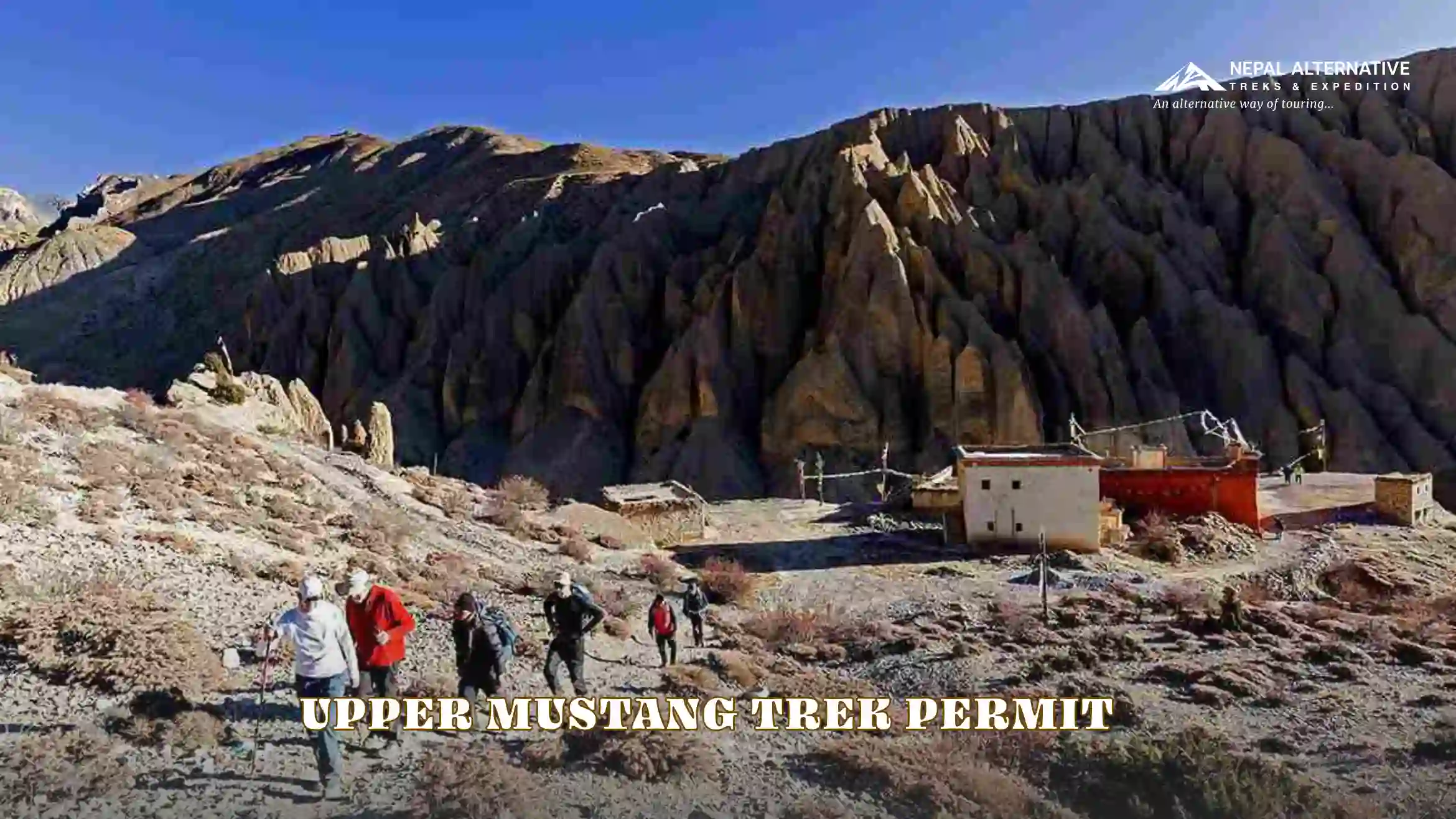
The Upper Mustang trek permit you actually need is a Restricted Area Permit (RAP), billed at USD 50 per person per day for time spent inside the restricted zone north of Kagbeni, plus an Annapurna Conservation Area Permit (ACAP).
You cannot buy the RAP yourself at a counter. A government-registered Nepali trekking agency must file it at the Department of Immigration, and a licensed guide must accompany you throughout the restricted area. That is the whole legal picture for trekking to Upper Mustang in 2026, before you worry about lodges, jeeps, or how many days you spend in Lo Manthang.
We file these Upper Mustang permits from our Kathmandu office for every Upper Mustang trek we run. This guide covers permits needed for an Upper Mustang trek only.
You need two permits for the Upper Mustang Trek: the Restricted Area Permit (RAP) and the Annapurna Conservation Area Permit (ACAP). You do not need a TIMS card for this route.
The RAP is the paper that lets you cross the checkpost at the north end of Kagbeni and continue toward Chele, Ghami, Tsarang, and Lo Manthang. Likewise, ACAP is the conservation ticket for the wider Annapurna area that you already enter in Jomsom, Kagbeni, and Marpha. Officers check both documents, so missing one of them will stop your trip even if the other is in order.
This pairing is why many blogs confuse Lower Mustang and Upper Mustang. Muktinath, Jomsom, and Kagbeni lie inside ACAP. The restricted kingdom begins only when you leave Kagbeni heading north. If you visit only Lower Mustang, you skip the RAP. If you want Lo Manthang, you need both permits.

The Restricted Area Permit is a Department of Immigration entry document for the former Kingdom of Lo. Nepal kept this northern strip under extra control because it sits against the Tibet border, because the walled town and monasteries are easy to damage with unmanaged tourism, and because the desert trail is remote enough that the government wants a registered agency and a licensed guide to trek with every foreign visitor.
On the permit itself, the restricted ground is not a vague “Mustang” label. It covers:
This boundary is why a day walk from Kagbeni to Tiri, or a jeep ride to Muktinath, is not an Upper Mustang trek. Those places lie south of the RAP line. The moment the groups leave Kagbeni for Chele, the RAP must be in the guide’s pocket because the first checkpost sits right at the village exit. Without it, you cannot enter the Upper Mustang area.
RAP fees are quoted in US dollars and paid in Nepali rupees through the agency. The RAP daily rate is the same for Indian and other foreign visitors. The permit is tied to the names, passport numbers, and dates we submit. It is non-transferable and cannot be extended beyond the last day of your Nepal visa. Nepali citizens do not buy the foreign RAP. Checkposts still record Nepali travelers, which is a register, not the USD permit.
Upper Mustang lies inside the Annapurna Conservation Area, so ACAP is required even if you already hold the Restricted Area Permit. ACAP is simpler than RAP. It is a single-entry conservation ticket with no daily charge, and it is checked in the lower valley as well as on the way north.
The registered trekking agency usually collects it in Kathmandu along with the RAP, so you don’t have to queue twice in Pokhara on a tight flight morning. You can also obtain ACAP at Nepal Tourism Board offices in Kathmandu or Pokhara, or through the NTNC e-permit portal, but the RAP must still go through Immigration via a registered agency. SAARC passport holders pay the lower ACAP rate.
The Upper Mustang Restricted Area Permit costs USD 50 per person per day for each day you spend inside the restricted zone. ACAP is a one-time fee of NPR 3,000 for most foreign visitors and NPR 1,000 for SAARC nationals.
Until late 2025, Immigration charged a flat USD 500 for the first 10 days for RAP, even if you only needed 4 or 5 days north of Kagbeni, then USD 50 for each extra day. The Cabinet moved to a straight daily rate in November 2025, and the change was gazetted that December. Now trek agencies file RAP for the exact number of restricted days on your itinerary, which is why a short jeep visit no longer has to carry a 10-day minimum.
Thus, if an agency still quotes you a mandatory USD 500 block for a 5-day stay for the RAP permit fee, ask them to confirm against the current Immigration fee, not a blog from 2024.
| Permit | Where it covers | 2026 fee | Paid how |
| Restricted Area Permit (RAP) | North of Kagbeni to Lo Manthang | USD 50 per person per day | Through a registered agency, in Nepali rupees at Immigration |
| Annapurna Conservation Area Permit (ACAP) | Jomsom, Kagbeni, Marpha, and the Annapurna conservation area | NPR 3,000 (foreign) / NPR 1,000 (SAARC) | Agency or Nepal Tourism Board, one-time |
| TIMS | Not used on this route | Not required | We do not file it for Upper Mustang |
| Stay north of Kagbeni | Old rule (until late 2025) | Current RAP |
| 5 days | USD 500 | USD 250 |
| 7 days | USD 500 | USD 350 |
| 10 days | USD 500 | USD 500 |
| 12 days | USD 600 | USD 600 |
A 10-day stay inside the zone still lands near USD 500. The real saving appears on shorter jeep tours and a few days’ stay in Upper Mustang, where RAP days count only the nights and walking days north of the Kagbeni checkpost, not your Kathmandu or Pokhara hotel nights. Your tour agency will count those days with you before they submit, so you never pay RAP for time spent outside the restricted area.
Package prices on our Upper Mustang trip pages already include RAP and ACAP. The figures above are the government fees inside that total, not an extra bill on arrival.
Lower Mustang, including Jomsom, Marpha, Kagbeni, and Muktinath, needs ACAP only. Upper Mustang, from the Kagbeni checkpost north to Lo Manthang, needs RAP plus ACAP.
This is the question we hear most from trekkers who have already walked part of the Annapurna Circuit. They reach Kagbeni, see the red cliffs to the north, and assume the same conservation ticket will take them to Lo Manthang. It will not. The conservation permit gets you through the Kali Gandaki villages. The restricted permit is a separate Immigration document, and our guides cannot persuade a checkpost officer to waive it.
If you are still choosing a trip length, that boundary also determines your budget. A Lower Mustang walk or Muktinath visit stays in the cheaper ACAP band. A Lo Manthang itinerary, whether it’s an 11 days Upper Mustang trek, 14 days Upper Mustang Trek, or the Upper Mustang jeep tour, always adds the daily RAP fee.
No. A TIMS card (Trekkers’ Information Management System) is not required for the Upper Mustang Trek when you already hold the Restricted Area Permit and ACAP.
Some older posts still list TIMS because it is used on other Nepal trails. On this route, Immigration already holds your name, passport, dates, and guide details on the RAP. Checkposts look for RAP and ACAP only. At Nepal Alternative Treks, we stopped filing TIMS for Upper Mustang after the 2023 conservation-area policy change, and our groups are never asked for a TIMS card at Kagbeni or Lo Manthang.
If a quote lists TIMS as a third mandatory fee for Lo Manthang, treat that as a copy-paste error from a different trek, not current practice on this trail.
Every foreign visitor who goes north of the Kagbeni checkpost needs the Restricted Area Permit, including Indian and other SAARC passport holders. Nepali citizens do not pay the foreign RAP.
Indian travelers still need the RAP at USD 50 per day. What changes for many Indian visitors is the Nepal visa (passport or voter ID on the usual Indian entry rules) and the cheaper ACAP fee. The restricted-area paper itself is not waived.
Similarly, children traveling on their own passports are included in the RAP file the trek agency submits. Immigration treats the permit as name-based, so the agency lists every foreign passport in the group on the application, rather than guessing at an age cutoff.
You also need the RAP if you are not walking. A jeep tour, motorbike trip, or helicopter day into Lo Manthang still crosses the same restricted wards. The fee follows the days spent inside the zone, not the fact that you sat in a vehicle.
No. A licensed Nepali trekking guide is mandatory for Upper Mustang, and the Restricted Area Permit is issued only through a registered agency. You cannot walk or drive the restricted zone as a Free Individual Trekker.
Independent walking, even with a strong map and prior Himalayan experience, is not legal here. Trek guides carry the original RAP, match your group to the checkpost list, and stay with you until you exit south through Kagbeni again. Further, a freelance guide who is not tied to a registered agency cannot collect the RAP on your behalf.
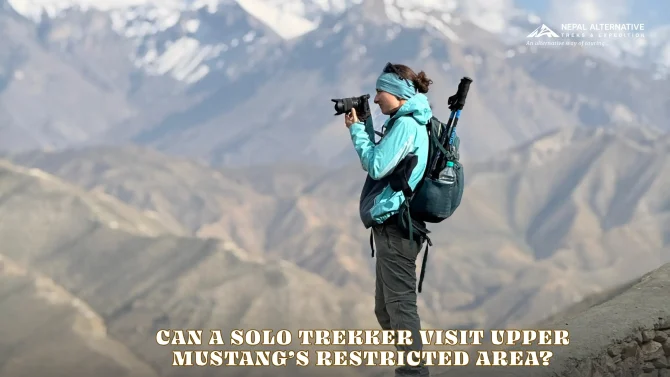
Yes. One foreign trekker can obtain an Upper Mustang Restricted Area Permit in 2026 if a registered agency files it and a licensed guide accompanies the trip, following the rules in effect on March 22, 2026. That said, you still cannot go alone in the sense of walking without a guide.
Earlier, Immigration would not issue a RAP for a single name, which led some companies to sell a dummy second permit. But now a trek company can file solo RAPs for travelers who book a private trip. What has not changed is the guide requirement: “solo” means one guest plus our guide, not a Free Individual Trekker.
If you want to share costs, joining a small group remains the cheaper way to split guide and jeep expenses. The permit itself is charged per person per day either way.
You can obtain the Restricted Area Permit at the Department of Immigration in Kathmandu, or through the Immigration office in Pokhara, and only through a registered trekking agency. Walk-in applications from individual foreigners are refused. Similarly, the Nepal Tourism Board issues the ACAP in Kathmandu or Pokhara.
At Nepal Alternative Treks, we prepare the file in Kathmandu, upload the group and guide details, then collect the printed RAP once Immigration clears it. For guests still abroad, we can start the digital RAP file using a valid visa application submission ID, then finalize it against the original passport after you land. This is especially useful in peak months, when you do not want to spend two working days of a short holiday waiting in an Immigration queue.
Do not plan to buy RAP in Jomsom or Kagbeni on the morning you intend to walk north. The checkpost stamps a permit that already exists. It does not create one.
Documents required for Upper Mustang permits include:
Before you fly, we ask for:
After you arrive in Kathmandu, we need the original passport to complete Immigration processing. A phone photo is enough to draft the file. It is not enough to collect the permit.
Furthermore, your visa length matters more than many expect. Immigration will not issue a RAP that extends beyond your visa stamp. If you hold a 15-day visa and want 12 days north of Kagbeni, we either shorten the itinerary or you extend the visa first.
We apply for the Upper Mustang permit in Kathmandu by lodging your passport details, visa, photos, Upper Mustang trek itinerary, and our guide’s license at the Department of Immigration. You do not need to stand in line yourself unless you wish to observe the process.
The sequence we use:
Extensions, if you add a night in Lo Manthang or lose a day to weather, are requested before the RAP expires, through Immigration, at the same daily rate. We do not treat Jomsom as a place to invent extra days after you have already overstayed. If a flight cancels and you are still south of Kagbeni, that delay does not consume RAP days. If you are already inside the restricted zone, it does.
Tell us your dates on WhatsApp or via the contact form, and we will tell you the exact RAP day count for the itinerary you want, including during Tiji festival weeks, when Lo Manthang fills quickly.
The Restricted Area Permit is valid only for the number of days printed on it, and those days represent the maximum time you may stay north of Kagbeni. It does not start on the date we collect it in Kathmandu.
If we file 7 RAP days, you must exit through the Kagbeni checkpost by the end of the seventh day. There is no official grace night. Officers count the permit, not your story about a late jeep. ACAP does not add extra RAP days. It only lets you be in the conservation area.
This is why we carefully account for Lo Manthang rest days, Chhoser cave side trips, and the drive back to Marpha. A rest day inside the walled town is a RAP day. A hotel night in Pokhara is not.
At the same time, ACAP has no daily limit. It is a one-entry conservation ticket valid for the duration of your trek in the Annapurna region.
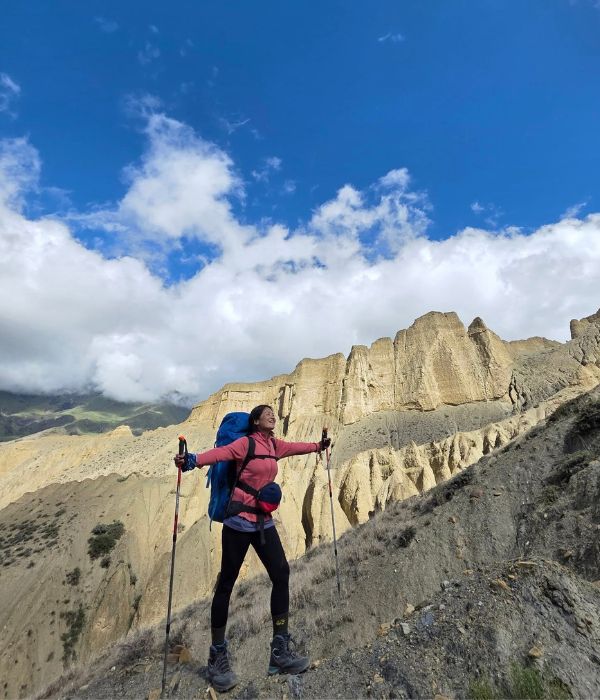
Permits are checked at several points along the route. ACAP permit is verified first, often in Jomsom or Kagbeni as you enter the Annapurna Conservation Area. The Restricted Area Permit (RAP) is then checked at the Kagbeni checkpost as you leave the village heading north, and again in places like Tsarang and Lo Manthang, plus once more when you exit south. Our guides keep the originals in a secure document pouch, because losing the paper at 3,800 m is not something you fix in an afternoon.
Entering without RAP, walking without the licensed guide named on the file, straying into closed ground toward the northern border, or staying past the last printed day can result in being turned back, fined, or referred to Immigration. Officers may also ask for ACAP at lower checkpoints, so both permits must travel together.
Closed areas along the Tibet frontier are not grey zones for a quick photo stop. Stay on the filed itinerary. Monastery and cave visits included in that itinerary are permitted. Improvising a border viewpoint is not.
Upper Mustang is one of several restricted-area treks in Nepal. Manaslu, Tsum, Nar-Phu, and Upper Dolpo all need an Immigration RAP plus a conservation permit, and all of them require a registered agency and a licensed guide. The difference that matters for your budget is the daily rate. Upper Mustang’s USD 50 a day is still among the higher restricted fees, which is why the late-2025 change from a 10-day minimum was such a large shift for shorter visits.
If you are chaining regions, RAP is not a single national ticket. A combined Manaslu, Annapurna Circuit, and Upper Mustang itinerary requires the Manaslu restricted permit for that section, the Upper Mustang RAP for days north of Kagbeni, plus matching conservation papers. We file them as separate Immigration items.
Once RAP and ACAP are secured, the trek in Upper Mustang region feels like any other guided walk in a dry valley: wind, dust, monasteries, and a walled town that still closes its gates in your head even when the doors are open. The permit work is the unromantic part, and it decides whether you leave Kagbeni on the morning you hoped.
Share your dates, passport nationality, and whether you prefer to walk or drive. We will count RAP days, verify them against your visa, and file both permits before you fly to Jomsom. For seasonal wind patterns and the Pokhara to Jomsom flight, check our best time for Upper Mustang alongside this page, not instead of it.
Yes. Every visitor needs a Restricted Area Permit (RAP) to go north of Kagbeni, plus ACAP for the Annapurna Conservation Area. ACAP alone suffices for Lower Mustang (Jomsom, Kagbeni, Muktinath), but will not get you through the checkpost toward Lo Manthang.
The RAP costs USD 50 per person per day for each day spent inside the restricted zone north of Kagbeni. ACAP is a one-time NPR 3,000 for foreigners and NPR 1,000 for SAARC nationals.
Yes. Foreign visitors can trek Upper Mustang when a registered Nepali agency files the RAP and a licensed guide accompanies the group. This rule applies to Indian and other SAARC passport holders as well as travelers from elsewhere.
No. Individual foreigners cannot apply for the RAP at Immigration, the Nepal Tourism Board, or the Kagbeni checkpost. You may buy ACAP yourself at Tourism Board offices in Kathmandu or Pokhara, but the RAP must go through a registered trekking agency in Nepal with a licensed guide named on the file.
With complete documents and your original passport in Kathmandu, the trek agency usually collects the RAP in 1 to 3 working days. October and April may add an extra day at Immigration, so send passport scans before you fly if your holiday is short. The Kagbeni checkpost only stamps a permit that already exists.
You can extend an Upper Mustang RAP at the same USD 50 per person per day rate if we apply before the printed days run out and your Nepal visa still covers the extra stay. A rest day in Lo Manthang or a delayed jeep inside the zone counts as a RAP day, so tell us before the last printed date rather than at the checkpost after you are already late.
Yes. A licensed Nepali guide is mandatory, and Immigration will not issue the RAP for unguided travel. Our guide carries the original RAP, matches your names to the checkpost list, and stays with you until you exit south through Kagbeni. A freelance guide not tied to a registered agency cannot collect the RAP on your behalf.
Yes. Jeep tours, motorbike trips, and helicopter visits require the same RAP and ACAP as a walking trek. The fee applies to entry into the restricted wards north of Kagbeni, not to how many kilometers you walk. Sitting in a vehicle does not exempt you from the RAP.
No. Nepali citizens do not purchase the foreign Restricted Area Permit issued by Immigration to visitors. Checkposts may still record names, contact details, and addresses in a local trail register, but this is not the USD daily permit.
Upper Mustang remains restricted because it borders Tibet, because its monasteries and walled town are vulnerable to unmanaged tourism, and because the government requires foreign movement to be tied to a registered agency and licensed guide.
Need assistance? Our travel expert Tej Bahadur Gurung is here to help! Please fill out the form below to initiate a chat and get your queries resolved quickly.