

Picture yourself standing at Mardi Himal High Camp during sunrise. The air is crisp, and the face of Machapuchare and the surrounding Annapurna peaks glows golden in the morning light. Now picture being in the exact same place during the monsoon season. Thick clouds cover everything, the trail is muddy and slippery, leeches are everywhere, and the mountain is completely hidden from view. Same trek. Same destination. Entirely different experience. The only difference? The season you chose to go.
Choosing the right time for the Mardi Himal Trek can make a huge difference between an ordinary trek and an unforgettable Himalayan adventure. The timing of your trek also has a major impact on your overall trekking experience. It affects everything from mountain views and trail conditions to temperatures, crowd levels, teahouse availability, and how comfortable the journey feels.
If you want the best of everything, including clear skies, stable trails, comfortable temperatures, and a beautiful sunrise view over Machapuchhre, choose October to November (autumn season). If you want to witness rhododendrons bloom along the Mardi Himal route, with slightly warmer weather and longer daylight, go for the spring season.
Which Season is Best for the Mardi Himal Trek?
Autumn (September to November) is the best season for the Mardi Himal Trek in Nepal, with spring (March to May) a close second. Autumn is also the peak season, thanks to the ideal combination of clear mountain views, stable weather, and comfortable trekking temperatures. Arriving after the monsoon season; autumn brings clean skies and air, as the monsoon rains have washed away dust and haze.
One of the highlights of trekking to Mardi in autumn is the crystal-clear view of iconic Machapuchhre Peak and other peaks of the Annapurna Range, making it the ideal time to trek. Likewise, during this season, trek routes are generally drier and safer with a lower chance of weather-related challenges, making the trek comfortable to complete with less risk.
Additionally, the rhododendron forests along the lower trails, with their bright red and pink flowers, make spring one of the best times to trek along the Mardi Himal trail. Besides, the warm weather, good visibility, and relatively safe trail conditions make the season ideal for trekking.
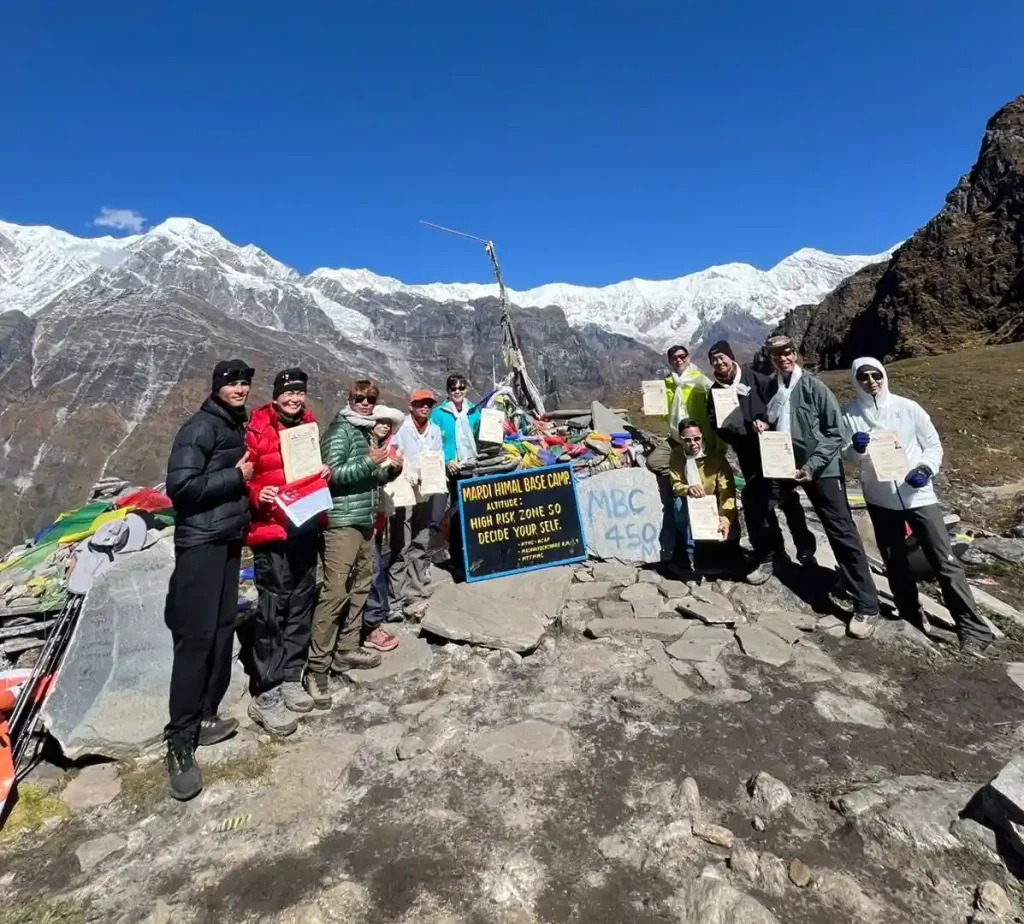
Why Spring Creates One of the Most Beautiful Mardi Himal Experiences
In spring (March to May), the Mardi Himal trail seems more like a colorful, living garden than a mountain path, full of rhododendron forests, plants, and trees growing again after winter. Likewise, the spring on the Mardi Himal trek route is when nature along the trail comes to life. Birds sing in the oak and pine forests, langur monkeys can be seen in the trees, and the forest becomes green, that showcase a beautiful contrast with the Annapurna mountain range.
With melting snow, waterfalls flow heavily, adding the soothing sound of running water to the lower parts of the Mardi trail. Similarly, days are longer, giving trekkers more daylight to enjoy spring’s beauty. Furthermore, spring lets trekkers enjoy both blooming landscapes and mountain views in one journey, something other seasons rarely match.
Why Autumn Remains the Most Popular Season for Mardi Himal Trek
Among the four seasons in Nepal, autumn is the most popular one for the Mardi Himal Trek, not because of one special feature, but because the conditions are consistently good in every way. One of the specialties of autumn is the clean air and dry weather after the recent monsoon season. As autumn offers reliable trekking conditions, many people choose the Mardi Himal Base Camp trek in this season.
Due to peak trekking season, the trek paths are in daily use, making the route clear and well-maintained. Thus, autumn is a popular time for trekking in Mardi Himal because the route is easier to follow. Likewise, temperatures remain stable between day and night, making it easier to pack light clothing and gear in autumn.
While autumn may not have the same colorful scenery as spring, it is still a popular time to trek to Mardi Himal because it offers reliable weather and good trail conditions.
Spring vs Autumn: Which Season Is Better for Mardi Himal Trek?
Spring and autumn both have qualities that make them the best time to visit the Mardi Base Camp and the Mardi Himal ridge. Although both seasons are best, trekkers seek a better option for their adventure. The table below compares the two seasons across the factors most important to trekkers.
| Factor | Autumn | Spring |
| Mountain Visibility | Sharpest and clearest skies | Good in the mornings, hazier by the afternoon |
| Temperature (daytime) | Cool and comfortable | Mild to slightly warm |
| Temperature (night, high camp) | Cold and freezing at high altitude | More moderate than autumn |
| Trail conditions | Dry and well-marked | Mostly dry, but some sections still have snow patches in high sections |
| Scenery | Clear mountain peaks and golden post-monsoon hillsides | Rhododendron blooms, dense green forest |
| Teahouse availability | Filled with trekkers, advance booking is recommended | Generally available |
| Wildlife and nature | Less active | Birdsong, langurs, and streams |
| Daylight hours | Shorter days | Longer days |
| Overall Trekking Comfort | Excellent | Best |
| Best For | Clear mountain-view seekers and photographers | Nature lovers and flower enthusiasts |
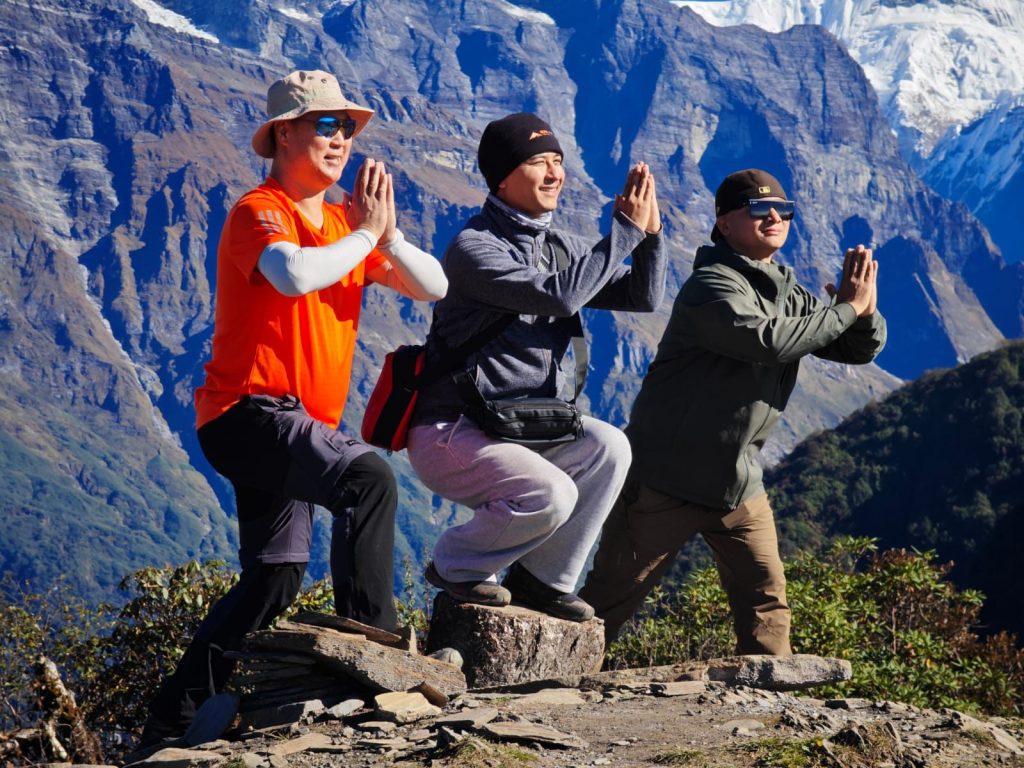
What Mountain Views Can You Expect in Different Seasons?
On the Mardi Himal journey, the mountain views you can expect depend on the season and time of day. In autumn, the air is very clean after the monsoon, offering the best views and an ideal trekking experience on the Mardi Himal adventure. From the upper camps and Mardi viewpoint, Machapuchhre Peak looks very close, and nearby peaks like Annapurna South, Hiunchuli, and Mardi Himal appear stunning.
Spring has a different pattern for mountain views than autumn. In the mornings, conditions are generally clear, so trekkers can enjoy great mountain views. However, by midday, clouds cover the sky and block mountain views. The suitable time for clear photos is before midday, when visibility is good.
Winter (December-February) offers clear air and exceptional mountain views. In cold, dry conditions, mountains like Machapuchhre and the Annapurna range look extremely sharp. However, winter weather can change quickly, with sudden snow or storms, reducing visibility for a day or more.
In addition, the summer/monsoon season (June to August) is the best time to avoid Mardi Himal for mountain views and other trekking perspectives. Continuous rainfall in summer/monsoon, along with thick clouds, covers the mountains for long periods. So peaks like Machapuchhre and Hiunchuli are hidden behind grey skies during the season.
Is Monsoon a Good Time for Mardi Himal Trek?
No, the monsoon is not a good time for the Mardi Himal Trek due to dangerous trail conditions, blocked mountain views, and leech-infested trails, all caused by rainfall. Monsoon (June to August) is the time when the Mardi area experiences heavy rainfall, continuously for days. Thus, if you are a beginner and want safe trail conditions, the Mardi Himal trek is not for you during the monsoon season.
Similarly, the monsoon season accounts for 80% of the annual rainfall, making trails muddy, slippery, and more difficult to walk on. Mountain views are limited due to rain and cloud cover. Moreover, heavy rainfall increases the risk of landslides, and river crossings become challenging due to high flow.
That said, the monsoon is also a good option for experienced trekkers who seek dense green scenery and don’t mind rainy weather. During the season, the air feels fresher with dense vegetation covering the hillsides. Trekkers hear birds, water, and their own footsteps. Additionally, Nepal’s monsoon season coincides with summer, bringing warm temperatures when it’s not raining.
Seasonal Temperature Variations on the Mardi Himal Route
The Mardi Himal Trek begins with a drive from Pokhara (830 m) to Deurali, followed by a trek to Forest Camp (2,600 m). The route then ascends to higher elevations on Badal Danda (3,300 m) and High Camp (3,700 m) before reaching Mardi Himal Base Camp (4,500 m).
As you go higher, the scenery becomes more rocky and mountainous, and the weather can change unpredictably. Similarly, as you gain altitude, it gets colder, about 2-3°C per 500 m of ascent. As a result, Base Camp can be 25-30°C colder than Pokhara, even on the same day.
Season by season
- Autumn (October-November):
As already mentioned above, autumn is the best time for the Mardi Himal Trek. During this time, the Mardi Himal route experiences plenty of sunshine, with daytime temperatures around 18-22°C in the lower valleys and 8-12°C at higher elevations. However, nights are cold, with temperatures at Base Camp dropping below -5°C. In fact, autumn nights around Mardi Himal are colder than those in spring.
- Spring (March-May):
Spring trekking in the Mardi Himal feels warmer in general. During this season, the daytime temperatures range from 12°C to 22°C in the lower and mid-hill areas. At higher elevations, from High Camp to Mardi Himal Base Camp, daytime temperatures are usually between 5°C and 12°C. Besides, the night is cold, with temperatures dropping below freezing
- Winter (December-February):
Winter is one of the challenging times to trek to Mardi Himal due to cold weather. During this time, the trail to Mardi Himal experiences the coldest weather, with daytime temperatures ranging from 6°C to 14°C at lower elevations. Similarly, higher areas are much colder, with temperatures ranging from -5°C to 6°C. Around High Camp and Mardi Himal Base Camp, nights are freezing with temperatures falling below 0°C. In the coldest part of winter, especially in January, nighttime temperatures at High Camp can drop to -15°C.
- Summer/Monsoon (June-August):
Summer/Monsoon is warm, but rain makes the entire Annapurna region wet. Daytime temperatures in the lower parts usually range from 18°C to 22°C. One advantage of trekking during this season is the milder nights, with temperatures typically ranging from 8°C to 15°C, making it much more comfortable than in other seasons.
Mardi Himal Trek Weather and Trek Conditions by Month
| Months | Forest Camp (Day/Night) | Badal Danda (Day/Night) | High Camp (Day/Night) | Mardi Himal Base Camp (Day/Night) | Trail Condition |
| January | 4–9°C / −2 to 2°C | 2–7°C / −4 to 0°C | −5 to 2°C / −15 to −10°C | −8 to 0°C / −20 to −15°C | Heavy snow above 3,000 m, icy, crampons essential |
| February | 5–10°C / −1 to 3°C | 3–8°C / −3 to 1°C | −4 to 3°C / −14 to −8°C | −6 to 2°C / −18 to −12°C | Deep snow at High Camp with a blocked route |
| March | 9–15°C / 2–7°C | 7–13°C / 0–5°C | 2–8°C / −5 to −2°C | 0–5°C / −10 to −6°C | Snow melting, early rhododendrons |
| April | 12–18°C / 5–10°C | 10–16°C / 3–8°C | 5–12°C / −3 to 0°C | 2–8°C / −8 to −4°C | Dry and rhododendrons in full bloom |
| May | 15–21°C / 8–13°C | 13–19°C / 6–11°C | 8–14°C / −2 to 2°C | 4–10°C / −6 to −2°C | Warm and pleasant, some humidity, late rainfall possible |
| June | 18–23°C / 12–16°C | 16–21°C / 10–14°C | 10–15°C / 2–6°C | 5–10°C / 0–4°C | Wet, slippery, leeches are active throughout forest sections |
| July | 19–24°C / 13–17°C | 17–22°C / 11–15°C | 11–16°C / 3–7°C | 6–12°C / 1–5°C | Very slippery, landslide risk high, leeches everywhere |
| August | 18–23°C / 12–16°C | 16–21°C / 10–14°C | 10–15°C / 3–8°C | 5–12°C / 0–5°C | soaked trails, landslides, and leeches |
| September | 15–20°C / 8–13°C | 13–18°C / 6–11°C | 9–14°C / 0–4°C | 4–10°C / −3 to 0°C | Trails drying, leeches fading |
| October | 12–17°C / 5–9°C | 10–15°C / 3–7°C | 8–12°C / −5 to −2°C | 5–10°C / −10 to −5°C | Dry, and stable, peak season, busy teahouses |
| November | 9–14°C / 2–6°C | 7–12°C / 0–4°C | 5–10°C / −7 to −4°C | 3–8°C / −12 to −7°C | Dry and stable, colder nights, peaceful trails |
| December | 5–10°C / −1 to 3°C | 3–8°C / −3 to 1°C | −2 to 5°C / −12 to −7°C | −5 to 2°C / −16 to −10°C | Snow arriving above 3,500 m, cold |
FAQs
Is October the best time for the Mardi Himal Trek?
Yes, October is the best time to trek Mardi Himal Trek due to stable weather, clear skies, clear mountain views, and comfortable temperatures. As it falls during the autumn season, it is also considered one of the peak trekking times in Nepal.
When do rhododendrons bloom on the Mardi trail?
Rhododendrons on the Mardi trail bloom in March and April, especially in late March and early April when the flowers are at their fullest. During this time, forest trails are filled with colorful red, pink, and white rhododendron blossoms, creating the most beautiful scenery on the route.
Which season has the fewest crowds on the Mardi trail?
The monsoon season (June to August) generally has the fewest crowds on the Mardi Himal Trek. Likewise, winter (December to February) also experiences fewer crowds, offering peaceful trails but colder temperatures. However, the route to Mardi Himal generally experiences fewer crowds than other trekking destinations in the Annapurna region, including Ghorepani Poon Hill and Annapurna Base Camp.
How far in advance should I book during peak season?
For peak season, it is recommended to book your trek at least 1-2 months in advance. Planning your trek early and booking in advance helps secure your guide, accommodation, and transportation.
When is the best time for beginner trekkers to do the Mardi Himal Trek?
October to November (autumn) and April (spring) are the best times for beginners to do the Mardi Himal Trek. Stable weather, clear blue skies, dry trails, and fully operational teahouses make this period safe and enjoyable for beginners to experience the beauty of Mardi Himal.


