Mountain, Forest, Village, Glacier, Hot Spring, Terrace
Region of Nepal
Region of Nepal
Annapurna Region, Kaski
Max. Altitude
Max. Altitude
4,130 m / 13,550 ft
7 Days Annapurna Base Camp Trek Overview
If you want an amazing Himalayan Trek without weeks of trekking, the Annapurna Base Camp (ABC) Trek can be your best journey. Few treks in Nepal offer what the ABC Trek does in just 7 days, a walk into a natural amphitheater of 7,000 m+ peaks. This is the Annapurna Sanctuary, a stunning glacial valley surrounded by mountain peaks. The feeling of standing at the base of Mount Annapurna after days of trekking is something words can’t describe.
The journey starts in Pokhara, the city of lakes, where the beautiful Mt. Machhapuchhre will excite you for the upcoming trek days. After a short drive from Pokhara, you get to Ghandruk, Nepal’s second-largest Gurung settlement. From Ghandruk, the trek follows the trail through Chhomrong, Bamboo, and Deurali, and Machhapuchhre Base Camp before reaching Annapurna Base Camp. One of the highlights of the trail is the constantly changing landscape. The trek begins in terraced farmland, then takes you through rhododendron and bamboo before entering the alpine landscape, all within Annapurna Conservation Area.
From Annapurna Base Camp, you’ll enjoy uninterrupted 360-degree views of some of the Himalayas’ most iconic peaks, including Annapurna I, Machhapuchhre (Fishtail), Annapurna South, Hiunchuli, Gangapurna, and Annapurna III. After exploring Annapurna Base Camp, the trail follows the same route back through Chhomrong before continuing down to Jhinu Danda. At Jhinu Danda, you can relax your tired muscles at the natural hot spring beside the Modi Khola River. The final drive from Jhinu Danda to Pokhara signals the end of your Annapurna Himalayan adventure.
This is a moderately challenging trek, with 5-7 hours of walking each day on steep stone staircases, forest trails, and, near the base camp, snow and moraine. The trek doesn’t require any technical climbing skills, but having a reasonable fitness level and hiking experience can help you a lot. With the right preparation and training, even beginners can complete the Annapurna trek. Additionally, the trek covers a round-trip distance of 61-71 km and reaches an elevation of 4,130 m (13,550 ft) above sea level.
Throughout the trek, you’ll stay in a local tea house where you’ll taste local dishes and experience the warm hospitality of the Gurung and Magar communities. For ideal trekking conditions and favorable weather, consider trekking to ABC during autumn (September to November) and spring (March to May).
Ready to stand face-to-face with the Annapurna Sanctuary?
7 Days Annapurna Base Camp Trek offers a perfect combination of Himalayan views, local culture, and adventure. Get in touch today for upcoming departure dates and a customized itinerary.
Grand views of the Annapurna, Nilgiri, and Dhaulagiri ranges.
Explore the Annapurna Conservation Area and its biodiversity.
Enjoy the Gurung and Magar culture and traditions along with their warm hospitality.
Visit the Machhapuchhre Base Camp on the route to Annapurna Base Camp.
Trek through the forests of rhododendrons, oaks, bamboo, and alpine meadows.
Trek through beautiful villages like Ghandruk, Chhomrong, Bamboo, Deurali, and many more.
Explore the base of the world’s tenth-highest peak, Annapurna.
Dip into the natural hot spring at Jhinu Danda and relax your tired muscles after a long trek.
Annapurna Base Camp Short Trek Difficulty
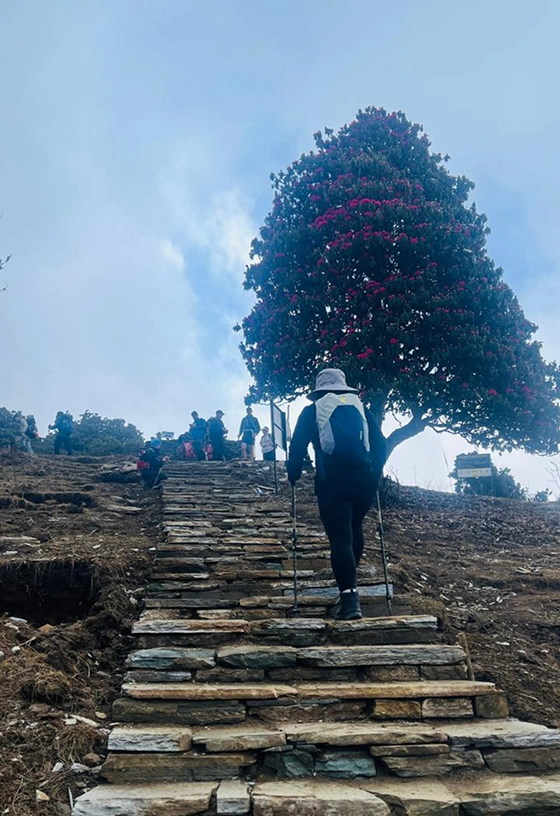
The Annapurna Base Camp Trek is a moderately difficult trekking route in Nepal. Although the trail does not have technical sections, trekkers must ascend and descend on steep sections. As the trail ascends, it becomes more rugged and rocky. Trekkers will have to climb more than 3,000 staircases while on the Annapurna Base Camp route.
During the trek, trekkers have to be prepared to walk for 5 to 7 hours, depending on the destination. Similarly, they have to be prepared to cover 8-18 km a day. Long hours of hiking on varied terrain are physically strenuous. Additionally, the base camp is situated at an elevation of 4,130 m. The high elevation can cause a risk of altitude sickness. Hence, proper acclimatization is necessary during the trek.
The Annapurna Base Camp Trek can also create mental difficulties for trekkers. The weather becomes unpredictable as you move to the higher elevations. Likewise, the facilities and infrastructure also become limited. These unpredictable changes and lack of connectivity and facilities can stress the trekkers. Hence, mental resilience is important for the trek.
The Annapurna Base Camp trail is filled with challenging adventures. So, trekkers should be physically and mentally prepared for the trek.
Questions before you book?
Our Nepal team replies on WhatsApp with trip details, dates, and custom options.
Drive from Pokhara to Ghandruk – Trek to Chhomrong (2,130 m)
Day 1 Facts
Trekking Time Average
3-4 hours Drive (55-60 km)
12 km Uphill hike
(5 hours)
Accommodation
Hotel Panorama/ Hotel Excellent View
Altitude
(2,130 m / 7,029 ft)
Included meals
Lunch, Dinner
Enjoy a delicious breakfast, witnessing the beautiful sight of Mount Machhapuchhre (6,997 m) from Pokhara. Afterward, you’ll pack your bags and drive towards Ghandruk. The road goes through the Pokhara Valley and passes through terraced fields, small villages along the way, and the Modi Khola river valley. As the drive continues, the beautiful Annapurna mountain range comes into view.
As you get to Ghandruk, you’ll suddenly feel the calmness of nature. It is a beautiful hillside village with traditional stone houses, slate roofs, narrow stone paths, and colorful prayer flags waving in front of a stunning mountain view. Take a moment to appreciate the village’s beauty with amazing close-up views of Machhapuchhre (Fishtail) and Annapurna South. If time allows, you’ll take a short walk around the village, chortens, and the Gurung Museum.
From Ghandruk, your official trek to Annapurna Base Camp begins. The trail goes downhill through forests and stone-paved paths, taking you through terraced farms and small Gurung and Chhetri villages. Along the way, you’ll cross several suspension bridges over fast-flowing mountain streams, while the Modi Khola River accompanies you much of the route.
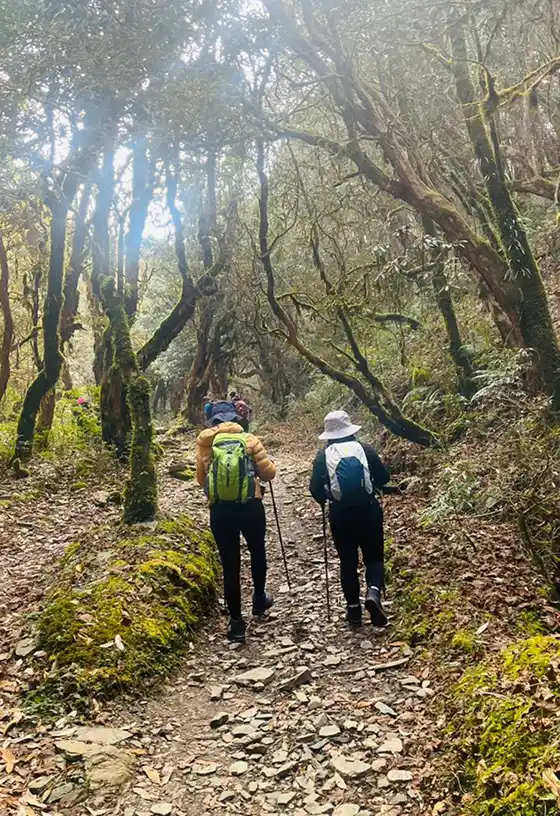
The trail has a mix of gentle downhill and moderate uphill sections as it passes through rhododendron and oak forests. Along the way, you’ll enjoy occasional views of the surrounding hills and, on clear days, distant mountain peaks. As the trail climbs toward Chhomrong, the uphill walk becomes steadier with many stone steps that take you through forested hillsides. At about 2,130 m, Chhomrong is the last major village before Annapurna Base Camp and marks the start of the more remote and rugged section of the trek. Overnight and dinner at Chhomrong.
Day 2
Chhomrong to Bamboo video highlights
Chhomrong to Bamboo video highlights
Chhomrong Khola Bridge
Chhomrong Khola Bridge
A beautiful water fountain
A beautiful water fountain
At Bamboo
At Bamboo
Chhomrong to Bamboo (2,300 m)
Day 2 Facts
Trekking Time Average
8-9 km Uphill hike
(4-6 hours)
Accommodation
Trekking Guest House or Similar category
Altitude
(2,300 m / 7,590 ft)
Included meals
Breakfast, Lunch, Dinner
Have a hearty morning meal at Chhomrong while enjoying the view of Annapurna South and Machhapuchhre. After breakfast, you’ll leave Chhomrong and begin a long, steep descent down a stone staircase into the valley below. As you walk downhill, you’ll cross a suspension bridge over the Chhomrong Khola and enter the Modi Khola Valley. From the bridge, the trail climbs up the other side of the valley along stone steps and forest paths, reaching the small village of Sinuwa.
From Sinuwa village, you can look back and enjoy views of Chhomrong and the surrounding green hills. Have lunch at Sinuwa before continuing the trek. Beyond the village, the scenery changes as the trail enters a dense subtropical forest filled with rhododendron and oak trees covered in moss.
The trail continues north through the small settlement of Kuldighar before descending toward the Modi Khola River. As you walk, the forest becomes denser, and the valley grows narrower, with steep hillsides on both sides of the trail. As you get closer to Bamboo, the trail passes through thick bamboo forests, with tall bamboo plants lining both sides of the path.
You’ll spend the night in Bamboo, surrounded by the peaceful sounds of the Modi Khola River and the forest around you. It’s a peaceful place to relax and recharge before continuing higher into the Annapurna Sanctuary the following day.
Day 3
Bamboo to Deurali video highlights
Bamboo to Deurali video highlights
101 Waterfall
101 Waterfall
At Himalaya
At Himalaya
At Deurali
At Deurali
Bamboo to Deurali (3,200 m)
Day 3 Facts
Trekking Time Average
12 km
(5 hours)
Accommodation
New Panorama Lodge or Similar category
Altitude
(3,200 m / 10,499 ft)
Included meals
Breakfast, Lunch, Dinner
Early morning, you’ll leave Bamboo after breakfast. From Bamboo, the trail begins with a short but steep climb out of the bamboo forest. It continues along the Modi Khola River, following the valley upstream as the surrounding cliffs and hillsides get closer. The trail continues through thick forest, with rhododendron, oak, and bamboo trees surrounding the path. The sound of the rushing river below accompanies your walk, adding to the peaceful atmosphere along the way.
Continuing the trek, you’ll get to Dovan, a small teahouse surrounded by forest and an ideal rest point during the steady climb. After Dovan, the route becomes steeper and more rugged, with rocky sections and thinner forest as altitude increases. Continuing north, the trail reaches Himalaya (also known as Himalpani), a small settlement at 2,920 m.
Himalaya village marks the transition from dense forest to a more open alpine landscape. The dense forest slowly fades away, replaced by shrubs and smaller plants that are better suited to the higher altitude. One of the highlights of the day is Hinku Cave, a large rock overhang that once provided shelter for travelers and porters along the route. The trail passes right under this impressive formation, giving you a close look at the rugged landscape around you.
Shortly after, you’ll cross a landslide-prone area below steep cliffs. This section reflects the constantly changing nature of the high mountain environment. As the trail continues upward, the landscape opens up. The forest disappears almost completely, replaced by rocky slopes, cascading waterfalls, and, on clear days, views of the impressive mountains ahead.
The final climb to Deurali follows a steady path along the right side of the Modi Khola. Deurali is the last place with forests before the trail opens into high-alpine, glacier-covered landscapes. Compared to the earlier forested stops, the village offers clearer and wider views. On clear evenings, you can see Hiunchuli and parts of the southern side of Machhapuchhre. Day’s overnight and dinner at Deurali’s teahouse.
Day 4
Deurali to Annapurna Base Camp video highlights
Deurali to Annapurna Base Camp video highlights
Deurali
Deurali
A walk from Deurali to MBC
A walk from Deurali to MBC
A stunning sun rise at ABC
A stunning sun rise at ABC
At the ABC
At the ABC
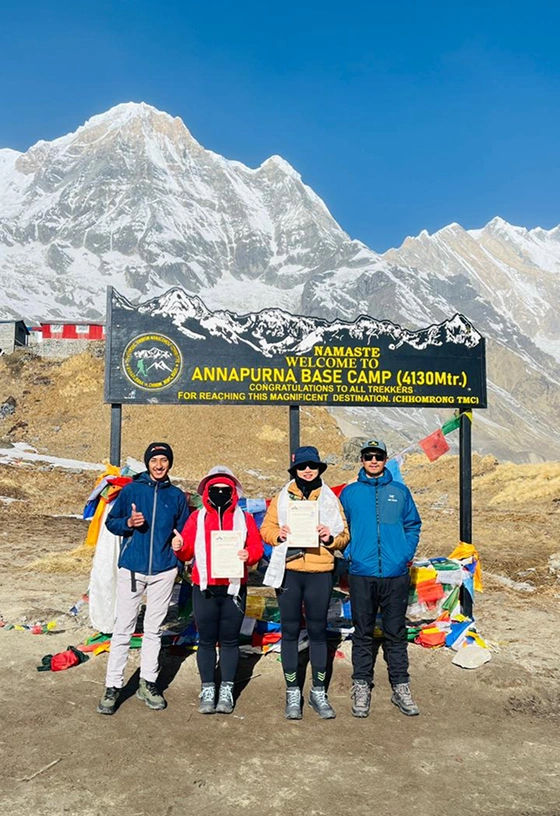
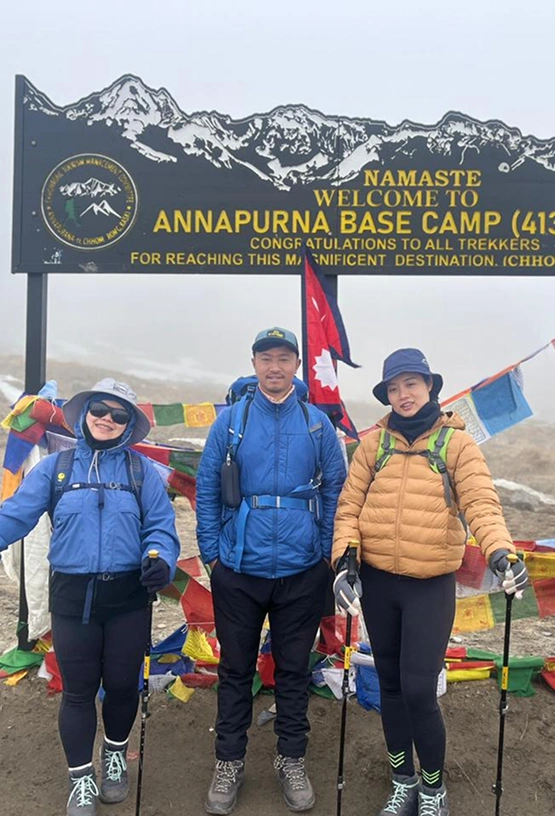
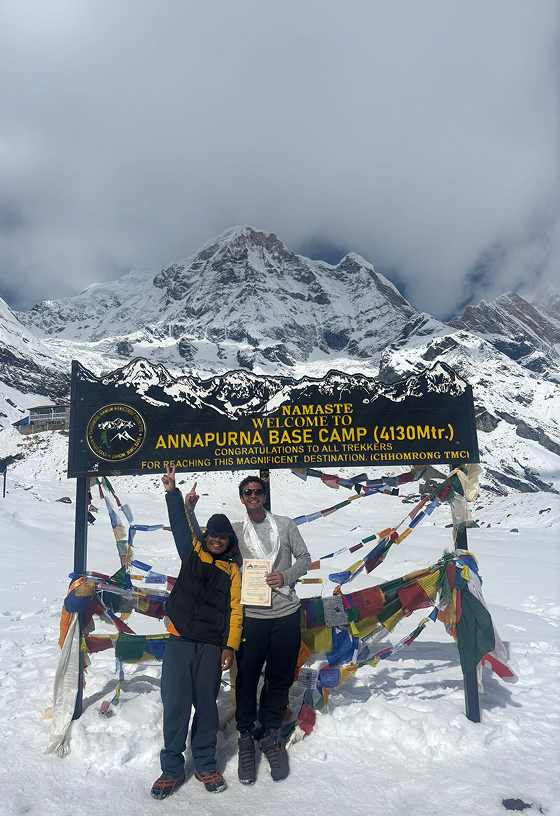
Happy Group of Trekkers at ABC
Happy Group of Trekkers at ABC
Deurali to Annapurna Base Camp (4,130 m)
Day 4 Facts
Trekking Time Average
8-9 km
(4 hours)
Accommodation
Annapurna Sanctuary Lodge or Similar category
Altitude
(4,130 m / 13,550 ft)
Included meals
Breakfast, Lunch, Dinner
After days of walking, this is the day when all the effort, challenges, and anticipation come together. You’ll leave Deurali after breakfast at your accommodation points. Leaving Deurali, the forests slowly disappear, replaced by a raw and alpine environment of mountain slopes and glacial debris as you enter the Annapurna Sanctuary.
The climb from Deurali follows a steady but mostly open section alongside the Modi Khola on the right side of the route. The mountains that once appeared only as distant will now seem closer, including Mount Hiunchuli, Annapurna South, and the southern face of Machhapuchhre. Around two hours after leaving Deurali, you get to Machhapuchhre Base Camp, located at 3,700 m.
Surrounded by mountain peaks, Machhapuchhre Base Camp is one of the trek’s most spectacular viewpoints. Many trekkers stop here for a while to enjoy the incredible scenery of Machhapuchhre, Annapurna I, Gangapurna, Gandharva Chuli, Annapurna South, and Hiunchuli. Also, you’ll enjoy your lunch at the location.
From Machhapuchhre Base Camp, the final walk to Annapurna Base Camp begins. Although the distance is shorter, the higher altitude makes the walk more challenging. The trail crosses open rocky ground and, depending on the season, patches of snow and ice before the glacial moraine. Every step towards ABC provides you with a closer sight of the Himalayan peaks from Gangapurna, Annapurna III, Annapurna South, and Hiunchuli.
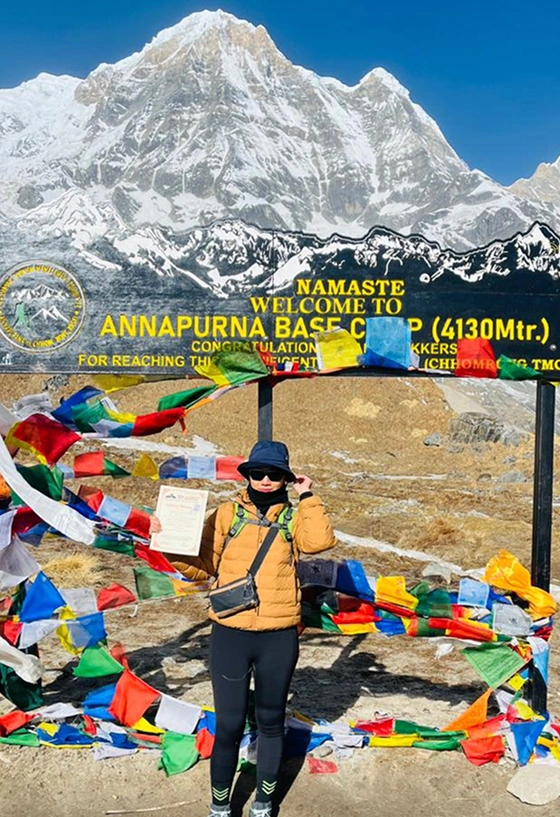
Reaching Annapurna Base Camp (4,130 m) is the highlight of the entire trek. You’ll stand at the foot of Annapurna I (8.091m), the world’s tenth-highest mountain. Besides, the base camp surrounds you with a 360-degree view of Hiunchuli (6,441 m), Gangapurna (6,454 m), and Machhapuchhre (6,997 m). Enjoy the sunset from the base camp and spend an overnight at the Annapurna Sanctuary Lodge or similar-category accommodation.
Day 5
ABC to Bamboo video highlights
ABC to Bamboo video highlights
The view of dominating Fishtail and MBC ahead down
The view of dominating Fishtail and MBC ahead down
Following Modi River towards Bamboo
Following Modi River towards Bamboo
At Bamboo
At Bamboo
After the reaching the view point
After the reaching the view point
Welcome to Annapurna Base Camp
Welcome to Annapurna Base Camp
Annapurna Base Camp to Bamboo (2,300 m)
Day 5 Facts
Trekking Time Average
12-16 km
(6-8 hours)
Accommodation
Trekking Guest house or Similar category
Altitude
(2,300 m / 7,590 ft)
Included meals
Breakfast, Lunch, Dinner
Wake up early to witness one of the most beautiful sunrises in the Himalayas. As the first rays of sunlight reach Annapurna I, its face changes from grey to soft pink and then to gold. Likewise, other peaks also glow one by one until the entire Annapurna Sanctuary shines in the morning sun. After breakfast, take one last look around Annapurna Base Camp; it’s time to begin the descent. The trail follows the same route back across rocky ground and glacial moraine.
Unlike the climb, the return journey is relaxed with clear morning skies, allowing uninterrupted views of the surrounding peaks. The route first descends to Machhapuchhre Base Camp, where you can enjoy one last close-up view of the iconic fishtail-shaped summit. The route then follows the right bank of the Modi Khola through the exposed section below steep rock walls, an area known for seasonal avalanche activity.
As you pass back through Himalaya (Himalpani), the trail returns to the forest. The open mountain views slowly fade, replaced by rhododendrons and oak trees. The trail continues downhill through the gorge, passing below Hinku Cave again and following the narrow path above the Modi Khola. As you continue downhill through Dovan, the trail winds through thicker forest, with the sound of the river becoming louder. the final section before reaching Bamboo takes you back into the dense bamboo forest that gives the village its name. Day’s overnight stay and dinner at Bamboo village.
Day 6
Bamboo to Jhinu Danda video highlights
Bamboo to Jhinu Danda video highlights
Bamboo to Sinuwa walk
Bamboo to Sinuwa walk
Jhinu hot spring
Jhinu hot spring
Jhinu Danda
Jhinu Danda
Bamboo to Jhinu Danda (1,600 m)
Day 6 Facts
Trekking Time Average
8.5-11 km
(5-6 hours)
Accommodation
Namaste Lodge/ Park Himalaya Hotel
Altitude
(1,600 m / 5,280 ft)
Included meals
Breakfast, Lunch, Dinner
As usual, your day begins with a warm cup of tea and a hearty breakfast. Afterward, you’ll leave Bamboo and climb out of the bamboo forest before following a steady path back through Sinuwa. The walk feels pleasant as it passes through cool and shaded rhododendron and oak forest. As you climb back to Sinuwa, the sight of Annapurna South and Machhapuchhre comes back into view.
From Sinuwa, instead of climbing back to Chhomrong, the trail descends toward the Chhomrong Khola. It then continues through terraced fields and small villages before reaching Jhinu Danda. This alternate trail passes through a mix of forest and open hillsides. As you descend, the weather becomes warmer, and the landscape seems greener.
The final descent into Jhinu Danda follows stone steps down toward the Modi Khola river valley. As you get to Jhinu Danda, you’ll check into the teahouse, have a rest, and make way towards the day’s major highlight, the hot spring. After days of walking, your legs and entire body must be tired, so the hot spring lets you relax. It is a mineral-rich water that works into sore muscles and joints, easing the fatigue of the trek. After bathing in the hot water, you’ll return to Jhinu Danda for the final night in the Annapurna region.
Day 7
Samrung to Pokhara video highlights
Samrung to Pokhara video highlights
Syauli Bazzar Waterfall
Syauli Bazzar Waterfall
Barahi Temple, Pokhara
Barahi Temple, Pokhara
Fewa Lake, Pokhara
Fewa Lake, Pokhara
Jhinu Danda to Samrung – Drive to Pokhara (820 m)
Day 7 Facts
Trekking Time Average
1-2 km (20 minutes)
70 km Drive (3-4 hours)
Altitude
(820 m / 2,706 ft)
Included meals
Breakfast
After a restful night by the river, the final day of the trek begins with an easy walk. Leaving Jhinu Danda, the trail gently descends alongside the Modi Khola, through a landscape that becomes warmer and greener as you lose elevation. The trail passes through small villages and cultivated fields, where you may see local farmers working in rice paddies, millet fields, and vegetable gardens.
Along the way, suspension bridges cross small streams that flow into the Modi Khola. The path is mostly flat, with a few ups and downs that make walking easier after the steep climbs and descents of the previous days. As you get to Samrung (also known as New Bridge or Syauli Bazaar on some routes), you’ll rest for a while and prepare yourself for the drive to Pokhara.
From Samrung, a private vehicle takes you back to Pokhara on a scenic drive. The road follows the Modi Khola valley before joining the main highway, Baglung. Within 3 to 4 hours, you’ll get to Pokhara. There, you can rest, explore lakeside, enjoy a good meal and a hot shower, or simply admire the same mountains you trekked below just days earlier.
What’s Included
Pick Up and Drop Off at Hotel in Pokhara before/after Trekking.
Lodge accommodation ( twin share basis) during the trek.
All meals ( breakfast, lunch and dinner ) during trek.
One highly experienced, first aid trained, fluent English-speaking, Specialized in the Annapurna region, friendly, and government-authorized local trekking guide
1 Porter per 2 Trekkers and keep luggage weight under 10kg per person.
Guide/ Porter’s food, accommodation, salary, insurance, transportation, and equipment.
Annapurna conservation area project ( ACAP) and necessary permits.
Overland transport as mentioned in the itinerary.
A Trek map, a duffel bag, water purification, first aid, oxygen saturation check up every day, a company t-shirt, and a trekking completion certificate.
Assistance for emergency rescue evacuation.
Government tax and service charge.
Public Liability Insurance.
What’s Not included
Hotel accommodation and meals in Kathmandu/Pokhara.
Hard and soft table drinks as tea/coffee, Coke, Fanta, mineral water, beer, hot shower, hot water, laundry, phone bill, etc.
Personal Travel insurance.
International Flight Tickets.
Nepal Tourist Visa Fee
Tips for guide and porter ( Highly suggested).
Add-ons and Options
Add-ons support your Annapurna Base Camp Trek with easy travel, essential gear, city tours, rafting, flights, and Pokhara stays. These add-ons can be included directly when you reserve your trek.
Go to the Join Our Group Departure or Book the Trip area, select the departure date you prefer, and continue through to checkout. On the checkout screen, you will see a menu of optional extras such as transport upgrades, trekking gear rental, sightseeing tours, and adventure experiences. You’re free to pick as many as you want and to increase the quantity for each option, so they are all added to your booking total before you confirm payment.
List of available add-ons:
Kathmandu to Pokhara by VIP Sofa Tourist Bus (USD 15 per person one way / USD 30 round trip): Travel by tourist bus with sofa-style seats between Kathmandu and Pokhara.
Private Vehicle Transfers Kathmandu to Pokhara (car USD 100, jeep USD 150, van USD 200): Use private cars, jeeps, or vans for more comfortable travel between Kathmandu and Pokhara.
Gear Rental (sleeping bags USD 10, jackets USD 10, Crampons/Spikes USD 10, poles USD 10): Rent essential trekking gear like sleeping bag, warm jacket, a pair of crampons/spikes, and a pair of walking poles instead of buying everything yourself.
Pokhara Sightseeing (USD 30 per person): Explore Pokhara’s lakeside, viewpoints, and key attractions with a guided tour.
Rafting at Trishuli River (USD 45 per person): Add a Trishuli rafting day for extra adventure around your trek.
Kathmandu City Tour (USD 30 per person): Visit temples, Durbar Squares, and markets in Kathmandu with a local guide.
Kathmandu to Pokhara by Flight (USD 120 one way / USD 240 round trip): Fly between Kathmandu and Pokhara to shorten travel time.
Paragliding in Pokhara (USD 90 per person for 45 minutes): Enjoy tandem paragliding over Pokhara with views of the Annapurna range.
Zipline in Pokhara (USD 80 per person): Try a zipline ride in the Pokhara area for a short, exciting add-on.
Hotel Accommodation in Pokhara (USD 50 per night for a double/twin share room with breakfast): Stay in a comfortable Pokhara hotel with breakfast included before or after your ABC trek.
Everest Aerial Tour 1 hour (USD 300 per person): Take a 1-hour aerial tour around Everest, including private airport transfers from your hotel in Kathmandu. This is a scenic, in-air tour without a landing.
Private Helicopter Tour to Annapurna Base Camp (USD 2,300 per flight – up to 5 people): Charter a private helicopter to Annapurna Base Camp for a scenic mountain flight and landing shared with your group.
Best Time For Annapurna Base Camp Trek
January
-10°C to 5°C
February
-8°C to 7°C
March
-5°C to 10°C
April
-2°C to 12°C
May
2°C to 15°C
June
5°C to 17°C
July
7°C to 18°C
August
7°C to 18°C
September
5°C to 16°C
October
-2°C to 11°C
November
-5°C to 8°C
December
-8°C to 5°C
Spring (March to May) and Autumn (September to November) are the best times for the Annapurna Base Camp (ABC) Trek. Still, the region has four distinct seasons, each offering unique trekking experiences. Here is a quick overview of the four seasons of the Annapurna Base Camp Short Trek:
Spring (March to May)
The spring season is popular for the Annapurna Base Camp Trek. The clear, favorable weather is ideal for trekking. Similarly, temperatures are warm in lowland regions, but higher elevations can get chilly. It can range between 15 to 20 degrees Celsius. The landscapes are also vibrant while the vegetation and wildlife are active in spring. The rhododendron forests are in full bloom, adding color to the landscape. Thus, trekkers can enjoy the scenic beauty while on trek.
The spring season also falls in the pre-monsoon season. Hence, there is very little chance of rainfall. The temperature of the Annapurna Base Camp ranges between 10 degrees Celsius to 0 degrees Celsius. The trail is also in safe and good condition. Thus, it is perfect for trekking and enjoying the flora and fauna of the Annapurna region.
Summer (June to August)
The summer season collides with the monsoon in Nepal. Hence, all across Nepal there is heavy rainfall. The frequent rainfall makes the trail of Annapurna Base Camp muddy and slippery. Additionally, there are risks of landslides and road blockage. The visibility is very poor in the summer season.
The temperature is hot during the summer season, ranging from 10 degrees Celsius to 23 degrees Celsius in the daytime. Likewise, the temperature at nighttime is slightly colder and ranges between 5 to 10 degrees Celsius. Summer season is not recommended for Annapurna Base Camp Trek.
Autumn (September to November)
The ideal season for the Annapurna Base Camp Short Trek is the autumn season. It is the post-monsoon season; hence, the sky is clear with warm weather. The views are brilliant as rain washes any impurities in the atmosphere. The vegetation is also luscious and greener. Also, you can enjoy the spectacular mountain views without obstruction.
The daytime temperature ranges from 10 degrees Celsius to 20 degrees Celsius in the higher regions. But the temperature can get colder and drop to 5 degrees Celsius during nighttime. The autumn season also coincides with the biggest Nepali festivals, Dashain and Tihar. Thus, winter is the best time for trekking as well as experiencing the cultural celebration of the Annapurna region.
Winter (December to February)
Winter brings snowfall in the higher elevations of the Annapurna region. The temperature drops significantly. From late December to early February, it is the coldest time of the year. The temperature of the Annapurna Base Camp drops to -10 degrees Celsius at this time. The temperature can get around -5 degrees Celsius after mid-February.
The snow-capped mountains look magnificent during winter. But due to the cold, only a few trekkers are going this season. Similarly, the accommodations can also close for the winter. With proper preparation, winter trekking is possible. However, if you are a beginner, then it is best to choose the spring or autumn season. For seasoned trekkers, the Annapurna Base Camp Trek during winter offers adventurous trek challenges.
Our scheduled group tours offer fixed departure dates, providing an excellent opportunity for travelers to join our small group trips.
Note : Our fixed group departure dates, services and price is guaranteed even if the group numbers are 1 person to maximum 18 persons. We will provide a guide cum porter if there is only 1 person to operate the trek and one more assistant guide if group size is above 10 persons. And of course, guide cum porter will carry 10 kg luggage
Book a private trip on your own date.
Every journey we create is uniquely tailored to you. Share your interests and passions, and our travel experts will design an unforgettable adventure filled with extraordinary, one-of-a-kind experiences crafted just for you.
ABC 5 day trek Absolutely brilliant! Our guide Nauser and porter Sanjay made our trip even better. Tej organised everything and it was amazing. Car transfers , tea houses , the trek itself was brilliant. I went with my 17 and 13 year old and they took excellent care of…
Great experiences with Alternative Trek December is an off season months for treking in ABC but with good organised team from Tej, our helpful organiser. It could be a memorable trip after all.
Good support and service with the good team From the first contact with Pak Tej, the response was fast and informative and during the trip, with a very helpful guide and porter until the end of the trip, the service provided by Pak Tej n team was extraordinary Thank You…
Namaste I really can’t Thank you enough for organizer Tej and my guide Andrea, and for everything they arranged for me to make this trip run smoothly. I made a mistake of calculating the dates of traveling and there was also a delay issue due to poor weather. But both…
The weather is pleasant, changing from cool to warm as summer approaches. Days also become longer, giving you more daylight for trekking.
Mostly clear mornings with occasional afternoon cloud. Rhododendrons are in bloom, and the weather is generally stable.
Excellent; one of the best seasons
Summer/Monsoon
June to August
Lower areas have a warm and humid subtropical climate, while higher elevations become colder with wetter alpine conditions.
Heavy rain is common, with high humidity, frequent cloud cover, and limited visibility. Thunderstorms may also occur occasionally.
Not recommended due to wet and low visibility
Autumn
September to November
Dry weather after the monsoon season, with clear skies and good visibility.
Stable weather with clear skies, very little rain, and excellent views of the mountain peaks.
Best season: peak trekking period
Winter
December to February
Cold alpine climate, especially above 3,000m.
Crisp, dry air with occasional snowfall at higher elevations; clear but cold,
Good but cold; manageable with proper gear
Annapurna Base Camp Trek vs Everest Base Camp Trek
Both the Annapurna Base Camp (ABC) Trek and Everest Base Camp (EBC) Trek are most visited trekking destinations of Nepal, drawing adventurers from around the world. Both treks offer stunning Himalayan views, unique Sherpa and Gurung culture, and a memorable trekking experience. However, they differ in difficulty, altitude, trek duration, cost, and the overall experience.
Factors
Annapurna Base Camp Trek
Everest Base Camp Trek
Maximum Altitude
4,130 m / 13,549 ft
5,364 m / 17,598 ft
Duration
7-10 days
12-14 days
Difficulty Level
Moderate
Moderate to Challenging
AMS Risk
Lower Risk
Higher risk (due to greater elevation)
Starting Point
Short drive from Pokhara to Ghandruk or Nayapul
Flight to Lukla from Kathmandu
Trail Terrain
Forests, rice terraces, rhododendron forests, river valleys, and stone steps
High alpine terrain, rocky trails, suspension bridges, and glacial moraine
Scenery
Annapurna range, Machapuchare (Fishtail), and lush valleys
Everest, Lhotse, Nuptse, Ama Dablam, and unique high-mountain landscape
Culture
Gurung and Magar villages
Sherpa villages, Buddhist monasteries
Required Permits
Annapurna Conservation Area Permit (ACAP)
Sagarmatha National Park Entry Permit and the Khumbu Pasang Lhamu Rural Municipality Entry Permit
Physical Challenge
Long daily walks but less extreme altitude gain
Long daily walks and greater altitude adaptation needed
Best For
Beginners, families, those with limited time
Experienced trekkers, bucket-list seekers, and those comfortable with higher-altitude trekking
Is Annapurna Base Camp Trek Suitable for Beginners?
Yes, the Annapurna Base Camp Trek is one of the most beginner-friendly treks in Nepal. It is a walking trek on well-established trails. You don’t need any climbing skills, ropes, or special equipment. The highest point is 4,130 m, which is much lower than Everest Base Camp at 5,364 m and Annapurna Circuit that reaches up to 5,416 m at Thorong La. Because of this, the risk of serious altitude sickness is lower, making it less difficult for beginners.
The route to Annapurna Base Camp has well-developed teahouses, so beginners don’t need to camp. They’ll stay in simple but comfortable lodges with beds, blankets, and hot meals. The trail is one of the most popular in the region, so it is well-marked and easy to follow. You’ll also meet many other trekkers along the way that makes the journey feel safer and less isolated.
That said, beginners should still prepare well before starting the trek. You’ll walk 5 to 7 hours each day. The trail includes many steep uphill and downhill stone staircases. Thus, a good level of fitness is important for the trek. Preparing with a few weeks of cardio and leg-strengthening exercises can make the trek more comfortable and enjoyable.
Temperatures can become very cold at higher elevations, especially near the base camp, even during the warmer trekking seasons. Therefore, wearing proper layers is necessary to stay warm and comfortable. Although the risk of altitude sickness is lower than on higher-altitude treks, it can still hit as you trek above 3,000 m. Taking time to acclimatize is important, especially if you’re following a shorter or faster-paced itinerary.
How Much Does the Annapurna Base Camp Trek Cost
The Annapurna Base Camp Trek cost range from USD 360 to 420 per person for a 7- day itinerary. The cost of the trek depends greatly on the group size. You have to pay USD 420 for a single pax, but if you are in a group of 13-18 people, the cost reduces to 360 per person. So, the trek is perfect to experience with your loved ones as it lets you create memories while minimizing the trek’s cost.
Besides, the ABC trek cost depends on factors like independent trek or guided trek, duration of the trek, whether it includes side trips like Ghorepani Poon Hill and season of trekking determine the trek’s actual cost. Moreover, porter service, transportation choice, any customization of luxury facilities, and cost inclusion and exclusion affect the trek’s cost.
Jhinu Hot Springs on the Annapurna Base Camp Trek
Jhinu Hot Springs (Jhinu Danda) is a natural thermal spring located at an altitude of about 1,600 m. It is a popular stop on the Annapurna Base Camp Trek, where trekkers can reach after a 15 to 20 minute walk from Jhinu Danda Village. The natural pools beside the Modi Khola River provide warm, mineral-rich water where trekkers can relax and soothe tired muscles after days of steep climbs and descents.
The hot springs of Jhinu Danda are known for their relaxing and healing benefits, helping reduce muscle soreness and fatigue. The warm water of the springs is also believed to support skin health and provide other wellness benefits.
Instead of just one pool, Jhinu Hot Springs usually has three pools with slightly different temperatures. Visitors can choose a warmer or cooler pool depending on their preference and how tired or sore they feel. Many trekkers enjoy switching between the warm hot spring pools and the cold river water nearby. This hot-and-cold therapy, where you soak in warm water and then take a cold dip, is believed to help with muscle recovery better than using the hot springs alone.
One important thing to know is that the hot springs are usually closed during the monsoon season (June-July). Heavy rains can cause the Modi Khola River to rise and flood the pools. If you are trekking during the summer months, check in advance and do not expect the hot springs being open.
Traditions and Local Life During the ABC Trek
The Annapurna Base Camp Trek is not just a simple walk through the Himalayas and walking through varied terrain to witness the beauty of the Annapurna massifs. Instead, the trail passes through villages like Ghandruk, which is traditionally home to the Gurung and Magar communities, a key highlight of the entire trek. Likewise, their tradition and local life are what differentiate the region from others.
The Gurung People (Tamu)
The Gurung people, also known as Tamu, are one of the main ethnic communities in the Annapurna region. They have a long history as skilled mountaineers and soldiers, especially through their service in the British Gurkha regiments. Their culture can be seen in daily village life, especially in places like Ghandruk, where you can find traditional houses and experience their warm hospitality. Many Gurung families run teahouses along the trekking route and welcome trekkers like family.
The Magar People
The Magar people live in the lower and middle hill areas along parts of the trail and are one of Nepal’s largest indigenous communities. They share some cultural similarities with the Gurung people, but also have their own unique traditions. They speak their own Tibeto-Burman language and follow a mix of Buddhist, Hindu, and traditional beliefs. The Magar are also known for their skills in crafts such as weaving and metalwork. Many Magar families rely on farming, raising animals, and running small lodges. They are well known for their kindness and helpful nature toward trekkers.
Meals and Accommodation During 7 Days ABC Trek
Along the Annapurna Base Camp Trek route, there are accommodation options such as tea houses, lodges, guesthouses, and homestays. Most of these accommodations offer twin-share rooms with shared bathrooms and common dining areas. The higher you get, the fewer facilities you’ll find.
Accommodation along the ABC trek is usually budget-friendly. Their facilities may be basic, but they are cozy and comfortable. Similarly, they charge additional costs for hot showers, WiFi/internet, and for charging electronic devices. Thus, trekkers should carry extra cash on the trek to ABC.
During the trek, trekkers need nutritious meals rich in carbohydrates and protein. The meal will include Dal Bhat, a Nepali staple, Western cuisine, and local delicacies. Dal Bhaat is an ideal meal for trekkers, as it is rich in nutrients. It consists of rice, lentil soup, curry (veg and non-veg), and pickle. The other common menu you will find while on trek is momo, chowmein, bread, etc.
It is best to avoid caffeinated and alcoholic drinks, hot chocolates, and dairy items while on trek. Similarly, excessive smoking should be avoided during the trek. The cost for drinks like tea, coffee, soft drinks, or alcoholic drinks is the trekkers’ expenses.
Permits and Paperwork for Annapurna Base Camp Trek
The Annapurna Base Camp Trek requires only an Annapurna Conservation Area Permit (ACAP).
Annapurna Conservation Area Project Permit (ACAP)
The Annapurna Base Camp Trek route goes through the Annapurna Conservation Area. It covers most of the trek route in the Annapurna region. Hence, this permit gives access to the conservation area. The objective behind the permit is to conserve both nature and the cultural heritage of the Annapurna region. This permit can also be obtained from Kathmandu or Pokhara.
The cost of the Annapurna Conservation Area Permit:
Nationality
Cost Per Person
Foreigners
NPR 3,000
SAARC Nationals
NPR 1,000
Required Paperwork for Annapurna Trek
Visa
Every foreigner needs a visa to stay in Nepal. They can get a tourist visa from the Nepal Embassy situated in their country. Similarly, they can get a tourist visa on arrival at the Tribhuvan International Airport. The visa allows foreigners to travel and trek across Nepal. The costs for a visa for Nepal are:
USD 30 for 15 days single-entry
USD 50 for 30 days single-entry
USD 120 for 90 days single-entry
Travel insurance
Another important piece of paperwork trekkers will need for the Annapurna Base Camp Trek is travel insurance. The insurance covers the expenses of medical emergencies. For example, if a trekker is injured and needs immediate rescue. At such times, medical expenses are covered by the insurance. Although the Annapurna Base Camp is moderately challenging, there is always the risk of accidents. You never know when accidents can happen. Thus, it is best to be prepared.
Travel insurance can also cover baggage loss, electronic device loss or damage, trip cancellation, or trip postponement. Therefore, it is important to understand the insurance’s terms and conditions. Also, make sure you read the policy before getting the travel insurance.
Fitness and experience requirements For Annapurna Base Camp Trek
The 7-Day Annapurna Base Camp Trek requires a moderate to good level of physical fitness. Trekkers should be ready to hike for 5-7 hours each day over several days. The trail includes many steep stone steps, especially the long staircases near Chhomrong and Dovan. Likewise, it is common to climb or descend 500 to 1,000 meters or more in a day, so having good fitness and stamina is important.
For treks like Annapurna Base Camp, it’s best to prepare 4-6 weeks before your trek by doing activities like running, cycling, stair climbing, or swimming. Strengthening your legs and core can also help protect your knees during long downhill walks.
In terms of experience, no technical climbing skills are required for the Annapurna Base Camp trek. While previous trekking experience isn’t mandatory, it is recommended. It also helps if you’re familiar with teahouse trekking, where you’ll stay in simple lodges, share bathrooms, and eat basic meals.
The trek is generally suitable for people aged 12 to 65 who are in good health. Children and older adults should check with their doctor before joining, as the trek doesn’t involve an acclimatization plan. That said, this 7-day version of ABC isn’t ideal for everyone. If you have a low fitness level, no hiking experience, heart or lung conditions, or have had altitude sickness before, an itinerary with a proper acclimatization plan is a better option.
Safety and security
Annapurna Base Camp is a very high-altitude place. So being safe during the trek is very important. For us, it is also the most important factor during the trek. We completely take care of your people during our trek. During the trek, you are under the supervision of an experienced guide who has a lot of knowledge about the place. In addition, we also take good care of the belongings of our trekkers. So, you should not worry about your belongings when you are traveling with us. Likewise, the accommodation facility we provide is also very safe for your stay. So, you can fully enjoy yourself.
Why You Should Choose Nepal Alternative Treks for ABC?
If you are looking for an Annapurna Base Camp Short Trek, then Nepal Alternative Treks has the perfect solution. Here are a few reasons why you should take the ABC Short Trek with Nepal Alternative Treks:
We craft creative and flexible itineraries to suit your preferences.
We are a government-registered agency with staff members who have over 21 years of experience.
Our government-licensed guides are local experts fluent in English, trained to provide first aid, and have deep knowledge of the Annapurna region’s trails, culture, and terrain.
We prioritize our clients’ security, and while on trek, we supervise and take complete care of our clients.
We also take care of your belongings, and the accommodations arranged for the client’s stay are completely safe.
We support sustainable tourism and take care of our guides and porters.
We provide small group sizes or private trek options, tailored itineraries based on fitness level and interests.We don’t have any hidden costs as our package shows a clear breakdown of what’s included and excluded.
We provide comfortable teahouses and nutritious meals along the route, with hygiene and comfort prioritized.
Options to hire personal porters so you can trek comfortably without carrying heavy loads.
We have a strong track record of customer satisfaction on this Annapurna trek.
Assistance with additional activities (Pokhara sightseeing, Rafting at Trishuli, Paragliding in Pokhara, Zipline in Pokhara, Everest aerial tour, etc.)
What to Pack for Annapurna Base Camp Trek?
Upper Body
2-3 moisture-wicking T-shirts or long-sleeve shirts to keep you dry and comfortable.
A fleece jacket or warm mid-layer for extra insulation.
A down jacket (essential for cold nights at higher elevations).
A waterproof and windproof outer jacket for protection from the weather.
A thermal base layer top for warmth at higher altitudes and during cold nights.
Lower Body
2 pairs of moisture-wicking hiking pants for comfort during long walks.
Thermal base layer bottoms for warmth at higher elevations.
Waterproof and windproof pants for protection from rain and strong winds.
Comfortable shorts (optional) for warmer, lower-altitude sections.
Moisture-wicking underwear.
Footwear
Broken-in, waterproof hiking boots with good ankle support for comfort and stability.
4-5 pairs of trekking socks (wool or synthetic) to keep feet warm and dry.
Liner socks (optional) to help prevent blisters.
Comfortable camp shoes or sandals for walking around teahouses in the evenings.
Head, Hand, and cold-weather gear
Warm beanie or wool hat to keep your head warm.
Sun hat or cap for protection from the sun at lower elevations.
Buff or neck gaiter to protect your neck from cold and wind.
Warm insulated gloves or mittens for cold conditions.
Thin liner gloves for better hand movement while staying warm.
Sunglasses with UV protection.
Daypacks and Bags
25-35L daypack for carrying daily essentials while trekking.
Duffel bag for your main gear (especially if you hire a porter).
Dry bags or waterproof pack liners to keep your belongings protected from moisture.
Rain cover for your backpack to protect your gear during wet weather.
Sleeping Gear
Sleeping bag rated to at least -10°C (14°F) to stay warm, as teahouses can get very cold at night.
Sleeping bag liner (optional) for extra warmth and added cleanliness.
Trekking Equipment
Trekking poles to provide support on steep uphill and downhill sections.
Two 1L water bottles or a hydration bladder to carry enough water during the trek.
Water purification tablets or a filter to ensure safe drinking water.
Power bank, since charging facilities are limited or expensive along the trail.
A comprehensive list of gear for all activities is listed on our dedicated page of Trekking Gear List
What People Ask About Annapurna Base Camp Trek
Is Annapurna Base Camp trekking route safe for trekkers ?
Yes, Annapurna Base Camp Trekking is safe for trekkers. Thousands of visitors complete the journey successfully every year from solo female trekkers to older adults, making it one of the safe trekking destination of Nepal.
What are the physical fitness and other health criteria required for this trek ?
Although it is a moderate level trek, some of the days pass through the steep with climbs and ascents that can be demanding and tiresome, so it is beneficial for all travelers to exercise daily from a month before their trip. This helps the body get accustomed to the physical work required during the journey. Participants with pre-existing medical conditions such as heart, lung, and blood disease should inform us before booking the trek and are advised to seek medical advice or consent from their doctors before the trek.
When is the best season for the Annapurna Trek?
The best season for Annapurna trek is during autumn (September to November) as the weather is stable, dry, and clear. Also, the atmosphere is merry during these seasons, as autumn is the major festive season of the country. Another favorable season for trekking is during spring (March to May) as the trails become more colorful and pleasing with the blooming of different wildflowers and Rhododendrons. The days are clear and perfect for trekking.
Do we need Travel Insurance for the ABC Trek?
Yes, you need a travel insurance for the ABC Trek. Although this trekking route is not at high risk for emergency evacuation, you are required to have travel insurance that covers medical and emergency helicopter rescue with evacuation expenses covering 4,200 m high altitude to be on the safe side.
What is Acute Mountain Sickness? What chances of catching AMS on the Annapurna trek route?
As you ascend, the atmospheric pressure decreases. Hence, the amount of oxygen available also decreases. When your body is unable to acclimatize adequately to a rapid decrease in oxygen volume, altitude sickness occurs. Moreover, you have some chances to get AMS on this trek as the trail ascends above 3,000 m in general.
Can we change money along the ABC trek? Can we pay by credit card or in foreign currency?
No, you won’t be able to change money along the ABC route. We recommend changing money at Thamel or Pokhara. Additionally, credit cards and foreign currency are not accepted along the route. You are better to take enough cash from Kathmandu/Pokhara.
What is the weight limit for porters?
Usually, we arrange one porter for two trekkers, and one porter carries weights up to 20 kilograms. Hence, each trekker’s luggage should weigh only up to 10 kilograms. However, if your essentials weigh more than that, we can provide you with a personal porter with some additional costs.
What kind of food will be provided during the Annapurna Trek?
Meals during the trek to Annapurna Base Camp involve authentic Nepali Dal-Bhat (rice and lentils) along with seasonal vegetables, spinach, and pickle. If you do not like it, you can choose any item from the wide range of menu offered by the lodges.
How can drinking water be managed in the mountain ?
Bottled plastic water is readily available along route at USD 1 per liter before reaching Chhommrong then it is banned above to ABC. So, we recommend you carry your own water bottles. You can fill them up with filtered water or boiled water wherever possible and purify it using chlorine or iodine. We shall provide water purification drops and tablets.
How can drinking water be managed in the Annapurna region?
Bottled plastic water is readily available along the trek at USD 1 per liter before reaching Chhomrong then it is banned on the Annapurna region. So, we recommend you carry your own water bottles. You can fill them up with filtered water or boiled water wherever possible and purify it using chlorine or iodine. We shall provide water purification drops and tablets.
How long will we have to hike each day?
An average day of trekking involves around 4 to 6 hours of hiking, including breaks for meals as needed. The average distance covered depends on the terrain and altitude, but ranges from 10 to 15 kilometers on average.
How long is the Annapurna Base Camp trek?
The Annapurna Base Camp Trek is a 7-day adventure that covers 61-71 km round-trip, starting in Ghandruk and ending in Samrung. However, the distance and duration of the trek depend on the chosen trek package and the itinerary customization.
What documents do we need to bring for the Annapurna journey?
You need to submit the following documents for Annapurna journey:
A copy of passport,
Passport-sized photos,
Flight details,
Copy of travel insurance (it has to cover Heli rescue and medical evacuation) and other documents required to claim it.
What views can I expect during the ABC Trek?
The Annapurna Base Camp (ABC) Trek offers an ever-changing landscape. The trek takes you from green subtropical valleys and terraced farmlands to an amazing mountain amphitheater surrounded by mountain peaks at 4,130 m.
Is Ghorepani Poon Hill Trek a part of the ABC itinerary?
No, the Ghorepani Poon Hill Trek is not part of the standard ABC Trek itinerary, but the two routes are in the same Annapurna region and can be combined.
What kind of toilet facilities are there? Will we be able to take showers during the Annapurna Trek?
Lodges or teahouses on the trek route have basic facilities and are likely to have western-style toilets, and sometimes even attached toilets. Yes, you can take a shower in the Annapurna region, but availability and comfort depends heavily on your altitude and the specific accommodation point.
Where can we hire trekking gear in Nepal?
There are plenty of shops around Thamel and Pokhara that sell as well as rent all the necessary gear for trekking, mountaineering, and peak climbing. These shops have great varieties of gear ranging based on their brand as well as price.
Is it possible to recharge batteries and electronics in the Annapurna Region?
Yes, recharging batteries and electronics, are available in the Annapurna region but at a minimal service charge. But, note that the Nepalese plugs are of Type D, and the voltage is about 220-240 V. So, make sure that your devices are chargeable. Otherwise, you shall require adapters and voltage stabilizers.
Is it possible to communicate with friends and family back home while on trek?
Yes, it is possible to communicate with friends and family while on the Annapurna trek. There are mobile networks, internet data, and Wi-Fi available in Annapurna, and you can connect to your friends and family back home. For mobile network and internet data, you will require a Nepalese SIM-Card. We recommend Namaste SIM to have better network coverage and 4G data service.
What if the guide/porter leaves alone on the trail?
Guides and porters will always walk together with you, but, sometimes in case such a circumstance occurs, you have to contact us immediately. We will then connect to our guides/porters and get back to you.
What is the weather and temperature we can expect during the Annapurna trek?
The temperature could range around and above 25 degrees Celsius in summers and decrease below -10 degrees Celsius in winters. During autumn and spring, temperature ranges around 10 to 20 degrees Celsius, making it suitable for trekking purposes.
Can I trek to the Annapurna region without a guide?
Yes, you can trek in the Annapurna region without a guide. However, it is not recommended, especially for beginners. For first-time trekkers or those unfamiliar with Himalayan conditions, trekking with a guide can make the experience safer and more enjoyable.
Let our local mountain experts craft a personalized itinerary around your schedule, fitness level, and travel goals — safe, authentic, and rooted in Nepal Alternative Treks’ trail experience.
Need assistance? Our travel expert Tej Bahadur Gurung is here to help! Please fill out the form below to initiate a chat and get your queries resolved quickly.








 British5.0 /5
 Kuala Lumpur, Malaysia5.0 /5